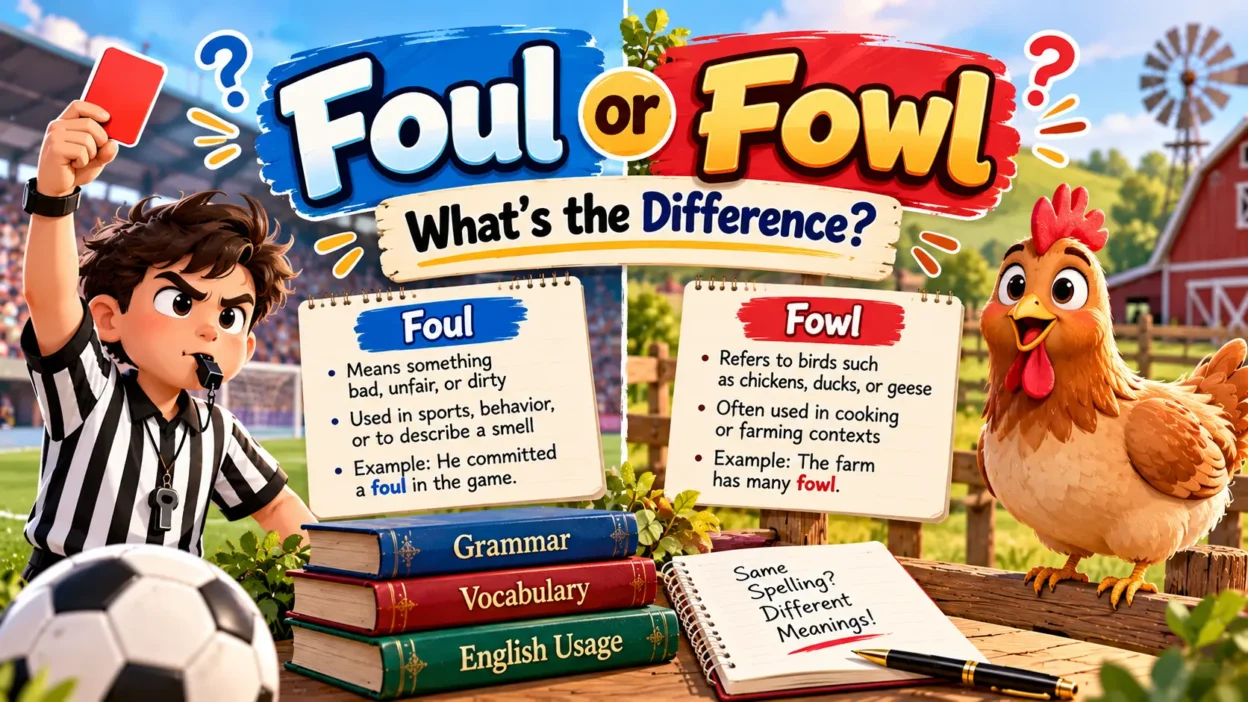
Have you ever wondered whether to write foul or fowl? These two English words sound exactly alike, but they have different meanings and spellings. The word foul describes something unpleasant, dirty, or unfair, while fowl refers to birds such as chickens, ducks, and turkeys. Understanding the difference between foul or fowl helps you avoid common spelling mistakes in everyday conversations, school assignments, and online messages. In this guide, you will learn their meanings, pronunciation, origins, synonyms, and practical examples. By the end, you will know exactly when to use foul and when to choose fowl.
📋Foul vs. Fowl
| Word | Meaning | Example |
|---|---|---|
| Foul | Dirty, unpleasant, or offensive | The garbage produced a foul smell. |
| Foul | A violation of rules | The referee called a foul. |
| Foul | To contaminate or obstruct | Oil can foul the water. |
| Fowl | A bird, especially poultry or game birds | The farmer raises fowl. |
Easy rule: Foul means something unpleasant or a rule violation. Fowl refers to birds.
📖 What Does Foul Mean?
The word foul describes something dirty, unpleasant, offensive, or unfair. It can function as an adjective, noun, or verb, depending on the context.
For example, you might describe rotten food as foul, criticize someone’s foul language, or call an illegal move in basketball a foul.
📝 Examples of Foul
- The kitchen had a foul smell.
- He used foul language during the argument.
- The referee called a foul during the match.
- The storm brought foul weather.
- Factory waste can foul the river.
🐔 What Does Fowl Mean?
The word fowl refers to birds, especially poultry and game birds. Chickens, ducks, turkeys, and geese are common examples.
People often use fowl when discussing farming, cooking, hunting, and wildlife. The word usually functions as a noun.
📝 Examples of Fowl
- The farmer raises fowl on his farm.
- Wild fowl gathered near the lake.
- The chef prepared fowl for dinner.
- Ducks and geese belong to the broader group of birds commonly called fowl.
🔊 Foul vs. Fowl: Pronunciation
Both words have the same pronunciation: /faʊl/. They rhyme with howl, bowl only in some accents? No—foul rhymes with howl, not bowl.
These words are homophones, meaning they sound alike but have different meanings and spellings.
- Foul: Adjective, noun, and verb.
- Fowl: Noun.
Because pronunciation cannot distinguish them, always consider the sentence’s meaning before choosing a spelling.
📚 Origin and Etymology
The words foul and fowl developed from different Old English words.
Foul comes from Old English fūl, which described something dirty, rotten, or morally offensive. Over time, English speakers extended its meaning to unpleasant weather, offensive language, and violations in sports.
Fowl comes from Old English fugol, meaning bird. Its modern form retains that connection, particularly when people discuss poultry and game birds.
These origins provide a simple memory trick: foul relates to unpleasant things, while fowl relates to birds.
💡 Common Meanings of Foul
The word foul has several meanings in modern English. The context determines which meaning a speaker intends.
🌧️ Foul as an Adjective
People use foul to describe something unpleasant, dirty, offensive, or unfavorable.
Examples include foul smells, foul language, foul weather, and foul play.
🏀 Foul as a Noun
In sports, a foul refers to an action that violates the rules. The word can also describe an offense or wrongdoing.
For example, a referee might call a foul when a basketball player illegally contacts an opponent.
🧹 Foul as a Verb
As a verb, foul can mean to contaminate something, obstruct a mechanism, or commit a rule violation.
For example, pollution can foul a river, and a fishing line can foul a boat’s propeller.
🍗 Common Meanings of Fowl
The word fowl primarily refers to birds, particularly poultry and game birds.
🐓 Domestic Fowl
Farmers raise domestic fowl for eggs, meat, or breeding. Chickens, turkeys, ducks, and geese are familiar examples.
🦆 Wild Fowl
Wild fowl include birds that people encounter in natural habitats, such as wetlands, lakes, and marshes. The term often appears in wildlife and hunting discussions.
🍽️ Fowl in Cooking
In culinary contexts, fowl can refer to the meat of certain birds. However, everyday American English usually uses specific words such as chicken, turkey, or duck.
✍️ Foul or Fowl: Example Sentences
| Example Sentence | Meaning |
|---|---|
| The trash produced a foul smell. | Unpleasant odor |
| The referee called a foul. | Rule violation |
| The player used foul language. | Offensive speech |
| We stayed home because of foul weather. | Bad weather |
| Pollution can foul the river. | Contaminate |
| The basketball player committed a foul. | Sports penalty |
| The farmer raises fowl. | Farm birds |
| The duck is a type of fowl. | Bird |
| Wild fowl visited the lake. | Wild birds |
| The chef prepared fowl for dinner. | Bird meat |
| The farmer feeds his fowl every morning. | Farm birds |
| We watched the fowl cross the field. | Birds |
📖 Synonyms of Foul
The following words can replace foul in certain contexts. Choose a synonym that matches the specific meaning you want to express.
| Synonym | Meaning |
|---|---|
| Dirty | Not clean |
| Filthy | Extremely dirty |
| Nasty | Very unpleasant |
| Disgusting | Causing disgust |
| Rotten | Decayed or spoiled |
| Unpleasant | Not enjoyable |
| Offensive | Causing offense |
| Repulsive | Extremely disagreeable |
| Putrid | Decaying and smelly |
| Polluted | Contaminated |
| Unfair | Not impartial |
| Dishonest | Not truthful |
| Wicked | Morally wrong |
| Vulgar | Crude or offensive |
| Unclean | Not clean |
🌟 Antonyms of Foul
Antonyms help you understand the opposite meaning of foul. The best choice depends on whether you describe cleanliness, smell, behavior, or fairness.
| Antonym | Meaning |
|---|---|
| Clean | Free from dirt |
| Fresh | Clean-smelling or recently produced |
| Pleasant | Enjoyable |
| Fragrant | Having a pleasant smell |
| Pure | Free from contamination |
| Fair | Following rules honestly |
| Honest | Truthful |
| Kind | Caring and considerate |
| Acceptable | Meeting expected standards |
| Sweet | Having a sugary taste or pleasant smell |
Remember that fowl does not have a direct antonym in ordinary English because it names a type of bird.
⚠️ Common Foul vs. Fowl Mistakes
Writers often confuse these words because they sound identical. Use the meaning of the sentence to select the correct spelling.
| Incorrect Sentence | Correct Sentence |
|---|---|
| The chicken is a foul. | The chicken is a fowl. |
| The room smells fowl. | The room smells foul. |
| The referee called a fowl. | The referee called a foul. |
| The farmer raised foul. | The farmer raised fowl. |
| He used fowl language. | He used foul language. |
| The fowl weather ruined our picnic. | The foul weather ruined our picnic. |
| The duck is a foul. | The duck is a fowl. |
| The player committed a fowl. | The player committed a foul. |
| The river smells fowl. | The river smells foul. |
| We cooked some foul for dinner. | We cooked some fowl for dinner. |
🌐 How People Use Foul and Fowl in Everyday Life
These words appear in conversations, social media posts, business writing, and academic discussions. Their meanings remain the same, even when people use them in different settings.
- Daily conversation: You might complain about a foul smell or discuss raising fowl.
- Social media: People might describe a bad experience as foul or share pictures of backyard fowl.
- Business communication: A report might discuss foul odors, polluted water, or food-quality concerns.
- Academic writing: Students might use foul when analyzing sports rules or fowl when studying birds.
- Online messaging: You might text, “That food smells foul,” or tell a friend about wild fowl near a lake.
Neither word has a standard texting abbreviation or a special internet meaning that replaces its basic definition.
❓ FAQs
Is foul or fowl correct?
Both spellings are correct. Use foul for something unpleasant, offensive, dirty, or against the rules. Use fowl for birds such as chickens, ducks, and turkeys.
Are foul and fowl homophones?
Yes. Both words share the same pronunciation but have different spellings and meanings.
Is a chicken a foul or a fowl?
A chicken is a fowl. The word describes poultry and certain other birds.
What does foul mean in sports?
A foul occurs when a player breaks a rule. For example, a basketball referee may call a foul after illegal contact between players.
What does foul language mean?
Foul language refers to rude, offensive, or vulgar words. People often use this phrase when discussing swearing.
Can fowl mean chicken meat?
Yes. In cooking, fowl can refer to the meat of certain birds, although Americans usually name the specific bird, such as chicken or turkey.
Does foul have a positive meaning?
Usually, foul carries a negative meaning. However, sports use it as a neutral technical term for a rule violation.
✅ Conclusion: Foul or Fowl?
The difference between foul and fowl becomes easy to understand once you learn their meanings. Although both words sound alike, they serve different purposes in English. Foul describes something unpleasant, dirty, offensive, or against the rules, while fowl refers to birds such as chickens, ducks, and turkeys. You can remember the difference by connecting foul with bad smells or unfair actions and fowl with birds. Pay attention to context whenever you write these words in school assignments, business communication, or online messages. With a little practice, you can avoid this common spelling mistake and improve your English.

Andrew Foster is a researcher and content writer at Differopedia, specializing in clear, accurate, and easy-to-understand comparison guides, definitions, and informational articles. His work focuses on helping readers make informed decisions through well-researched, reliable content.