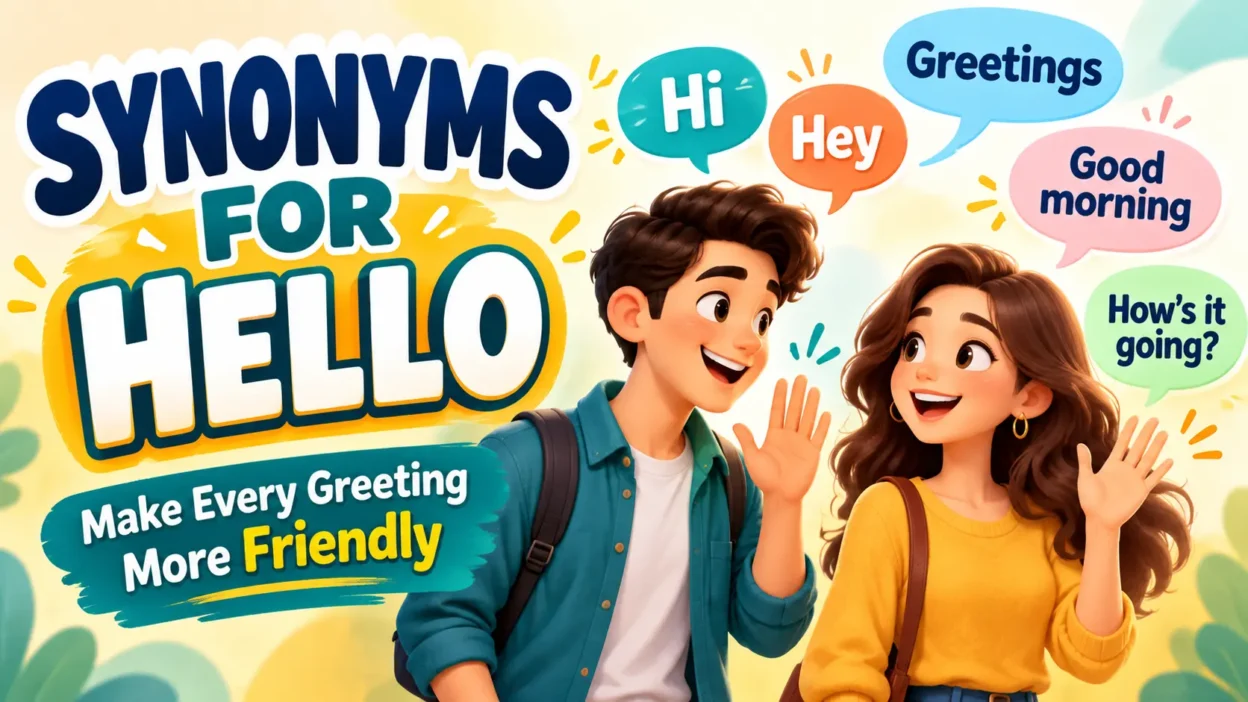
Finding the right greeting can make a conversation feel warmer, friendlier, or more professional. The best synonyms for hello depend on whom you’re speaking to and the situation. For example, “Hey!” works well with friends, while “Good morning” is a polite choice for workplace conversations. Although many greetings express the same basic idea, they carry different tones and levels of formality. Some are perfect for text messages, while others suit business emails or formal introductions. In this guide, you’ll discover common alternatives to hello, their meanings, and natural examples to help you choose the right greeting for any situation.
👋 What Are the Best Synonyms for Hello?
The most common synonyms for hello include hi, hey, greetings, howdy, good morning, good afternoon, good evening, and hello there. Other expressions, such as “What’s up?” and “How’s it going?”, work as casual greetings.
The best alternative depends on your purpose:
- Formal: Greetings, good morning, good afternoon
- Casual: Hi, hey, what’s up
- Friendly: Hello there, hey there, hiya
- Professional: Hello, good morning, pleased to meet you
- Regional: Howdy, good day
- Welcoming: Welcome, glad to see you
- Texting: Hey, hiya, sup
📖 Hello at a Glance
| Feature | Details |
|---|---|
| Word | Hello |
| Part of speech | Interjection and noun |
| Meaning | An expression used to greet someone |
| Pronunciation | /həˈloʊ/ |
| Syllables | Two |
| Common synonyms | Hi, hey, greetings, howdy |
| Formal alternatives | Good morning, good afternoon |
| Informal alternatives | What’s up, hey there |
| Opposite in context | Goodbye, farewell |
😊 Casual Synonyms for Hello
Casual greetings are useful when talking to friends, classmates, family members, or coworkers you know well. They sound natural in everyday conversations, text messages, and online chats.
- Hi: A simple, friendly greeting suitable for most everyday situations.
- Hey: A relaxed greeting commonly used among friends and acquaintances.
- What’s up?: An informal way to greet someone and ask what is happening.
- How’s it going?: A friendly question about someone’s life or current situation.
- How are you doing?: A conversational greeting that expresses interest in the other person.
- What’s new?: A way to ask whether anything interesting has happened recently.
- How’s everything?: A relaxed greeting that asks how things are going.
- What’s happening?: An informal expression used to greet someone or ask about current events.
- Hiya: A cheerful, informal alternative to hi, especially common in British English.
- Hey there: A warm and conversational greeting.
- Yo: A very informal greeting used mainly among friends.
- Sup?: A shortened form of “What’s up?” often found in texting and casual speech.
Examples:
- “Hey, are you coming to the party tonight?”
- “What’s up? I haven’t seen you in ages!”
Usage tip: Use casual greetings with people who are comfortable with informal language. “Yo” and “sup” may sound too relaxed in professional situations.
🤝 Formal Synonyms for Hello
Formal greetings help establish a respectful tone when addressing clients, managers, interviewers, unfamiliar people, or a professional audience.
- Greetings: A formal or ceremonial way to address people.
- Good morning: A polite greeting used in the morning.
- Good afternoon: A respectful greeting used in the afternoon.
- Good evening: A polite greeting used in the evening.
- Good day: A formal or regional greeting that can sound traditional in American English.
- Pleased to meet you: A courteous expression used when meeting someone for the first time.
- How do you do?: A traditional formal greeting, especially associated with introductions.
- Welcome: An expression used to greet someone arriving at a place or event.
- Salutations: A formal or literary term for greetings, sometimes used humorously in everyday conversation.
Examples:
- “Good morning, everyone. Thank you for joining today’s meeting.”
- “Greetings, Dr. Morgan. It’s a pleasure to have you here.”
Usage tip: In modern American workplaces, “Hello” and “Good morning” are usually safer choices than “Salutations” or “How do you do?”
💛 Friendly Synonyms for Hello
Friendly greetings help conversations feel welcoming and personal. They’re useful when reconnecting with someone, welcoming a guest, or starting a conversation with a familiar person.
- Hello there: A warm and approachable greeting.
- Hey there: A casual, friendly way to get someone’s attention or start a conversation.
- Hi there: A cheerful alternative to a plain hi.
- Nice to see you: A friendly expression used when meeting someone you already know.
- Good to see you: A warm greeting that communicates pleasure at seeing someone.
- Glad to see you: An enthusiastic expression of happiness at someone’s arrival.
- How have you been?: A greeting used when reconnecting with someone after some time.
- Long time no see: An informal expression used when meeting someone after a long absence.
- Welcome back: A greeting for someone returning to a place or activity.
- Hey, stranger!: A playful greeting for someone you haven’t seen in a while.
Examples:
- “Hi there! How was your weekend?”
- “Long time no see! What have you been up to?”
Usage tip: “Nice to see you” generally suits someone you already know, while “Nice to meet you” is more appropriate when meeting someone for the first time.
💼 Professional Synonyms for Hello
Professional greetings should be polite, clear, and appropriate for the relationship. The best choice may differ between an email, a meeting, and a conversation with a client.
| Greeting | Best use | Tone |
|---|---|---|
| Hello | General workplace communication | Neutral |
| Good morning | Starting a morning meeting | Polite |
| Good afternoon | Greeting colleagues or clients later in the day | Professional |
| Hi [Name] | Everyday workplace emails | Friendly |
| Greetings | Formal announcements or group messages | Formal |
| Welcome | Receiving a visitor or new employee | Warm |
| Pleased to meet you | First-time introductions | Respectful |
Examples:
- “Hello, Jordan. I’m following up on the proposal we discussed.”
- “Good afternoon, everyone. Let’s get started with the presentation.”
Usage tip: In American business emails, “Hi [Name]” is widely accepted for routine communication. Use “Dear [Name]” when a more traditional written salutation is appropriate.
📱 Synonyms for Hello in Text Messages
Text messages usually call for short, natural greetings. Your relationship with the recipient and the purpose of the message should guide your choice.
- Hey: A relaxed way to start a conversation.
- Hi: A simple, neutral greeting.
- Heyyy: A playful, expressive variation of hey.
- Hii: An informal spelling used to convey enthusiasm or affection.
- Sup: A very casual alternative to hello.
- Hey, you: A familiar greeting that can sound playful or affectionate.
- Morning!: A shortened, casual version of good morning.
- Hey, what’s up?: A friendly opener that invites a response.
- Hi! Got a minute?: A useful way to start a conversation when you need someone’s attention.
- Hey, how have you been?: A natural greeting when reconnecting with someone.
Examples:
- “Hey! Are we still meeting at six?”
- “Morning! Hope your day is off to a good start.”
Usage tip: Repeated letters can make a message feel more expressive, but they aren’t appropriate for every recipient. Keep greetings simple when texting clients or professional contacts.
🌎 Regional and Cultural Alternatives to Hello
Some greetings are associated with particular regions or cultural settings. Understanding these differences helps you use them naturally.
- Howdy: A friendly greeting strongly associated with Texas and the American South.
- Good day: A greeting used in several varieties of English, including Australian English, though it can sound formal or old-fashioned in the United States.
- G’day: A familiar Australian greeting, especially in informal conversation.
- Hiya: A casual greeting common in British English and other varieties.
- Ahoy: A greeting historically associated with sailors; today, it’s often playful.
- Welcome: A broadly understood greeting used to receive guests or visitors.
- Greetings: A formal, literary, or occasionally humorous greeting.
Examples:
- “Howdy! Welcome to Texas.”
- “G’day! How’s your morning going?”
Usage tip: Regional greetings can add personality to dialogue, creative writing, and casual conversation. However, avoid assuming everyone from a particular region uses the same expressions.
🔍 Hello Synonyms: How to Choose the Right Word
Not every alternative to hello means exactly the same thing. Some expressions are greetings, while others are questions, introductions, or welcoming phrases.
| Expression | Meaning and distinction |
|---|---|
| Hi | A direct, general greeting |
| Hey | An informal greeting that can also attract attention |
| What’s up? | A greeting phrased as a question |
| How are you? | A greeting that asks about someone’s well-being |
| Nice to meet you | An expression used during a first introduction |
| Nice to see you | A greeting for someone you already know |
| Welcome | An expression of hospitality |
| Greetings | A formal or ceremonial greeting |
| Good morning | A greeting tied to the time of day |
| Goodbye | A farewell, not a synonym for hello |
✍️ How to Choose the Best Greeting
Consider these three factors before choosing an alternative:
1. Your audience: Use “Hey” with friends, but choose “Hello” or “Good morning” when a more professional tone is needed.
2. The situation: “Welcome” works when receiving guests, while “Pleased to meet you” suits a first introduction.
3. Your tone: Choose “Hi there” for warmth, “Greetings” for formality, and “What’s up?” for relaxed conversation.
⚠️ Common Mistakes When Using Hello Synonyms
Even familiar greetings can sound unnatural when used in the wrong context.
- Using “What’s up?” in every professional email: This can sound too casual for formal correspondence.
- Confusing “Nice to meet you” with “Nice to see you”: The first usually applies to a first meeting; the second generally applies to someone you already know.
- Using “Good evening” as a farewell in every situation: It can be a greeting, but “Have a good evening” is more natural when wishing someone well as they leave.
- Treating “Welcome” as an exact replacement for hello: Welcome emphasizes receiving someone rather than simply acknowledging them.
- Assuming “Howdy” is universal: It is widely recognizable but has a distinctly regional or playful flavor in many American contexts.
Choosing the right expression makes your communication sound more natural and helps prevent misunderstandings.
❓ FAQs
What are five synonyms for hello?
Five common synonyms are hi, hey, greetings, howdy, and hello there.
What are some unique ways to say hello?
“Ahoy,” “Howdy,” “Hey, stranger!” and “Well, hello there!” offer more personality than a standard greeting. Their suitability depends on the setting.
How can I say hello without using the word hello?
Try “Hi,” “Good morning,” “Hey there,” “What’s up?” or “How’s it going?” Choose an expression that fits your relationship with the other person.
What is a sweet way to say hello?
“Hey, you,” “Hi there,” and “Good to see you” can sound warm and affectionate. The tone depends on your relationship and how you deliver the greeting.
Which hello synonym is best for a business email?
“Hello [Name]” and “Hi [Name]” are practical choices for most business emails. “Dear [Name]” is appropriate when a more traditional salutation is preferred.
Is greetings formal or informal?
“Greetings” is generally formal, literary, or deliberately playful. It is less common than “Hi” or “Hello” in ordinary American conversation.
Can how are you replace hello?
Yes. “How are you?” often functions as a greeting, even though it is grammatically a question about someone’s well-being.
Is howdy a common American greeting?
“Howdy” is a recognizable American greeting, particularly associated with Texas and the American South. It is informal and can sound playful outside those regional contexts.
🎯 Conclusion
The best synonyms for hello depend on your audience, purpose, and preferred tone. “Hi” and “hey” are excellent everyday alternatives, while “Good morning” and “Greetings” work well in more formal situations. For friendly conversations, expressions such as “Hey there,” “How’s it going?” and “Nice to see you” add warmth and personality.
Choose a greeting that feels natural for the moment. A simple, well-matched expression can make conversations smoother, create a welcoming impression, and help you communicate more effectively.

Andrew Foster is a researcher and content writer at Differopedia, specializing in clear, accurate, and easy-to-understand comparison guides, definitions, and informational articles. His work focuses on helping readers make informed decisions through well-researched, reliable content.