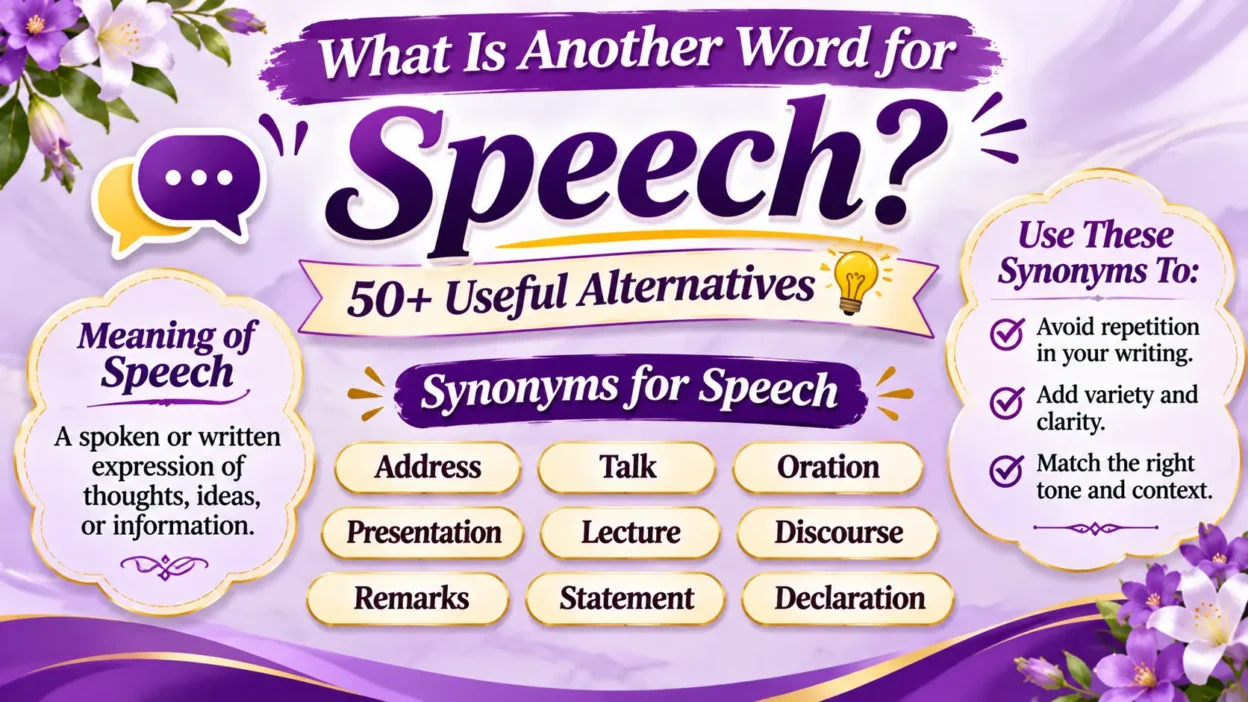
Finding the right synonyms for speech can make your writing more expressive, natural, and precise. Words such as talk, conversation, dialogue, and address offer different ways to describe spoken communication. While some alternatives suit casual conversations, others work better for formal presentations, public speaking, and professional discussions. Understanding these differences helps you choose words that match your intended meaning and tone. Whether you’re writing an essay, preparing a presentation, or expanding your vocabulary, exploring speech synonyms can improve your communication skills. In this guide, you’ll discover 50+ useful alternatives, their meanings, and practical examples to help you use them confidently.
What Are the Best Synonyms for Speech? 💬
The best synonyms for speech include talk, conversation, address, lecture, presentation, discourse, dialogue, discussion, statement, oration, announcement, and monologue.
The most suitable alternative depends on the situation. For example, address works well for a formal public speech, conversation describes informal communication, and lecture refers to an educational talk.
Word at a Glance 📖
| Word Feature | Details |
|---|---|
| Word | Speech |
| Part of Speech | Noun |
| Pronunciation | /spiːtʃ/ |
| Syllables | 1 |
| Meaning | Spoken communication or a formal spoken presentation |
| Common Synonyms | Talk, address, conversation, discourse |
| Opposite Concepts | Silence, quietness, muteness |
| Usage | Formal, informal, academic, and everyday English |
Top Synonyms for Speech: Comparison Table 📝
Here are some of the most useful alternatives to the word speech, along with their meanings and common contexts.
| Synonym | Meaning | Best Context |
|---|---|---|
| Talk | Spoken communication | Everyday situations |
| Conversation | Informal exchange of ideas | Personal communication |
| Address | Formal speech to an audience | Public events |
| Lecture | Educational spoken presentation | Academic settings |
| Presentation | Organized explanation | Meetings and conferences |
| Discourse | Extended communication or discussion | Academic and formal writing |
| Dialogue | Exchange between two or more people | Discussions and literature |
| Discussion | Conversation about a subject | Group communication |
| Oration | Formal and elaborate speech | Ceremonies |
| Monologue | Speech by one person | Theater and presentations |
| Statement | Spoken or written declaration | Official situations |
| Announcement | Publicly shared information | News and events |
| Remarks | Short spoken comments | Meetings and ceremonies |
| Debate | Formal exchange of opposing arguments | Politics and education |
| Testimony | Formal statement of evidence | Legal settings |
| Sermon | Religious or moral talk | Religious gatherings |
| Narrative | Spoken or written account | Storytelling |
| Utterance | A spoken word or group of words | Linguistics |
| Communication | Sharing information or ideas | General contexts |
| Commentary | Spoken explanation or opinion | Media and analysis |
Synonyms for Speech by Category 🎯
Different situations call for different words. Understanding these categories will help you choose alternatives that match your intended meaning and tone.
Everyday Synonyms for Speech 💬
These words describe ordinary communication between people. They work naturally in conversations, casual writing, and daily interactions.
- Talk: A general exchange of spoken information.
- Conversation: An informal discussion between people.
- Chat: A friendly and relaxed conversation.
- Discussion: A conversation focused on a particular topic.
- Dialogue: An exchange of ideas between two or more people.
- Exchange: A short interaction involving spoken comments.
- Communication: The process of sharing information.
- Interaction: Direct communication between individuals.
- Discussion: A conversation involving opinions or ideas.
- Banter: Playful and friendly conversation.
Examples:
- We had a long conversation about our future plans.
- The teacher encouraged an open discussion among students.
Formal Synonyms for Speech 🎓
Formal alternatives are useful in professional writing, academic assignments, official events, and public communication.
- Address: A formal speech delivered to an audience.
- Discourse: An extended formal discussion or communication.
- Oration: A carefully prepared and formal speech.
- Lecture: An informative talk, usually delivered by an expert.
- Presentation: An organized explanation of a subject.
- Statement: A formal declaration of information or opinion.
- Declaration: An official or emphatic announcement.
- Remarks: Brief comments delivered publicly.
- Dissertation: A lengthy academic work, not a direct synonym for an oral speech.
- Pronouncement: A formal or authoritative statement.
Examples:
- The president delivered an inspiring address to the audience.
- The professor gave a lecture about modern literature.
Synonyms for Public Speech 🎤
When someone speaks in front of a group, certain words describe the occasion or speaking style more accurately than the general term speech.
- Public address: A speech delivered before an audience.
- Keynote: A principal speech at an event or conference.
- Oration: A formal and often elaborate public speech.
- Presentation: An organized talk explaining information.
- Proclamation: A formal public announcement.
- Announcement: Information shared publicly.
- Welcome address: A speech welcoming guests.
- Commencement address: A speech delivered at a graduation ceremony.
- Tribute: A speech or expression honoring someone.
- Sermon: A religious or moral speech.
Synonyms for a Long Speech 📚
These alternatives describe extended speaking, detailed explanations, or continuous verbal communication.
- Discourse: An extended discussion or formal communication.
- Monologue: A lengthy speech by one person.
- Lecture: An extended educational presentation.
- Narration: Spoken storytelling or description.
- Commentary: An extended explanation or expression of opinions.
- Exposition: A detailed explanation of an idea or subject.
- Oration: A formal, structured speech.
- Soliloquy: A speech in which a character expresses private thoughts, especially in drama.
How to Choose the Right Synonym for Speech? 🤔
Not every synonym can replace speech in every sentence. The best choice depends on whether you mean spoken communication, a public presentation, or a particular person’s words.
| If You Mean… | Choose This Word |
|---|---|
| Casual speaking | Talk |
| Friendly communication | Chat |
| Two-way communication | Conversation |
| Formal public speaking | Address |
| Educational speaking | Lecture |
| Organized business speaking | Presentation |
| A long formal discussion | Discourse |
| One person’s extended speaking | Monologue |
| Religious teaching | Sermon |
| A formal argument | Debate |
| A short public comment | Remarks |
| A single spoken expression | Utterance |
Usage tip: If you are describing a prepared speech at a graduation ceremony, address is usually more appropriate than conversation. However, if two friends are exchanging ideas, conversation is the more natural choice.
Meaning of Speech and Its Different Uses 🗣️
The noun speech has several related meanings in English. Understanding them makes it easier to select an accurate synonym.
1. Spoken communication: Speech refers to the ability or act of expressing thoughts through spoken words.
Example: Children gradually develop their speech as they grow.
2. A formal presentation: Speech can describe a prepared talk delivered to an audience.
Example: The guest delivered a powerful speech at the ceremony.
3. A person’s way of speaking: Speech can also describe someone’s speaking style, pronunciation, or manner of expression.
Example: Her speech became clearer after months of practice.
4. Freedom of expression: In phrases such as freedom of speech, the word refers to the right to express opinions and ideas.
Example: Freedom of speech is an important democratic principle.
Speech vs. Talk vs. Address: What’s the Difference? 🔍
These three words are related, but they are not always interchangeable.
| Word | Main Difference | Example |
|---|---|---|
| Speech | A spoken presentation or ability to communicate verbally | She delivered a speech. |
| Talk | A general spoken presentation or conversation | We had a talk. |
| Address | A formal speech directed to an audience | He gave an address. |
A speech is often prepared and organized, although it does not have to be. A talk can be informal or formal, depending on the situation. An address generally has a formal audience and purpose.
Common Collocations With Speech ✍️
Collocations are words that naturally appear together. Learning these combinations can improve your vocabulary and make your writing sound more fluent.
| Collocation | Example |
|---|---|
| Deliver a speech | She will deliver a speech tomorrow. |
| Give a speech | He gave a speech at school. |
| Freedom of speech | Everyone deserves freedom of speech. |
| Speech disorder | The child received help for a speech disorder. |
| Speech recognition | The software uses speech recognition. |
| Speech therapy | She attends speech therapy sessions. |
| Public speech | Public speech requires preparation. |
| Opening speech | The host delivered the opening speech. |
| Political speech | The candidate prepared a political speech. |
| Speech competition | Students participated in a speech competition. |
Common Mistakes When Using Speech Synonyms ⚠️
Choosing a synonym without considering its meaning can make a sentence confusing. Watch out for these common mistakes:
- Using conversation for a formal address: A conversation usually involves an exchange, while an address is delivered to an audience.
- Confusing monologue with dialogue: A monologue involves one speaker, whereas dialogue involves an exchange between speakers.
- Using lecture for every speech: A lecture generally has an educational or informative purpose.
- Treating utterance as a complete speech: An utterance can be just one word or a short expression.
- Confusing debate with discussion: A debate involves opposing arguments, while a discussion can be more collaborative.
FAQs📚
Are speech and communication the same?
No. Speech is a form of communication that uses spoken language. Communication is broader and also includes writing, gestures, facial expressions, and other ways of sharing information.
Is dialogue another word for speech?
Sometimes. Dialogue describes an exchange of spoken words between two or more people. It is not usually interchangeable with a formal speech delivered by one person.
Can I use presentation instead of speech?
Yes. Presentation works when someone delivers organized information to an audience. However, a presentation may also include slides, demonstrations, and visual materials.
What is another word for an inspirational speech?
Motivational address, inspirational talk, keynote, and oration can describe speeches intended to encourage or inspire listeners.
What is the difference between an oration and a lecture?
An oration is a formal, often carefully prepared speech, sometimes delivered for a ceremonial occasion. A lecture primarily aims to teach or explain a subject.
Is a monologue a type of speech?
Yes. A monologue is an extended speech delivered by one person without an ongoing exchange with another speaker.
What is another word for speech in academic writing?
Depending on the context, you can use discourse, verbal communication, address, presentation, or oral communication.
What is a synonym for speech in a legal context?
Testimony, statement, and declaration may be suitable, depending on the legal situation. Testimony specifically refers to evidence or statements given by a witness.
Conclusion 🏁
Choosing the right synonyms for speech depends on your meaning, audience, and writing style. Words such as talk, conversation, and chat work well for everyday communication, while address, oration, and lecture suit more formal situations. In academic and professional writing, alternatives like discourse, presentation, and verbal communication can make your sentences more precise. Always consider the context before replacing the word speech with another expression. The right choice helps you communicate your ideas clearly and naturally. By understanding these differences, you can make your writing more engaging, professional, and effective.

Andrew Foster is a researcher and content writer at Differopedia, specializing in clear, accurate, and easy-to-understand comparison guides, definitions, and informational articles. His work focuses on helping readers make informed decisions through well-researched, reliable content.