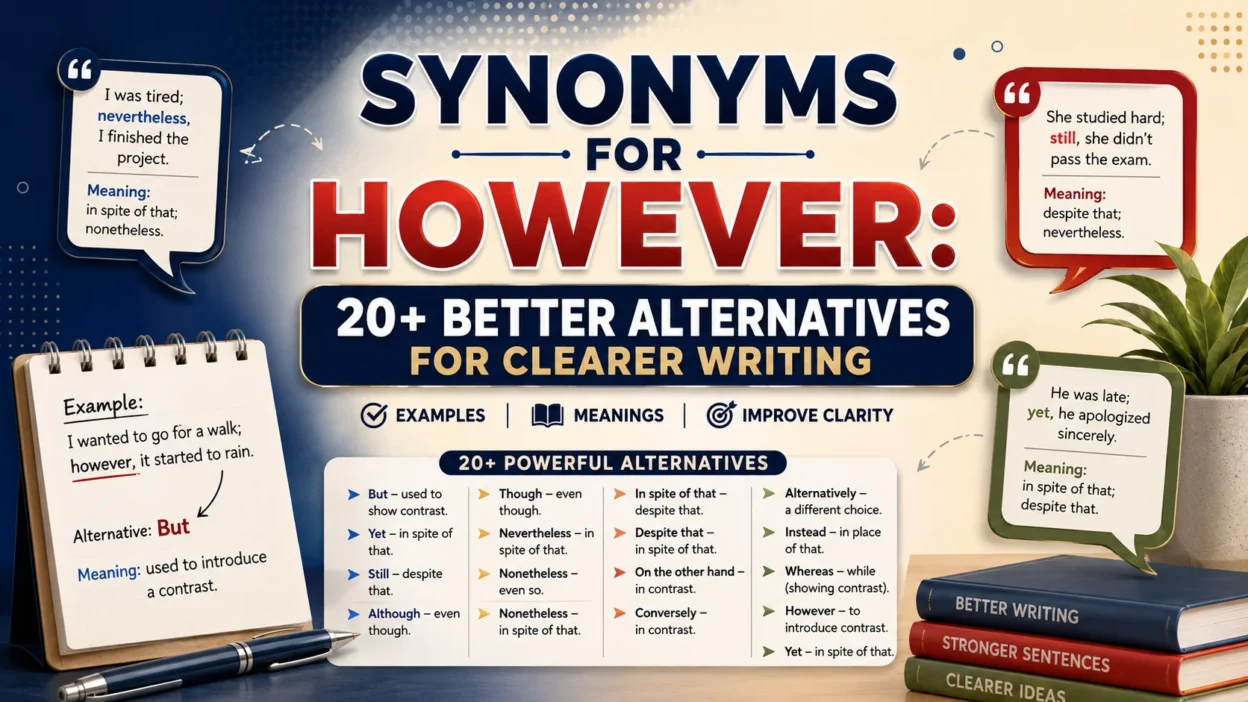
Every writer knows how useful however can be. It clearly introduces a contrast, qualification, or unexpected point. However, using the same transition repeatedly can make your writing feel predictable. Fortunately, English offers many synonyms for however and alternative expressions, ranging from formal choices such as nevertheless and nonetheless to conversational options such as though and still.
The key is not simply replacing however with another word. Different alternatives express slightly different relationships between ideas. Some emphasize contrast, some show concession, while others introduce an opposing viewpoint or an alternative option. This guide explains the most useful alternatives to however, when to use them, and how they differ in tone and meaning.
Quick Answer
The best synonym for however depends on your sentence and tone. For formal writing, nevertheless, nonetheless, and yet are strong choices. For everyday writing, still, though, and even so sound natural. Use on the other hand when presenting another viewpoint and in contrast when highlighting a clear difference. Not every alternative is a direct synonym, so choose the expression that best matches the relationship between your ideas.
Word at a Glance
| Property | Details |
|---|---|
| Word | However |
| Part of Speech | Conjunctive adverb |
| Primary Meaning | Introduces contrast, qualification, or concession |
| Formality | Neutral to formal |
| Tone | Logical, objective, and slightly emphatic |
| Common Uses | Essays, reports, articles, business writing, and everyday writing |
| Best Alternatives | Nevertheless, nonetheless, yet, still, though, even so |
Pronunciation
- IPA: /haʊˈɛv.ər/
- Phonetic: how-EV-er
- Syllables: how-ev-er
- Stress: Second syllable
Best Synonyms and Alternatives for However
Some expressions can replace however with little change in meaning, while others work only in particular contexts.
| Alternative | Meaning or Function | Example |
| Nevertheless | Despite what was previously stated | The weather was poor; nevertheless, we continued. |
| Nonetheless | Despite that fact | The task was difficult; nonetheless, she completed it. |
| Yet | Introduces an unexpected contrast | He trained hard, yet he lost the match. |
| Still | Shows that something remains true despite a problem | It is expensive; still, I want to buy it. |
| Though | Casual contrast or concession | The restaurant is expensive, though. |
| Even so | Despite the previous point | The evidence was limited; even so, they proceeded. |
| On the other hand | Introduces another viewpoint | The house is small; on the other hand, it is affordable. |
| In contrast | Highlights a clear difference | The first model is cheap; in contrast, the second is expensive. |
| Conversely | Shows an opposite relationship | Exercise improves health; conversely, inactivity can cause problems. |
| By comparison | Highlights differences between subjects | The old model was slow; by comparison, the new one is much faster. |
| At the same time | Balances two ideas that coexist | The job is demanding; at the same time, it is rewarding. |
| On the contrary | Directly rejects or corrects a previous idea | It isn’t difficult; on the contrary, it is quite simple. |
| Although | Introduces a subordinate contrast clause | Although it was raining, we went outside. |
| Whereas | Directly compares contrasting facts | Sarah likes cities, whereas Tom prefers rural areas. |
| Albeit | Introduces a formal qualification | The solution was useful, albeit expensive. |
Important: These are best understood as synonyms and alternatives, not as perfect one-to-one replacements. For example, alternatively usually presents another option rather than a contrast, while on the contrary directly contradicts or corrects a previous statement.
Formal and Academic Alternatives
When writing an academic paper, report, research article, or professional document, these alternatives work particularly well:
Nevertheless
Nevertheless means “despite that” or “in spite of what was just mentioned.” It is one of the closest formal alternatives to however.
The sample size was small; nevertheless, the results were significant.
Nonetheless
Nonetheless has almost the same meaning as nevertheless. It emphasizes that the previous fact does not prevent the following statement from being true.
The evidence was limited; nonetheless, the researchers continued their investigation.
Yet
Yet is concise and often adds a sense of surprise or unexpected contrast.
The experiment was carefully designed, yet the results were inconclusive.
Albeit
Albeit is a formal way to introduce a qualification.
The product was successful, albeit expensive.
Conversational and Casual Alternatives
In everyday communication, you don’t always need a formal transition.
Though
Though is especially natural at the end of a sentence.
I’d like to join you. It’s a little late, though.
It can also introduce a subordinate clause:
Though it was expensive, we bought it.
Still
Still is short and conversational while clearly showing that the second idea remains true despite the first.
I know the risks. Still, I want to try.
Even So
Even so means “despite that” and works well in both conversation and general writing.
The instructions were confusing. Even so, we managed to finish the project.
At the Same Time
Use at the same time when two ideas can both be true rather than directly contradicting each other.
The course is challenging. At the same time, it is very rewarding.
Stronger Contrast and Comparison
Some alternatives are better when you want to emphasize a difference rather than simply qualify the previous statement.
On the Other Hand
Use on the other hand when presenting another perspective, advantage, disadvantage, or side of an issue.
The apartment is small. On the other hand, the location is excellent.
In Contrast
In contrast works especially well when comparing two distinct people, things, situations, or results.
The northern region receives heavy rainfall. In contrast, the southern region is much drier.
Conversely
Conversely indicates an opposite relationship. It is particularly useful in analytical, academic, and data-focused writing.
Higher prices can reduce demand. Conversely, lower prices may encourage more purchases.
On the Contrary
Be careful with on the contrary. It does not simply mean “however.” It is used to reject or correct a previous statement.
The movie wasn’t boring. On the contrary, it was extremely entertaining.
Compare that with:
The movie was long; however, it was entertaining.
The first sentence contradicts the negative claim; the second simply qualifies a criticism.
However vs. Its Closest Alternatives
Choosing the right word becomes easier when you understand the subtle differences.
| Word | Main Function | Tone | Best Use |
| However | General contrast | Neutral | Most situations |
| Nevertheless | Contrast despite a fact | Formal | Academic and professional writing |
| Nonetheless | Similar to nevertheless | Formal | Reports and formal prose |
| Yet | Contrast with surprise | Neutral/Formal | Essays and persuasive writing |
| Still | Shows persistence despite something | Neutral/Informal | General and conversational writing |
| Though | Soft or casual concession | Informal/Neutral | Conversation and casual writing |
| Even so | Despite the previous point | Neutral | General writing |
| On the other hand | Presents another viewpoint | Neutral | Comparisons and arguments |
| In contrast | Highlights a difference | Neutral/Formal | Comparisons and analysis |
Meaning and Usage of However
At its core, however signals a contrast between two ideas. It tells the reader that the next statement qualifies, limits, or differs from the previous one.
For example:
The restaurant has excellent reviews; however, the service is slow.
Here, however introduces a negative point that qualifies the positive review.
Another example:
I wanted to attend the conference; however, my flight was canceled.
The second clause explains an obstacle that prevented the intended action.
Punctuation: How to Use However Correctly
Punctuation is one of the most important things to understand about however.
When however connects two independent clauses, use a semicolon before it and a comma after it:
The proposal was well written; however, the budget was insufficient.
You can also begin a new sentence with however:
The proposal was well written. However, the budget was insufficient.
When however appears in the middle of a clause as an interrupter, commas commonly set it off:
The proposal, however, was well written.
This makes however different from but, which is a coordinating conjunction:
The proposal was well written, but the budget was insufficient.
Common Mistakes to Avoid
1. Repeating However Too Often
There is no strict rule that says you can use however only once or twice per paragraph. The real issue is noticeable repetition. If several sentences rely on the same transition, vary your wording where appropriate.
2. Confusing However With Although
However and although have different grammatical roles.
Correct:
Although it rained, we went outside.
Also correct:
It rained. However, we went outside.
3. Using a Comma Instead of a Semicolon
When however joins two independent clauses, avoid a comma splice:
❌ I was tired, however, I continued working.
✅ I was tired; however, I continued working.
4. Treating Every Alternative as an Exact Synonym
Nevertheless can often replace however, but alternatively cannot always do so. Alternatively introduces another choice:
You can take the train. Alternatively, you can drive.
5. Using “On the Contrary” for Any Contrast
On the contrary is stronger than however. Use it when correcting or rejecting a previous claim, not simply when introducing a different point.
Examples in Different Contexts
Academic:
The study found a positive correlation between exercise and mental health. Nevertheless, the researchers noted that correlation does not prove causation.
Business:
Sales increased this quarter; however, customer satisfaction declined.
Everyday Conversation:
I’d love to go out tonight. It’s expensive, though.
Journalistic:
The new policy could reduce emissions. Yet critics argue that it may increase costs.
Comparison:
The first product is more affordable. In contrast, the premium model offers more features.
Related Words
Several words and expressions are related to contrast but do not always function exactly like however:
- Although — introduces a concession
- Whereas — compares two contrasting situations
- While — can introduce contrast as well as time
- Albeit — introduces a formal qualification
- But — coordinating conjunction used for direct contrast
- On the other hand — introduces another perspective
For non-contrastive transitions, consider words such as:
- Furthermore — adds information
- Moreover — strengthens or adds a point
- Likewise — shows similarity
- Similarly — indicates a parallel situation
FAQs
Is “however” the same as “but”?
Not exactly. But is a coordinating conjunction, while however is a conjunctive adverb. Their meanings can overlap, but their punctuation and grammatical roles differ.
What is the best formal synonym for however?
Nevertheless and nonetheless are among the closest formal alternatives. Yet is also useful when you want a shorter or more emphatic contrast.
Can I use “though” instead of “however”?
Sometimes. Though works particularly well in casual writing and conversation, especially at the end of a sentence. It is not interchangeable with however in every grammatical position.
Is “nonetheless” one word?
Yes. Nonetheless is normally written as one word. The older expression none the less is uncommon in modern English.
What is the difference between “however” and “on the other hand”?
However generally introduces a contrast or qualification. On the other hand usually presents another perspective, side, advantage, or disadvantage.
What should I use in very formal writing?
For formal or academic writing, nevertheless, nonetheless, yet, and in contrast can work well depending on the relationship between the ideas.
Conclusion
Using different synonyms for however can make your writing smoother, more precise, and less repetitive. However, the best alternative depends on what you want to communicate. Choose nevertheless or nonetheless for formal concession, yet for a concise or surprising contrast, though and still for a more conversational tone, and on the other hand or in contrast when you are presenting different perspectives or comparing subjects.
The goal isn’t to eliminate however from your writing. It remains a useful and versatile transition. Instead, learn the subtle differences between its alternatives and choose the expression that accurately reflects your meaning, tone, and audience.

Andrew Foster is a researcher and content writer at Differopedia, specializing in clear, accurate, and easy-to-understand comparison guides, definitions, and informational articles. His work focuses on helping readers make informed decisions through well-researched, reliable content.