
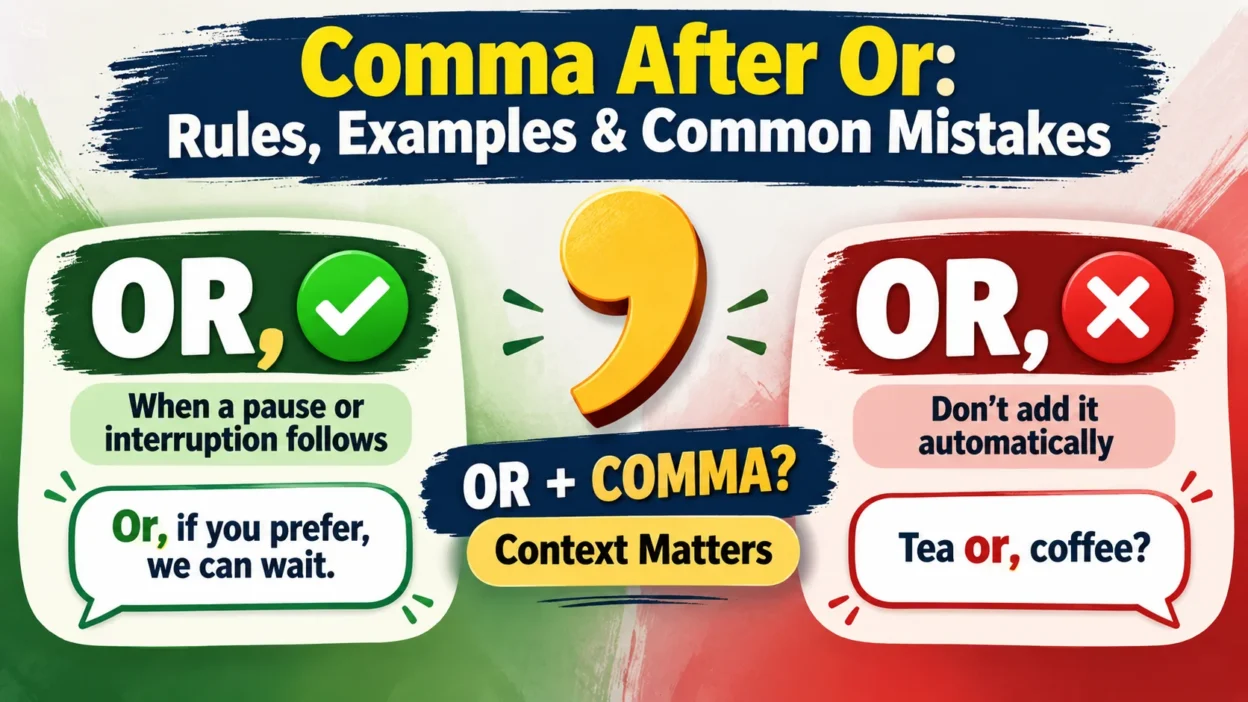
If you are wondering whether you need a comma after or, the answer is usually no. The conjunction or normally connects alternatives without a comma immediately after it, as in “You can call me or send me a message.” However, a comma can appear after or when an interrupter or parenthetical phrase follows it, such as “You can call me or, if you prefer, send me an email.” Understanding this distinction helps you avoid unnecessary punctuation in everyday, academic, and professional writing. In this guide, you will learn when to use a comma after or, when to leave it out, and how punctuation changes with different sentence structures.
📌Do You Put a Comma After “Or”?
You usually do not put a comma after “or.” Writers normally place or directly before the alternative it introduces.
A comma can follow or when an interrupter comes immediately after it.
| Term | Meaning | Usage | Category |
|---|---|---|---|
| Comma after or | Comma immediately following or | Usually introduces an interrupter | Punctuation |
| Or | A conjunction showing alternatives | Connects choices or possibilities | Grammar |
| Interrupter | Extra information inserted into a sentence | Usually appears between commas | Grammar |
| Comma before or | Comma placed immediately before or | Often joins independent clauses | Punctuation |
For example:
- Correct: You can stay or leave.
- Correct: You can stay or, if you prefer, leave.
- Incorrect: You can stay or, leave.
The second example works because if you prefer interrupts the main sentence.
🔤 What Does “Or” Mean?
Or is a coordinating conjunction that presents an alternative or choice. It can connect nouns, verbs, adjectives, phrases, or clauses.
You use it when you want to show that someone can choose between two or more possibilities.
Examples include:
- Would you like tea or coffee?
- You can walk or take the bus.
- We can eat at home or go out.
- Call me or send me a message.
The word or itself does not require a comma after it. The grammatical structure determines the punctuation.
✏️ When Do You Use a Comma After “Or”?
You can place a comma after or when an interrupter immediately follows it. An interrupter adds information, qualification, emphasis, or commentary without forming an essential part of the main sentence.
Consider this example:
You can call me or, if you prefer, send me an email.
The basic sentence is:
You can call me or send me an email.
The phrase if you prefer interrupts that structure, so commas surround it.
Another example is:
We can leave now or, to be honest, wait until tomorrow.
Without the interruption, the sentence becomes:
We can leave now or wait until tomorrow.
This test makes the rule easy to remember: if the words after “or” form an interrupting expression, commas can surround those words.
🚫 When Should You Not Use a Comma After “Or”?
You should not add a comma after or simply because you pause while reading the sentence.
For example:
You can call or text me.
Not:
You can call or, text me.
The word or directly connects the two alternatives, so the comma has no grammatical purpose.
The same rule applies to longer alternatives:
We can drive to the beach or take the train.
Not:
We can drive to the beach or, take the train.
You should also avoid automatically adding a comma after or when it begins a sentence:
Or you can wait until tomorrow.
Not:
Or, you can wait until tomorrow.
However, if an interrupter follows the introductory or, commas can appear:
Or, if you prefer, you can wait until tomorrow.
The commas surround if you prefer, which acts as the interruption.
🔗 Comma Before “Or” vs. After “Or”
Many writers confuse a comma before or with a comma after or. These punctuation choices serve different purposes.
Use a comma before or when it connects two independent clauses:
We can leave now, or we can wait until morning.
Both parts can stand as complete sentences:
- We can leave now.
- We can wait until morning.
However, you generally do not need a comma when or connects two words, phrases, or verbs that share the same subject:
You can walk or take the bus.
Grammar sources identify this distinction as one of the main rules for punctuation with or.
A comma after or usually signals an interrupter:
You can walk or, if you’re tired, take the bus.
Think of the two rules this way:
Comma before or: often connects independent clauses.
Comma after or: usually introduces an interrupting expression.
📝 Examples of a Comma After “Or”
These examples show when the punctuation works naturally.
| Example Sentence | Meaning |
|---|---|
| You can call me or, if you prefer, send a text. | The phrase “if you prefer” interrupts the sentence. |
| We can eat here or, if you’re hungry, try another restaurant. | The conditional phrase adds information. |
| Take the train or, if it runs late, catch a bus. | The interruption gives another condition. |
| You can stay or, if you feel tired, go home. | The inserted phrase qualifies the second option. |
| We can start now or, if everyone agrees, wait another hour. | The phrase adds a condition. |
| You can email me or, if necessary, call my office. | “If necessary” interrupts the alternatives. |
| We could drive or, to be honest, take a taxi. | “To be honest” adds commentary. |
| Choose the blue one or, if you prefer, the green one. | The interruption expresses preference. |
| We can continue or, I suppose, stop here. | “I suppose” adds the speaker’s opinion. |
| You can work today or, if you want, finish tomorrow. | The conditional phrase interrupts the choice. |
The comma does not belong to or itself. Instead, the punctuation marks the beginning and end of the inserted expression.
📚 Common Mistakes With “Or”
Writers often add unnecessary punctuation because they treat or as though it automatically requires a pause.
| Mistake | Correct Usage |
|---|---|
| You can stay or, leave. | You can stay or leave. |
| Call me or, text me. | Call me or text me. |
| We can walk or, drive. | We can walk or drive. |
| Or, you can wait. | Or you can wait. |
| Tea or, coffee? | Tea or coffee? |
| Choose red or, blue. | Choose red or blue. |
| You can work or, rest. | You can work or rest. |
| We can meet today or, tomorrow. | We can meet today or tomorrow. |
| Take the bus or, walk home. | Take the bus or walk home. |
| You can stay or, if you want. | You can stay or, if you want, leave. |
Notice the final example carefully. If if you want interrupts the sentence, you need another comma after the interruption.
📋 “Or” in Lists and the Oxford Comma
The rules change slightly when or appears in a list containing three or more items.
For example:
You can choose tea, coffee, or juice.
The comma before or represents the Oxford comma, also called the serial comma. Many style guides recommend it because it can make lists easier to understand, although writers can follow different style conventions.
You do not, however, place a comma after or simply because it introduces the final item:
Choose tea, coffee, or juice.
Not:
Choose tea, coffee, or, juice.
The comma after or would incorrectly separate the conjunction from the final item.
💬 How Does “Or” Work in Everyday Writing?
You will encounter or constantly in conversations, emails, text messages, websites, school assignments, and professional writing.
In casual communication, people often write short alternatives:
Call me or text me.
In business writing, you might see:
Please email the document or contact our office.
In academic writing, writers use or to present alternatives, possibilities, or contrasting interpretations:
The results may reflect environmental or behavioral factors.
In social media and messaging, punctuation often becomes more relaxed, but standard grammar still helps readers understand your meaning.
When you write formally, focus on sentence structure rather than inserting commas where you hear a pause.
❓ FAQs
Should I put a comma after “or”?
Usually, no. You only need a comma after or when an interrupter immediately follows it.
Can “or” start a sentence?
Yes. You can begin a sentence with or, especially in conversational and general writing.
You can come with us. Or you can stay here.
Do not automatically add a comma after the introductory or.
Is “or,” ever correct?
Yes. The combination can appear when or introduces an interrupting phrase.
Or, if you prefer, we can leave now.
The comma belongs to the parenthetical expression.
Do I need a comma before “or”?
Sometimes. Use a comma before or when it connects two independent clauses. You generally omit it when or connects individual words or phrases.
Do I use a comma after “or” in a list?
No. A list may require a comma before the final or, but you normally should not put a comma immediately after it.
What is an interrupter?
An interrupter adds extra information to a sentence without changing its basic structure. Writers usually place commas around the interrupter.
Is “or, if you prefer,” correct?
Yes. For example:
You can call me or, if you prefer, send an email.
The commas correctly surround if you prefer.
Is “or, you can” grammatically correct?
Usually, no. Write “or you can” unless an interrupter follows or.
🧠 Easy Trick to Remember the Rule
Here is a simple way to remember punctuation after or:
Do not add a comma just because you see “or.”
First, look at what comes after it.
If or directly connects the next word, phrase, or clause, leave the comma out:
You can stay or leave.
If an interrupter follows or, use commas around that interruption:
You can stay or, if you prefer, leave.
If or connects two independent clauses, consider a comma before or:
You can stay, or you can leave.
This approach works because it focuses on sentence structure rather than an arbitrary punctuation rule.
🎯 Conclusion
The comma after or rule becomes easier when you understand what follows the conjunction. In normal sentences, you should not place a comma immediately after or, as in “You can call or text me.” However, a comma can appear after or when an interrupter follows it, such as “You can call me or, if you prefer, send an email.” You should also remember that a comma before or can connect two independent clauses, while lists may use an Oxford comma before the final or. By identifying what or connects and checking for an interrupting phrase, you can choose the correct punctuation with confidence.

Andrew Foster is a researcher and content writer at Differopedia, specializing in clear, accurate, and easy-to-understand comparison guides, definitions, and informational articles. His work focuses on helping readers make informed decisions through well-researched, reliable content.