
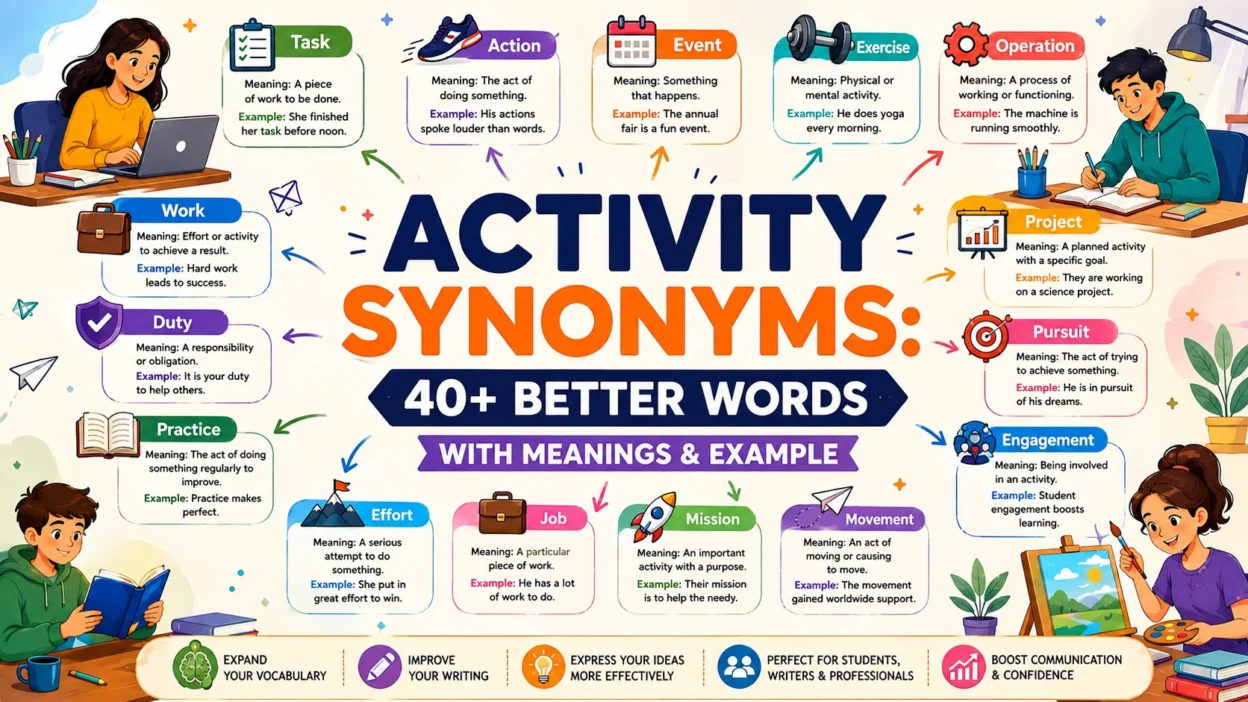
Activity is one of those everyday nouns that pops up constantly—in fitness chats, office emails, school schedules, and news headlines. It’s reliable, but overusing it makes your writing feel repetitive. Fortunately, English offers a rich variety of alternatives, each with its own nuance and best use. This guide gives you practical synonyms for activity, organized by context, with clear examples so you can pick the perfect word every time.
Quick Answer
General busyness calls for action, movement, or bustle. For a dedicated task, pursuit, undertaking, or endeavor work well. Physical effort is best described with exercise or exertion. And for vibrant, energetic atmospheres, buzz, hubbub, or liveliness are perfect choices.
Word at a Glance
| Aspect | Detail |
|---|---|
| Part of Speech | Noun (countable & uncountable) |
| Plural | Activities |
| Pronunciation | /ækˈtɪv.ə.ti/ (UK), /ækˈtɪv.ə.t̬i/ (US) |
| Syllables | ac-tiv-i-ty (4) |
| Word Family | active (adj.), actively (adv.), activate (v.) |
Pronunciation
IPA: /ækˈtɪv.ə.ti/ (UK), /ækˈtɪv.ə.t̬i/ (US)
Phonetic: ak-TIV-uh-tee
Stress falls on the second syllable.
Meaning of Activity
Activity has two main senses. First, it means the state of being active—busyness, motion, or energy in general. Second, it refers to a specific action or pursuit—something you do. Knowing which sense you’re using is the first step to choosing the right synonym.
Examples:
Top Synonyms by Context with Examples
For General Busyness & Motion
Action – the most direct substitute, with a purposeful tone.
- “We need action on this issue immediately.”
- “The action in the stock market was intense today.”
Movement – suggests physical motion or a collective effort.
- “There’s a lot of movement in the housing market right now.”
- “The civil rights movement transformed the nation.”
Bustle – lively, energetic, often noisy activity.
- “I love the bustle of the morning market.”
- “The bustle of the train station overwhelmed her.”
Hubbub – emphasizes noise and confusion.
- “The hubbub of voices made it hard to concentrate.”
- “After the announcement, there was a hubbub in the crowd.”
Buzz – exciting, vibrant energy.
- “The new restaurant has a real buzz about it.”
- “There’s always a buzz in the office on Friday afternoons.”
Liveliness – spirited, engaging energy.
- “Her liveliness brightened the entire room.”
- “The liveliness of the festival attracted thousands.”
For Specific Tasks & Pursuits
Pursuit – a dedicated, often long-term interest.
- “She devoted her life to the pursuit of knowledge.”
- “Outdoor pursuits like hiking and camping are popular here.”
Undertaking – a formal or sizable project.
- “Building a new hospital is a massive undertaking.”
- “Starting a business is a risky undertaking.”
Endeavor – sustained, intentional effort.
- “Volunteering is a worthwhile endeavor.”
- “His scientific endeavors earned him international recognition.”
Project – planned work with a clear goal.
- “The class is working on a group project.”
- “Her latest project involves renovating an old house.”
Task – a specific piece of work.
- “My first task was to organize the files.”
- “She completed the task in under an hour.”
Pastime – a leisure activity done for enjoyment.
- “Reading is my favorite pastime.”
- “Gardening is a relaxing pastime for many retirees.”
Hobby – a regular leisure pursuit.
- “His hobbies include photography and woodworking.”
- “Collecting stamps used to be a popular hobby.”
Enterprise – a business-like or risky activity.
- “Starting a farm is a challenging enterprise.”
- “The company is involved in several commercial enterprises.”
For Physical Exertion
Exercise – physical activity for health or training.
- “She gets at least 30 minutes of exercise daily.”
- “Regular exercise improves mental health.”
Exertion – emphasizes strain and effort.
- “The climb required considerable physical exertion.”
- “She collapsed from sheer exertion.”
Workout – informal, fitness-focused.
- “His morning workout includes weights and cardio.”
- “I need a good workout after sitting all day.”
For Business & Professional Settings
Operations – day-to-day functioning.
- “The company’s operations were disrupted by the storm.”
- “He oversees all manufacturing operations.”
Functioning – the working state of a system.
- “The factory resumed normal functioning after repairs.”
- “Proper functioning of the equipment is essential.”
Commerce – formal term for trade and transactions.
- “E-commerce has revolutionized retail.”
- “The city is a hub of international commerce.”
Usage Comparison Table
| Synonym | Primary Sense | Formality | Example Sentence |
|---|---|---|---|
| Action | Purposeful doing | Neutral | “We need action, not just talk.” |
| Bustle | Lively, noisy busyness | Informal | “The bustle of the train station was overwhelming.” |
| Undertaking | Formal project | Formal | “This is a risky undertaking.” |
| Endeavor | Sustained effort | Formal | “His lifelong endeavor was to cure cancer.” |
| Exercise | Physical training | Neutral | “Daily exercise keeps you fit.” |
| Pastime | Leisure hobby | Neutral | “Knitting is a relaxing pastime.” |
| Operations | Business functioning | Formal | “The company’s operations span three continents.” |
| Task | Specific piece of work | Neutral | “Her first task was to organize the files.” |
Countable vs. Uncountable with Examples
This distinction is crucial for natural usage.
- Uncountable – general state of busyness:
“There was too much activity in the room to focus.” - Countable – specific events or tasks:
“The teacher listed five activities for the afternoon.”
Choose synonyms accordingly:
- Uncountable synonyms: bustle, buzz, movement, action
“There’s a lot of bustle in the square.” - Countable synonyms: pursuit, task, project, endeavor
“She has several academic pursuits.”
Formality & Tone with Examples
Match your word to your audience:
Informal / Vivid: buzz, hubbub, bustle, workout
- “The party was full of buzz and excitement.”
Neutral: action, movement, task, exercise
- “The project requires decisive action.”
Formal: undertaking, endeavor, operation, enterprise
- “The research endeavor took ten years to complete.”
How to Choose the Right Word
- Ask: Am I describing a general atmosphere or a specific thing?
- Atmosphere → bustle, buzz, movement
- Specific thing → task, project, pursuit
- Ask: Is it physical or mental?
- Physical → exercise, exertion, workout
- Mental → pursuit, pastime, project
- Ask: Is the tone formal or informal?
- Formal → undertaking, endeavor, operation
- Informal → buzz, hubbub, workout
Grammar Notes
- Plural: activities – replace -y with -ies.
- Adjective: active – “She leads an active lifestyle.”
- Adverb: actively – “He participated actively in the discussion.”
- Verb: activate – “Press this button to activate the alarm.”
Common Collocations with Examples
Using natural pairings makes you sound fluent:
- Physical / Mental / Social / Economic activity
“Economic activity has slowed this quarter.” - Criminal / Illegal / Suspicious activity
“The police received a report of suspicious activity.” - Outdoor / Recreational / Extracurricular activity
“The school offers many extracurricular activities.” - Brain / Volcanic / Seismic activity
“Seismic activity has increased near the volcano.” - A flurry of activity / A burst of activity / A hive of activity
“The office was a hive of activity before the deadline.” - To engage in activity / To monitor activity
“The system monitors activity 24 hours a day.”
Common Mistakes to Avoid
❌ Incorrect: “The activity of the engine was impressive.”
✅ Correct: “The engine’s performance was impressive.” (Use a more precise noun when referring to how something works.)
❌ Incorrect: “There were many activity in the park.”
✅ Correct: “There were many activities in the park.” (Use the plural form when referring to multiple events or tasks.)
❌ Avoid using action when you mean general busyness. Instead, choose activity if you’re describing movement or overall busyness rather than a deliberate act.
Example:
“The office was full of activity.” ✔️
“The office was full of action.” ❌ (This suggests excitement, conflict, or a dramatic event.)
❌ Likewise, don’t use bustle in formal reports or academic writing. Instead, select activity, operations, or movement, depending on the context.
Real-Life Examples
The airport was buzzing with activity before the holiday weekend.
Meanwhile, children enjoyed a variety of outdoor activities at summer camp.
Police officers noticed suspicious activity near the parking lot.
In addition, regular physical activity can improve heart health.
The company expanded its business operations across three countries.
After the concert ended, the streets remained full of movement and excitement.
Reading is a relaxing pastime that many people enjoy.
Finally, volunteers participated in several community activities throughout the year.
How to Choose the Right Synonym
If you’re talking about general busyness, choose activity, movement, or bustle.
However, if you’re describing a specific task or project, words like task, project, or undertaking are better choices.
Similarly, when discussing fitness, exercise or workout sounds more natural than activity.
For business writing, operations is usually the most appropriate alternative.
Activity vs. Action
Although these words are related, they are not always interchangeable.
Activity refers to general movement, busyness, or something people do.
Action, on the other hand, usually describes a deliberate or purposeful act.
✅ There was a lot of activity in the shopping mall.
✅ The manager took immediate action to solve the problem.
Real-Life Examples Across Settings
Business Report:
“The new policy boosted economic activity in the region, with small businesses reporting a 15% increase in sales.”
Fitness Blog:
“Incorporating daily exercise—even a brisk 20-minute walk—counts as meaningful physical activity for most adults.”
Education:
“The teacher designed interactive tasks that turned passive listening into engaging activities for the students.”
Urban Life:
“Saturday morning at the farmers’ market is a hive of activity—vendors, shoppers, and musicians all blend into a cheerful bustle.”
Scientific:
“Volcanologists detected increased seismic movement near the mountain, prompting evacuation plans.”
Personal:
“Gardening has become his favorite pastime since retirement.”
Workplace:
“The project is a major undertaking that requires months of planning.”
Related Words
- Action – the process of doing something
- Deed – an intentional, often significant act
- Operation – functioning or a planned procedure
- Process – a series of steps leading to a result
- Work – effort applied to achieve a purpose
- Dynamics – forces that stimulate change or growth
Opposite Words with Examples
- Inactivity – lack of action
“After months of inactivity, he started exercising again.” - Idleness – doing nothing purposeful
“Idleness can lead to boredom and depression.” - Inaction – failure to act
“The government’s inaction frustrated many citizens.” - Stillness – absence of movement
“The stillness of the forest was interrupted by a bird’s call.” - Stagnation – no progress or flow
“Economic stagnation has affected the entire region.” - Dormancy – suspended activity
“The volcano has been in a state of dormancy for decades.”
FAQs
1. Can I use “action” and “activity” interchangeably?
Not always. Action implies purpose; activity is more general. “Police took action” vs. “Police observed activity.”
2. What’s the most formal synonym for activity?
Undertaking, endeavor, and operation are formal choices.
3. Which synonym suggests pleasant energy?
Buzz and liveliness convey appealing, positive energy.
4. How do I choose between “activity” and “activities”?
Use singular for general state; plural for individual events.
5. What’s a synonym for activity that implies effort?
Exertion or endeavor highlight effort and strain.
6. Is “bustle” countable?
No, it’s uncountable—you say “a lot of bustle.”
7. What’s a good synonym for a work-related activity?
Project, task, or operation.
8. What’s a casual word for activity?
Buzz or hustle and bustle are informal and vivid.
Conclusion
Choosing the right synonym for activity is about context, formality, and precision. For busy scenes, reach for bustle or buzz; for serious projects, pick undertaking or endeavor; for fitness, use exercise or exertion; for business, choose operations or commerce. Avoid repeating the same word—vary your vocabulary to keep your writing fresh and clear. But don’t force a synonym if activity fits perfectly; it’s a reliable workhorse. With this guide and the examples provided, you’ll confidently select the best word for every situation.

Andrew Foster is a researcher and content writer at Differopedia, specializing in clear, accurate, and easy-to-understand comparison guides, definitions, and informational articles. His work focuses on helping readers make informed decisions through well-researched, reliable content.