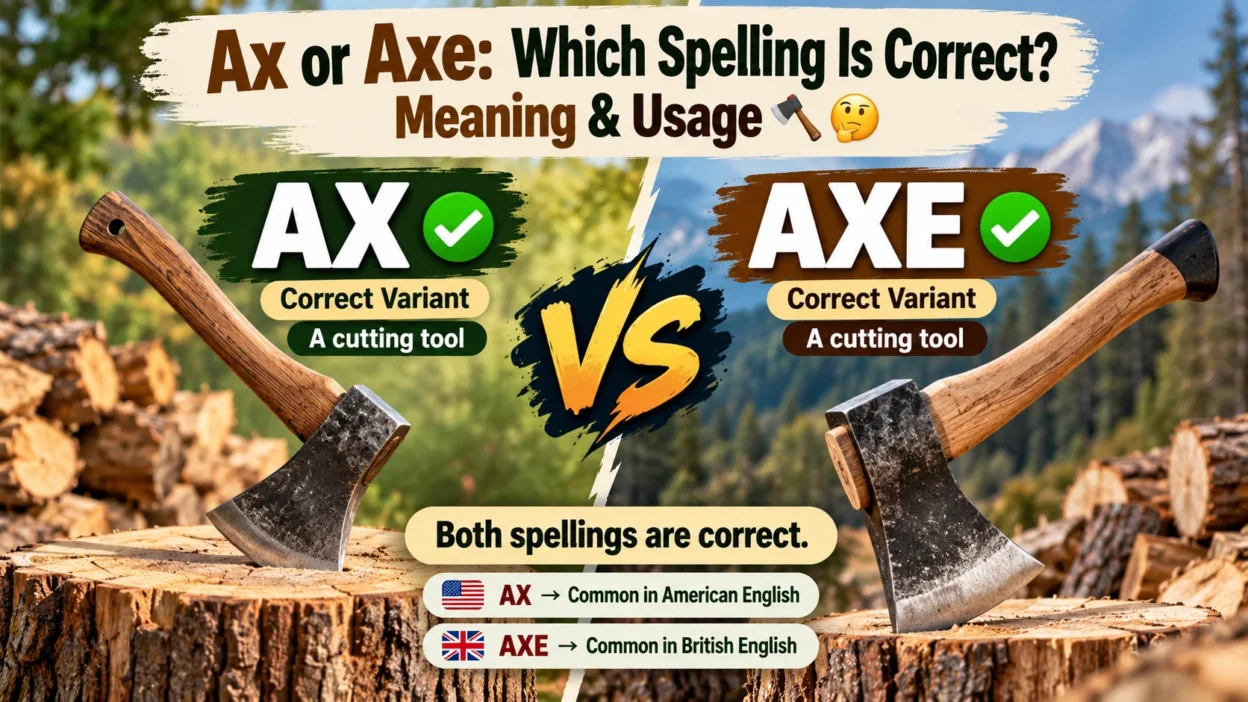
Have you ever wondered whether you should write ax or axe? Both spellings are correct and refer to the same cutting tool, although regional spelling preferences often determine which form writers choose. Ax appears frequently in American English, while axe remains the more common form in British English and many other varieties. Both words can also work as verbs when you mean to cut, remove, cancel, or eliminate something. In this guide, you’ll learn the meaning, pronunciation, grammar, origin, regional differences, examples, synonyms, related expressions, and common mistakes associated with ax vs. axe.
⚡ Ax or Axe
Both ax and axe are correct. They have the same basic meaning, pronunciation, and grammatical functions. Your choice mainly depends on the English variety or editorial style you follow.
| Term | Meaning | Usage | Category |
|---|---|---|---|
| Ax | A cutting tool; also to cut or eliminate | Common and well established in American English | Noun / Verb |
| Axe | A cutting tool; also to cut or eliminate | Conventional in British English and widely used elsewhere | Noun / Verb |
For American writing, ax offers a concise standard spelling. For British English, axe provides the conventional form. However, American writers can also use axe, so you should not treat it as an incorrect spelling.
📖 What Does Ax or Axe Mean?
As a noun, ax or axe means a tool with a sharp blade attached to a handle. People use an ax or axe to chop wood, cut branches, split logs, and perform similar cutting tasks.
As a verb, the word can describe cutting with the tool. Modern English also gives the verb a figurative meaning: to remove, cancel, dismiss, or eliminate something.
For example, a company might axe a project, while a television network might ax a program. People also use the expression get the ax/axe when someone loses a job or something faces cancellation.
🔊 Pronunciation and Part of Speech
Both spellings have the same pronunciation: /æks/. The extra e in axe does not change the sound.
Both forms can function as:
- Noun: She picked up an ax.
- Verb: The company decided to ax the project.
🏛️ Origin and Etymology
The word has ancient Germanic roots. English developed forms such as Old English æx and eax for the cutting tool, and related forms appeared in other Germanic languages.
Over time, English writers used different spellings, including ax and axe. The shorter ax became especially established in American English, while axe remained strongly associated with British English. Noah Webster also favored shorter American spellings, which helped support forms such as ax in American dictionaries.
🌎 Ax vs. Axe in American and British English
Regional spelling creates most of the confusion surrounding these words. The difference does not involve pronunciation or meaning; instead, writers follow different spelling traditions.
In American English, both ax and axe appear in real-world writing. Style guides may prefer ax, while some dictionaries and writers still use axe. In British English, axe remains the conventional spelling.
A simple comparison looks like this:
| English Variety | Preferred/Typical Form |
|---|---|
| American English | ax or axe |
| British English | axe |
| Australian English | axe |
| New Zealand English | axe |
| International writing | axe is widely recognizable |
If you write for a US audience, ax works naturally. If you write for a British audience, choose axe. Most importantly, keep your spelling consistent throughout the same piece of writing.
✍️ Ax or Axe: Usage Examples
Both spellings work in the same grammatical situations. You simply change the spelling according to your preferred English variety.
| Example Sentence | Meaning |
|---|---|
| He grabbed an ax from the shed. | He took the cutting tool. |
| She used an axe to chop the wood. | She used the tool for cutting. |
| The carpenter sharpened his ax. | He improved the blade. |
| We carried an axe during the camping trip. | We carried the cutting tool. |
| The company decided to ax the outdated plan. | The company removed the plan. |
| The network axed the show after one season. | The network canceled the show. |
| The manager may axe several unnecessary expenses. | The manager may eliminate expenses. |
| He used an ax to split the log. | He divided the log with the tool. |
| The workers carried an axe into the forest. | They carried a cutting tool. |
| The editor axed several paragraphs. | The editor removed the paragraphs. |
🔤 Synonyms for Ax or Axe
The best synonym depends on whether you mean the physical tool or the figurative verb.
| Synonym | Meaning |
|---|---|
| Hatchet | A small chopping tool |
| Tomahawk | A light ax traditionally associated with Indigenous peoples |
| Chopper | A tool used for chopping |
| Cleaver | A heavy-bladed cutting tool |
| Tool | A general implement used for work |
| Blade | A sharp cutting component |
| Cutter | Something designed to cut |
| Adze | A tool with a blade set at a right angle |
| Machete | A long cutting blade |
| Chop | To cut with repeated blows |
| Cut | To divide or remove |
| Slash | To cut forcefully |
| Remove | To take something away |
| Cancel | To stop a planned activity |
| Eliminate | To remove something completely |
🚫 Antonyms and Contrasting Terms
Because ax/axe has both literal and figurative meanings, its antonyms depend on context.
| Antonym | Meaning |
|---|---|
| Build | To create rather than destroy |
| Create | To bring something into existence |
| Construct | To make or assemble |
| Add | To include something |
| Keep | To retain something |
| Preserve | To protect something |
| Maintain | To continue supporting something |
| Restore | To bring something back |
| Continue | To allow something to proceed |
| Approve | To accept or support something |
For example, cancel contrasts with continue, while destroy contrasts with build.
🔗 Related Terms and Expressions
You will often encounter ax or axe in compound words and idiomatic expressions. The spelling usually follows the regional preference of the writer.
| Related Term | Meaning |
|---|---|
| Ax head / axe head | The bladed part of the tool |
| Ax handle / axe handle | The handle attached to the blade |
| Fire ax / fire axe | An ax designed for emergency use |
| Hand ax / hand axe | A smaller hand-held ax |
| Battle-ax / battle-axe | A weapon or figurative description |
| Stone ax / stone axe | An ax made with a stone blade |
| Ice ax / ice axe | A mountaineering tool |
| Pickax / pickaxe | A tool with a pointed end and blade |
| Poleax / poleaxe | A weapon mounted on a pole |
| Ax to grind | A personal complaint or hidden motive |
| Get the ax | Lose a job or face cancellation |
| Take an ax to | Cut, remove, or drastically revise |
| Axed | Canceled or removed |
| Axing | The act of removing or canceling |
| Woodcutting ax | A tool designed for cutting wood |
The idiom “have an ax to grind” means that someone has a personal interest, complaint, or motive behind an argument. Both ax and axe can appear in this expression.
⚠️ Common Mistakes With Ax and Axe
Writers often make mistakes because they assume the two forms have different meanings.
| Mistake | Correct Usage |
|---|---|
| “Ax is always wrong.” | Ax is a correct spelling. |
| “Axe is always wrong in American English.” | American English accepts axe. |
| Treating ax and axe as different tools | Both forms name the same tool. |
| Changing pronunciation because of the e | Both forms sound the same. |
| Mixing styles without reason | Choose one form and stay consistent. |
| Writing “a axe” | Write an axe. |
| Writing “a ax” | Write an ax. |
| Assuming axe only works as a noun | Axe can also function as a verb. |
| Assuming ax only works as a noun | Ax can also function as a verb. |
| Calling ax an abbreviation | Ax is a complete English word. |
Remember that an comes before both ax and axe because both words begin with a vowel sound: an ax and an axe.
💬 How People Use Ax or Axe Today
You can encounter these words in everyday conversation, woodworking, outdoor activities, literature, journalism, business writing, and online communication.
In everyday conversation, people usually discuss the physical tool. In business communication, the figurative verb appears more often when someone talks about cutting costs, canceling projects, or removing positions.
Social media users may also use expressions such as “get the axe” or “take an axe to the budget” in a figurative way. Writers can choose either spelling, but regional consistency makes the text easier to read.
In academic writing, follow the spelling convention required by your institution or style guide. In online messaging, people generally understand both forms without difficulty.
❓ FAQs
Is ax or axe correct?
Both are correct. Ax has strong support in American English, while axe remains the conventional British spelling.
Is ax American or British?
Ax is especially associated with American English. British English generally prefers axe.
Is axe acceptable in American English?
Yes. Axe is acceptable in American English, even though some American style guides prefer the shorter form ax.
Do ax and axe sound the same?
Yes. Both normally have the pronunciation /æks/.
Does ax mean something different from axe?
No. Ax and axe normally have the same meanings. The difference concerns spelling rather than definition.
What is the plural of ax or axe?
The plural is axes for both forms. For example, you can write, “The workers carried several axes.”
Which spelling should I use in American English?
Use ax if you want a concise American spelling, especially when your chosen style guide recommends it. However, axe also remains correct.
Which spelling should I use in British English?
Use axe. It remains the conventional British English spelling.
🏁 Conclusion
So, should you write ax or axe? The answer depends mainly on your preferred variety of English. Both forms describe the same cutting tool, share the same pronunciation, and can function as nouns or verbs. American English commonly uses ax, although axe also appears frequently and remains correct. British English generally favors axe.
You do not need to worry about choosing a completely different word. Instead, consider your audience, follow the appropriate spelling convention, and remain consistent. If you write primarily for American readers, ax provides a clear standard choice. If you follow British English, axe fits naturally. Once you understand this regional spelling difference, you can confidently use either form without treating one as a mistake.

Andrew Foster is a researcher and content writer at Differopedia, specializing in clear, accurate, and easy-to-understand comparison guides, definitions, and informational articles. His work focuses on helping readers make informed decisions through well-researched, reliable content.