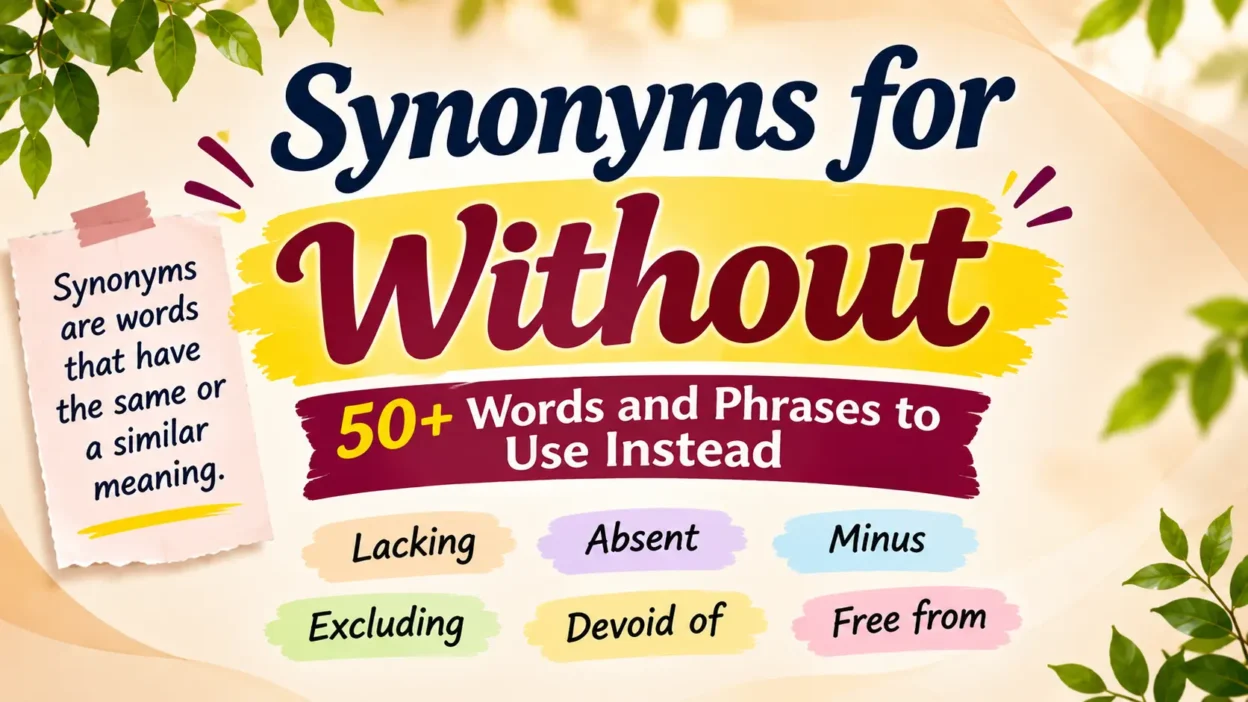
Finding the right synonyms for without can make your writing clearer, more natural, and less repetitive. Although “without” is a commonly used English preposition, repeating it too often can make sentences sound predictable. Alternatives such as lacking, minus, absent, excluding, free from, and in the absence of can express similar ideas in different ways. However, each alternative has its own meaning and grammatical usage. Some describe something missing, while others indicate exclusion, independence, or the absence of a particular condition. Understanding these differences will help you choose the right words for everyday conversations, academic writing, professional communication, and creative expression.
⚡What Are the Best Synonyms for Without?
The best synonyms for without include lacking, minus, absent, excluding, free from, in the absence of, deprived of, outside, and not having. The most suitable alternative depends on whether you mean something is missing, excluded, unavailable, or not accompanied by something else.
📖 Word at a Glance
| Word Detail | Information |
|---|---|
| Word | Without |
| Part of Speech | Preposition, adverb |
| Pronunciation | /wɪˈðaʊt/ |
| Phonetic Spelling | wih-THOWT |
| Syllables | 2 (with-out) |
| Main Meaning | In the absence of something |
| Common Usage | Expressing absence, exclusion, or lack |
| Opposite | With |
🔤 Top Synonyms for Without: Comparison Table
The following alternatives cover different situations in which you might want to replace “without.” Consider their meanings and levels of formality before using them.
| Synonym | Meaning | Best Context |
|---|---|---|
| Lacking | Not having something necessary | General writing |
| Minus | With something removed | Numbers and informal writing |
| Absent | Not present | Formal writing |
| Excluding | Leaving something out | Lists and descriptions |
| Free from | Not affected by something | Health and general writing |
| Devoid of | Completely lacking something | Descriptive writing |
| Bereft of | Having lost or lacking something | Literary writing |
| Deprived of | Prevented from having something | Formal writing |
| In the absence of | When something is not available | Professional writing |
| Not having | Being without possession | Everyday English |
| Independent of | Not relying on something | Academic writing |
| Unaccompanied by | Not having something alongside | Formal descriptions |
📝 Synonyms for Without by Category
Different situations call for different alternatives. Grouping synonyms by meaning makes it easier to identify the right word for your sentence.
🌿 Words That Mean Lacking Something
These alternatives describe a person, object, or situation that does not have something.
- Lacking: Not having something desirable or necessary.
- Devoid of: Completely empty of a particular quality or thing.
- Bereft of: Having lost or being deprived of something.
- Deficient in: Not having enough of something.
- Short of: Having less than the required amount.
- Wanting: Lacking something that is needed or expected.
- Destitute of: Completely lacking something, often used in formal or literary contexts.
- Missing: Not present when expected.
Examples:
- The report was lacking essential information.
- His explanation was devoid of useful details.
Usage tip: Use “lacking” for everyday situations and “devoid of” when emphasizing a complete absence.
🚫 Words That Mean Excluding Something
When “without” means leaving something out of a group, list, or calculation, these alternatives may work better.
- Excluding: Not including a particular person or thing.
- Except: Leaving out a specific item or person.
- Barring: Excluding something or someone.
- Omitting: Intentionally leaving something out.
- Save for: Except for a particular thing; mainly formal or literary.
- Apart from: Except for or in addition to, depending on context.
- Minus: With a particular amount or item taken away.
Examples:
- Everyone attended the meeting except John.
- The final price is $50, excluding delivery charges.
Usage tip: “Excluding” is particularly useful in business documents, pricing information, and formal descriptions.
✨ Words That Mean Free From Something
Sometimes, “without” describes freedom from a problem, restriction, or unwanted condition.
- Free from: Not affected by something.
- Clear of: Not containing or being affected by something.
- Unburdened by: Not troubled by a responsibility or concern.
- Independent of: Not depending on something.
- Unaffected by: Not influenced or changed by something.
- Exempt from: Officially excused from an obligation or requirement.
- Immune to: Protected against or unaffected by something.
Examples:
- She wanted a vacation free from stress.
- The organization is independent of government funding.
Usage tip: Choose “free from” for general situations and “exempt from” when discussing official rules or obligations.
📚 Formal and Literary Alternatives
For academic assignments, professional documents, and creative writing, some expressions offer a more sophisticated way to communicate absence.
- In the absence of: When something is not present or available.
- Deprived of: Not allowed to have or use something.
- Bereft of: Lacking something, often emotionally or dramatically.
- Devoid of: Entirely lacking a quality or substance.
- Unaccompanied by: Not accompanied by another person or thing.
- Independent of: Not dependent on something.
- In lieu of: Instead of something, rather than without it.
Examples:
- In the absence of further evidence, the decision remains unchanged.
- The proposal was submitted unaccompanied by supporting documents.
Usage tip: “In the absence of” is a useful formal alternative, while “in lieu of” means “instead of,” not simply “without.”
📌 What Does Without Mean?
“Without” generally means not having, not including, or not being accompanied by someone or something. It can also describe an action performed when a particular thing is unavailable or absent.
The word has several common uses in English:
Absence: Something is not present.
Example: She left without her umbrella.
Lack of possession: Someone does not have something.
Example: He cannot travel without his passport.
Exclusion: Something is deliberately left out.
Example: The meal comes without dessert.
Absence of an action: Something happens without another action taking place.
Example: She completed the assignment without asking for help.
🔄 How to Choose the Right Synonym for Without
Choosing a replacement requires understanding the meaning of your original sentence. A synonym may be grammatically correct but still communicate a slightly different idea.
| Original Expression | Better Alternative | Revised Sentence |
|---|---|---|
| Without any help | Independently | She completed the project independently. |
| Without enough money | Lacking funds | The organization was lacking funds. |
| Without sugar | Sugar-free | I ordered a sugar-free drink. |
| Without permission | Unauthorized | The entry was unauthorized. |
| Without including taxes | Excluding taxes | The price is $100, excluding taxes. |
| Without evidence | In the absence of evidence | In the absence of evidence, no action was taken. |
| Without stress | Free from stress | She wanted a day free from stress. |
🎯 Quick Tips for Selecting the Best Word
- Use lacking when describing something that is missing.
- Use minus when referring to subtraction or removal.
- Use excluding when leaving something out of a group or calculation.
- Use devoid of when emphasizing a complete lack.
- Use free from when describing freedom from an unwanted condition.
- Use independently when someone accomplishes something without assistance.
- Use in the absence of for formal explanations.
✍️ Grammar Notes: How to Use Without Correctly
“Without” is primarily a preposition. It can be followed by a noun, pronoun, or gerund (an -ing verb form).
Without + noun
She went outside without her jacket.
Without + pronoun
I cannot complete this task without you.
Without + gerund
He left without saying goodbye.
Without + noun phrase
They completed the project without any additional funding.
A common grammatical mistake is using an infinitive directly after “without.”
Incorrect: She left without to say goodbye.
Correct: She left without saying goodbye.
Remember that the gerund form is generally required when a verb follows “without.”
⚠️ Common Mistakes When Replacing Without
Not every synonym can replace “without” directly. Some alternatives change the meaning or require a different sentence structure.
| Common Mistake | Better Usage |
|---|---|
| Using “in lieu of” to mean without | Use “in the absence of” |
| Using “except” when describing general lack | Use “lacking” |
| Using “minus” in every formal sentence | Use “excluding” where appropriate |
| Using “devoid of” for ordinary possession | Use “not having” |
| Using “independent of” for simple absence | Use “without” or “not having” |
For example, “She attended the event without her husband” does not necessarily mean she attended independently of him. The original sentence simply indicates that he was not accompanying her.
💬 Real-Life Examples of Without and Its Synonyms
These examples demonstrate how different alternatives work in natural English sentences.
| Original Sentence | Alternative Sentence |
|---|---|
| He completed the work without help. | He completed the work independently. |
| The room was without furniture. | The room was devoid of furniture. |
| She went out without a coat. | She went out unaccompanied by a coat. |
| We cannot proceed without permission. | We cannot proceed without authorization. |
| The product comes without added sugar. | The product is free from added sugar. |
| He lived without financial support. | He lived without financial assistance. |
| The document was without errors. | The document was free from errors. |
| She spoke without fear. | She spoke fearlessly. |
🔍 Related Words and Expressions
Understanding related vocabulary can help expand your English vocabulary and improve sentence variety.
- Absence: The state of something not being present.
- Lack: The state of not having enough of something.
- Exclusion: The act of leaving someone or something out.
- Omission: Something that has been left out.
- Shortage: A situation in which there is not enough of something.
- Deficiency: A lack of something necessary.
- Independence: The state of not depending on others.
- Removal: The act of taking something away.
❓ FAQs
What are the 5 best synonyms for without?
The five useful alternatives are lacking, absent, excluding, minus, and free from. Each has a slightly different meaning and grammatical use.
What is a synonym for without in one word?
Depending on the context, one-word alternatives include lacking, minus, absent, and excluding.
How can I say without in a professional way?
Use expressions such as “in the absence of,” “excluding,” “free from,” or “unaccompanied by” when they accurately match your intended meaning.
What is another word for without something?
You can use “lacking,” “devoid of,” “not having,” or “bereft of.” Choose according to the degree and type of absence.
What does without mean in a sentence?
It indicates that something is missing, unavailable, excluded, or not accompanying another thing.
Is minus a synonym for without?
Sometimes. “Minus” works when something has been removed or subtracted, such as “coffee minus sugar.” It does not fit every use of “without.”
What is a synonym for without someone?
Depending on the situation, you can use “unaccompanied by,” “independently of,” or “in someone’s absence.”
What is the difference between without and lacking?
“Without” indicates the absence of something, while “lacking” describes not having something that may be needed or expected. Their meanings overlap, but their grammatical structures differ.
✅ Conclusion
Learning different synonyms for without can make your English more expressive, natural, and engaging. Using alternative words such as lacking, absent, minus, excluding, and devoid of helps you avoid repetition and communicate your ideas more effectively. Expressions like free from and in the absence of are also useful in formal and everyday writing. However, choosing the right synonym depends on the meaning and grammatical structure of your sentence. Some alternatives describe something missing, while others express exclusion or independence. By understanding these differences, you can make your writing clearer, smoother, and more precise.

Andrew Foster is a researcher and content writer at Differopedia, specializing in clear, accurate, and easy-to-understand comparison guides, definitions, and informational articles. His work focuses on helping readers make informed decisions through well-researched, reliable content.