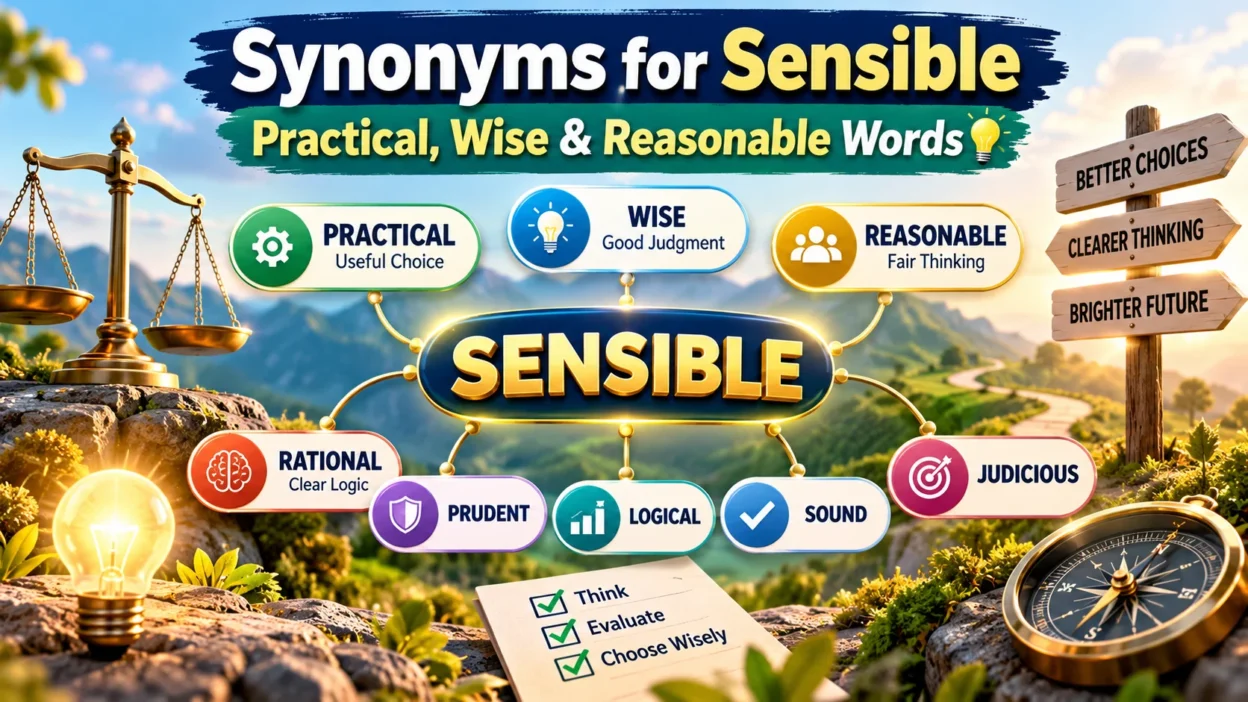
Finding the right word for sensible depends on what you mean. You might be describing someone who makes good decisions, an idea that is practical, or advice that shows sound judgment. Useful synonyms for sensible include practical, reasonable, rational, wise, prudent, logical, sound, level-headed, and judicious.
The best synonym changes with context. For example, practical works well for a useful solution, while wise often describes a thoughtful decision based on experience. Understanding these differences helps you choose a word that sounds natural rather than simply replacing sensible with the closest dictionary match.
⚡What Are the Best Synonyms for Sensible?
The most common synonyms for sensible are practical, reasonable, rational, logical, wise, prudent, sound, judicious, level-headed, and thoughtful. They all suggest good judgment, but each carries a slightly different meaning.
For everyday writing, reasonable, practical, and logical are usually the safest choices. For more formal writing, prudent, judicious, and sound can be more precise.
📖 Sensible at a Glance
| Word | Meaning | Best Context | Tone |
|---|---|---|---|
| Sensible | Showing good judgment | General use | Neutral |
| Practical | Useful and realistic | Plans, solutions | Neutral |
| Reasonable | Fair and logical | Opinions, requests | Neutral |
| Rational | Based on reason | Decisions, arguments | Formal |
| Logical | Following clear reasoning | Ideas, explanations | Neutral |
| Wise | Showing good judgment and experience | Decisions, advice | Positive |
| Prudent | Careful about risks and consequences | Money, decisions | Formal |
| Sound | Reliable and well-founded | Advice, reasoning | Neutral/Formal |
| Judicious | Showing careful judgment | Decisions, choices | Formal |
| Level-headed | Calm and sensible | People, behavior | Informal |
🔤 Pronunciation and Meaning of Sensible
Sensible is pronounced /ˈsɛnsəbəl/ and has three syllables: sen-si-ble.
As an adjective, sensible describes someone or something that demonstrates good judgment, practicality, or reason. A sensible person generally considers facts and consequences before acting.
Example 1:
Maria made a sensible decision to save some money before moving.
Example 2:
Wearing comfortable shoes was a sensible choice for the long hike.
The word can describe people, decisions, advice, choices, plans, clothing, solutions, and behavior.
🧩 Top Synonyms for Sensible
The following words are among the most useful alternatives, but they are not completely interchangeable. Their subtle differences can change the tone of a sentence.
| Synonym | Example |
|---|---|
| Practical | We need a practical solution to the problem. |
| Reasonable | That sounds like a reasonable request. |
| Rational | She gave a rational explanation. |
| Logical | His conclusion was logical and easy to understand. |
| Wise | It was wise to check the contract first. |
| Prudent | Saving an emergency fund is a prudent choice. |
| Sound | The manager offered sound advice. |
| Judicious | He made a judicious investment. |
| Level-headed | She remained level-headed during the crisis. |
| Thoughtful | That was a thoughtful and sensible decision. |
🛠️ Sensible Synonyms for Practical Ideas
When sensible means realistic, useful, or suited to a particular situation, practical is often the strongest synonym. It focuses less on intelligence and more on whether something can actually work.
Practical is especially useful for describing solutions, plans, clothing, purchases, and approaches.
- We need a practical way to reduce costs.
- Buying a durable backpack was a practical decision.
- Her advice was practical and easy to follow.
Other useful alternatives include realistic, workable, functional, useful, and viable. However, these words emphasize usefulness or feasibility rather than good judgment alone.
⚖️ Synonyms for Sensible Decisions and Choices
When talking about a sensible decision, words such as wise, prudent, reasonable, and judicious work particularly well.
Wise suggests good judgment, often based on knowledge or experience. Prudent emphasizes caution and careful consideration of possible risks. Judicious has a more formal tone and suggests balanced, thoughtful judgment.
For example:
- It was wise to ask for professional advice.
- It was prudent to keep an emergency fund.
- The board made a judicious decision after reviewing the evidence.
If you want an everyday alternative, reasonable is usually more natural than judicious.
🧠 Synonyms for Sensible Thinking and Reasoning
When sensible refers to thinking that is based on facts and sound reasoning, rational and logical are particularly appropriate.
Rational describes thinking that is guided by reason rather than emotion or impulse. Logical emphasizes a clear connection between ideas, evidence, and conclusions.
Sound is another useful choice. It often describes reasoning, judgment, advice, or arguments that are reliable and well-founded.
For example:
The proposal is based on sound reasoning.
He offered a logical explanation for the unexpected result.
She tried to make a rational decision instead of reacting emotionally.
👤 Synonyms for a Sensible Person
If you want to describe someone who regularly makes good decisions, several alternatives are available.
Level-headed is a natural conversational choice for someone who remains calm and thinks clearly. Reasonable can describe someone who is fair and willing to listen. Wise suggests strong judgment, knowledge, or life experience.
Other possibilities include practical, rational, thoughtful, responsible, mature, judicious, and prudent.
Compare these examples:
Jake is very level-headed when problems arise.
My aunt is wise and always gives thoughtful advice.
Sam is practical and usually finds a workable solution.
These words describe slightly different qualities, so the best choice depends on what you want to emphasize.
✍️ How to Choose the Right Synonym
Choosing among synonyms for sensible becomes easier when you identify the exact quality you want to describe.
Use practical when something is useful and realistic. Use reasonable when something is fair, acceptable, or based on sound judgment. Choose rational when the focus is reason rather than emotion.
Use logical when ideas follow a clear line of reasoning. Choose wise when a decision demonstrates strong judgment or experience. Prudent works particularly well when someone carefully considers risk or future consequences.
For formal writing, judicious and sound can add precision without sounding overly complicated.
📝 Common Collocations With Sensible
Certain combinations with sensible sound especially natural in English. Learning these common collocations can help you use the word correctly.
Common examples include:
- sensible decision
- sensible choice
- sensible approach
- sensible solution
- sensible advice
- sensible person
- sensible plan
- sensible option
- sensible precautions
- sensible behavior
For example, a sensible approach to budgeting sounds natural because the adjective describes a method that is practical and well considered.
🚫 Common Mistakes With Sensible Synonyms
A common mistake is assuming that every synonym can replace sensible in every sentence. Although related words share a general idea, their meanings are not identical.
For instance, logical does not always mean practical. An idea can be logically consistent but difficult to implement. Similarly, wise can imply experience or long-term judgment, while reasonable may simply mean fair or acceptable.
Another issue is formality. Level-headed is natural in conversation, while judicious is more common in formal or professional writing.
Always consider the sentence’s meaning, audience, and tone before choosing a replacement.
🔄 Related Words and Opposites
Words related to sensible include sense, sensibility, sensibly, reason, reasoning, judgment, practicality, wisdom, prudence, and rationality.
Common opposites include foolish, unreasonable, irrational, impractical, reckless, illogical, careless, and absurd.
The correct antonym also depends on context. For example, impractical is the opposite of practical, while irrational is the opposite of rational. Reckless is a stronger opposite when the focus is on ignoring risk or consequences.
❓ FAQs About Sensible
What does sensible mean?
Sensible means showing good judgment, reason, or practicality. It can describe a person, decision, idea, plan, or action.
Can sensible mean practical?
Yes. In many situations, sensible means practical, realistic, or useful.
Can sensible mean intelligent?
Sometimes, but the meanings are not identical. Sensible focuses on good judgment, while intelligent primarily refers to mental ability or understanding.
Is sensible a positive word?
Yes. Sensible generally has a positive or approving meaning because it suggests responsible and well-considered behavior.
What is the difference between sensible and reasonable?
Sensible often emphasizes good judgment or practicality. Reasonable can emphasize fairness, acceptability, or logical thinking.
What is the difference between sensible and rational?
Rational specifically emphasizes reason and logical thought. Sensible has a broader meaning that can include practicality and good judgment.
What is the difference between sensible and prudent?
Both suggest careful judgment. Prudent places stronger emphasis on caution, risk, and future consequences.
How can I avoid repeating sensible in my writing?
Choose a replacement based on the intended meaning. Use practical for usefulness, reasonable for fairness, logical for reasoning, wise for strong judgment, and prudent for careful decisions.
🎯 Conclusion
The best synonyms for sensible include practical, reasonable, rational, logical, wise, prudent, sound, judicious, level-headed, and thoughtful. Although these words overlap, each highlights a different aspect of good judgment.
For everyday writing, reasonable and practical are versatile choices. Use wise when experience and judgment matter, rational or logical when reasoning is the focus, and prudent or judicious for more formal contexts. Choosing the synonym that matches the exact meaning will make your writing clearer, more precise, and more natural.

Andrew Foster is a researcher and content writer at Differopedia, specializing in clear, accurate, and easy-to-understand comparison guides, definitions, and informational articles. His work focuses on helping readers make informed decisions through well-researched, reliable content.