
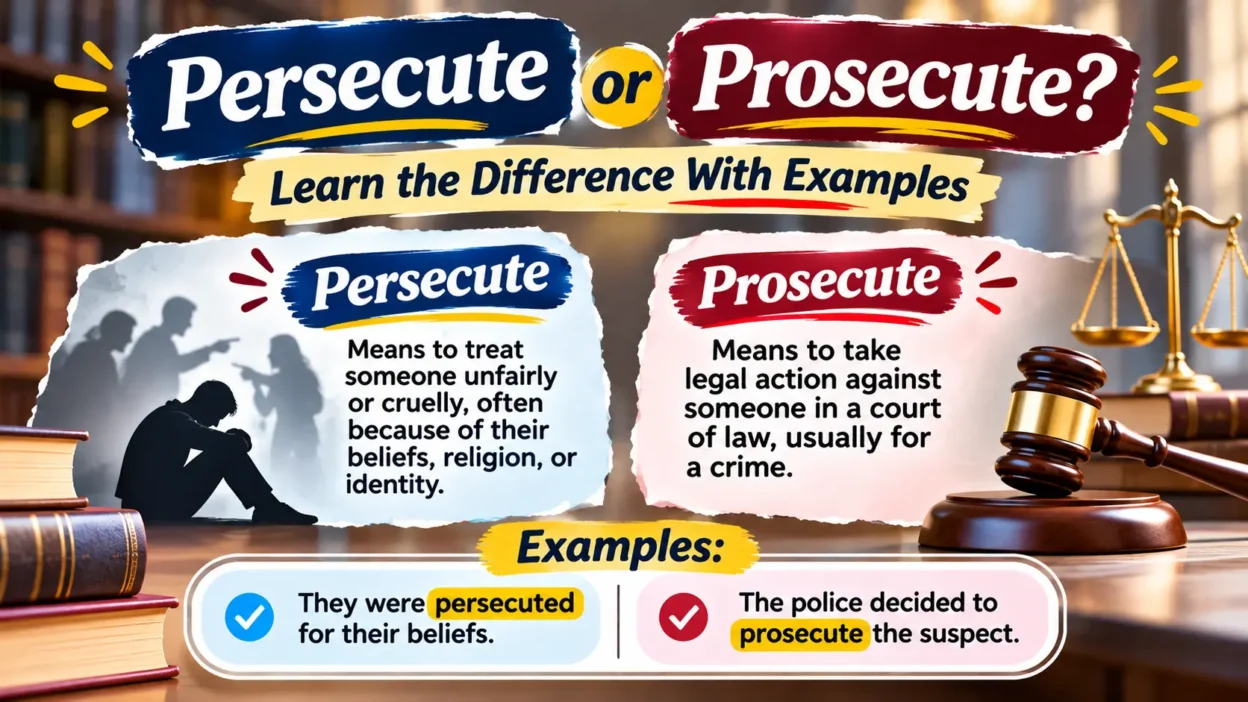
Have you ever confused persecute vs prosecute because these words look and sound so similar? Although they share similar spelling, they have completely different meanings. Persecute means to treat someone cruelly or unfairly because of their beliefs, identity, or background, while prosecute means to take legal action against someone accused of a crime. For example, a government may persecute people because of their religion, while a prosecutor may prosecute someone for fraud. Understanding the difference will help you improve your English vocabulary and avoid common writing mistakes. In this guide, you’ll explore their meanings, pronunciations, differences, synonyms, antonyms, and practical examples.
⚡Persecute vs Prosecute
The main difference is simple: persecute means to mistreat someone, while prosecute means to take legal action against someone.
| Term | Meaning | Usage | Category |
|---|---|---|---|
| Persecute | To treat someone cruelly or unfairly | They persecute religious community. | Verb |
| Prosecute | To bring legal action against someone | The state will prosecute the suspect. | Verb |
Easy trick: Persecute means oppression; prosecute means legal action.
😟 What Does Persecute Mean?
Persecute means to repeatedly treat someone cruelly, unfairly, or harshly. People commonly use this word when someone experiences discrimination, harassment, oppression, or bullying because of their identity, religion, political opinions, or personal beliefs.
Pronunciation: /ˈpɝː.sə.kjuːt/
Part of speech: Verb
Word forms: Persecute, persecutes, persecuted, persecuting.
Origin: The word comes through Old French from Latin persequi, meaning to pursue or follow with hostility.
Examples of Persecute
- The government persecuted people because of their religious beliefs.
- Some individuals persecute others for expressing different opinions.
- The dictator continued to persecute political opponents.
- Nobody deserves to persecute another person because of their identity.
People also use persecute informally to describe persistent annoyance.
For example: “My little brother persecutes me with questions every morning.”
⚖️ What Does Prosecute Mean?
Prosecute means to bring legal action against someone accused of committing a crime. Prosecutors and authorized legal representatives use this word when they pursue criminal cases through the court system.
Pronunciation: /ˈprɑː.sə.kjuːt/
Part of speech: Verb
Word forms: Prosecute, prosecutes, prosecuted, prosecuting.
Origin: The word comes from Latin prosequi, meaning to follow, pursue, or continue.
Examples of Prosecute
- The government will prosecute the suspect for fraud.
- The district attorney decided to prosecute the criminal case.
- Authorities may prosecute businesses that violate environmental laws.
- The prosecutor presented evidence to prosecute the defendant.
People also use prosecute in a broader sense to describe pursuing an activity or course of action.
For example: “The organization continued to prosecute its campaign for environmental protection.”
🔍 Persecute vs Prosecute: Key Differences
Although both words share similar spelling and historical connections, they describe different actions. Understanding their purposes and contexts makes them easier to distinguish.
| Comparison | Persecute | Prosecute |
|---|---|---|
| Meaning | To mistreat someone | To take legal action |
| Purpose | To cause suffering | To pursue justice |
| Context | Social, religious, political | Legal and criminal |
| Common subject | Individuals or authorities | Prosecutors or governments |
| Common object | People or communities | Defendants or criminal cases |
| Related noun | Persecution | Prosecution |
| Example | They persecute community. | They prosecute criminals. |
How to Remember the Difference
Use these simple questions:
- Does someone mistreat another person because of their beliefs or identity? Choose persecute.
- Does someone bring criminal charges against an accused person? Choose prosecute.
For example:
- Authorities persecute citizens who criticize their policies.
- Authorities prosecute citizens who commit serious crimes.
The first sentence describes oppression, while the second describes legal proceedings.
📚 Persecute vs Prosecute Example Sentences
Examples help you understand how these words work in everyday English. Here are practical sentences showing their correct meanings.
| Example Sentence | Meaning |
|---|---|
| People should never persecute others for their religion. | Nobody should mistreat people because of their faith. |
| The dictator persecuted political opponents. | The dictator oppressed people who disagreed with him. |
| Some communities persecute individuals with different beliefs. | Some communities mistreat people for their opinions. |
| The journalist exposed officials who persecute innocent citizens. | The journalist revealed unfair treatment. |
| Nobody deserves to persecute another person. | Nobody should treat others cruelly. |
| The authorities decided to prosecute the suspect. | Authorities pursued legal action. |
| The state may prosecute the businessman for fraud. | The state may bring criminal charges. |
| Prosecutors will prosecute the case next month. | Prosecutors will pursue the legal case. |
| The government agreed to prosecute corrupt officials. | The government will pursue criminal charges. |
| The court may prosecute the company for breaking environmental regulations. | The company may face legal proceedings. |
🔄 Synonyms of Persecute and Prosecute
Synonyms help you develop a stronger vocabulary and understand related expressions. However, remember that synonyms from one category cannot automatically replace words from the other.
Synonyms of Persecute
| Synonym | Meaning |
|---|---|
| Harass | To repeatedly trouble someone |
| Oppress | To treat someone cruelly |
| Torment | To cause suffering |
| Bully | To intimidate someone |
| Victimize | To treat someone unfairly |
| Abuse | To treat someone harmfully |
| Mistreat | To treat someone badly |
| Tyrannize | To exercise cruel control |
| Hound | To pursue someone persistently |
| Intimidate | To frighten someone |
Synonyms of Prosecute
| Synonym | Meaning |
|---|---|
| Indict | To formally charge someone |
| Sue | To bring legal action |
| Charge | To accuse someone formally |
| Arraign | To bring an accused person before a court |
| Litigate | To resolve a dispute through legal proceedings |
| Try | To examine a case in court |
| Pursue | To continue a course of action |
| Bring to trial | To take someone to court |
| Take to court | To initiate legal proceedings |
| Seek conviction | To pursue a finding of guilt |
⚖️ Antonyms of Persecute and Prosecute
Antonyms express opposite or contrasting meanings. These words help you understand the distinction between mistreatment, protection, and legal action.
Antonyms of Persecute
| Antonym | Meaning |
|---|---|
| Protect | To keep someone safe |
| Defend | To support someone against attacks |
| Support | To help someone |
| Respect | To treat someone with consideration |
| Encourage | To give someone confidence |
| Champion | To publicly support someone |
| Uphold | To maintain or support |
| Accommodate | To consider someone’s needs |
| Assist | To provide help |
| Protect | To prevent harm |
Antonyms or Opposing Terms of Prosecute
| Term | Meaning |
|---|---|
| Defend | To represent an accused person |
| Acquit | To declare someone not guilty |
| Exonerate | To clear someone of responsibility |
| Dismiss | To end a legal case |
| Drop charges | To stop pursuing criminal charges |
| Absolve | To free someone from blame |
| Pardon | To officially forgive an offense |
| Vindicate | To clear someone of suspicion |
| Release | To set someone free |
| Defend against | To challenge allegations |
📝 Related Words and Their Meanings
Understanding related vocabulary will help you recognize these words in legal discussions, academic writing, and everyday conversations.
| Related Word | Meaning |
|---|---|
| Persecution | Persistent cruel treatment |
| Persecutor | Someone who mistreats others |
| Persecuted | Experiencing oppression |
| Persecuting | Continuously mistreating someone |
| Prosecution | The process of pursuing legal action |
| Prosecutor | A lawyer representing the government |
| Prosecuted | Faced legal proceedings |
| Prosecuting | Pursuing a criminal case |
| Defendant | Someone accused of a crime |
| Plaintiff | Someone who brings a civil lawsuit |
| Indictment | A formal criminal accusation |
| Litigation | The process of resolving legal disputes |
| Oppression | Cruel or unfair exercise of power |
| Discrimination | Unfair treatment |
| Acquittal | A decision declaring someone not guilty |
🚫 Common Mistakes When Using Persecute and Prosecute
English learners often confuse these verbs because their spellings look similar. However, choosing the correct word becomes easier when you understand the context.
| Mistake | Correct Usage |
|---|---|
| Police will persecute the criminal for theft. | Police will prosecute the criminal for theft. |
| The government prosecuted people for their religion. | The government persecuted people for their religion. |
| The lawyer decided to persecute the defendant. | The lawyer decided to prosecute the defendant. |
| Authorities prosecuted community for their beliefs. | Authorities persecuted community for their beliefs. |
| The dictator prosecuted political opponents. | The dictator persecuted political opponents. |
| The court persecuted the businessman for fraud. | The court prosecuted the businessman for fraud. |
| The prosecutor persecuted the defendant in court. | The prosecutor prosecuted the defendant in court. |
| Officials persecuted the accused for committing fraud. | Officials prosecuted the accused for committing fraud. |
| The state will persecute the suspect for theft. | The state will prosecute the suspect for theft. |
| People should prosecute others because of their identity. | People should never persecute others because of their identity. |
🌎 Where Do People Use Persecute and Prosecute?
Both words appear in different communication settings, but their meanings depend on the subject and situation.
Daily conversation: People use persecute to describe bullying, unfair treatment, or persistent annoyance. They use prosecute when discussing criminal charges or legal problems.
Social media: Users discuss persecution when talking about religious freedom, discrimination, political opinions, and human rights. They use prosecution when discussing criminal cases and legal controversies.
Business communication: Employees may use persecute when describing workplace harassment. Business professionals use prosecute when discussing fraud, regulatory violations, and criminal investigations.
Academic writing: Researchers use persecute when discussing historical oppression and discrimination. They use prosecute when examining criminal justice systems and legal procedures.
Online messaging: Friends might jokingly say, “Stop persecuting me about my weekend plans!” Someone might also write, “I’m going to prosecute you for stealing my fries!” Both examples use exaggeration for humor.
❓ FAQs
What Is the Main Difference Between Persecute and Prosecute?
Persecute means to mistreat someone, while prosecute means to bring legal action against someone accused of a crime.
Is It Persecute or Prosecute Someone?
Both expressions are correct. Use persecute someone when describing harassment or oppression. Use prosecute someone when describing criminal legal action.
What Is the Difference Between Persecution and Prosecution?
Persecution means persistent cruel or unfair treatment. Prosecution means the legal process of pursuing a criminal case against an accused person.
What Is the Difference Between a Prosecutor and a Persecutor?
A prosecutor represents the government in a criminal case. A persecutor mistreats, harasses, or oppresses another person.
Can Someone Be Both Persecuted and Prosecuted?
Yes. Someone may experience oppression because of their beliefs and also face criminal charges. These describe two separate situations.
Is Persecute a Negative Word?
Yes. It describes cruel, unfair, or oppressive behavior, often involving discrimination, harassment, or abuse of power.
Is Prosecute Only Used in Criminal Law?
No. It can also mean pursuing or carrying out an activity, such as prosecuting a campaign or course of action.
🎯 Conclusion
Understanding persecute vs prosecute helps you avoid common vocabulary mistakes and communicate more accurately. Although these words look similar, they describe completely different situations. Use persecute when someone experiences cruelty, harassment, discrimination, or oppression because of their beliefs or identity. Choose prosecute when authorities or legal representatives pursue criminal charges against an accused person. Remember this simple distinction: persecution involves mistreatment, while prosecution involves legal action. Practice using both words in your everyday conversations, professional writing, and academic work. Once you understand their meanings and contexts, you’ll find it much easier to choose the correct word whenever you encounter these commonly confused English verbs.

Andrew Foster is a researcher and content writer at Differopedia, specializing in clear, accurate, and easy-to-understand comparison guides, definitions, and informational articles. His work focuses on helping readers make informed decisions through well-researched, reliable content.