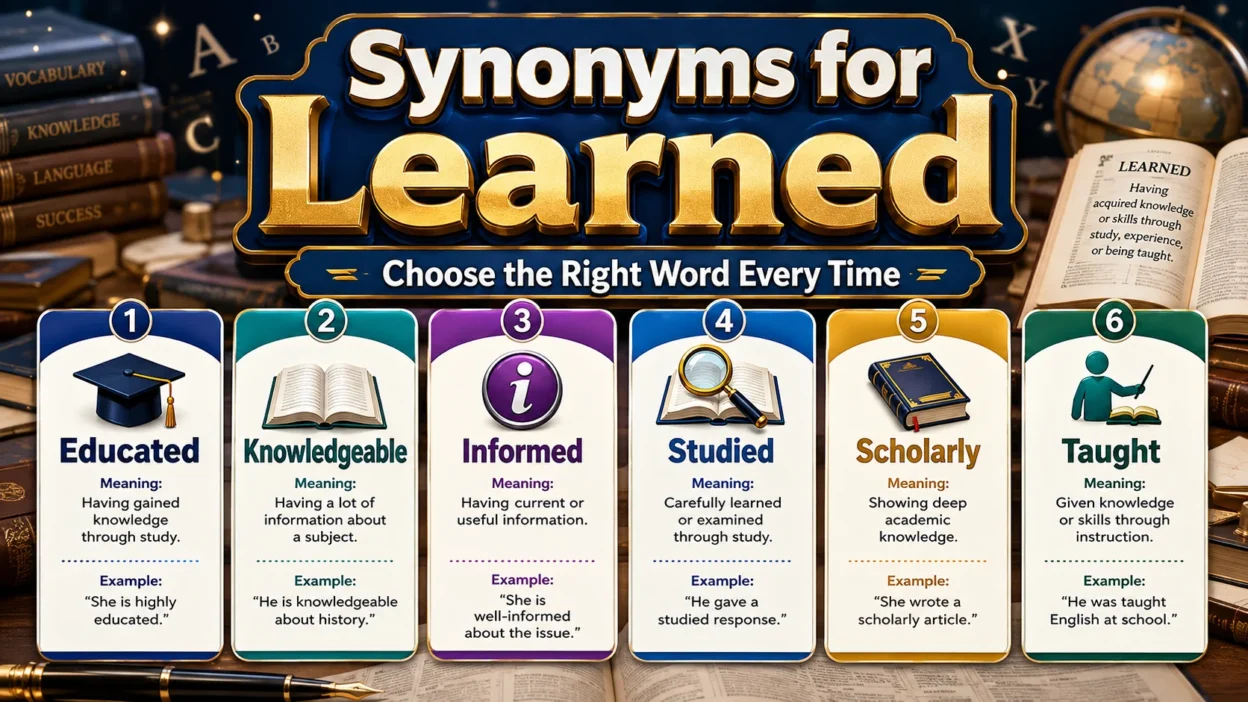
Have you ever struggled to find just the right word for someone exceptionally knowledgeable? You have likely searched for synonyms for learned. This word carries weight and respect, signifying more than basic education—it suggests depth of understanding, often hard-won through years of study or rich experience. Whether you are writing an academic paper, crafting a professional biography, or simply elevating your everyday vocabulary, having a strong command of these synonyms makes your writing more precise and engaging.
This guide explores the nuances of this important adjective, offering a wide range of alternatives categorized by context to help you choose the perfect word every time.
Quick Answer
What are the best synonyms for learned? The most direct options include scholarly, erudite, knowledgeable, well-read, educated, and literate. Your best choice depends on context. For example, erudite implies deep, scholarly knowledge; well-read suggests extensive reading; and educated is the most general term for someone with formal instruction.
Word at a Glance
| Attribute | Detail |
|---|---|
| Part of Speech | Adjective (also past tense verb) |
| Primary Meaning | Having or showing profound knowledge, education, or scholarship |
| Pronunciation (Adj) | /ˈlɜːrnɪd/ (LUR-nid) – two syllables |
| Pronunciation (Verb) | /lɜːrnd/ (lurnd) – one syllable |
| Formality | Formal to standard |
| Tone | Respectful, admiring, authoritative |
Pronunciation
The pronunciation of learned changes depending on how you use it:
- As an Adjective (knowledgeable): Say it with two syllables: /ˈlɜːrnɪd/ (LUR-nid). Enunciate the second syllable clearly.
- As a Past-Tense Verb (acquired knowledge): Say it with one syllable: /lɜːrnd/ (lurnd), rhyming with “turned.”
This distinction marks polished English usage and prevents confusion in spoken communication.
What Does “Learned” Really Mean?
The adjective learned describes someone who has acquired great knowledge through study and experience. It goes beyond being simply “smart” or “intelligent”—it implies cultivated, systematic, and often profound understanding.
Two Distinct Meanings
1. Possessing Knowledge: Applied to people, indicating deep knowledge.
Example: “The university hired a learned historian to lead the new research institute.”
2. Acquired, Not Innate: Applied to behaviors or skills obtained through learning rather than instinct.
Example: “Typing is a learned skill that requires practice to master.”
Top Synonyms for “Learned”
| Synonym | Meaning & Nuance | Best Used When | Example Sentence |
|---|---|---|---|
| Erudite | Having or showing great, often specialized knowledge | You want to emphasize deep, scholarly expertise | “The professor’s erudite lecture captivated students.” |
| Scholarly | Relating to serious academic study | Describing rigorous, well-researched work | “She published several scholarly articles.” |
| Well-read | Knowledge gained from extensive reading | Describing someone with wide literary knowledge | “He was clever, well-read, and interested in the arts.” |
| Knowledgeable | Having a great deal of knowledge | A versatile term for subject-specific or general expertise | “The guide was incredibly knowledgeable about the city’s history.” |
| Educated | Having received good education | A broad, neutral substitute for learned | “My aunt has educated tastes in music.” |
| Literate | Able to read and write; having knowledge of a subject | Emphasizing reading ability or subject familiarity | “She is computer literate.” |
Synonyms by Category
Formal & Academic Contexts
- Erudite – deep, specialized scholarly knowledge
- Scholarly – rigorous, academic approach
- Academic – theoretical rather than practical
- Lettered – formally educated and well-read
General & Everyday Usage
- Knowledgeable – all-purpose, widely applicable
- Well-informed – up-to-date on current affairs
- Well-read – extensive reading background
- Educated – the most direct learned synonym
Intellectual & Refined
- Cultured – refined through exposure to arts and ideas
- Proper– showing cultural and social development
- Sophisticated – worldly, refined, and knowledgeable
Usage Comparison Table
| Context | Best Synonym | Why |
|---|---|---|
| Academic writing | Erudite, Scholarly | Conveys rigor and depth |
| Professional bio | Knowledgeable, Well-informed | Signals competence without pretension |
| Describing a reader | Well-read | Emphasizes extensive reading |
| General description | Educated, Knowledgeable | Clear, neutral, widely understood |
| Cultural refinement | Cultured, Sophisticated | Highlights aesthetic and social awareness |
Choose the Right Word
Selecting the perfect synonym requires understanding subtle differences. For exceptionally deep knowledge, erudite is your best choice. When describing academic work, scholarly fits perfectly. If someone has gained knowledge through extensive reading, call them well-read. For practical expertise in a specific area, knowledgeable works well. Finally, for the most general and versatile option, educated is your go-to word.
Grammar Notes
Pronunciation Distinction:
- Adjective: learned (LUR-nid) – two syllables
- Verb: learned (lurnd) – one syllable
Usage:
- Learned typically appears before nouns (attributive): “a learned professor”
- It is less common as a predicate adjective: “The professor is learned”
Comparison:
- More learned / most learned
- Example: “She is one of the most learned scholars in her field.”
Common Collocations
| Collocation | Example |
|---|---|
| Learned scholar | “The conference featured several learned scholars.” |
| Learned society | “He was elected to the learned society.” |
| Learned journal | “She published in a prestigious learned journal.” |
| Learned discourse | “Their learned discourse continued for hours.” |
| Learned treatise | “He wrote a learned treatise on the subject.” |
| Learned profession | “Medicine and law are learned professions.” |
Common Mistakes to Avoid
Mispronouncing the Adjective
- ❌ Pronouncing “learned” as one syllable when used as an adjective
- ✅ Pronounce it LUR-nid (two syllables) instead
Using “Learned” for Basic Knowledge
- ❌ “My five-year-old is learned in colors.”
- ✅ “My five-year-old knows her colors.” (Reserve learned for advanced knowledge)
Overusing in Casual Contexts
- ❌ “She’s a learned cook.”
- ✅ “She’s a skilled cook.” (Use learned for intellectual or scholarly contexts)
Writing Tips
To improve your writing, start by matching formality to context—learned fits formal writing but may sound stiff in casual conversation. Additionally, consider using specific alternatives; erudite works well for scholarly depth, well-read suits reading habits, and knowledgeable fits practical expertise. Furthermore, vary your vocabulary by alternating among synonyms while respecting their nuances. Finally, think carefully about your subject; a learned historian differs significantly from a knowledgeable tour guide.
Real-Life Examples
“The learned judge delivered a ruling that cited centuries of legal precedent.”
“After decades of research, Dr. Chen was recognized as one of the most erudite voices in her field.”
“The book is too scholarly for casual reading but invaluable for researchers.”
“He was well-read in philosophy, history, and classical literature.”
Related Words
- Academic – theoretical, scholarly
- Cultivated – refined through education
- Enlightened – having knowledge and understanding
- Intellectual – relating to the intellect
- Studious – devoted to study
Opposite Words
- Ignorant – lacking knowledge
- Uneducated – without formal education
- Illiterate – unable to read or write
- Uninformed – lacking information
- Unlearned – not having knowledge (pronounced with one syllable)
FAQs
1. Can you describe a book as learned?
Yes. A “learned book” means the author wrote it for scholarly readers or it contains scholarly content.
2. Is learned a positive or negative descriptor?
It carries a positive tone—people use it to show respect for someone’s knowledge.
3. Which past tense form is correct—learned or learnt?
Both forms are correct. Americans use learned; British English speakers favor learnt.
4. How can I use learned in a sentence?
Example: “The learned professor delivered a fascinating lecture.”
5. Does knowledgeable mean the same as learned?
Yes, though knowledgeable is more general and less formal.
6. What does well-learned mean?
It means thoroughly learned or studied, but it appears less frequently than learned itself.
7. Can someone become learned without attending school?
Yes—extensive self-study and experience can produce a learned individual.
8. How do learned and scholarly differ?
Scholarly specifically relates to academic study, while learned encompasses any deep knowledge.
Conclusion
Mastering synonyms for learned enhances your vocabulary and allows you to describe intellectual depth with precision. Whether you choose erudite for scholarly sophistication, knowledgeable for practical expertise, or well-read for literary breadth, each word adds unique nuance to your writing. Remember the pronunciation distinction—learned as two syllables when describing someone knowledgeable—and you will communicate with clarity and authority.
The next time you encounter a truly learned individual, you will have exactly the right word to describe them.

Andrew Foster is a researcher and content writer at Differopedia, specializing in clear, accurate, and easy-to-understand comparison guides, definitions, and informational articles. His work focuses on helping readers make informed decisions through well-researched, reliable content.