
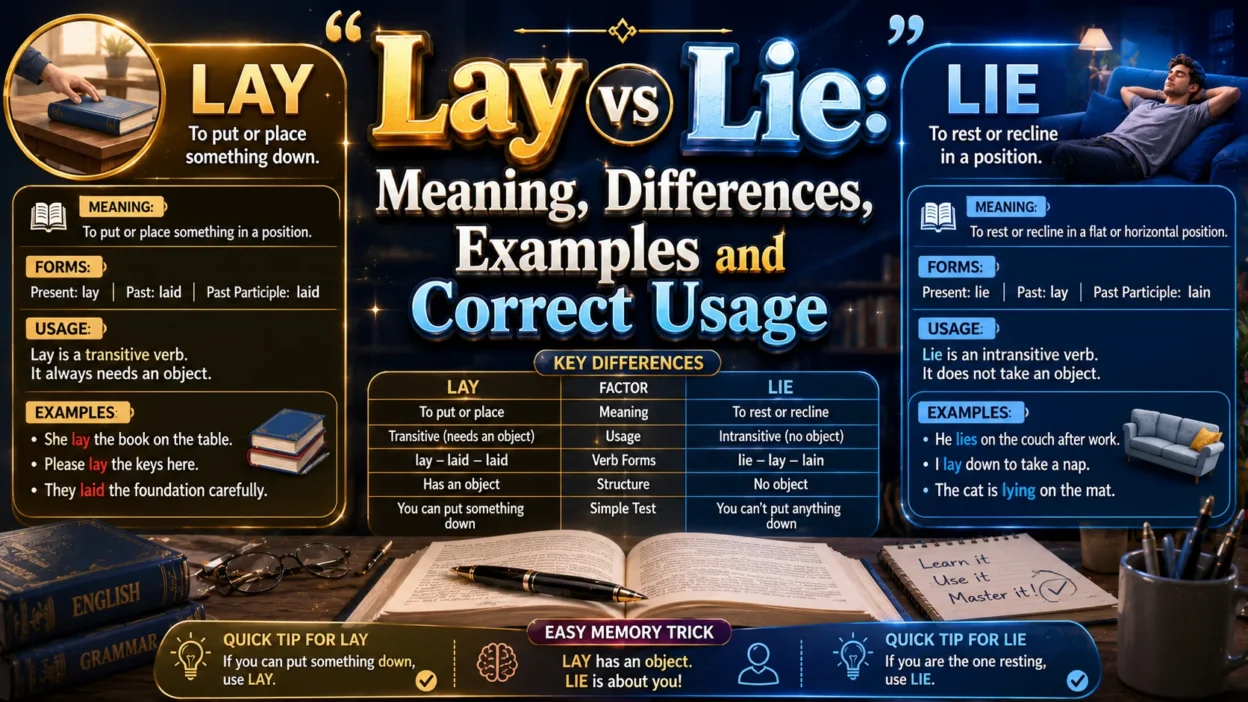
You might wonder why two simple verbs cause so much confusion. Lay and lie sound different, but their meanings and verb forms can be surprisingly easy to mix up. The basic difference is simple: lay means to put or place something down, while lie means to recline or be in a resting position.
The most useful rule to remember is this: You lay something down, but you lie down yourself. The verb lay requires a direct object, while lie does not. For example, you can lay a book on the table, but you lie on the sofa.
The confusion becomes greater when the verbs change tense because the past tense of lie is lay, while the past tense of lay is laid. This guide explains the difference between lay and lie, their forms, common mistakes, examples, pronunciation, American and British usage, and an easy way to remember which word to use.
Quick Comparison: Lay vs Lie
| Word | Meaning | Requires Object? | Example |
|---|---|---|---|
| Lay | To put or place something | Yes | I lay the book on the desk. |
| Lie | To recline or rest | No | I lie on the sofa. |
| Laid | Past tense/past participle of lay | Yes | She laid the keys on the table. |
| Lay | Past tense of lie | No | I lay on the beach yesterday. |
| Lain | Past participle of lie | No | I have lain here for hours. |
| Laying | Present participle of lay | Yes | He is laying the blanket down. |
| Lying | Present participle of lie | No | She is lying on the bed. |
Lay vs Lie: The Main Difference
The easiest way to understand these verbs is to focus on whether there is an object receiving the action.
Lay: To Put or Place Something
Lay is a transitive verb, which means it normally needs a direct object. You lay something somewhere.
Examples:
- Please lay the book on the table.
- She laid the baby in the crib.
- I am laying the clothes on the bed.
- He laid the documents on my desk.
In each example, something is being placed somewhere.
A useful test is to replace lay with put. If “put” works, lay is probably the correct choice.
I will lay the keys on the table.
I will put the keys on the table.
Lie: To Recline or Rest
Lie is an intransitive verb, meaning it does not take a direct object when it means to recline or rest.
Examples:
- I need to lie down.
- She likes to lie on the sofa.
- The dog is lying on the floor.
- We lay on the grass yesterday.
You can think of lie as describing the position of a person, animal, or thing rather than an action performed on an object.
The Golden Rule: Lay Something, Lie Yourself
The simplest memory trick is:
You lay something down. You lie down yourself.
Ask yourself:
Am I placing something? → Use lay.
Am I reclining or resting? → Use lie.
For example:
- I lay the phone on the table.
- I lie on the bed.
- Please lay the towel on the chair.
- I need to lie down.
Another helpful trick is:
Lay = put
Lie = recline
This works particularly well when you are unsure which verb belongs in a sentence.
Lay and Lie Verb Forms
The confusing part is that the verbs change differently in the past tense.
| Tense | Lay = to place | Lie = to recline |
| Present | lay | lie |
| Present third person | lays | lies |
| Past | laid | lay |
| Past participle | laid | lain |
| Present participle | laying | lying |
Consider these examples:
Present:
- I lay the book on the desk.
- I lie on the sofa.
Past:
- I laid the book on the desk.
- I lay on the sofa yesterday.
Past participle:
- I have laid the book on the desk.
- I have lain on the sofa all afternoon.
Present participle:
- I am laying the book on the desk.
- I am lying on the sofa.
The important pattern is:
Lay → laid → laid
Lie → lay → lain
Lay vs Lie: Common Mistakes
These verbs are frequently confused in everyday English. Here are some of the most common mistakes and their corrections:
| Incorrect | Correct |
| I need to lay down. | I need to lie down. |
| I laid on the bed yesterday. | I lay on the bed yesterday. |
| I have laid in bed all morning. | I have lain in bed all morning. |
| Please lie the book on the table. | Please lay the book on the table. |
| I am laying on the floor. | I am lying on the floor. |
| She lays down for a nap. | She lies down for a nap. |
| They have laid on the beach all day. | They have lain on the beach all day. |
| He layed the blanket down. | He laid the blanket down. |
| The cat is laying on the mat. | The cat is lying on the mat. |
Remember that layed is not the standard past tense of lay. The correct form is laid.
Lay vs Lie Examples in Everyday English
Seeing the verbs in context makes the distinction much easier.
Examples of Lay
- Please lay your phone on the counter.
- She laid the baby gently in the crib.
- He laid his jacket on the chair.
- I am laying the plates on the table.
- They laid the foundation for the new building.
- The hen is laying an egg.
- She laid the cards on the table.
Examples of Lie
- I need to lie down for a few minutes.
- He likes to lie on the grass.
- The cat is lying under the table.
- She lies awake at night.
- We lay on the beach yesterday.
- I have lain awake for hours.
- The dog is lying beside the door.
Lay vs Lie in American and British English
The basic grammatical rules for lay and lie are the same in American and British English. Both varieties use lay for placing something and lie for reclining.
However, informal speech can differ.
In American English, “lay down” is very common in casual conversation when people mean “lie down.” Although you may hear it frequently, traditional standard grammar uses lie down when there is no object.
- Standard: “I need to lie down.”
- Common informal usage: “I need to lay down.”
British English also follows the standard distinction. One notable vocabulary difference is “lay the table,” which is especially common in British English. American English more commonly says “set the table.”
- British: “Please lay the table.”
- American: “Please set the table.”
These differences do not change the fundamental grammar of lay and lie.
The Other Meaning of Lie: Telling an Untruth
There is another important source of confusion: lie can also mean to tell an untruth.
This is a completely different verb from lie meaning “to recline.”
When lie means “to tell an untruth,” its forms are:
Lie → lied → lied → lying
Examples:
- He lies about his age.
- She lied to her parents.
- I have never lied to you.
- Are you lying to me?
Compare that with lie meaning “to recline”:
Lie → lay → lain → lying
Examples:
- I lie on the sofa every evening.
- I lay on the sofa yesterday.
- I have lain here for an hour.
- I am lying on the sofa now.
So, the two meanings of lie have different past forms:
| Meaning | Present | Past | Past Participle |
| Recline | lie | lay | lain |
| Tell an untruth | lie | lied | lied |
Is “Laying” Ever Correct?
Yes. Laying is completely correct when lay means putting or placing something.
For example:
- I am laying the book on the desk.
- She is laying the baby in the crib.
- He is laying the clothes on the bed.
But if you are reclining, use lying:
- I am lying on the bed.
- She is lying on the sofa.
- The dog is lying on the floor.
The presence of an object can help you choose the right form.
Pronunciation of Lay and Lie
The two words are also easy to distinguish by pronunciation:
- Lay: /leɪ/ — rhymes with say
- Lie: /laɪ/ — rhymes with sky
Although pronunciation can help, meaning and sentence structure are more reliable ways to choose between them.
Lay vs Lie in Real-Life Writing
These verbs appear in everyday conversation, social media posts, emails, business writing, and academic work.
You might write:
- “I am lying in bed reading a book.”
- “Please lay the documents on my desk.”
- “The answer lies in the available evidence.”
- “We laid the foundation for the project.”
- “The team is laying out its plans for the next quarter.”
Knowing the distinction helps make your writing clearer and more polished, especially in professional and academic contexts.
Synonyms and Related Words
Synonyms for Lay
Depending on context, useful alternatives include:
- Put
- Place
- Set
- Position
- Arrange
- Spread
- Deposit
- Establish
- Install
These are not interchangeable in every sentence, so always consider the exact meaning.
Synonyms for Lie
When lie means to recline, related words include:
- Recline
- Rest
- Stretch out
- Relax
- Settle
- Remain
- Rest horizontally
These words can help you understand the underlying meaning without creating confusion about verb forms.
Easy Way to Remember Lay vs Lie
If you still confuse these verbs, remember this simple sentence:
“Lay it down; lie down.”
Ask yourself what comes after the verb.
- Lay + something: “Lay the book down.”
- Lie + yourself: “Lie down.”
For past tense, remember:
Lay → laid → laid
Lie → lay → lain
A quick mental check can prevent most mistakes:
Can I replace the verb with “put”?
If yes, choose lay.
Can I replace it with “recline”?
If yes, choose lie.
FAQs
Is it “lay down” or “lie down”?
Use lie down when you mean to recline or rest. Use lay down when you are placing an object somewhere.
What is the past tense of lie?
When lie means to recline, its past tense is lay.
Example: “I lay on the couch yesterday.”
What is the past tense of lay?
The past tense of lay is laid.
Example: “I laid the book on the table.”
Is “layed” a word?
Layed is not the standard past tense of the verb lay. The correct form is laid.
Is “lying” correct?
Yes. Lying is the present participle of lie when it means reclining or telling an untruth.
Examples: “I am lying on the bed.” / “Are you lying to me?”
What is the difference between laid and lain?
Laid is the past tense and past participle of lay. Lain is the past participle of lie when it means to recline.
- “I have laid the book there.”
- “I have lain here all morning.”
Do Americans and British speakers use lay and lie differently?
The basic grammatical rules are the same. Informal American speech commonly uses “lay down” where standard grammar calls for “lie down,” while British English commonly uses “lay the table” where American English often says “set the table.”
Conclusion
The difference between lay and lie becomes much easier once you focus on whether an object is involved. Lay means to put or place something and normally requires a direct object. Lie means to recline or rest and does not take a direct object in that sense.
The most important forms to remember are lay–laid–laid for placing something and lie–lay–lain for reclining. Also remember that lie meaning “tell an untruth” follows a different pattern: lie–lied–lied.
When in doubt, use the simple rule: you lay something, but you lie down yourself. With a little practice, these commonly confused verbs become much easier to use correctly.

Andrew Foster is a researcher and content writer at Differopedia, specializing in clear, accurate, and easy-to-understand comparison guides, definitions, and informational articles. His work focuses on helping readers make informed decisions through well-researched, reliable content.