Finding the right synonyms of holistic can make your writing more precise, especially when you are describing health, education, business, personal development, or a complete system. Although words such as comprehensive, integrated, and all-encompassing are often used in place of holistic, each has a slightly different meaning.
The adjective holistic describes an approach that considers a person, system, problem, or situation as a complete whole rather than examining only one part. The best synonym depends on whether you want to emphasize completeness, connection, inclusion, or the relationship between different parts.
🔎What Are the Synonyms of Holistic?
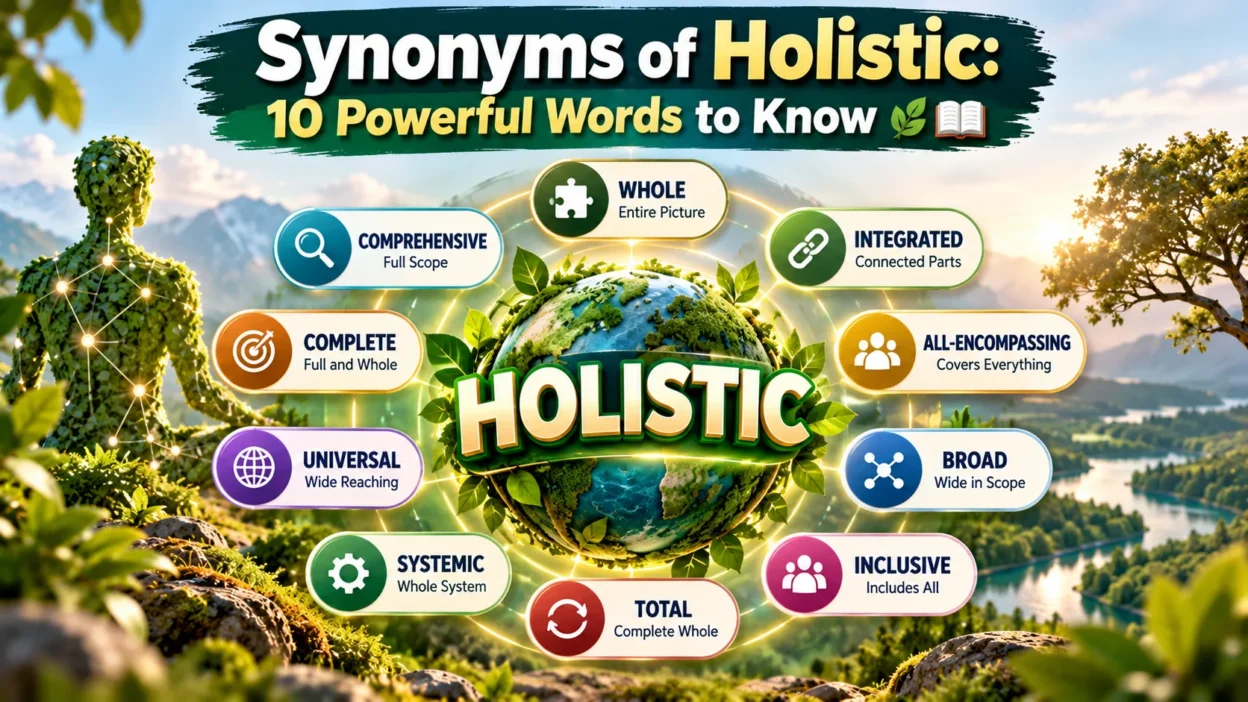
The most useful synonyms of holistic are comprehensive, all-encompassing, integrated, complete, whole, unified, inclusive, broad-based, systemic, and total.
Among these, comprehensive is usually the closest general-purpose alternative. Integrated works especially well when separate parts are connected, while all-encompassing emphasizes very broad coverage.
📚 Word at a Glance
| Feature | Details |
|---|---|
| Word | Holistic |
| Part of speech | Adjective |
| Pronunciation | /hoʊˈlɪstɪk/ |
| Syllables | Ho-lis-tic |
| Basic meaning | Considering something as a whole |
| Related noun | Holism |
| Common contexts | Health, education, business, wellness, psychology |
| Closest general synonym | Comprehensive |
🗣️ Pronunciation of Holistic
IPA: /hoʊˈlɪstɪk/
Phonetic spelling: hoh-LIS-tik
Syllables: ho-lis-tic
The main stress falls on the second syllable. The word is commonly used in formal and professional English.
🧩 What Does Holistic Mean?
Holistic means considering something as a complete whole, particularly by recognizing how its different parts interact or relate to one another.
For example, a holistic healthcare approach may consider physical health, emotional well-being, nutrition, sleep, lifestyle, and other relevant factors instead of focusing on a single symptom.
The same idea applies outside healthcare. A holistic education program may consider academic, emotional, social, and creative development together.
Example:
The company developed a holistic strategy that addressed employee well-being, workplace culture, productivity, and professional development.
Usage tip: Use holistic when the relationship between different parts matters. If you only mean “covering many subjects,” comprehensive may be a more precise choice.
📊 Top Synonyms of Holistic
| Synonym | Meaning | Best Context |
|---|---|---|
| Comprehensive | Covering all important aspects | Reports, plans, research |
| All-encompassing | Including everything relevant | Broad descriptions |
| Integrated | Combining connected parts | Healthcare, education, systems |
| Complete | Having all necessary parts | General writing |
| Whole | Referring to the entire thing | General and simple writing |
| Unified | Forming one connected whole | Organizations and ideas |
| Inclusive | Including different people or aspects | Education and society |
| Broad-based | Covering a wide range | Strategies and knowledge |
| Systemic | Relating to an entire system | Social issues, organizations |
| Total | Complete or entire | General descriptions |
🏆 Comprehensive
Comprehensive is one of the closest and most versatile synonyms for holistic. It means covering all or nearly all important aspects of something rather than dealing with only one limited area.
Example:
The doctor conducted a comprehensive evaluation of the patient’s overall health.
Formality: Formal and neutral
Tone: Thorough and professional
Best context: Reports, evaluations, plans, research, healthcare, and education
Unlike holistic, comprehensive primarily emphasizes coverage and completeness, not necessarily the interaction between different parts.
🔗 Integrated
Integrated means that separate parts have been combined so they work together as a connected whole. It is particularly useful when the relationship between components is central to the meaning.
Example:
The school introduced an integrated approach that connects academic learning with practical skills.
Formality: Formal
Tone: Professional and systematic
Best context: Education, healthcare, technology, business, and organizational planning
Choose integrated instead of holistic when you specifically want to emphasize connection, coordination, or combination.
🌎 All-Encompassing
All-encompassing describes something that includes a very wide range of elements or aspects. It is stronger than many ordinary alternatives because it suggests that almost nothing relevant has been left out.
Example:
The organization created an all-encompassing plan for community development.
Formality: Neutral to formal
Tone: Broad and emphatic
Best context: Strategies, plans, descriptions, policies, and large-scale approaches
It is a good alternative when the key idea is breadth, rather than the interconnectedness associated with holistic.
🧱 Complete and Whole
Complete and whole are simpler alternatives to holistic. Complete means that something contains everything necessary, while whole refers to the entire entity rather than an individual component.
Examples:
- We need a complete assessment before making a decision.
- The treatment considers the whole person rather than one symptom.
Formality: Neutral
Tone: Clear and straightforward
Best context: Everyday writing and simple explanations
Whole can be especially natural in phrases such as whole-person care, whole-system approach, and whole-person development.
🧠 Unified
Unified describes separate elements that have been brought together to form a single, coherent whole. It works well when cooperation, consistency, or common purpose matters.
Example:
The team adopted a unified strategy for improving customer service.
Formality: Neutral to formal
Tone: Organized and cohesive
Best context: Business, organizations, teams, strategies, and ideas
Unlike holistic, unified often focuses more on bringing things together than on understanding the complete system.
🌱 Inclusive
Inclusive means including a broad range of people, ideas, perspectives, or elements rather than excluding some of them.
Example:
The university developed a more inclusive approach to student development.
Formality: Neutral to formal
Tone: Open and considerate
Best context: Education, workplaces, communities, social policy, and accessibility
Inclusive is not a perfect synonym for holistic. It is better when the intended meaning involves representation or participation.
🏢 Systemic
Systemic relates to an entire system rather than a single isolated part. It is especially useful when discussing problems that arise from relationships, structures, or processes within a larger system.
Example:
The organization needs a systemic solution rather than a temporary fix.
Formality: Formal
Tone: Analytical
Best context: Business, sociology, politics, healthcare, organizations, and research
Systemic and holistic can overlap, but they are not identical. Systemic focuses strongly on systems and their structures, while holistic has a broader meaning.
⚖️ How to Choose the Right Synonym
Choosing among synonyms of holistic becomes easier when you identify the exact idea you want to express.
Use comprehensive when you mean that something covers all major areas. Use integrated when different components are connected and work together. Choose all-encompassing when you want to stress an extremely broad scope.
Use complete when something contains everything necessary, and whole when you want simple language that contrasts the entire entity with individual parts. Choose unified when separate elements have been brought together, and systemic when the entire structure or system is relevant.
For example:
The company needs a comprehensive review of its operations.
Here, the emphasis is on covering the important areas.
The company needs an integrated approach to operations.
Here, the emphasis is on making different functions work together.
The company needs a systemic solution to its organizational problems.
Here, the emphasis is on problems within the larger organizational system.
✍️ Common Collocations With Holistic
Some common phrases make the meaning of holistic easier to understand:
- holistic approach
- holistic health
- holistic care
- holistic treatment
- holistic education
- holistic development
- holistic perspective
- holistic view
- holistic strategy
- holistic wellness
- holistic assessment
- holistic understanding
- holistic solution
- holistic framework
- holistic practice
These expressions are particularly common in professional, educational, healthcare, and wellness writing.
🚫 Common Mistakes With Holistic Synonyms
One common mistake is assuming that every synonym can replace holistic in every sentence. They cannot.
For example, comprehensive does not always communicate the idea that different parts influence one another. Similarly, inclusive usually refers to including people, perspectives, or groups and therefore may not work when describing a complete system.
Another mistake is using holistic simply to mean “large” or “extensive.” The word has a more specific sense: it focuses on the whole and the relationship among its parts.
For precise writing, first identify whether you mean complete coverage, interconnected parts, inclusion, unity, or an entire system.
💬 Real-Life Examples
Here are several natural examples showing how these alternatives work:
- The therapist takes a holistic approach to patient care.
- The report provides a comprehensive analysis of the issue.
- The hospital uses an integrated model of healthcare.
- The policy offers an all-encompassing framework for reform.
- The course provides a broad-based education.
- The organization needs a unified strategy.
- The program takes a whole-person approach to development.
- Researchers examined the systemic causes of the problem.
Each sentence communicates a slightly different idea, which is why context matters when selecting a synonym.
❓ FAQs About Synonyms of Holistic
What are the best synonyms of holistic?
The strongest general alternatives are comprehensive, integrated, all-encompassing, complete, whole, unified, inclusive, broad-based, and systemic.
Which synonym is most formal?
Comprehensive, integrated, all-encompassing, and systemic generally have a formal or professional tone.
What is a simple synonym for holistic?
Whole is one of the simplest alternatives, while complete can also work when the intended meaning is completeness.
What is the difference between holistic and comprehensive?
Holistic focuses on the whole and how its parts relate, while comprehensive focuses primarily on covering all important aspects.
What is the difference between holistic and integrated?
Holistic emphasizes understanding the whole. Integrated emphasizes combining separate parts so they function together.
Is whole-person a synonym for holistic?
In healthcare and wellness contexts, whole-person can closely express the same idea, particularly when physical, emotional, mental, and social factors are considered together.
Is systemic the same as holistic?
No. The meanings overlap, but systemic specifically concerns an entire system and its structures, relationships, or processes.
What is the opposite of a holistic approach?
A fragmented, narrow, isolated, partial, or reductionist approach may contrast with a holistic approach, depending on the context.
📝 Conclusion
The best synonyms of holistic include comprehensive, integrated, all-encompassing, complete, whole, unified, inclusive, broad-based, and systemic. While these words overlap with holistic, they are not perfect substitutes in every situation.
Use comprehensive when you mean broad coverage, integrated when separate parts work together, all-encompassing for an especially broad scope, and systemic when the entire system matters. For simpler language, whole or complete may be more natural.
Choosing the right synonym depends on the exact meaning you want to communicate. When the central idea is understanding a person, problem, or system by considering the whole and the relationships among its parts, holistic remains the most precise choice.

Andrew Foster is a researcher and content writer at Differopedia, specializing in clear, accurate, and easy-to-understand comparison guides, definitions, and informational articles. His work focuses on helping readers make informed decisions through well-researched, reliable content.