Finding the right synonyms for rude can make your writing more precise and natural. The word rude is broad: it can describe poor manners, disrespectful speech, an abrupt tone, or behavior that ignores social courtesy. Depending on the situation, words such as impolite, discourteous, disrespectful, tactless, and insolent can express slightly different ideas. Choosing the right alternative helps you describe someone’s behavior accurately without making the sentence sound unnecessarily harsh.
⚡What Are Some Synonyms for Rude?
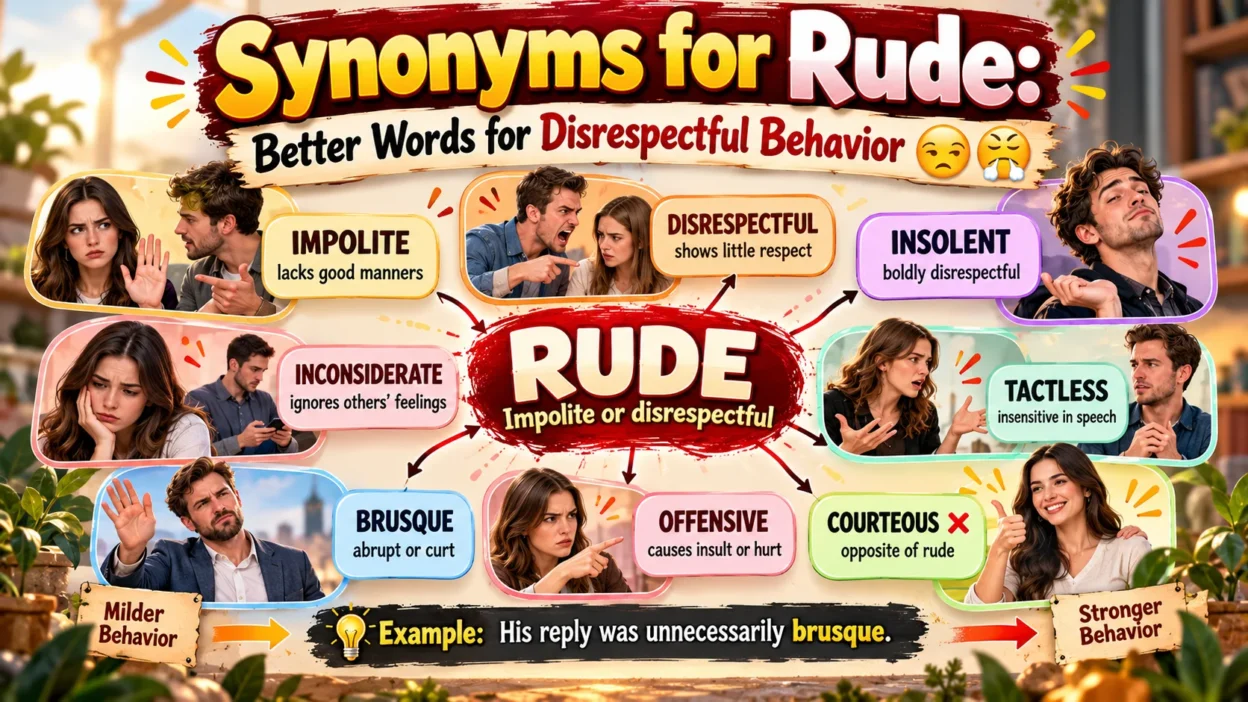
The most common synonyms for rude are impolite, discourteous, disrespectful, uncivil, inconsiderate, ill-mannered, tactless, brusque, insolent, impertinent, offensive, crass, boorish, and churlish.
The best choice depends on the meaning you want to convey. For example, impolite simply means lacking good manners, while disrespectful emphasizes a lack of respect. Brusque describes an abrupt manner, and tactless suggests that someone speaks or acts without considering other people’s feelings.
📖 Rude Meaning and Definition
Rude is an adjective meaning not polite, courteous, or respectful. It can describe a person’s words, actions, attitude, or behavior.
For example:
- The customer was rude to the cashier.
- His rude comment made everyone uncomfortable.
The word can also describe something socially unacceptable or lacking refinement, as in a rude interruption or a rude gesture. In some contexts, particularly informal ones, rude can also refer to something offensive or indecent.
Because the word has several shades of meaning, a more specific synonym is often preferable when you want to explain exactly what was wrong.
📊 Top Synonyms for Rude: A Quick Comparison
| Synonym | Main Meaning | Tone | Example |
|---|---|---|---|
| Impolite | Lacking good manners | Neutral | His reply was impolite. |
| Discourteous | Lacking courtesy | Formal | The service was discourteous. |
| Disrespectful | Showing insufficient respect | Strong | His remarks were disrespectful. |
| Inconsiderate | Not thinking about others | Mild | It was inconsiderate to interrupt. |
| Uncivil | Not polite or courteous | Formal | Their exchange became uncivil. |
| Ill-mannered | Having poor manners | Direct | The child seemed ill-mannered. |
| Tactless | Lacking sensitivity | Neutral | Her question was tactless. |
| Brusque | Abrupt and curt | Neutral | His brusque answer surprised me. |
| Insolent | Boldly disrespectful | Strong | The employee gave an insolent reply. |
| Impertinent | Inappropriately bold | Formal | That was an impertinent question. |
| Offensive | Causing hurt or insult | Strong | His remark was offensive. |
| Crass | Insensitive or vulgar | Strong | The joke was crass. |
| Boorish | Rough and badly mannered | Strong | His boorish behavior embarrassed us. |
| Churlish | Rude and unfriendly | Formal | He gave a churlish response. |
🧩 Synonyms for Rude by Context
Different situations call for different alternatives. A synonym that works well in casual conversation may sound unnatural in a formal email, while a strong word may exaggerate a relatively minor incident.
😊 Mild and Everyday Alternatives
If someone simply fails to use good manners, impolite, ill-mannered, or discourteous usually works well.
- It was impolite to leave without saying goodbye.
- The waiter was courteous despite the customer’s ill-mannered behavior.
- His response sounded discourteous.
Impolite is probably the safest general alternative to rude.
😠 Stronger Words for Disrespectful Behavior
When someone’s behavior goes beyond poor manners, disrespectful, insolent, or offensive may be more accurate.
- His disrespectful comments upset his colleague.
- The student gave an insolent answer to the teacher.
- That joke was offensive to several people.
These words should be used carefully because they communicate stronger criticism than impolite.
🗣️ Alternatives for Rude Speech
When the problem is someone’s way of speaking, blunt, brusque, tactless, or curt may be more precise.
- Her answer was blunt but honest.
- The receptionist sounded brusque on the phone.
- His question was tactless.
- She gave me a curt reply.
These words do not always mean deliberately rude. Someone can be blunt or brusque without intending to insult anyone.
🎩 Formal Synonyms for Rude
For professional or academic writing, consider discourteous, uncivil, disrespectful, or inconsiderate.
For example:
- The letter contained several discourteous remarks.
- The discussion became increasingly uncivil.
- His conduct was considered disrespectful.
- Ignoring the customer’s request was inconsiderate.
These alternatives can sound more measured than simply calling someone rude.
✍️ Rude Synonyms for Writing and Essays
If you are writing an essay, report, review, or formal description, avoid replacing rude with a stronger word unless the context supports it.
Useful choices include:
- Impolite for poor manners
- Discourteous for a formal description of poor courtesy
- Disrespectful for behavior showing insufficient respect
- Inconsiderate for behavior that ignores others’ needs
- Tactless for insensitive comments
- Brusque for an abrupt manner
- Uncivil for unpleasant or discourteous interaction
- Offensive for words or actions that cause insult
For example, instead of writing “The manager was rude,” you could write “The manager’s response was brusque and dismissive.” This gives the reader more information about what actually happened.
🔍 How to Choose the Right Synonym
The easiest way to choose among words similar to rude is to identify the specific behavior.
😊 Use impolite when the person simply fails to follow normal standards of courtesy.
🙅 Use disrespectful when the behavior communicates a lack of respect toward someone.
💭 Use inconsiderate when the person fails to consider another person’s needs or feelings.
🗣️ Use tactless when someone says something insensitive without handling the situation carefully.
⚡ Use brusque when someone is unusually abrupt or curt.
😒 Use insolent when someone openly shows disrespect, especially toward a person in authority.
🚫 Use offensive when the words or actions are likely to insult, hurt, or anger someone.
This distinction makes your vocabulary more exact and prevents unnecessary exaggeration.
📝 Common Collocations With Rude
Some combinations with rude occur naturally in everyday English:
- rude behavior
- rude comment
- rude remark
- rude question
- rude gesture
- rude response
- rude attitude
- rude interruption
- rude customer
- rude person
- rude manner
- rude language
Similar collocations can be created with its synonyms. For example, disrespectful behavior, tactless remark, brusque response, discourteous treatment, and offensive comment are all natural combinations.
⚠️ Common Mistakes When Using Rude Synonyms
One common mistake is treating every synonym as an exact replacement. Most synonyms have slightly different meanings.
For example, blunt does not always mean rude. A person can be blunt because they communicate directly without intending to offend.
Likewise, curt usually describes a brief, abrupt response rather than deliberate disrespect. Insolent is much stronger and often suggests open defiance or disrespect toward someone.
Another mistake is using highly formal words in casual situations. Saying “That was a discourteous thing to do” is grammatically correct, but “That was impolite” or “That was rude” may sound more natural in ordinary conversation.
🔄 Opposite Words for Rude
The main antonyms of rude are words associated with courtesy, respect, and good manners.
Common opposites include:
- Polite
- Courteous
- Respectful
- Considerate
- Civil
- Well-mannered
- Thoughtful
- Gracious
- Tactful
- Respectable
For example, “She was rude to the staff” can become “She was courteous to the staff” when expressing the opposite idea.
💬 Real-Life Examples of Rude Synonyms
Here are examples showing how different alternatives change the meaning:
Impolite:
It was impolite to check your phone while she was speaking.
Disrespectful:
His disrespectful comments offended his teacher.
Inconsiderate:
Leaving the meeting room without cleaning up was inconsiderate.
Tactless:
Asking about someone’s salary at dinner was tactless.
Brusque:
The doctor’s brusque response made the patient uncomfortable.
Insolent:
The employee’s insolent reply surprised his supervisor.
Offensive:
The advertisement was criticized for using offensive language.
These examples show why selecting a synonym based on context is more effective than simply replacing one word with another.
❓ FAQs About Synonyms for Rude
What are the 10 best synonyms for rude?
Ten widely useful alternatives are impolite, discourteous, disrespectful, inconsiderate, uncivil, ill-mannered, tactless, brusque, insolent, and offensive.
What is the closest synonym to rude?
Impolite is generally the closest everyday synonym because both words describe a lack of good manners or courtesy.
What is a sophisticated word for rude?
Discourteous, churlish, boorish, impertinent, and insolent can sound more formal or sophisticated, but each has a somewhat different meaning.
What is another word for rude but not mean?
Impolite, discourteous, abrupt, or tactless may work when you want to describe poor behavior without suggesting malicious intent.
What word means extremely rude?
Depending on the context, insolent, offensive, boorish, or crass can describe particularly objectionable behavior.
What is the difference between rude and impolite?
Both refer to a lack of good manners. Impolite is often more neutral, while rude is broader and can sound more direct or critical.
What is the difference between rude and disrespectful?
Rude generally concerns poor manners or discourtesy. Disrespectful specifically indicates that someone has failed to show proper respect.
Can rude be used to describe a person?
Yes. Rude can describe a person’s behavior or the person themselves, as in “He was rude to the receptionist.” In formal writing, describing the specific behavior is often more informative than labeling the person.
🎯 Conclusion
The best synonyms for rude depend on what you actually want to describe. Impolite is the closest everyday alternative, while discourteous works well in formal contexts. Choose disrespectful when respect is the central issue, inconsiderate when someone ignores other people’s feelings or needs, tactless for insensitive comments, and brusque for an abrupt manner. More forceful words such as insolent, crass, boorish, and offensive should be reserved for situations that genuinely justify their stronger meanings. Using these distinctions gives your writing greater precision and helps you communicate exactly why a person’s words or actions were considered rude.

Andrew Foster is a researcher and content writer at Differopedia, specializing in clear, accurate, and easy-to-understand comparison guides, definitions, and informational articles. His work focuses on helping readers make informed decisions through well-researched, reliable content.