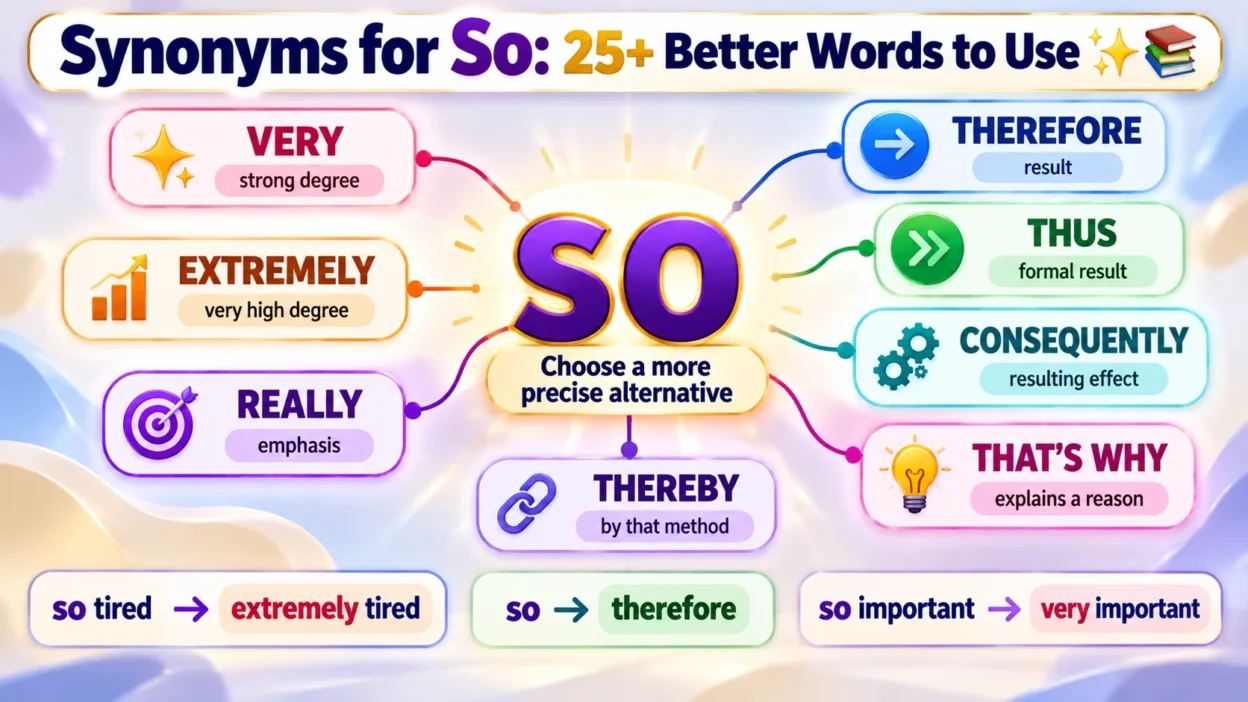
The word so is one of the most flexible words in English. It can show a result, strengthen an adjective, describe a manner, or refer back to something already mentioned. Because its meaning changes with context, the best synonyms for so also change from sentence to sentence.
For example, so in “It was so cold” means “very,” while so in “It was raining, so we stayed home” means “therefore” or “as a result.” Understanding these differences helps you choose a replacement that sounds natural and precise.
⚡What Are the Best Synonyms for So?
The right synonym depends on the meaning of so:
| Meaning of so | Useful Synonyms |
|---|---|
| As a result | therefore, thus, hence, consequently, accordingly |
| To a great degree | very, extremely, highly, remarkably, particularly |
| In this way | thus, this way, in this manner |
| Therefore / for that reason | therefore, consequently, for that reason |
| In agreement | indeed, certainly, exactly |
| To such an extent | that much, to that extent, this much |
The most common formal alternatives are therefore, thus, hence, consequently, and accordingly. When so means “very,” however, very or extremely is usually more appropriate.
📖 So: Meaning and Definition
So is a highly versatile English word that can function as an adverb, conjunction, or pro-form depending on the sentence.
As an adverb, it can mean to such a degree:
The movie was so interesting that I watched it twice.
Here, so means “very” or “to a great degree.”
As a conjunction, so can introduce a result:
The store was closed, so we went somewhere else.
In this sentence, so means “therefore” or “as a result.”
It can also refer to something previously stated:
“Is the meeting canceled?”
“I think so.”
Here, so means approximately “that is true” or “that is the case.”
🔤 Pronunciation of So
- Word: so
- IPA: /soʊ/
- Phonetic: soh
- Syllables: 1
- Part of speech: adverb, conjunction, or pro-form
The pronunciation is the same regardless of which meaning is intended.
📊 Top Synonyms for So at a Glance
| Synonym | Meaning | Formality | Best Context |
|---|---|---|---|
| Therefore | for that reason | Formal | Essays, reports |
| Thus | as a result / in this way | Formal | Academic writing |
| Hence | for this reason | Formal | Formal and academic writing |
| Consequently | as a result | Formal | Reports, explanations |
| Accordingly | as a result; suitably | Formal | Professional writing |
| Very | to a high degree | Neutral | Everyday English |
| Extremely | to a very high degree | Neutral/Formal | Strong emphasis |
| Highly | to a great degree | Neutral/Formal | Qualities and evaluations |
| Particularly | especially | Neutral | Specific emphasis |
| Remarkably | unusually or notably | Neutral/Formal | Strong description |
🧭 Synonyms for So Meaning “Therefore”
When so connects a cause with its result, several alternatives can make writing more precise.
Therefore
Therefore means “for that reason” or “as a result.” It is especially common in formal and academic writing.
The evidence was incomplete; therefore, the researchers repeated the experiment.
Usage tip: Use therefore when the second statement follows logically from the first.
Thus
Thus can mean “therefore” or “in this way.” It is concise and common in formal writing.
The roads were blocked, thus delaying the delivery.
It can also describe a method:
Hold the handle thus.
Hence
Hence means “for this reason” or “as a consequence.” It is more formal than everyday so.
The equipment was damaged; hence, the delay.
Best context: Academic, technical, literary, and formal writing.
Consequently
Consequently emphasizes a result that follows from a previous event or condition.
The company reduced production. Consequently, fewer products were available.
Accordingly
Accordingly can mean “as a result” or “in a manner appropriate to the situation.”
The weather forecast changed, so we adjusted the schedule accordingly.
It is particularly useful in professional and formal contexts.
✨ Synonyms for So Meaning “Very”
Sometimes so is used before an adjective or adverb to express a high degree.
The test was so difficult.
Here are useful alternatives:
Very
Very is the simplest replacement when so means “to a high degree.”
The test was very difficult.
Unlike so, very does not normally introduce a result clause in the same construction.
Extremely
Extremely gives stronger emphasis than very.
The weather was extremely cold.
It works well when you want to emphasize an unusually high degree.
Highly
Highly means “to a great degree,” particularly with certain adjectives and participles.
She is highly respected in her field.
Some combinations sound much more natural with highly than with very.
Particularly
Particularly means “especially” or “to a notable degree.”
The final chapter was particularly interesting.
It is useful when highlighting one feature among several.
Remarkably
Remarkably suggests that something is unusually noticeable or impressive.
The old building is remarkably well preserved.
🎯 How to Choose the Right Synonym for So
The easiest way to choose a replacement is to identify what so is doing in the sentence.
If it introduces a result, consider:
- therefore
- thus
- hence
- consequently
- accordingly
If it means very, consider:
- very
- extremely
- highly
- particularly
- remarkably
If it means in this way, consider:
- thus
- in this manner
- in this way
If it refers to something previously mentioned, a direct synonym may not work. In:
I believe so.
you might instead write:
I believe that is true.
This changes the structure rather than simply swapping one word for another.
✍️ Synonyms for So in Formal and Academic Writing
In academic writing, repeatedly using so can sometimes make a sentence sound conversational. More precise alternatives can clarify the relationship between ideas.
Everyday:
The sample was contaminated, so the experiment was repeated.
Formal:
The sample was contaminated; therefore, the experiment was repeated.
Another option is:
The sample was contaminated; consequently, the experiment was repeated.
However, formal alternatives should not be used simply to make writing sound sophisticated. So is perfectly acceptable in many professional contexts, especially when the relationship between ideas is clear.
📝 Common Collocations With So
Some expressions containing so are fixed or highly conventional, so replacing so can make them unnatural.
Common examples include:
- so far
- so much
- so many
- so that
- so long as
- even so
- if so
- and so on
- so to speak
- I think so
- so do I
- so does she
For example, so far means “until now”:
So far, everything has gone according to plan.
You would not normally replace it with therefore or very. This illustrates why context matters when finding synonyms.
⚠️ Common Mistakes With Synonyms for So
One frequent mistake is treating every synonym as interchangeable.
❌ The weather was therefore cold.
✅ The weather was very cold.
Therefore expresses a result, while very expresses degree.
Another mistake is using formal connectors where they do not fit naturally:
❌ She was extremely tired, hence she went to bed.
A more natural version is:
She was extremely tired, so she went to bed.
Or, in formal writing:
She was extremely tired; therefore, she went to bed.
Punctuation also matters with conjunctive adverbs such as therefore and consequently. When they connect two independent clauses, a semicolon and comma are often appropriate:
The road was flooded; therefore, we took another route.
💬 Real-Life Examples of So and Its Alternatives
Here are examples showing how meaning changes according to context:
- So: It was so cold that we stayed inside.
- Very: It was very cold outside.
- Therefore: The roads were icy; therefore, school was closed.
- Thus: The first test failed, thus requiring further investigation.
- Consequently: The shipment arrived late; consequently, the store opened later than planned.
- Hence: The information was incomplete; hence, we requested another report.
- Highly: The new employee is highly capable.
- Particularly: I found the final section particularly useful.
- In this way: Arrange the pieces in this way to create the correct shape.
These examples show why choosing a synonym based only on the word itself can lead to awkward or incorrect sentences.
🔄 Related Words and Opposite Ideas
There is no single opposite of so because the word has several meanings.
When so means very, possible contrasting expressions include:
- slightly
- somewhat
- barely
- hardly
- minimally
When so means therefore, its opposite idea may be expressed through words such as:
- nevertheless
- however
- despite that
- conversely
These are not direct antonyms in every sentence. They express contrasting relationships rather than simply being opposites of so.
❓ FAQs About Synonyms for So
What are the most common synonyms for so?
The most useful alternatives include therefore, thus, hence, consequently, accordingly, very, extremely, and highly. The correct choice depends on the meaning of so.
What is the best synonym for so in academic writing?
When so means “as a result,” therefore and consequently are common choices. Thus is also widely used in academic and technical writing.
What is the best synonym for so in everyday English?
In everyday conversation, so itself is often the most natural choice. When it means “very,” very is usually the simplest alternative.
Can “therefore” replace “so” everywhere?
No. Therefore mainly expresses a result or conclusion. It cannot replace so when so means “very,” “in this way,” or refers to a previous statement.
Is “hence” more formal than “so”?
Generally, yes. Hence is more common in formal, academic, technical, or literary contexts than in casual conversation.
What can I use instead of “so” in a professional email?
For a result, therefore, consequently, or accordingly can work. However, there is no need to avoid so simply because an email is professional.
What can replace “so” before an adjective?
If so means “to a high degree,” alternatives include very, extremely, highly, particularly, and remarkably, depending on the adjective.
Why does “so” have so many synonyms?
Because so performs several different grammatical and semantic functions. A synonym must match the particular meaning being expressed rather than the word alone.
✅ Conclusion
The best synonyms for so depend entirely on context. When so means “as a result,” use words such as therefore, thus, hence, consequently, or accordingly. When it means “very,” alternatives such as very, extremely, highly, particularly, and remarkably are more appropriate.
The key is not to replace so automatically. First identify its meaning, then choose the word that preserves both the original sense and the natural tone of the sentence. In many everyday situations, so remains the clearest and most natural choice.

Andrew Foster is a researcher and content writer at Differopedia, specializing in clear, accurate, and easy-to-understand comparison guides, definitions, and informational articles. His work focuses on helping readers make informed decisions through well-researched, reliable content.