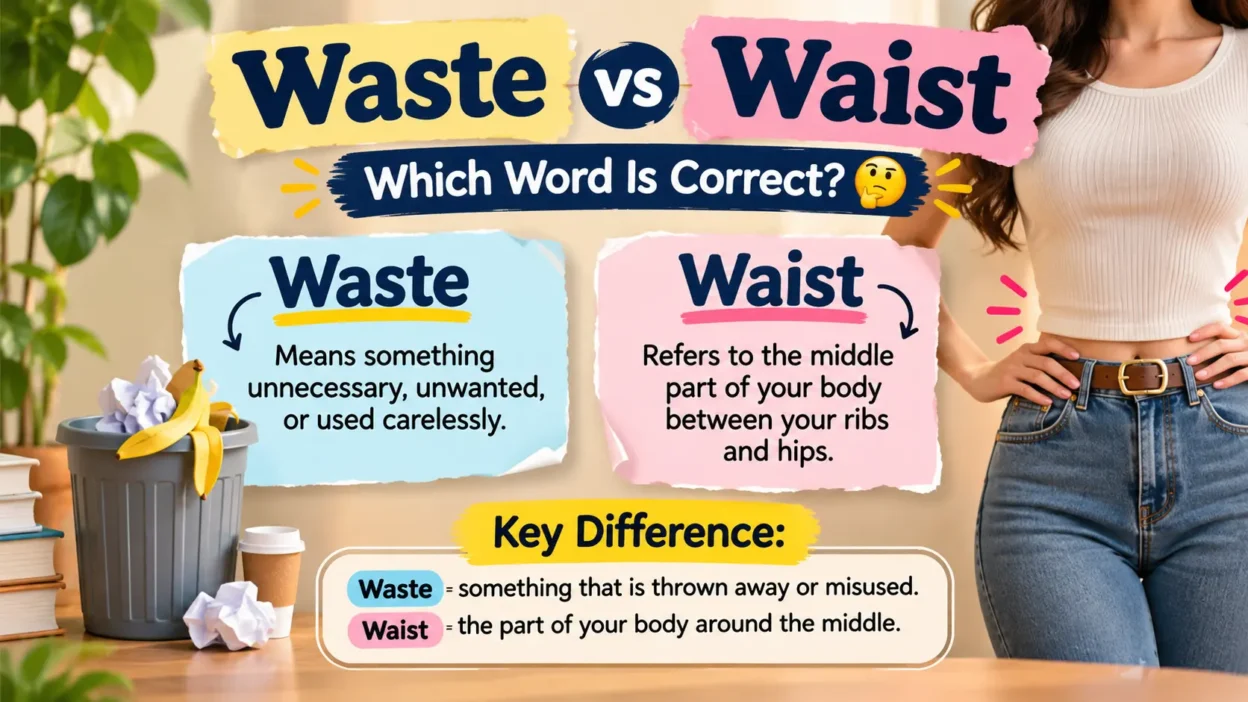
Have you ever confused waste vs waist when writing an English sentence? These words sound exactly alike but have completely different meanings and spellings. Waste refers to unwanted things or the careless use of time, money, and resources, while waist describes the middle part of your body between your ribs and hips. For example, you should write, “Don’t waste your money,” but “These jeans fit perfectly around my waist.” Both words are homophones, which means they share the same pronunciation but have different meanings. Understanding their difference will help you improve your English spelling, grammar, and everyday communication. In this guide, we will explore their definitions, pronunciation, examples, synonyms, antonyms, and common mistakes so you can use both words confidently.
🔍 Waste vs Waist
Waste means unwanted material or the careless use of something valuable, such as time, money, food, or energy. Waist means the middle part of your body between your ribs and hips.
| Term | Meaning | Usage | Category |
|---|---|---|---|
| Waste | Unwanted material or careless use | Don’t waste your money. | Noun, verb, adjective |
| Waist | Middle part of the body | She measured her waist. | Noun |
Both words sound identical, but their meanings differ. They are homophones, which means they share the same pronunciation but have different spellings and meanings. Homophones+1
🗑️ What Does Waste Mean?
Waste refers to unwanted materials, unnecessary things, or the careless use of valuable resources. You can use it when discussing garbage, food, money, time, electricity, or effort.
- Pronunciation: /weɪst/
- Part of speech: Noun, verb, and adjective
- Meaning: Unwanted material, unnecessary use, or careless spending.
Different Uses of Waste
- As a noun: Waste describes something unwanted or an unnecessary use of resources. Example: Plastic waste harms the environment.
- As a verb: Waste means using something carelessly. Example: Don’t waste your time.
- As an adjective: Waste describes discarded materials or unused land. Example: The factory produces waste materials.
Examples of Waste
- You should never waste drinking water.
- I don’t want to waste my money on unnecessary purchases.
- The restaurant throws away too much food waste.
- We must reduce plastic waste to protect nature.
👖 What Does Waist Mean?
Waist refers to the middle section of your body between your ribs and hips. People also use this word when discussing clothing, fashion, body measurements, and garment sizes.
- Pronunciation: /weɪst/
- Part of speech: Noun
- Meaning: The middle part of the body or the corresponding section of clothing.
Different Uses of Waist
- Body meaning: The area between your ribs and hips. Example: She has a slim waist.
- Clothing meaning: The section of trousers, skirts, or dresses that fits around your waist. Example: These jeans have a comfortable waist.
- Measurement meaning: The circumference around your middle body area. Example: My waist measures 30 inches.
Examples of Waist
- She tied a belt around her waist.
- My waist measurement is 32 inches.
- These trousers feel tight around the waist.
- He placed his hands on his waist.
⚖️ Waste vs Waist: Main Differences
The biggest difference between waste and waist involves their meanings, grammatical functions, and everyday applications. Waste relates to unwanted materials or unnecessary consumption, while waist describes a body part or clothing section.
| Feature | Waste | Waist |
|---|---|---|
| Pronunciation | /weɪst/ | /weɪst/ |
| Meaning | Unwanted material or misuse | Middle body section |
| Part of speech | Noun, verb, adjective | Noun |
| Context | Garbage, time, money | Body, fashion, clothing |
| Plural | Wastes | Waists |
| Related word | Wasted | Waistline |
| Example | Don’t waste food. | Measure your waist. |
Remember that you cannot replace one word with the other without changing the meaning of your sentence.
📝 Waste vs Waist: 10 Example Sentences
Examples can help you understand how both words work in everyday English. Notice how the surrounding words explain which spelling you need.
| Example Sentence | Meaning |
|---|---|
| Don’t waste your time. | Avoid unnecessary activities. |
| She measured her waist. | She checked her body measurement. |
| Food waste creates environmental problems. | Unwanted food harms the environment. |
| He wore a belt around his waist. | He wore a belt around his middle. |
| We should not waste electricity. | We should conserve energy. |
| Her waist looks beautiful in that dress. | The dress highlights her middle section. |
| Throw the waste into the trash can. | Dispose of unwanted material. |
| These pants fit my waist perfectly. | The pants fit around my middle. |
| You waste too much money on shopping. | You spend money unnecessarily. |
| The tailor adjusted the waist of my trousers. | The tailor changed the garment’s fit. |
🔄 Synonyms of Waste and Waist
Synonyms help you understand related meanings and expand your vocabulary. However, remember that waste and waist have different synonym groups.
Synonyms of waste
| Synonym | Meaning |
|---|---|
| Garbage | Unwanted material |
| Rubbish | Something discarded |
| Trash | Unwanted items |
| Debris | Scattered remains |
| Refuse | Discarded material |
| Squander | Spend carelessly |
| Misuse | Use incorrectly |
| Dissipate | Gradually use up |
| Consume | Use resources |
| Extravagance | Excessive spending |
Synonyms of waist
| Synonym | Meaning |
|---|---|
| Midsection | Middle body area |
| Middle | Central part |
| Torso | Main part of the body |
| Abdomen | Belly region |
| Waistline | Line around the waist |
| Girth | Measurement around something |
These words do not always work as direct replacements. Choose a synonym that fits your sentence.
↔️ Antonyms of Waste and Waist
Waste has several opposites depending on its meaning. Waist does not have a direct antonym because it names a specific body part.
| Word | Antonym | Meaning |
|---|---|---|
| Waste (verb) | Save | Keep resources |
| Waste (verb) | Conserve | Protect resources |
| Waste (verb) | Preserve | Maintain something |
| Waste (verb) | Utilize | Put to practical use |
| Waste (noun) | Value | Importance or usefulness |
| Wasteful | Economical | Avoiding unnecessary expenses |
| Wasteful | Efficient | Producing useful results |
| Wasteful | Thrifty | Careful with money |
| Wasteful | Productive | Achieving useful outcomes |
| Wasteful | Resourceful | Using available resources wisely |
📚 Related Terms of Waste and Waist
Learning related vocabulary can help you recognize these words in different contexts.
| Related Word | Meaning |
|---|---|
| Wastebasket | A container for unwanted paper or rubbish |
| Wastewater | Water containing unwanted substances |
| Wastepaper | Paper that people discard |
| Waste disposal | The process of removing unwanted materials |
| Food waste | Food that people throw away |
| Waistband | A band around the waist of clothing |
| Waistline | The line or measurement around the waist |
| Waistcoat | A sleeveless garment worn over a shirt |
| High-waisted | Clothing that sits high around the waist |
| Low-waisted | Clothing that sits low around the waist |
| Wasteful | Using resources carelessly |
| Wasted | Used without a useful result |
| Wasting | Using something unnecessarily |
| Waist size | Measurement around the waist |
| Waste management | The collection and disposal of unwanted materials |
💬 How to Use Waste and Waist in Daily Life
Both words appear in everyday communication, but their contexts help you choose the correct spelling.
- Daily conversation: You might say, “Don’t waste your time,” when someone spends time unnecessarily. You can also say, “My waist hurts,” when discussing discomfort around your middle.
- Social media: People use waste in posts about food waste, money, and environmental protection. They use waist when discussing fashion, fitness, and clothing.
- Business communication: Companies discuss waste management, production waste, and resource conservation.
- Academic writing: Students use waste when writing about environmental pollution, resource consumption, and sustainability. They use waist in discussions involving anatomy, measurements, and clothing.
- Online messaging: You might text, “Stop wasting money!” or “What’s your waist size?”
❌ Common Mistakes: Waste vs Waist
Because spell-check tools recognize both words, they might not catch an incorrect choice. Always check the meaning before submitting your writing.
| Mistake | Correct Usage |
|---|---|
| Don’t waist your time. | Don’t waste your time. |
| My waste measures 30 inches. | My waist measures 30 inches. |
| Stop waisting money. | Stop wasting money. |
| She wore a belt around her waste. | She wore a belt around her waist. |
| Reduce plastic waist. | Reduce plastic waste. |
| He measured his waste size. | He measured his waist size. |
| Don’t waist food. | Don’t waste food. |
| The dress fits my waste. | The dress fits my waist. |
| We produce too much plastic waist. | We produce too much plastic waste. |
| Her wasteline looks beautiful. | Her waistline looks beautiful. |
🧠 Easy Tricks to Remember Waste vs Waist
Try these simple memory tricks whenever you struggle to choose between the two words.
- Waste = Trash: Think about a wastebasket whenever you see this spelling.
- Waist = Body: Remember that your waist holds your belt around your middle.
- Waste = Resources: Use this word when discussing time, money, food, or energy.
- Waist = Clothing: Think about jeans, trousers, dresses, and body measurements.
A useful way to remember the difference is to connect waste with things you throw away and waist with the part of your body where you wear a belt.
❓ Frequently Asked Questions
1. Is it waste or waist?
Both spellings are correct, but they have different meanings. Use waste for unwanted materials or careless resource use. Use waist for the middle part of your body.
2. Are waste and waist homophones?
Yes. Waste and waist are homophones because they share the same pronunciation but have different spellings and meanings.
3. How do you pronounce waste and waist?
Both words have the same pronunciation: /weɪst/. They sound like the word “taste” without the initial T.
4. Is waist a noun or a verb?
Waist is a noun. It describes the middle part of your body or the corresponding section of clothing.
5. Can waste be a verb?
Yes. Waste works as a verb, noun, and adjective. For example, you can waste money, produce waste, or discuss waste materials.
6. What is the plural of waist?
The plural form of waist is waists. For example, the clothing store offers trousers with different waist sizes.
7. What is the difference between waist and waistline?
Waist refers to the middle part of your body. Waistline describes the line or measurement around that area, or the corresponding line of a garment.
🔎 Semantic Keywords and Related Search Terms
These related terms help cover the different search intents behind waste vs waist:
- Waste vs waist difference
- Waste meaning
- Waist meaning
- Waste definition
- Waist definition
- Waste pronunciation
- Waist pronunciation
- Homophones in English
- Commonly confused words
- Waste in a sentence
- Waist in a sentence
- Waste or waist spelling
- Waste time
- Waste money
- Food waste
- Plastic waste
- Waste management
- Waist measurement
- Waist size
- Waistline
- Body measurements
- Clothing terminology
- English grammar
- English vocabulary
🎯 Conclusion
Understanding waste vs waist becomes easy when you learn their different meanings. Use waste when discussing garbage, unnecessary spending, or wasted resources, and choose waist when referring to the middle part of your body or clothing measurements. Remember, waste relates to things you throw away, while waist relates to the area where you wear a belt. Practice using both words in everyday sentences to improve your spelling and vocabulary. With this simple distinction, you can confidently avoid confusing these homophones in your writing.

Andrew Foster is a researcher and content writer at Differopedia, specializing in clear, accurate, and easy-to-understand comparison guides, definitions, and informational articles. His work focuses on helping readers make informed decisions through well-researched, reliable content.