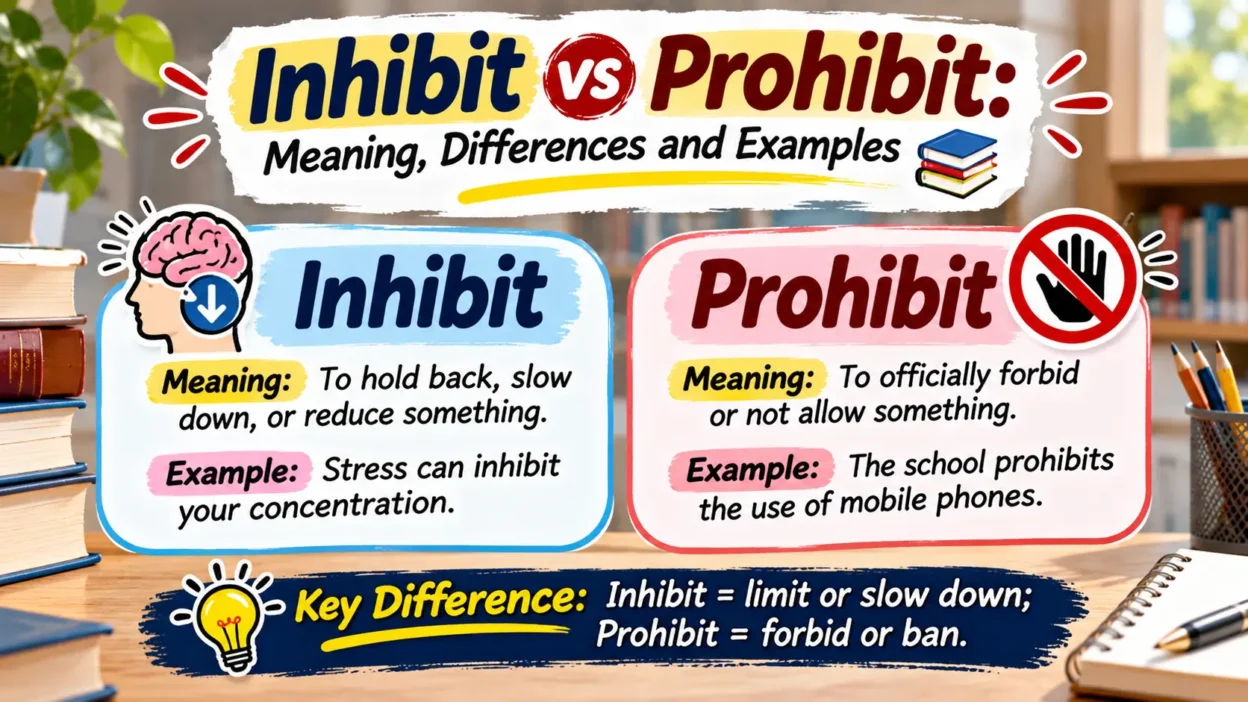
Have you ever wondered whether you should use inhibit or prohibit in a sentence? Although these words look similar and both relate to stopping or preventing something, they have different meanings and uses. Understanding inhibit vs prohibit helps you choose the correct word in everyday conversations, academic writing, and professional communication. Inhibit means to restrict, slow down, or hold back an action or process, while prohibit means to officially forbid something through a rule, law, or policy. For example, fear can inhibit someone from speaking confidently, while a school can prohibit students from using phones during an examination.
⚡Inhibit vs Prohibit
| Term | Meaning | Example |
|---|---|---|
| Inhibit | To restrict, hold back, or slow something down | Fear can inhibit confidence. |
| Prohibit | To officially forbid something | Schools prohibit cheating. |
Easy way to remember:
- Inhibit = Hold back.
- Prohibit = Forbid.
📖 What Does Inhibit Mean?
Inhibit means to restrain, restrict, discourage, or slow down an action or process. It often describes something that makes an activity more difficult without completely stopping it.
Pronunciation: in-HIB-it
IPA: /ɪnˈhɪbɪt/
Part of Speech: Verb
Examples:
- Fear can inhibit personal growth.
- Stress may inhibit concentration.
- Poor communication can inhibit teamwork.
Origin: Inhibit comes from the Latin word inhibēre, meaning to hold back or restrain.
🚫 What Does Prohibit Mean?
Prohibit means to officially forbid or disallow an action. People commonly use it when laws, regulations, organizations, or authorities establish restrictions.
Pronunciation: pro-HIB-it
IPA: /proʊˈhɪbɪt/
Part of Speech: Verb
Examples:
- The school prohibits cheating.
- Local laws prohibit parking here.
- The company prohibits unauthorized access.
Origin: Prohibit comes from the Latin word prohibēre, meaning to prevent, keep away, or forbid.
🔍 Inhibit vs Prohibit: Key Differences
Although both words relate to prevention, they describe different types of restrictions.
| Difference | Inhibit | Prohibit |
|---|---|---|
| Meaning | Hold back or restrict | Forbid or disallow |
| Purpose | Limit an action or process | Prevent an action through a restriction |
| Common cause | Fear, stress, or obstacles | Laws, rules, or policies |
| Usage | Psychology and science | Legal and official contexts |
| Example | Anxiety inhibits confidence. | Rules prohibit cheating. |
Remember: Use inhibit when something makes an action harder. Use prohibit when someone or something does not allow an action.
📝 Inhibit vs Prohibit: Example Sentences
These examples show how both words work in everyday and professional situations.
| Example Sentence | Meaning |
|---|---|
| Fear can inhibit creativity. | Fear limits creative thinking. |
| Stress may inhibit learning. | Stress makes learning difficult. |
| Poor lighting can inhibit productivity. | Poor lighting reduces work efficiency. |
| High costs inhibit business growth. | Expenses slow business development. |
| Shyness can inhibit communication. | Shyness makes communication difficult. |
| Certain chemicals inhibit bacterial growth. | Chemicals slow bacterial development. |
| The school prohibits cheating. | School rules forbid cheating. |
| The law prohibits illegal parking. | Regulations forbid parking. |
| The company prohibits sharing private information. | Company policy forbids sharing confidential details. |
| The restaurant prohibits outside food. | Restaurant rules do not allow outside food. |
| The museum prohibits touching exhibits. | Visitors cannot touch the displays. |
| The website prohibits abusive comments. | Website rules forbid offensive comments. |
🔄 Synonyms of Inhibit
Inhibit has several synonyms that describe restriction, restraint, and prevention.
| Synonym | Meaning |
|---|---|
| Restrain | Hold something back |
| Restrict | Limit an action |
| Hinder | Make progress difficult |
| Impede | Obstruct progress |
| Hamper | Create difficulties |
| Suppress | Hold something down |
| Stifle | Prevent development |
| Curb | Control or reduce |
| Limit | Set boundaries |
| Discourage | Reduce willingness |
| Constrain | Restrict freedom |
| Deter | Discourage an action |
| Obstruct | Block progress |
| Thwart | Prevent success |
| Repress | Hold back feelings |
🚫 Synonyms of Prohibit
These synonyms describe forbidding or disallowing an activity.
| Synonym | Meaning |
|---|---|
| Forbid | Order someone not to act |
| Ban | Officially disallow |
| Disallow | Refuse permission |
| Outlaw | Make something illegal |
| Proscribe | Officially forbid |
| Bar | Prevent participation |
| Interdict | Prohibit through an order |
| Veto | Reject or refuse |
| Debar | Prevent participation |
| Embargo | Restrict trade or movement |
| Block | Stop an action |
| Deny | Refuse permission |
↔️ Antonyms of Inhibit and Prohibit
| Inhibit Antonym | Prohibit Antonym |
|---|---|
| Encourage | Allow |
| Facilitate | Permit |
| Enable | Authorize |
| Promote | Approve |
| Support | Accept |
| Stimulate | Legalize |
| Assist | Endorse |
| Liberate | Welcome |
📚 Related Words and Their Meanings
| Related Word | Meaning |
|---|---|
| Inhibition | The act of holding something back |
| Inhibitor | Something that slows a process |
| Inhibited | Restrained or held back |
| Inhibitory | Having a restrictive effect |
| Uninhibited | Free from restraint |
| Prohibition | An official ban |
| Prohibited | Not allowed |
| Prohibitory | Intended to forbid |
| Restriction | A limitation |
| Permission | Approval to act |
| Prevention | The act of stopping something |
| Regulation | An official rule |
| Restraint | Control over behavior |
| Proscriptive | Expressing a prohibition |
| Inhibitive | Tending to restrict |
🌎 Real-Life Usage of Inhibit and Prohibit
Daily Conversation: People use inhibit when discussing emotions and personal challenges. For example, fear can inhibit someone from making new friends. Parents may prohibit children from staying outside late.
Social Media: Motivational writers might say, “Don’t let negativity inhibit your dreams.” Social media platforms prohibit spam, harassment, and abusive comments.
Business Communication: Financial difficulties can inhibit business growth. Company policies may prohibit employees from sharing confidential information.
Academic Writing: Researchers use inhibit when discussing biological processes, enzyme activity, and psychological behavior. Academic institutions prohibit plagiarism and examination cheating.
Online Messaging: You might write, “Don’t let embarrassment inhibit your confidence.” A group administrator might say, “Our group prohibits promotional links.”
⚠️ Common Mistakes When Using Inhibit and Prohibit
| Mistake | Correct Usage |
|---|---|
| Fear prohibits my confidence. | Fear inhibits my confidence. |
| The law inhibits smoking. | The law prohibits smoking. |
| Stress prohibits concentration. | Stress inhibits concentration. |
| The school inhibits cheating. | The school prohibits cheating. |
| Shyness prohibits communication. | Shyness inhibits communication. |
| Company rules inhibit unauthorized access. | Company rules prohibit unauthorized access. |
| Anxiety prohibits creativity. | Anxiety inhibits creativity. |
| The sign inhibits parking. | The sign prohibits parking. |
Both verbs can take a direct object. You can also use the construction “inhibit someone from doing something” or “prohibit someone from doing something.”
❓ FAQs
Is Inhibit the Same as Prohibit?
No. Inhibit means to restrict or hold something back, while prohibit means to officially forbid an action.
Does Inhibit Mean Stop Completely?
Not always. Inhibit often means to slow down, limit, or make something more difficult rather than stop it entirely.
Does Prohibit Mean Forbid?
Yes. Prohibit means to forbid or disallow an activity through a rule, law, or decision.
Is Prohibit Stronger Than Inhibit?
Generally, yes. Prohibit communicates a direct restriction, while inhibit often describes something that limits an action or process.
What Is the Opposite of Inhibit?
Common antonyms include encourage, facilitate, enable, promote, and stimulate.
What Is the Opposite of Prohibit?
Common antonyms include allow, permit, authorize, approve, and accept.
Can You Use Inhibit and Prohibit Interchangeably?
Not in every situation. Inhibit usually describes an obstacle or limiting influence, while prohibit generally describes something that a rule or authority forbids.
What Are the Past Tense Forms?
Both verbs follow regular conjugation patterns:
| Verb Form | Inhibit | Prohibit |
|---|---|---|
| Present | Inhibit | Prohibit |
| Past | Inhibited | Prohibited |
| Present participle | Inhibiting | Prohibiting |
| Past participle | Inhibited | Prohibited |
🎯 Conclusion
Understanding inhibit vs prohibit becomes easier when you remember their central meanings. Inhibit means to hold back, restrict, or slow down an action, process, or behavior. Prohibit means to officially forbid or disallow something through a rule, policy, or law. Use inhibit when you describe fear, stress, or other factors that limit progress. Choose prohibit when you discuss regulations, restrictions, and forbidden activities. Although both words relate to prevention, they do not always work interchangeably. Practice using them in different sentences, and you will develop a better understanding of their meanings. With these simple distinctions, you can use both words confidently in everyday conversations, academic assignments, and professional writing.

Andrew Foster is a researcher and content writer at Differopedia, specializing in clear, accurate, and easy-to-understand comparison guides, definitions, and informational articles. His work focuses on helping readers make informed decisions through well-researched, reliable content.