If you are confused about any way vs anyway, you are not alone. These two expressions look almost identical and sound the same when spoken, but they have different meanings and grammatical functions. Knowing when to write any way as two words and anyway as one word can make your English clearer and more accurate.
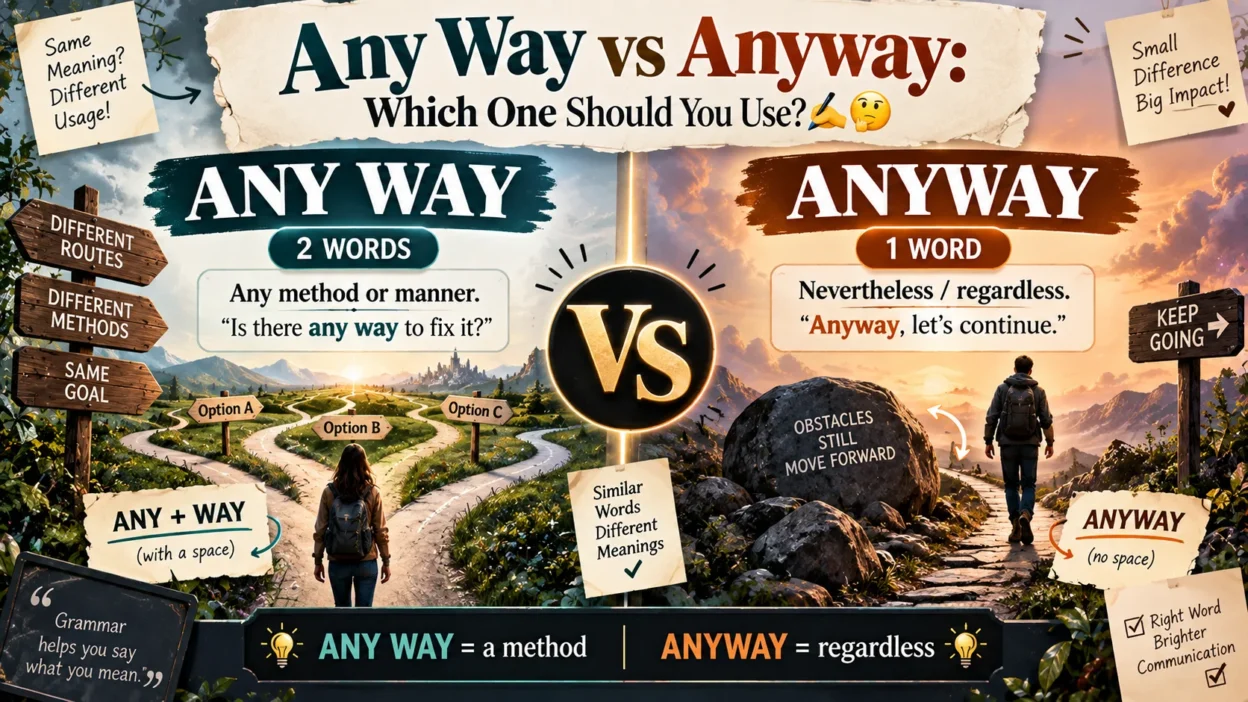
The basic rule is simple: anyway usually means “regardless,” “in any case,” or “nevertheless,” while any way refers to a method, manner, direction, or possible means of doing something. For example, “It was raining, but we went anyway” means we went regardless of the rain. However, “Is there any way to fix it?” asks whether a method of fixing something exists.
🔎 Any Way vs Anyway:
| Term | Meaning | Function | Example |
|---|---|---|---|
| Anyway | Regardless; in any case | Adverb/discourse marker | I was tired, but I went anyway. |
| Any way | By any method; in any manner | Determiner + noun | Is there any way to solve this? |
The easiest way to remember the difference is to ask yourself what you mean. If you mean “regardless” or “in any case,” use anyway. If you mean “by any method” or “in any manner,” use any way.
📖 What Does “Anyway” Mean?
Anyway is an adverb that commonly means regardless, in any case, nevertheless, or despite that. It often shows that something happens even though another fact might have prevented it.
For example:
- I was exhausted, but I finished the work anyway.
- It was expensive, but she bought it anyway.
- He didn’t agree with us, but he helped anyway.
In these sentences, anyway means something similar to “regardless” or “despite the circumstances.”
Anyway can also introduce a new topic or return to an earlier subject.
Anyway, let’s get back to the main question.
Here, it works as a conversational transition rather than describing a method.
🛠️ What Does “Any Way” Mean?
Any way is a two-word phrase made up of the determiner any and the noun way. It refers to any method, manner, route, direction, or possible means.
For example:
- Is there any way to repair this computer?
- You can arrange the furniture any way you like.
- Can I help you in any way?
- Is there any way to reach the station before noon?
In each example, any way refers to a method, manner, or means.
A useful test is to replace any way with phrases such as “in any manner,” “by any method,” or “through any means.” If the sentence still makes sense, you probably need the two-word form.
🧠 How to Remember Any Way vs Anyway
The simplest memory trick is:
Anyway = regardless
It was difficult, but I did it anyway.
Any way = any method
Is there any way to make this easier?
You can also use the method test. Ask:
Am I talking about a method, manner, route, or means?
If yes, write any way.
Am I saying regardless, nevertheless, or in any case?
If yes, write anyway.
Compare these sentences:
- I didn’t feel well, but I went anyway.
- Is there any way I can help?
The first sentence means “regardless.” The second asks about a possible method of helping.
✍️ Anyway vs Any Way: Example Sentences
Examples make the distinction much easier to understand. Notice how the meaning changes depending on whether anyway is written as one word or any way as two.
Examples With “Anyway”
- She was nervous, but she performed anyway.
- I don’t know the answer anyway.
- Anyway, what were you saying?
- The weather was terrible, but we traveled anyway.
- He didn’t want to go, but he came anyway.
- Anyway, let’s discuss the next topic.
- It may take longer, but we’ll finish it anyway.
- I wasn’t invited, but I went anyway.
Examples With “Any Way”
- Is there any way to contact her?
- Can you help me in any way?
- You can solve the problem any way you prefer.
- Is there any way to reduce the cost?
- She searched for any way to escape the situation.
- You may organize the files any way you want.
- Is there any way to improve this sentence?
- I’ll support you in any way I can.
The difference becomes clear when you focus on the meaning rather than the pronunciation.
⚠️ Common Mistakes With Any Way and Anyway
One of the most common mistakes is writing anyway when you actually mean any way.
Incorrect:
Is there anyway to fix this problem?
Correct:
Is there any way to fix this problem?
The question asks about a method, so any way must be written as two words.
Another common mistake is using any way when the intended meaning is “regardless.”
Incorrect:
She was tired, but she continued any way.
Correct:
She was tired, but she continued anyway.
Here, the person continued despite being tired, so anyway is correct.
Another example:
Any way, let’s move on.
This should be:
Anyway, let’s move on.
In this sentence, anyway is being used as a transition word.
💬 Anyway vs Any Way in Everyday and Online English
Anyway is very common in everyday conversation. Speakers use it to change subjects, return to a previous point, finish a conversation, or show that something happened despite a difficulty.
For example:
Anyway, I need to leave now.
It can also appear in informal online communication:
I wasn’t planning to post this, but here it is anyway.
Any way, on the other hand, commonly appears when people ask about possibilities or methods:
Is there any way to download the file?
The two expressions may sound identical when spoken, which explains why people frequently confuse them in writing.
🗣️ Can “Anyway” Start a Sentence?
Yes. Anyway can naturally begin a sentence, especially when it introduces a transition or returns to a previous topic.
Examples include:
- Anyway, let’s continue.
- Anyway, what happened next?
- Anyway, I have to go now.
- Anyway, let’s focus on the important part.
When anyway functions as an introductory transition, a comma often follows it.
However, punctuation depends on how the word functions in the sentence. When anyway simply means “regardless,” it does not automatically require a comma.
🤔 Is “Anyways” Correct?
Anyways is a real word and appears in dictionaries, particularly as an informal or nonstandard variant of anyway. It has a long history in English and is still used in casual speech and informal communication.
However, anyway is generally the safer choice in standard formal English.
For professional writing, academic work, websites, and other polished content, use:
Anyway, let’s continue.
rather than:
Anyways, let’s continue.
This does not mean “anyways” never occurs in legitimate English. It simply has a more informal or regional flavor.
🔄 Words Related to “Anyway”
Several words and phrases have meanings similar to anyway, although they are not interchangeable in every sentence.
- Regardless — without being affected by something
- Nevertheless — despite what was previously mentioned
- Nonetheless — despite that
- Anyhow — in any case or regardless
- In any case — whatever the circumstances
- At any rate — regardless of the situation
- Even so — despite that fact
- All the same — despite everything
For example:
It was difficult, but we continued anyway.
You could also say:
It was difficult, but we continued regardless.
However, each alternative can have a slightly different tone or grammatical role, so replacing words mechanically is not always appropriate.
🚫 Are “Anyway” and “Any Way” Antonyms?
No. Anyway and any way are not antonyms. They are different grammatical constructions with different meanings.
Similarly, words such as therefore, thus, hence, and accordingly are not true antonyms of anyway. They generally express cause, consequence, or result rather than the opposite meaning.
It is more useful to study related transition words instead of treating these expressions as antonyms.
📚 Any Way vs Anyway in Formal Writing
Both forms can appear in formal writing, but they serve different purposes.
Use anyway when you mean “regardless” or “in any case”:
The evidence was limited, but the researchers proceeded anyway.
Use any way when you mean “by any method” or “in any manner”:
The participants were allowed to respond in any way they considered appropriate.
In highly formal academic writing, alternatives such as nevertheless, regardless, or in any case may sometimes provide a more precise or formal tone. Still, anyway itself is a standard English word.
❓ Frequently Asked Questions
What is the difference between any way and anyway?
Anyway means “regardless,” “nevertheless,” or “in any case.” Any way means “by any method,” “in any manner,” or refers to a possible route or means.
Is “any way” always two words?
When any way refers to a method, manner, direction, or route, it is written as two words.
Can “anyway” mean “in any way”?
Historically, anyway has had broader meanings, but in modern standard English, anyway most commonly means “regardless” or “in any case.” Use any way when you specifically mean “in any manner” or “by any method.”
Can anyway start a sentence?
Yes. Anyway can start a sentence when it functions as a transition or discourse marker.
What does “thanks anyway” mean?
“Thanks anyway” expresses gratitude despite an unsuccessful result or an unfavorable circumstance.
I couldn’t solve the problem, but thanks anyway for trying.
Is “anyhow” the same as “anyway”?
Anyhow and anyway can both mean “regardless” or “in any case” in many contexts. They are related, although their tone and frequency can vary depending on the speaker and context.
🎯 Conclusion
Mastering any way vs anyway becomes easy when you understand the meaning behind each expression. Use anyway when you mean “regardless,” “nevertheless,” or “in any case,” while any way refers to a method, manner, route, or possible means. When you are unsure, simply ask yourself whether you mean “regardless” or “by any method.” This simple rule can help you avoid a common English grammar mistake and make your writing clearer and more precise. With regular practice, choosing between anyway and any way will become natural, helping you communicate with greater confidence in everyday and formal English.

Andrew Foster is a researcher and content writer at Differopedia, specializing in clear, accurate, and easy-to-understand comparison guides, definitions, and informational articles. His work focuses on helping readers make informed decisions through well-researched, reliable content.