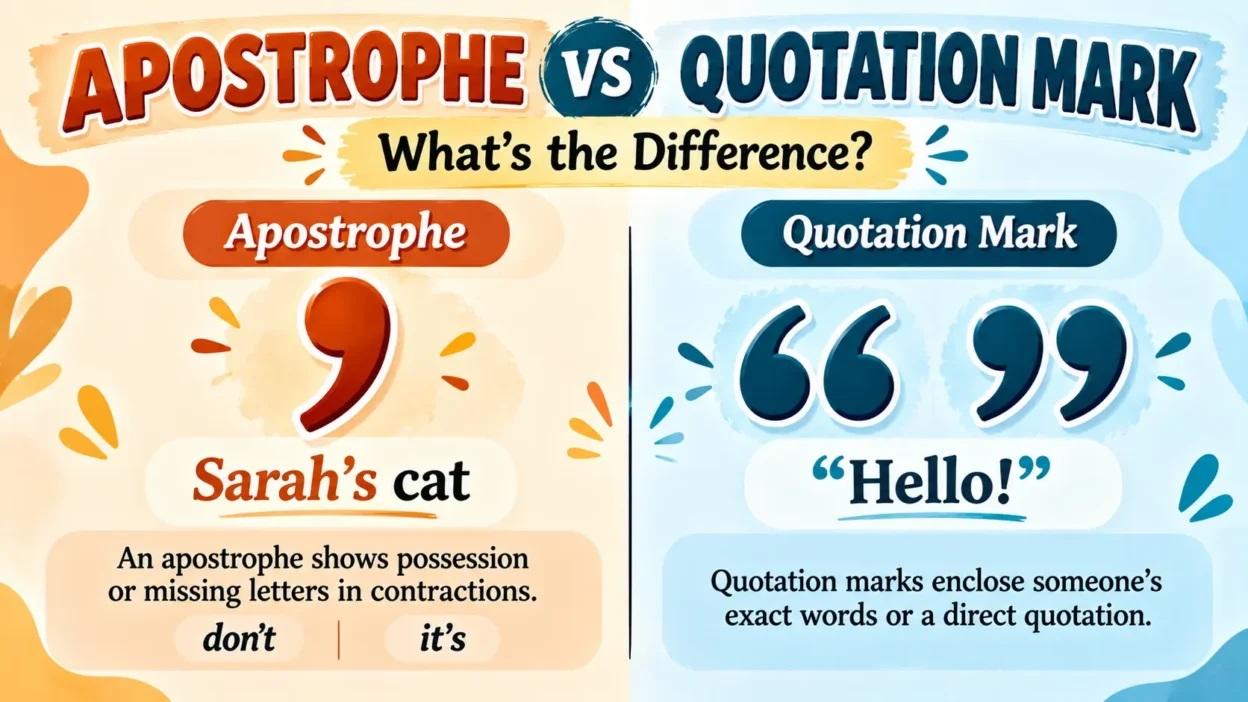
Understanding apostrophe vs quotation mark helps you improve your grammar and write more clearly. Although these punctuation marks look similar, they serve different purposes in English. An apostrophe (‘) shows possession, forms contractions, or indicates missing letters, while quotation marks (” “) identify someone’s exact words or dialogue. For example, “Emma’s book” uses an apostrophe to show ownership, while “Emma said, ‘I love this book’” uses quotation marks to show her words. Many writers confuse these symbols because they look similar on a keyboard. However, each mark follows specific rules that help readers understand your meaning. In this guide, you’ll learn their key differences, explore common grammar rules, and discover practical examples. Whether you write school assignments, emails, blog posts, or social media updates, these tips will help you use both punctuation marks correctly.
🔎Apostrophe vs Quotation Mark
An apostrophe (‘) shows possession, creates contractions, or marks omitted letters. Quotation marks (” “) identify direct speech, quoted text, or certain titles.
| Term | Meaning | Usage | Category |
|---|---|---|---|
| Apostrophe (‘) | Shows possession or omitted letters | Sarah’s bag, don’t | Punctuation |
| Quotation marks (” “) | Identify quoted words or dialogue | She said, “Hello.” | Punctuation |
| Single quotation marks (‘ ‘) | Mark quotations in some styles or nested quotes | “He called it ‘amazing.’” | Punctuation |
📖 What Is an Apostrophe?
An apostrophe is a punctuation mark that looks like a small raised comma. Writers mainly use it to show possession, form contractions, and indicate omitted letters or numbers.
Pronunciation: uh-POS-truh-fee
Part of speech: Noun
✏️ Main Uses of Apostrophes
- Possession: The apostrophe shows that something belongs to someone or something. Example: Maria’s phone.
- Contractions: It joins words by replacing missing letters. Example: cannot becomes can’t.
- Omitted letters: It sometimes represents missing sounds or letters in informal expressions.
- Omitted numbers: Writers may use apostrophes in expressions such as the ’90s, although styles differ.
📝 Apostrophe Examples
- The dog’s collar looks new.
- James’s car needs fuel.
- I can’t attend the meeting.
- They’re waiting outside.
- The children’s toys fill the room.
Remember that an apostrophe does not automatically make a word plural. For example, write three apples, not three apple’s.
💬 What Is a Quotation Mark?
Quotation marks are punctuation marks that surround words someone has spoken or written. American English typically uses double quotation marks (“ ”) for direct quotations, while some British English styles prefer single quotation marks (‘ ’).
Pronunciation: kwoh-TAY-shun marks
Part of speech: Noun phrase
📌 Main Uses of Quotation Marks
- Direct speech: They show the exact words a person says.
- Direct quotations: They identify words copied from a source.
- Dialogue: They help readers follow conversations in stories.
- Titles: Some style guides use quotation marks for short stories, articles, poems, and other shorter works.
- Special wording: Writers sometimes use quotation marks to discuss a word or signal irony, but overuse can confuse readers.
🗣️ Quotation Mark Examples
- Mia said, “I need some help.”
- He asked, “Where is the library?”
- The article states, “Practice improves writing.”
- “Please sit down,” the teacher said.
- I enjoyed the short story “The Gift of the Magi.”
Use quotation marks when you reproduce someone’s exact words. If you paraphrase the idea in your own words, you usually do not need them.
⚖️ Key Differences Between Apostrophes and Quotation Marks
Apostrophes and quotation marks perform different grammatical jobs. The following comparison makes the distinction easy to remember.
| Feature | Apostrophe | Quotation Marks |
|---|---|---|
| Main purpose | Shows possession or missing letters | Identifies quoted words |
| Appearance | ‘ | ” ” or ‘ ’ |
| Common example | Olivia’s notebook | Olivia said, “Hello.” |
| Contractions | Yes | No |
| Possession | Yes | No |
| Direct speech | No | Yes |
| Common mistake | Adding apostrophes to ordinary plurals | Quoting words without a clear reason |
Easy rule: Use an apostrophe to build or clarify a word. Use quotation marks to show which words someone said, wrote, or quoted.
📚 Literal Meaning, Origin, and Context
The word apostrophe comes through Latin from Greek apostrophos, associated with turning away or omitting. In writing, the mark developed a role in indicating omitted letters and later became important for possession in English.
The word quotation relates to citing or repeating words from another source. Quotation marks developed as typographic signs that help readers recognize quoted material.
Today, both marks appear in books, newspapers, websites, academic papers, and digital messages. Their exact appearance may change with a font or writing system, but their main functions remain distinct.
💡 15 Apostrophe and Quotation Mark Examples
These examples show how each punctuation mark works in everyday English.
| Example Sentence | Meaning |
|---|---|
| 1. Lily’s backpack is red. | Apostrophe shows possession. |
| 2. I don’t understand the question. | Apostrophe forms a contraction. |
| 3. We’re leaving at noon. | Apostrophe replaces missing letters. |
| 4. The teacher’s desk is clean. | The desk belongs to the teacher. |
| 5. The girls’ team won the game. | The team belongs to multiple girls. |
| 6. “I feel great,” Noah said. | Quotation marks show direct speech. |
| 7. She asked, “Can you help me?” | Quotation marks identify a question. |
| 8. “Stop!” the driver shouted. | Quotation marks show spoken words. |
| 9. My favorite poem is “The Road Not Taken.” | Quotation marks identify a poem title. |
| 10. Dad said, “Dinner is ready.” | Quotation marks show dialogue. |
| 11. The sign reads, “Keep the door closed.” | Quotation marks reproduce written words. |
| 12. “I heard him say ‘hello,’” Mia explained. | Single marks identify a quotation within a quotation. |
| 13. It’s raining outside. | Apostrophe replaces letters in it is. |
| 14. “Honesty matters,” the coach said. | Quotation marks identify exact speech. |
| 15. The students’ projects look impressive. | Apostrophe shows plural possession. |
🚫 Common Apostrophe Mistakes
Writers often add apostrophes where they do not belong. Use these corrections to improve your punctuation.
| Mistake | Correct Usage |
|---|---|
| The cat’s are sleeping. | The cats are sleeping. |
| I dont know. | I don’t know. |
| The teachers room is open. | The teacher’s room is open. |
| The childrens books are here. | The children’s books are here. |
| Your welcome. | You’re welcome. |
| Its a sunny day. | It’s a sunny day. |
| The 1990’s were exciting. | The 1990s were exciting. |
| Two apple’s fell. | Two apples fell. |
| The dogs bone is missing. | The dog’s bone is missing. |
| The players uniforms are ready. | The players’ uniforms are ready. |
Notice the difference between its and it’s. The first shows possession, while the second means it is or it has.
❌ Common Quotation Mark Mistakes
Quotation marks can also cause confusion, especially when writers punctuate dialogue or quote sources.
| Mistake | Correct Usage |
|---|---|
| She said I am ready. | She said, “I am ready.” |
| “Where are you going”. | “Where are you going?” |
| He called it a “great idea” and left. | He called it a “great idea” and left. |
| I “love” pizza. | I love pizza. |
| She said, “I agree”. | She said, “I agree.” |
| “Please help me”, he said. | “Please help me,” he said. |
| He asked “Are you ready?” | He asked, “Are you ready?” |
| “Hello, she said.” | “Hello,” she said. |
| The word “book” is a noun | The word book is a noun. |
| She wrote “The Gift of the Magi” | She wrote “The Gift of the Magi.” |
In American English, commas and periods usually go inside closing quotation marks. Other punctuation rules may vary by country, style guide, and sentence meaning.
🌎 Where Do We Use These Punctuation Marks?
Apostrophes and quotation marks appear in many kinds of writing, but each mark serves a different purpose.
🗨️ Daily Conversation
People use apostrophes when writing everyday contractions such as I’m, we’ve, and isn’t. Writers use quotation marks when they report someone’s exact words.
📱 Social Media and Texting
You may write “That’s amazing!” in a message or quote a friend’s comment in a post. Apostrophes help preserve standard spelling, even in casual conversations.
💼 Business Communication
Emails often include contractions and possessive forms, such as the client’s request. Quotation marks help you refer to exact statements from colleagues, customers, or reports.
🎓 Academic Writing
Students use apostrophes for possession and contractions when the assignment allows them. They use quotation marks for direct quotations and follow the required citation style when they quote a source.
🔤 Related Terms and Vocabulary
These punctuation terms will help you understand grammar discussions and improve your writing.
| Related Word | Meaning |
|---|---|
| Punctuation | Marks that organize written language |
| Comma | Separates elements or clauses |
| Period | Ends a statement in American English |
| Colon | Introduces an explanation or list |
| Semicolon | Connects closely related independent clauses |
| Parentheses | Enclose additional information |
| Brackets | Enclose inserted or clarifying material |
| Hyphen | Connects certain words or word parts |
| Dash | Marks a break or adds emphasis |
| Ellipsis | Indicates omitted words or a pause |
| Contraction | A shortened form of words |
| Possessive | A form that expresses ownership or association |
| Direct speech | The exact words a speaker uses |
| Paraphrase | A restatement of someone’s idea |
| Citation | A reference to a source |
❓ FAQs
Are apostrophes and quotation marks the same?
No. Apostrophes show possession or omitted letters, while quotation marks identify exact words or dialogue.
Can I use single quotation marks instead of double quotation marks?
Yes, when your chosen style guide permits them. American English generally uses double quotation marks first, while many British styles use single quotation marks first.
Do apostrophes show plural words?
No. Ordinary plurals usually need no apostrophe. Write books, cars, and students, not book’s, car’s, or student’s when you mean more than one.
Where does punctuation go inside quotation marks?
In American English, commas and periods generally go inside closing quotation marks. Question marks and exclamation points depend on whether they belong to the quoted words or the surrounding sentence.
Should I put quotation marks around a word for emphasis?
Usually not. Use italics or rewrite the sentence when you want emphasis. Quotation marks can suggest irony, doubt, or an unusual meaning.
What is the difference between a quotation mark and an apostrophe on a keyboard?
A straight apostrophe (‘) and a straight double quotation mark (“) use different keyboard characters. Curly apostrophes and quotation marks have typographic opening or closing shapes.
Does “its” need an apostrophe?
No, when its shows possession. Use it’s when you mean it is or it has.
✅ Conclusion: Apostrophe vs Quotation Mark
Understanding apostrophe vs quotation mark helps you write clear and accurate English. An apostrophe shows possession, forms contractions, or marks omitted letters, while quotation marks identify direct speech, quoted text, and certain titles. To use them correctly, consider what your sentence needs and choose the appropriate punctuation mark. Avoid adding apostrophes to ordinary plural words, and use quotation marks only when they serve a clear purpose. With regular practice, you’ll learn to recognize the differences and avoid common grammar mistakes. Apply these simple rules to your emails, school assignments, blog posts, and everyday messages. Correct punctuation makes your writing easier to understand and helps you communicate with confidence.

Andrew Foster is a researcher and content writer at Differopedia, specializing in clear, accurate, and easy-to-understand comparison guides, definitions, and informational articles. His work focuses on helping readers make informed decisions through well-researched, reliable content.