
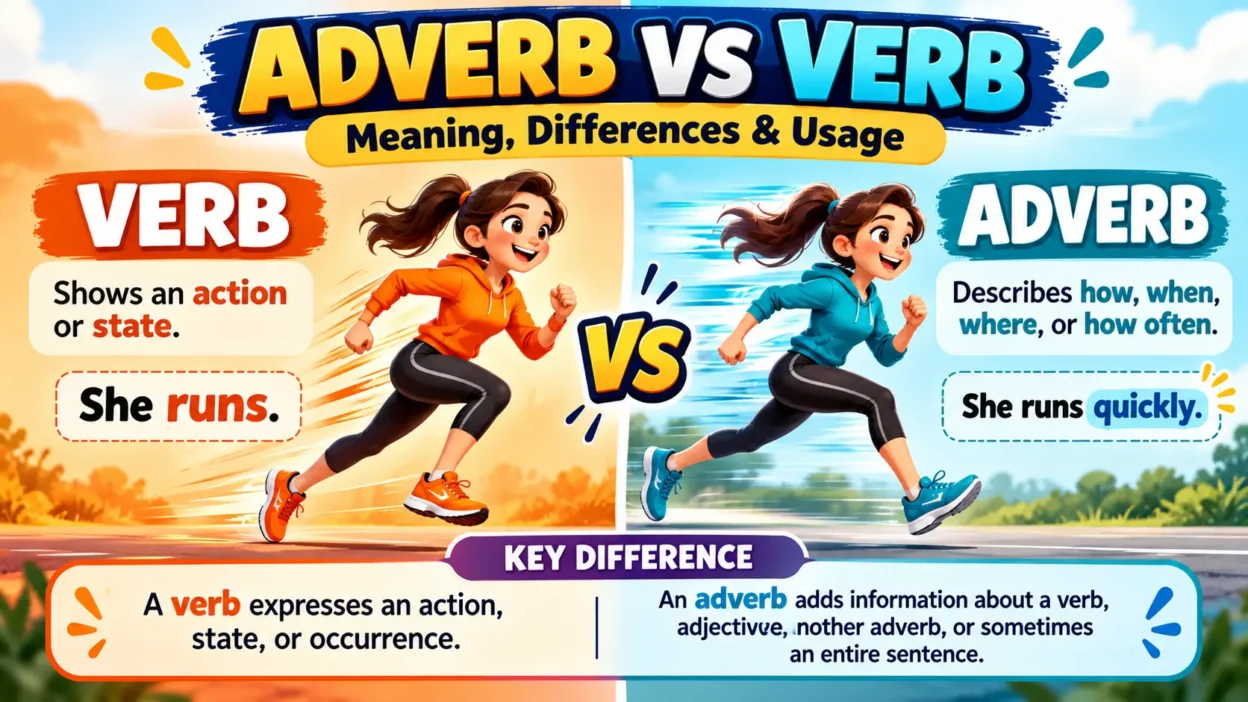
When learning English grammar, understanding adverb vs verb helps you write better sentences and communicate clearly. Although both parts of speech play important roles, they serve different purposes. A verb expresses an action, state, or occurrence, while an adverb adds details about a verb, an adjective, another adverb, or an entire sentence. For example, in “She runs quickly,” runs acts as a verb, while quickly explains how she runs. Understanding these differences can help you improve your vocabulary, sentence structure, and grammar skills. In this guide, you will explore definitions, examples, types, common mistakes, and simple ways to identify adverbs and verbs in everyday conversations, academic writing, and online communication.
⚡Adverb vs Verb
| Term | Meaning | Example | Category |
|---|---|---|---|
| Verb | Expresses an action, state, or occurrence | She writes daily. | Part of speech |
| Adverb | Modifies a verb, adjective, another adverb, or sentence | She writes carefully. | Part of speech |
| Action verb | Shows an action | They laugh. | Verb type |
| Linking verb | Connects a subject to a description or identity | He seems tired. | Verb type |
| Adverb of manner | Explains how something happens | She speaks softly. | Adverb type |
📚 What Is a Verb? Definition and Meaning
A verb is a word that expresses an action, state, experience, or occurrence. Verbs help readers understand what someone or something does, feels, thinks, or is.
Pronunciation: /vɝːb/ in American English.
Examples of verbs:
- Run: I run every morning.
- Think: She thinks about her future.
- Write: He writes short stories.
- Feel: We feel excited.
- Become: She became a teacher.
📝 Types of Verbs
- Action verbs: Describe physical or mental actions, such as jump, eat, think, and remember.
- Linking verbs: Connect a subject with a description or identity, such as be, seem, become, and appear.
- Helping verbs: Work with main verbs to express tense, possibility, or necessity, such as have, do, can, and will.
- Transitive verbs: Take a direct object, as in “Maya opened the door.”
- Intransitive verbs: Do not take a direct object, as in “The baby laughed.”
The word verb comes from the Latin verbum, meaning “word.” English adopted the term through French and Latin grammatical traditions.
💡 What Is an Adverb? Definition and Meaning
An adverb is a word that modifies a verb, an adjective, another adverb, or sometimes a whole sentence. Adverbs often explain how, when, where, how often, or to what extent something happens.
Pronunciation: /ˈæd.vɝːb/ in American English.
Examples of adverbs:
- Quickly: She finished her homework quickly.
- Yesterday: We visited our grandparents yesterday.
- Outside: The children played outside.
- Often: I often read before bed.
- Very: The movie was very interesting.
- Fortunately: Fortunately, everyone arrived safely.
🎯 Types of Adverbs
| Type | Purpose | Example |
|---|---|---|
| Adverb of manner | Explains how something happens | He drives carefully. |
| Adverb of time | Explains when something happens | She arrived yesterday. |
| Adverb of place | Explains where something happens | Come here. |
| Adverb of frequency | Explains how often something happens | We rarely eat out. |
| Adverb of degree | Shows intensity or extent | The water feels extremely cold. |
| Sentence adverb | Comments on the whole sentence | Fortunately, we found the keys. |
The word adverb comes from the Latin adverbium. The term traditionally describes a word that relates to a verb, although modern English adverbs can modify other grammatical elements too.
🔍 Adverb vs Verb: What Is the Main Difference?
The main difference between an adverb and a verb lies in their grammatical functions. A verb expresses an action, state, or occurrence, while an adverb adds information about an action, description, or sentence.
Consider these examples:
- Verb: The dog barks.
- Adverb: The dog barks loudly.
- Verb and adverb: The athlete runs quickly.
- Verb and adverb of time: We arrived early.
In “The athlete runs quickly,” runs tells you what the athlete does, while quickly explains how the athlete runs.
A verb usually forms the main part of a sentence’s predicate. An adverb adds detail, but a sentence does not always need one.
✏️ 10 Examples of Adverbs and Verbs in Sentences
| Example sentence | Verb | Adverb |
|---|---|---|
| She sings beautifully. | Sings | Beautifully |
| He runs quickly. | Runs | Quickly |
| They arrived yesterday. | Arrived | Yesterday |
| We often visit the park. | Visit | Often |
| The baby slept peacefully. | Slept | Peacefully |
| Tom answered correctly. | Answered | Correctly |
| The children played outside. | Played | Outside |
| I almost forgot your birthday. | Forgot | Almost |
| She speaks very clearly. | Speaks | Very, clearly |
| Fortunately, we found the missing wallet. | Found | Fortunately |
Some sentences contain multiple adverbs. For example, “She speaks very clearly” uses clearly to describe how she speaks and very to intensify clearly.
🧠 How to Identify an Adverb or Verb
You can identify these parts of speech by examining the role a word plays in its sentence.
- Find the action or state. Ask what the subject does or what the subject is experiencing. The answer often identifies the verb.
- Look for additional details. Ask how, when, where, or how often the action happens. These questions can help you identify an adverb.
- Check what the word modifies. An adverb can modify a verb, an adjective, another adverb, or a whole sentence.
- Read the complete sentence. A word’s grammatical function depends on its context, not just its spelling.
For example, in “The bird sings sweetly,” sings expresses the action, and sweetly describes how the bird sings.
⚠️ Common Mistakes When Comparing Adverbs and Verbs
| Mistake | Correct usage |
|---|---|
| Calling quickly a verb | Identify quickly as an adverb in “She runs quickly.” |
| Calling run an adverb | Identify run as a verb in “I run daily.” |
| Assuming every adverb ends in -ly | Recognize adverbs such as fast, well, often, and here. |
| Assuming every -ly word is an adverb | Identify friendly as an adjective in “She is friendly.” |
| Confusing good and well | Write “She sings well” when describing how she sings. |
| Treating an adjective as a verb | Identify happy as an adjective in “He feels happy.” |
| Assuming every sentence needs an adverb | Write “Birds fly” without adding unnecessary details. |
| Confusing helping verbs with adverbs | Identify will as a helping verb in “She will travel.” |
| Ignoring sentence context | Examine the word’s function before classifying it. |
| Calling very a verb | Identify very as an adverb in “very tall.” |
🔄 Adverb Synonyms and Related Terms
Adverbs do not share one universal synonym because they express different meanings. However, these related words can help you expand your vocabulary and understand adverb usage.
| Adverb | Similar word | Meaning |
|---|---|---|
| Quickly | Rapidly | At a fast speed |
| Slowly | Gradually | At a low speed or in stages |
| Carefully | Cautiously | With attention |
| Happily | Joyfully | With happiness |
| Quietly | Silently | With little or no noise |
| Correctly | Accurately | Without errors |
| Often | Frequently | Many times |
| Rarely | Seldom | Not often |
| Almost | Nearly | Close to a point or amount |
| Clearly | Plainly | In an understandable way |
| Immediately | Instantly | Without delay |
| Beautifully | Elegantly | In an attractive or graceful way |
| Easily | Effortlessly | Without much difficulty |
| Suddenly | Abruptly | Unexpectedly or quickly |
| Eventually | Finally | After some time |
Verbs also have synonyms that express related actions. For example, run can sometimes mean sprint, jog, or race, depending on the context.
🌎 Where Do People Use Adverbs and Verbs?
People use verbs and adverbs in nearly every form of English communication.
- Daily conversation: You might say, “I usually walk to work.” The verb walk expresses an action, and usually explains its frequency.
- Social media: Someone might write, “This song sounds amazing.” The verb sounds connects the subject to a description.
- Business communication: You could write, “Please respond promptly.” The verb respond expresses an action, and promptly describes when to perform it.
- Academic writing: A student might write, “The results clearly demonstrate the pattern.” The verb demonstrate expresses the action, and clearly modifies it.
- Online messaging: You might text, “I will reply later.” The helping verb will works with reply, while later provides information about time.
Understanding these differences helps you choose the right words and construct clearer sentences.
❓ FAQs
What is the difference between an adverb and a verb?
A verb expresses an action, state, or occurrence, while an adverb modifies a verb, adjective, another adverb, or sometimes a sentence.
Can a sentence contain both an adverb and a verb?
Yes. In “She dances gracefully,” dances is the verb, and gracefully is the adverb.
Do all adverbs end in -ly?
No. Words such as fast, well, here, often, and soon can function as adverbs without the -ly ending.
Can an adverb modify an adjective?
Yes. In “The test was extremely difficult,” extremely modifies the adjective difficult.
Is quickly a verb or an adverb?
Quickly usually functions as an adverb. For example, “He finished quickly” uses quickly to explain how he finished.
Is fast an adverb or a verb?
Fast can function as an adverb or an adjective, depending on context. In “She runs fast,” it acts as an adverb. In “A fast car passed us,” it acts as an adjective.
Can an adverb appear at the beginning of a sentence?
Yes. In “Fortunately, we arrived on time,” the adverb fortunately comments on the entire sentence.
How can I identify a verb quickly?
Look for the word that expresses the subject’s action or state. Then check whether helping verbs accompany it, as in “They have finished.”
✅ Conclusion
Understanding adverb vs verb becomes easier when you focus on each word’s role in a sentence. A verb expresses an action, state, or occurrence, while an adverb explains how, when, where, or how often something happens. For example, in “She speaks clearly,” speaks is the verb, and clearly is the adverb. You can identify these parts of speech by examining the surrounding words and understanding their functions. Remember that not every adverb ends in -ly, and some words can serve different grammatical roles depending on context. Practice with everyday sentences, reading exercises, and writing activities to improve your grammar and vocabulary. With regular practice, you can recognize verbs and adverbs more confidently and communicate more effectively in spoken and written English.

Andrew Foster is a researcher and content writer at Differopedia, specializing in clear, accurate, and easy-to-understand comparison guides, definitions, and informational articles. His work focuses on helping readers make informed decisions through well-researched, reliable content.