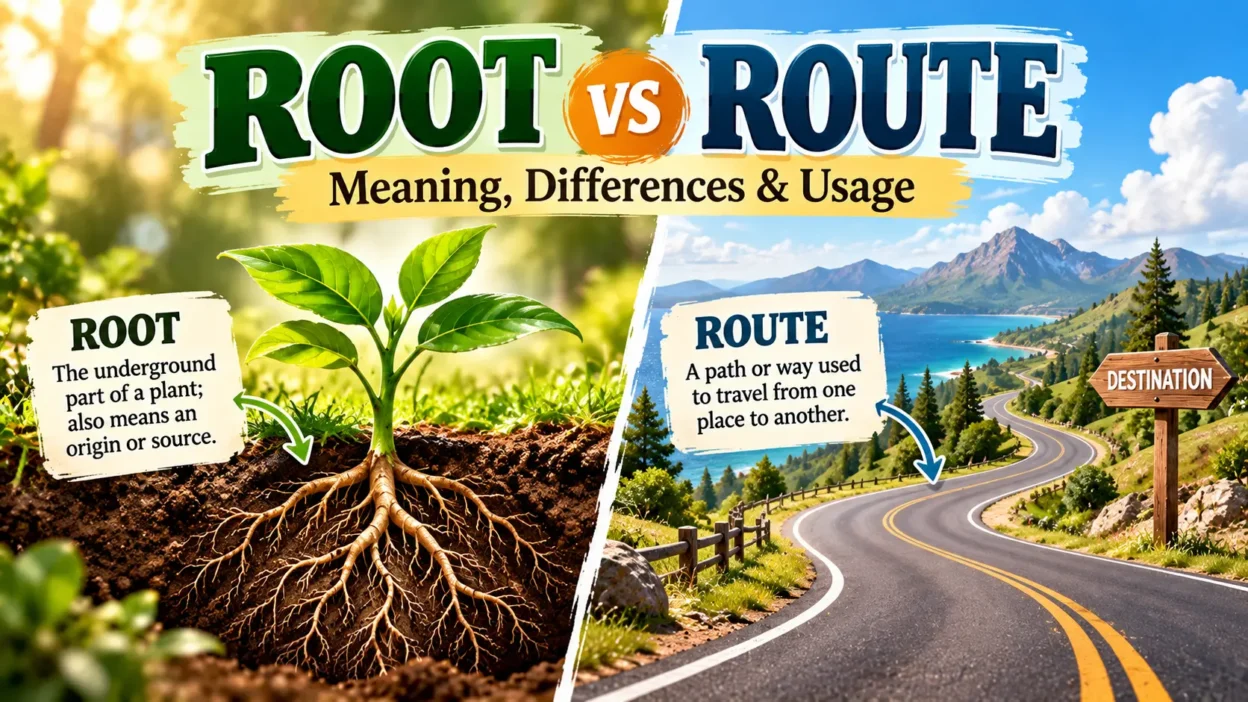
Have you ever wondered about the difference between root vs route? These two words can sound alike in American English, but they have different meanings and uses. The word root refers to a plant part, the origin of something, or the main cause of a problem. In contrast, route means a path, road, or direction that connects places. For example, you might find the root cause of a computer problem or choose the quickest route to work. Although these words sometimes share the same pronunciation, you cannot use them interchangeably. In this guide, you’ll explore their meanings, pronunciations, origins, synonyms, examples, and common mistakes to help you use both words correctly.
⚡Root vs Route
| Term | Meaning | Example | Category |
|---|---|---|---|
| Root | Origin, source, foundation, or plant part | The root of the problem | Noun, verb |
| Route | A path, road, or direction | The shortest route home | Noun, verb |
Quick tip: Think of a root as the source of something and a route as the way you travel.
🌱 What Does Root Mean?
The word root has several meanings, depending on the context. Its most familiar meaning describes the part of a plant that absorbs water and nutrients from the soil.
People also use root to describe the origin or foundation of something. For example, the root of a disagreement might involve a misunderstanding, while the roots of a family connect to its ancestors.
- Pronunciation: /ruːt/
- Part of speech: Noun and verb
- Literal meaning: The underground part of a plant.
- Figurative meaning: The origin, source, or fundamental cause of something.
- Verb meaning: To establish roots, support someone enthusiastically, or remove something by its roots.
Examples:
- The tree has deep roots.
- We need to find the root of this problem.
- I always root for my favorite basketball team.
🛣️ What Does Route Mean?
A route describes a path, road, or course that someone or something follows to reach a destination. People use the word when discussing travel, deliveries, transportation, and directions.
The word can also describe a planned course of action or the path that data takes through a computer network.
- Pronunciation: /ruːt/ or /raʊt/, depending on dialect and speaker.
- Part of speech: Noun and verb
- Literal meaning: A road or path between locations.
- Figurative meaning: A method, process, or way to achieve a goal.
- Verb meaning: To direct someone or something along a particular path.
Examples:
- We chose a scenic route through the mountains.
- The delivery driver follows a regular route.
- The system routes messages to the correct department.
🔊 Root vs Route: Pronunciation Differences
Pronunciation creates much of the confusion between these words.
Most American English speakers pronounce root with the long “oo” sound, as in food. Speakers pronounce route in two common ways: it can rhyme with root, or it can rhyme with out.
| Word | Pronunciation | Rhymes With |
|---|---|---|
| Root | /ruːt/ | Food, boot |
| Route | /ruːt/ | Root, boot |
| Route | /raʊt/ | Out, shout |
Both pronunciations of route occur in English. Regional preferences and personal habits influence which pronunciation speakers choose.
Remember that pronunciation does not change the spelling or basic meaning of the word. Context helps you identify the intended meaning.
📚 Root vs Route: Origin and Etymology
The words root and route have different histories.
Root comes from Old English rōt, which developed from Germanic language forms associated with the underground part of a plant. Over time, English speakers extended its meaning to include origins, foundations, and fundamental causes.
Route entered English through French route, which traces back to Latin rupta, associated with a broken or opened road. English speakers eventually adopted the word to describe a path or course of travel.
Although their modern pronunciations sometimes overlap, their histories and meanings remain distinct.
✍️ Root vs Route: 15 Example Sentences
These examples show how each word works in real situations. Notice how the surrounding words reveal the intended meaning.
| Example Sentence | Meaning |
|---|---|
| 1. The roots of the tree spread across the garden. | Underground plant parts |
| 2. We discovered the root of the argument. | Main cause |
| 3. My family has roots in Texas. | Family origins |
| 4. Practice helps you root out bad habits. | Remove or eliminate |
| 5. I always root for our school team. | Cheer for someone |
| 6. We took a different route to work. | Path to a destination |
| 7. The driver memorized the delivery route. | Planned travel path |
| 8. This route offers beautiful mountain views. | Road or course |
| 9. Education can provide a route to success. | Way to achieve a goal |
| 10. The computer routes requests to the correct server. | Directs data |
| 11. The gardener examined the plant’s roots. | Underground plant structures |
| 12. Let’s identify the root cause of the delay. | Fundamental cause |
| 13. The bus follows the same route every morning. | Regular course |
| 14. We need to root out the source of the error. | Find and eliminate a cause |
| 15. The coastal route takes us past several beaches. | Road along the coast |
🔄 Root vs Route: Synonyms and Related Words
The following words can help you understand each term more clearly. However, synonyms do not always fit every context.
🌿 Synonyms for Root
| Synonym | Meaning |
|---|---|
| Origin | Where something begins |
| Source | Where something comes from |
| Cause | Something that produces a result |
| Foundation | The supporting base of something |
| Basis | The underlying principle |
| Beginning | The starting point |
| Core | The central or essential part |
| Base | The bottom or supporting part |
| Essence | The fundamental nature of something |
| Ancestor | A person from an earlier generation |
| Rootstock | The rooted base of a plant |
| Derivation | The origin or formation of something |
| Groundwork | Basic work that supports later progress |
| Stem | The main supporting part of a plant |
| Heritage | Traditions and origins passed down through generations |
🛣️ Synonyms for Route
| Synonym | Meaning |
|---|---|
| Path | A way to travel |
| Road | A prepared surface for vehicles |
| Way | A direction or method |
| Course | A planned direction or progression |
| Track | A marked or established path |
| Trail | A path through a natural area |
| Highway | A major public road |
| Passage | A way through or between places |
| Direction | The way someone or something moves |
| Itinerary | A planned travel schedule |
| Journey | Travel from one place to another |
| Circuit | A route that returns to its starting point |
| Detour | An alternative route |
| Lane | A narrow road or part of a road |
| Corridor | A passage or travel connection |
↔️ Root vs Route: Antonyms
Neither word has one perfect opposite in every context. These terms work as opposites in particular situations.
| Word | Antonym | Meaning |
|---|---|---|
| Root | Branch | A part that extends from a main stem or structure |
| Root | Leaf | A plant part with a different function |
| Root | Surface | The outside or upper layer |
| Root | Result | An outcome rather than an origin |
| Root | Conclusion | An ending rather than a beginning |
| Route | Dead end | A path that does not continue through |
| Route | Obstacle | Something that blocks progress |
| Route | Blockage | Something that prevents passage |
| Route | Standstill | A complete stop in movement |
| Route | Detention | A state of being held rather than moving freely |
Important: These are contextual opposites, not exact antonyms in every dictionary sense.
🗣️ How People Use Root and Route in Everyday Life
People use these words in several settings. The surrounding context usually makes the meaning clear.
💬 Daily Conversation
You might discuss the root of a disagreement with a friend or ask someone which route leads to a restaurant. The first word describes a cause; the second describes a path.
📱 Social Media and Online Messaging
People discuss the root cause of online arguments, family roots, and personal growth. They also share travel routes, running routes, and directions to events.
Neither root nor route has a special texting meaning that replaces its standard definition.
💼 Business Communication
Businesses investigate the root cause of customer complaints and technical failures. Delivery companies plan efficient routes to reduce travel time and fuel costs.
🎓 Academic Writing
Students may explore the roots of a historical conflict or examine the root of a mathematical expression. Geography students might study transportation routes, migration routes, or trade routes.
💻 Technology
In computing, root can refer to the highest-level directory or an account with extensive administrative privileges. A route can describe how a network sends data between destinations or how an application directs users to different pages.
⚠️ Common Root vs Route Mistakes
Writers sometimes confuse these words because they share similar sounds. Use the meaning of the sentence to select the correct spelling.
| Mistake | Correct Usage |
|---|---|
| We found the route of the problem. | We found the root of the problem. |
| Take the root to the airport. | Take the route to the airport. |
| The tree has deep routes. | The tree has deep roots. |
| I always root my favorite team. | I always root for my favorite team. |
| The driver changed the root. | The driver changed the route. |
| We studied the route causes of the conflict. | We studied the root causes of the conflict. |
| This root leads to the beach. | This route leads to the beach. |
| My family has deep routes in Ohio. | My family has deep roots in Ohio. |
| The software selected a new root for the data. | The software selected a new route for the data. |
| She wants to understand the route of the issue. | She wants to understand the root of the issue. |
🔎 Root vs Route: Semantic Keywords and Related Terms
These related terms help explain the different contexts in which people encounter root and route.
- Root-related keywords: root meaning, root definition, root word, root cause, root system, plant roots, family roots, cultural roots, root origin, root of a problem, root out, root for a team, square root, root directory.
- Route-related keywords: route meaning, route definition, route pronunciation, travel route, shortest route, road route, delivery route, bus route, scenic route, network routing, route planner, alternate route, trade route, migration route, route to success.
The phrase root word refers to a basic word form that can help explain related words. In mathematics, a square root identifies a number that produces a given value when multiplied by itself. In transportation, a route planner helps people select a path to a destination.
These distinctions make it easier to choose the correct term in different contexts.
❓ Frequently Asked Questions About Root vs Route
🌱 What is the main difference between root and route?
A root refers to an origin, foundation, or plant part. A route refers to a path, road, or direction that someone or something follows.
🔊 Do root and route sound the same?
Sometimes. Many American English speakers pronounce both words the same way, while others pronounce route to rhyme with out.
✍️ Should I write root cause or route cause?
Write root cause. This expression describes the fundamental reason something happens.
🛣️ Is it root or route to the airport?
Write route to the airport because you mean the road or path you will travel.
🌳 What does root mean figuratively?
Root can describe the origin or fundamental cause of something. For example, the root of a disagreement might involve a misunderstanding.
🚗 What does route mean in simple English?
A route is a way to get from one place to another. A map can show you the best route to your destination.
💻 What does route mean in technology?
In technology, a route describes how a system directs data, requests, or traffic toward a destination. A router, for example, helps direct network traffic.
📖 Can root and route replace each other?
No. Although the words sometimes sound alike, their meanings differ. Use root for an origin or foundation and route for a path or direction.
✅ Conclusion
Understanding root vs route becomes easy when you focus on their meanings rather than their sounds. A root refers to the origin, foundation, or underground part of a plant, while a route describes a path or direction to a destination. For example, you investigate the root of a problem but follow a route to work. You can also talk about your family roots or plan a scenic route for a trip. Both words appear in everyday conversations, academic writing, business, and technology. Although their pronunciations sometimes sound alike, their meanings and spellings remain different. To choose the correct word, simply ask yourself: Am I talking about a source or a path?

Andrew Foster is a researcher and content writer at Differopedia, specializing in clear, accurate, and easy-to-understand comparison guides, definitions, and informational articles. His work focuses on helping readers make informed decisions through well-researched, reliable content.