
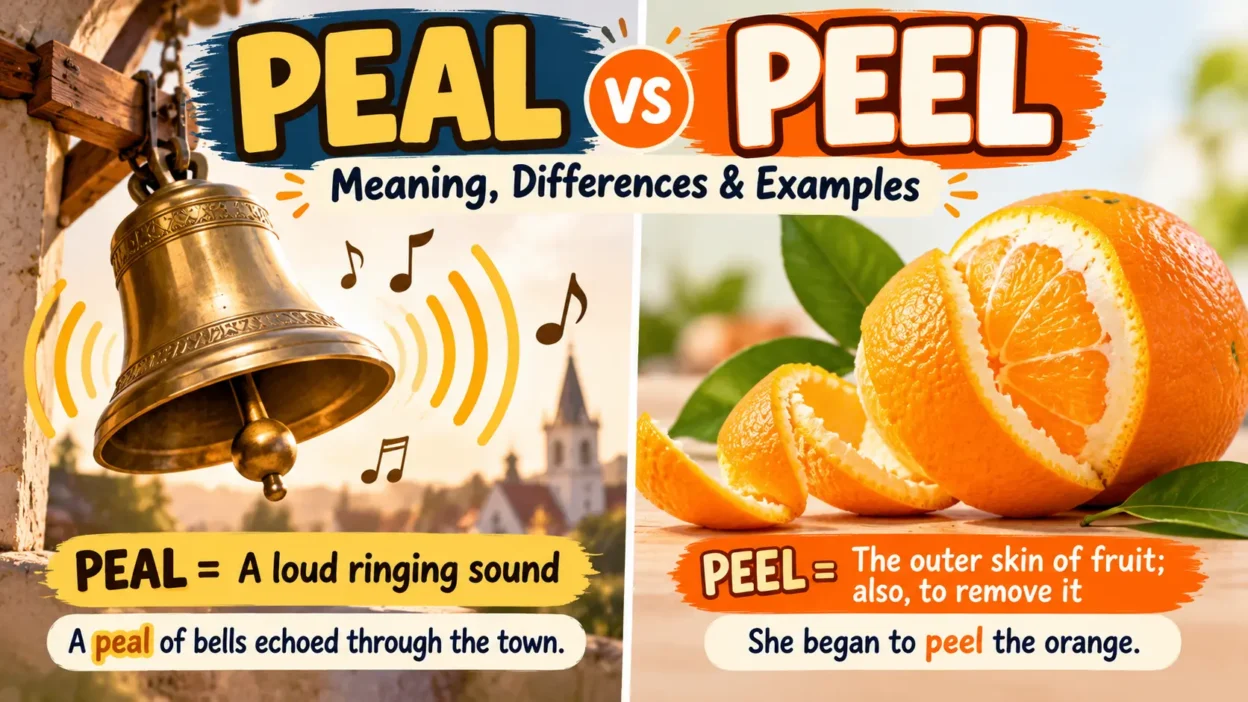
Have you ever wondered whether to write peal vs peel when describing ringing bells or removing fruit skin? Although these words sound exactly alike, they have different meanings and uses. Peal refers to a loud, clear sound, such as ringing bells, thunder, or joyful laughter. In contrast, peel means to remove an outer covering or describes the skin of a fruit or vegetable. Both words are homophones, which means they share the same pronunciation but have different spellings and meanings. Understanding their differences will help you avoid common spelling mistakes and improve your writing. In this guide, you’ll learn their definitions, pronunciation, examples, synonyms, and practical uses so you can confidently choose the correct word.
🔎 Peal vs Peel
| Term | Meaning | Usage | Category |
|---|---|---|---|
| Peal | A loud ringing sound or burst of laughter | A peal of bells filled the air. | Noun and verb |
| Peel | To remove an outer covering or the covering itself | Please peel the orange. | Noun and verb |
Quick tip: Remember peal for sounds and peel for skins, coverings, and removing them.
🔔 What Does Peal Mean?
Peal is a noun that describes a loud, clear, and resonant sound. People commonly use it for bells, laughter, and thunder. As a verb, peal means to ring loudly or produce a series of clear sounds.
For example, you might hear a peal of church bells on a Sunday morning or a peal of laughter when friends share a funny story.
Pronunciation: /piːl/
Part of speech: Noun and verb.
Origin: Peal developed through Middle English and became associated with ringing bells and other loud, resonant sounds.
Examples of Peal in Sentences
- The church bells rang out in a joyful peal.
- Her funny story triggered a peal of laughter.
- A sudden peal of thunder startled the children.
- The bells pealed across the village at noon.
🍊 What Does Peel Mean?
Peel refers to removing the outer skin or covering of something. As a noun, it describes the outer layer itself, especially the skin of fruit and vegetables.
For example, you peel a banana before eating it. You might also add lemon peel to a recipe for extra flavor. People use the word in other situations, too, such as when paint peels away from a wall.
Pronunciation: /piːl/
Part of speech: Noun and verb.
Origin: Peel entered English through historical forms associated with removing skin or an outer covering.
Examples of Peel in Sentences
- Please peel the potatoes before cooking them.
- She added orange peel to the cake mixture.
- The old paint began to peel from the door.
- His sunburned skin started to peel.
⚖️ Peal vs Peel: Main Differences
The main difference between peal and peel involves their meanings. Both words sound alike, but they describe different things.
Peal relates to sound. You can hear bells peal, experience a peal of laughter, or listen to a peal of thunder. The word often suggests a loud, clear, or sudden noise.
Peel relates to outer coverings and separation. You can peel fruit, remove a vegetable’s skin, or watch paint peel from a surface. It describes the action of removing a layer or the layer itself.
Neither spelling replaces the other. Always consider the meaning of your sentence before choosing between them.
✍️ Peal vs Peel: Example Sentences
| Example Sentence | Meaning |
|---|---|
| A peal of bells announced the wedding. | A loud ringing sound. |
| Her joke caused a peal of laughter. | A sudden burst of laughter. |
| We heard a peal of thunder during the storm. | A loud sound of thunder. |
| The church bells pealed at midnight. | The bells rang loudly. |
| A peal of laughter echoed across the playground. | A burst of laughter. |
| The bells pealed as the parade passed. | The bells produced a ringing sound. |
| Please peel the apple before making the pie. | Remove the apple’s skin. |
| I added lemon peel to the recipe. | The outer layer of a lemon. |
| He used a knife to peel the potatoes. | Remove the potato skins. |
| The paint began to peel after the rain. | The paint separated from the surface. |
| Peel the banana before eating it. | Remove the banana’s covering. |
| The dry skin started to peel. | The skin began to come away. |
🔄 Synonyms for Peal and Peel
Synonyms can help you express similar ideas, but choose replacements that fit your sentence.
| Synonym | Meaning |
|---|---|
| Ring | Produce a clear sound. |
| Chime | Make a musical ringing sound. |
| Toll | Ring a bell slowly or solemnly. |
| Clang | Produce a loud metallic sound. |
| Clangor | A loud, continuous metallic noise. |
| Clatter | Make a series of noisy sounds. |
| Burst | A sudden release of sound or emotion. |
| Roar | Produce a deep, powerful sound. |
| Laugh | Express amusement vocally. |
| Rind | The outer covering of certain fruits. |
| Skin | The outer layer of a fruit or vegetable. |
| Husk | A dry outer covering of a seed or plant. |
| Shell | A hard protective outer covering. |
| Remove | Take something away. |
| Strip | Remove an outer layer. |
| Pare | Cut away a thin outer layer. |
| Uncover | Remove something that covers an object. |
| Shed | Cast off an outer layer. |
🚫 Antonyms for Peal and Peel
Neither word has one perfect antonym in every context. However, these opposites can help you understand their meanings.
| Antonym | Meaning |
|---|---|
| Silence | The absence of sound. |
| Quiet | A state with little noise. |
| Stillness | A lack of movement or disturbance. |
| Mute | Make something silent. |
| Muffle | Reduce the loudness of a sound. |
| Cover | Place something over an object. |
| Coat | Apply a covering to a surface. |
| Wrap | Enclose something in a covering. |
| Encase | Surround something with a protective layer. |
| Protect | Keep something safe from damage. |
Note: The first five words contrast with peal when it describes sound. The remaining words contrast with peel when it describes removing a covering.
📚 Related Words to Know
| Related Word | Meaning |
|---|---|
| Homophone | A word that sounds like another word but has a different meaning or spelling. |
| Homonym | A word that shares a form or pronunciation with another word but has a different meaning. |
| Homograph | A word that shares its spelling with another word but has a different meaning. |
| Pronunciation | The way someone says a word. |
| Etymology | The history and origin of a word. |
| Bell | An object that produces a ringing sound. |
| Chime | A clear musical ringing sound. |
| Thunder | The sound that follows lightning. |
| Laughter | The sound or act of laughing. |
| Rind | The outer layer of certain fruits. |
| Zest | The flavorful outer part of citrus peel. |
| Skin | The outer layer of an organism or fruit. |
| Husk | A dry covering around a seed or grain. |
| Peel off | Remove or separate an outer layer. |
| Peeling | The process of removing or losing a covering. |
🗣️ How People Use Peal and Peel in Real Life
Everyday Conversation
People use peal when describing bells, laughter, or other loud sounds. For instance, you might say, “A peal of laughter came from the next room.”
People use peel much more frequently in cooking and household conversations. You might ask someone to peel an apple or explain that the paint has started to peel.
Social Media and Online Messaging
On social media, writers might describe a funny video as causing a peal of laughter. Food bloggers often use peel in recipes, cooking tips, and fruit-preparation videos.
Neither word has a special, widely established slang or texting meaning. Their meanings generally remain the same online as they do in standard English.
Business Communication
You might encounter peal in writing about church bells, public ceremonies, sound effects, or expressive storytelling. Meanwhile, peel can appear in food production, packaging, maintenance reports, and product instructions.
For example, a food manufacturer might explain how workers peel vegetables before processing them.
Academic Writing
Students may encounter peal in literature when authors describe bells, laughter, or dramatic sounds. They may encounter peel in scientific writing about plant structures, fruit skins, or the separation of surface layers.
Understanding context helps you select the correct spelling in essays, reports, and examinations.
⚠️ Common Mistakes: Peal vs Peel
| Mistake | Correct Usage |
|---|---|
| The church bells gave a peel. | The church bells gave a peal. |
| She heard a peel of laughter. | She heard a peal of laughter. |
| A peel of thunder shook the house. | A peal of thunder shook the house. |
| Please peal the orange. | Please peel the orange. |
| He removed the apple peal. | He removed the apple peel. |
| The paint began to peal. | The paint began to peel. |
| I added lemon peal to the cake. | I added lemon peel to the cake. |
| The bells peeled at noon. | The bells pealed at noon. |
| She used a pealer to remove the skin. | She used a peeler to remove the skin. |
| The banana’s peal was thick. | The banana’s peel was thick. |
🧠 Semantic Keywords and Related Vocabulary
Readers searching for peal vs peel often want to understand homophones, spelling differences, pronunciation, word meanings, and examples. These related terms help explain the distinction clearly.
Important semantic keywords include peal meaning, peel meaning, peal definition, peel definition, peal vs peel difference, homophones, words that sound alike, ringing bells, peal of laughter, peal of thunder, fruit peel, orange peel, lemon peel, peeling paint, peel as a verb, peel as a noun, peal as a verb, peal as a noun, pronunciation, etymology, synonyms, antonyms, and commonly confused words.
Remember that both words have the same pronunciation, but their spelling depends on the meaning you intend. Use peal for ringing sounds and peel for removing an outer covering or referring to that covering.
❓ Frequently Asked Questions
What Is the Easiest Way to Remember Peal vs Peel?
Connect peal with sound and peel with skin. Bells produce a peal, while you peel an orange.
Can Peal Describe Laughter?
Yes. A peal of laughter describes a loud, sudden burst of laughter.
Can Peel Describe Paint?
Yes. When paint separates from a surface, you can say that the paint begins to peel.
Does Peal Have a Plural Form?
Yes. The plural is peals. For example, “The peals of bells echoed through the town.”
What Is the Past Tense of Peal?
The past tense is pealed. For example, “The bells pealed at noon.”
What Is the Past Tense of Peel?
The past tense is peeled. For example, “She peeled the potatoes before dinner.”
Is Peel Always About Fruit?
No. People also use peel for skin, paint, and other outer layers that separate from a surface.
Why Do People Confuse Peal and Peel?
People confuse these words because they sound identical. Their different meanings and spellings make context the key to choosing the right word.
✅ Conclusion
Understanding peal vs peel becomes easy when you remember their different meanings. Use peal to describe loud sounds, such as ringing bells, thunder, or joyful laughter. In contrast, use peel when removing an outer covering or referring to the skin of a fruit or vegetable. Although both words sound exactly alike, their meanings and spellings differ. To choose the correct word, consider the context and identify whether your sentence describes a sound or a covering. Practice using both words in everyday conversations, schoolwork, and professional writing. With these simple tips, you’ll confidently avoid spelling mistakes and use peal and peel correctly.

Andrew Foster is a researcher and content writer at Differopedia, specializing in clear, accurate, and easy-to-understand comparison guides, definitions, and informational articles. His work focuses on helping readers make informed decisions through well-researched, reliable content.