You have probably hesitated before choosing between either and neither. They look similar, but they mean opposite things. Either offers a choice between two options, while neither rejects both. We use these words daily when ordering food, making plans, or agreeing with someone. This short guide clears up every rule, shows you how Americans and Brits say them differently, and helps you avoid common traps.
Quick Answer Table
| Term | Meaning | Usage | Category |
|---|---|---|---|
| Either | One of two alternatives | “You can take either road.” | Positive choice |
| Neither | Not one and not the other | “Neither road leads home.” | Negative choice |
| Either…or | Links two positive alternatives | “Either John or Mary will come.” | Correlative pair |
| Neither…nor | Links two negative alternatives | “Neither John nor Mary came.” | Correlative pair |
Main Meaning Section
Definition
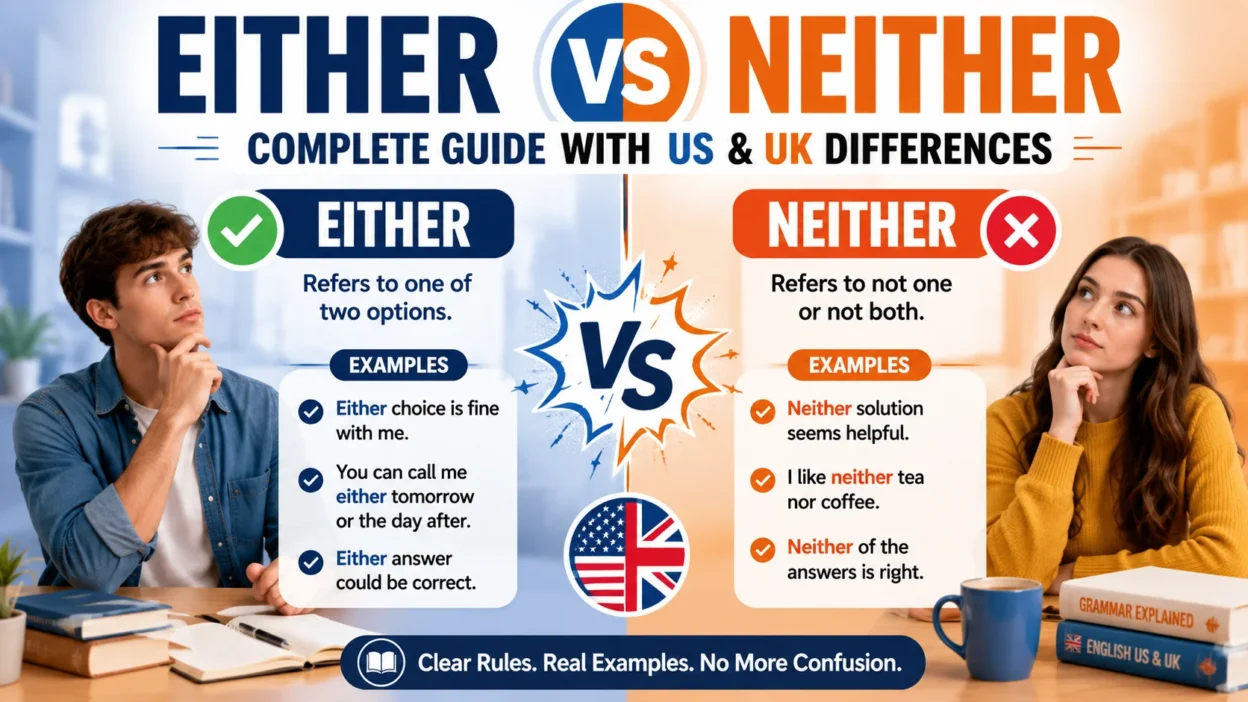
Either means “one or the other of two people or things.”
Neither means “not the one and not the other” – it is the negative form of either.
Pronunciation (US vs UK)
This is where Americans and Brits differ noticeably.
- Either – US: /ˈiːðər/ (EE-ther) ; UK: /ˈaɪðər/ (EYE-ther). Both are correct, but Americans strongly prefer EE-ther, while Brits often use EYE-ther (though EE-ther is also common in the UK).
- Neither – US: /ˈniːðər/ (NEE-ther) ; UK: /ˈnaɪðər/ (NYE-ther). Again, US speakers usually say NEE-ther, and UK speakers lean toward NYE-ther.
Tip: If you are speaking to an American, use EE-ther / NEE-ther. In the UK, you will hear both, but EYE-ther / NYE-ther sound distinctly British.
Part of Speech
Both words work as determiners, pronouns, adverbs, and conjunctions depending on the sentence.
Origin
Either comes from Old English ǣgther, a contraction of ǣg (ever) + hwæther (which of two). Neither combines ne (not) + either – literally “not either.”
Detailed Explanation
Literal Meaning
Literally, either points to one item in a pair. Neither points to zero items in that pair.
Common Everyday Meaning
In daily speech, we use either to give permission or present options. We use neither to disagree or refuse both suggestions.
Internet, Slang & Texting Meaning
- Texting: People shorten “either” to “eitr” or simply use “or.”
- Slang: “Me neither” is the standard casual reply to a negative statement (e.g., “I don’t like pizza.” – “Me neither.”).
- Social media: You will see “either way” to mean “regardless of which option.”
Usage Examples Table
| Example Sentence | Meaning |
|---|---|
| You can choose either color for the walls. | Choose one of the two colors. |
| Neither candidate impressed us during the debate. | Both candidates failed to impress. |
| I do not want either of those desserts. | I want zero of those two desserts. |
| Either you finish your homework, or you lose screen time. | Choose between two consequences. |
| Neither the manager nor the staff knew about the change. | Both the manager and staff were unaware. |
| We can meet either on Monday or Tuesday. | We have two possible meeting days. |
| She likes neither coffee nor tea. | She dislikes both coffee and tea. |
| You will find the keys in either drawer. | The keys are in one of the two drawers. |
| Neither answer seems correct to me. | Both answers look wrong. |
| Either we fix this now, or we give up. | We face a direct choice between action and quitting. |
Synonyms Table
| Synonym | Meaning |
|---|---|
| Any (of two) | One of two (informal) |
| One or the other | A single alternative |
| Whichever | No matter which one |
| Any one | A single item from a pair |
| Nor (with neither) | Connects negative alternatives |
| Not any | Zero of the options |
| None (of two) | Not one of the pair |
| No (one of two) | Negative choice |
| Either one | One of the two |
| Neither one | Not either |
| Both (in negative context) | Used with “not both” to mean neither |
| Not either | The full form of neither |
| Any which way | Regardless of choice |
| One of two | A binary selection |
| The one or the other | Formal choice expression |
Antonyms Table
| Antonym | Meaning |
|---|---|
| Both | The two together |
| Each | Every one of the two individually |
| Every | All items (more than two) |
| All | The entire set |
| Any (of many) | One from multiple options |
| Either (positive) | Affirmative choice |
| One | A single item |
| This (specific) | A definite item |
| That (specific) | Another definite item |
| Some | An unspecified amount or number |
Related Terms Table
| Related Word | Meaning |
|---|---|
| Or | Connects alternatives (used with either) |
| Nor | Connects negatives (used with neither) |
| Else | Other alternative |
| Otherwise | In different circumstances |
| Alternative | Another option |
| Choice | A selection between options |
| Option | One of several possibilities |
| Decision | The act of choosing |
| Preference | A greater liking for one option |
| Selection | The chosen item |
| Vote | A formal choice |
| Pick | An informal choice |
| Dilemma | A difficult choice between two |
| Ultimatum | A final choice |
| Binary | Involving two options |
Real‑Life Usage (US vs UK)
You will hear either and neither everywhere, but Americans and Brits handle them slightly differently.
- Daily conversation: Americans say “Me neither” almost exclusively. Brits also say “Me neither,” but you might hear “Nor me” in more informal UK speech.
- Social media: Both US and UK users write “either way” frequently. Americans often type “idc either way” (I don’t care either way).
- Business communication: In the US, we use singular verbs after either/neither (e.g., “Neither option is good”). In the UK, you will occasionally see plural verbs in informal writing (e.g., “Neither option are good”), though this is considered non‑standard.
- Academic writing: Both regions agree on strict singular verb agreement for formal texts.
- Online messaging: US users text “either or” for a quick choice; UK users might say “either / or” with a slash.
Country rule: Verb agreement is the same in formal US and UK English – always singular after either and neither when they act as subjects.
Common Mistakes Table
| Mistake | Correct Usage |
|---|---|
| Using “either” with more than two options | Use “any” for three or more (e.g., “Any of these books”). |
| Saying “me either” for a negative reply | Say “me neither” (e.g., “I don’t like it.” – “Me neither.”). |
| Using double negatives with neither | Say “Neither John nor Mary came” (not “Neither John not Mary didn’t come”). |
| Forgetting the “nor” after neither | Use “nor” – “Neither the price nor the quality impressed us.” |
| Using “or” after neither | Always use “nor” (e.g., “Neither here nor there”). |
| Using plural verbs formally | Say “Neither option works” (not “work”). |
| Confusing “either” with “too” in negatives | Use “either” in negative sentences (“I don’t want it either”). |
| Writing “neither…or” | Correct: “neither…nor”. |
| Using “either” when you mean “both” | “Both” means two together; “either” means one. |
| Using “neither” when you mean “none” | “None” works for three+; “neither” is only for two. |
Semantic Keywords (Natural Usage)
When we discuss either vs neither, we naturally touch on choice, alternative, binary options, negative agreement, correlative conjunctions, singular verb, pronoun agreement, and US vs UK pronunciation. We also consider grammar rules, common errors, and formal vs informal usage. These terms help search engines understand that we cover the full topic from every angle.
FAQ Section
Q1: What is the basic difference between either and neither?
A: Either means one of two; neither means not one and not the other.
Q2: Which verb form follows either/neither as a subject?
A: Always a singular verb (e.g., “Neither works”) in formal US and UK English.
Q3: Do Americans and Brits pronounce these words differently?
A: Yes – US prefers EE‑ther / NEE‑ther; UK often says EYE‑ther / NYE‑ther.
Q4: Can I start a sentence with either or neither?
A: Yes – e.g., “Either works for me.” / “Neither is acceptable.”
Q5: Is “neither” always negative?
A: Yes – it always negates both options. It never expresses a positive choice.
Q6: What is the rule for either…or and neither…nor?
A: Use “or” with either and “nor” with neither. Keep the paired items parallel.
Conclusion
Now you know the complete difference between either and neither. Remember, either gives you one option out of two, while neither gives you zero. Pay attention to your audience – Americans expect EE‑ther and NEE‑ther, while Brits often appreciate EYE‑ther and NYE‑ther. Stick to singular verbs in formal writing, and always use “nor” after neither. Most importantly, practice using them in real sentences. The more you use these words actively, the more natural they become. So, either you master them today, or you keep this guide handy – we recommend the first choice!

Andrew Foster is a researcher and content writer at Differopedia, specializing in clear, accurate, and easy-to-understand comparison guides, definitions, and informational articles. His work focuses on helping readers make informed decisions through well-researched, reliable content.