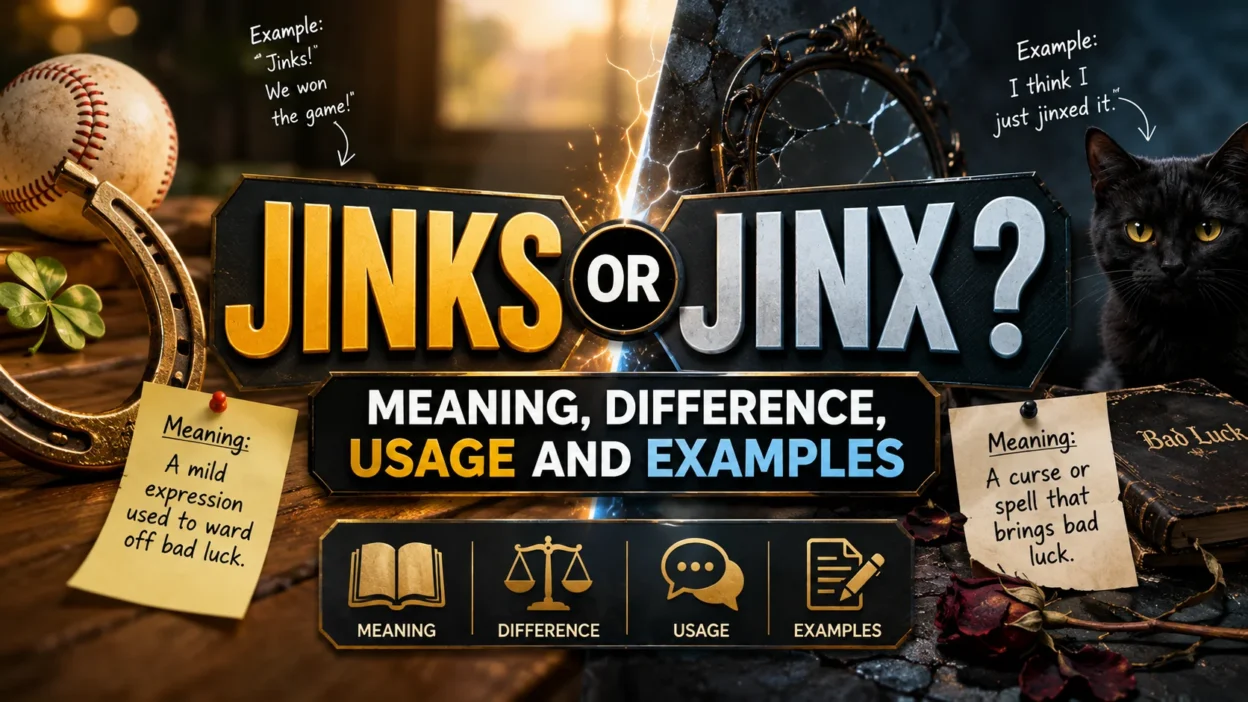
Although jinks and jinx sound exactly alike, they do not mean the same thing. This is why many people accidentally write “don’t jinks it” when the correct phrase is “don’t jinx it.” If you’re wondering which spelling to use, you’re in the right place.
In modern English, jinx refers to bad luck, a curse, or something believed to bring misfortune. It can also be used as a verb, as in “I hope I didn’t jinx it.” Meanwhile, jinks is a completely different word that usually appears in the phrase high jinks, meaning playful or mischievous behavior.
This guide explains the meaning of jinx, how it differs from jinks, where the word came from, and how to use both words correctly in everyday English.
Quick Answer
| Word | Meaning | Example |
|---|---|---|
| Jinx | A curse, bad luck, or someone believed to bring bad luck | Don’t jinx it! |
| Jinx (verb) | To cause bad luck | I hope I didn’t jinx the game. |
| Jinx (interjection) | Said when two people speak the same words together | Jinx! You owe me a Coke! |
| Jinks | Playful antics or lively mischief | The children were up to high jinks. |
Quick Tip: If you’re talking about bad luck, the correct spelling is always jinx. Use jinks only when referring to high jinks, meaning playful behavior.
What Does “Jinx” Mean?
Jinx (pronounced “jinks”) is a noun, verb, and interjection in English.
As a noun, it means a person, object, or situation believed to bring bad luck.
Example: Some fans think the old stadium is a jinx.
As a verb, it means to accidentally cause bad luck by saying or doing something too soon.
Example: Don’t jinx our chances by celebrating early.
As an interjection, people shout “Jinx!” when two people say the same words at exactly the same time. In many parts of the United States, the winner jokingly adds, “You owe me a Coke!”
Pronunciation
- US English: /dʒɪŋks/
- UK English: /dʒɪŋks/
- Rhymes with: links, sinks, and thinks.
Although the spelling ends with x, Americans and Britons pronounce jinx the same way.
Where Did the Word “Jinx” Come From?
The word jinx has an interesting history. It can be traced back to the Latin word iynx, the name of a small bird called the wryneck, which ancient Greeks associated with magic and spells. Over time, the word became linked with the idea of a curse or bad luck.
The modern spelling jinx became popular in American English in the early 1900s, especially in baseball. Players and fans believed that mentioning a winning streak or a no-hitter too soon could bring bad luck. From there, the word spread into everyday English and is now commonly used whenever people worry about tempting fate.
Usage Note: Today, jinx is almost always used figuratively, not literally. When someone says, “Don’t jinx it,” they usually aren’t talking about real magic—they’re simply expressing a common superstition that speaking too soon might ruin a good outcome.
Jinks vs. Jinx: What’s the Difference?
Although jinks and jinx are pronounced the same way, they have different meanings and should never be used interchangeably.
Jinx
Jinx refers to bad luck, a curse, or something believed to cause misfortune. It can also be used as a verb, meaning to bring bad luck.
Examples:
- Don’t jinx our vacation by talking about bad weather.
- She believes the old house is jinxed.
- I hope I didn’t jinx the interview.
Jinks
Jinks has nothing to do with bad luck. It usually appears in the phrase high jinks, which means playful, noisy, or mischievous behavior.
Examples:
- The children were up to high jinks all afternoon.
- Their harmless high jinks made everyone laugh.
Remember: If you’re talking about bad luck, use jinx. If you’re talking about playful antics, use jinks.
Side-by-Side Comparison
| Jinx | Jinks |
|---|---|
| Means bad luck or a curse | Means playful or mischievous behavior |
| Can be a noun, verb, or interjection | Used mainly as a plural noun |
| Example: Don’t jinx it! | Example: The campers enjoyed high jinks. |
Which Spelling Is Correct?
The correct spelling depends on what you mean.
Use jinx when referring to:
- Bad luck
- A superstition
- A curse
- Bringing bad luck
- The childhood game
Use jinks only when referring to high jinks or playful behavior.
Correct vs. Incorrect Usage
| ✅ Correct | ❌ Incorrect |
|---|---|
| “Don’t jinx it” | “Don’t jinks it” |
| “He is a jinx” | “He is a jinks” |
| “She jinxed the game” | “She jinksed the game” |
| “High jinks” | “High jinx” |
| “Jinx! You owe me a Coke” | “Jinks! You owe me a Coke” |
| “He believes in jinxes” | “He believes in jinkses” |
Common Expressions with “Jinx”
You’ll often hear these expressions in everyday English:
- Don’t jinx it. – Don’t say something that might bring bad luck.
- Put a jinx on someone. – Cause someone to have bad luck.
- Break the jinx. – End a streak of bad luck.
- Jinxed. – Believed to be unlucky.
- Jinx! – Said when two people speak the same words at once.
Real-Life Examples
- “We’re definitely going to win.”
“Don’t jinx it!” - “Our team finally broke the jinx after ten years.”
- “That restaurant seems jinxed. Every business there closes within a year.”
US vs. UK Usage
The meaning of jinx is the same in both American and British English, but some expressions are more common in the United States.
In American English
- “Don’t jinx it!” is heard very often.
- Children commonly play the “Jinx! You owe me a Coke!” game.
- Sports fans frequently avoid saying a team will win because they don’t want to jinx the result.
In British English
- Jinx also means bad luck or a curse.
- Children usually just say “Jinx!” without adding “You owe me a Coke.”
- The phrase high jinks is slightly more common in British writing than in American English.
Usage Tip
Outside the fixed expression high jinks, you’ll almost always need the spelling jinx. If you’re unsure which word to use, ask yourself one simple question:
Am I talking about bad luck or playful behavior?
If it’s bad luck, choose jinx. If it’s playful mischief, choose jinks.
Everyday Examples of Jinx
Seeing the word in context is the easiest way to remember how to use it correctly.
- Don’t jinx the weather—we’re planning a picnic tomorrow.
- I hope I didn’t jinx my interview by talking about it too soon.
- Some fans believe the new stadium is jinxed.
- We finally broke the jinx after losing five games in a row.
- Jinx! You owe me a Coke!
- She joked that she’s jinxed whenever she buys a lottery ticket.
Examples of High Jinks
Remember, jinks is mainly used in the phrase high jinks.
- The children were up to high jinks during the sleepover.
- Their high jinks kept everyone laughing.
- The movie is full of fun high jinks and silly adventures.
Synonyms of Jinx
Depending on the context, these words have similar meanings:
| Synonym | Meaning |
|---|---|
| Curse | A spell believed to bring bad luck |
| Hex | A magical curse |
| Whammy | Informal bad luck or misfortune |
| Hoodoo | Something believed to cause bad luck |
| Misfortune | Unlucky events |
| Bad omen | A sign of future bad luck |
Note: None of these words can replace high jinks, because jinks has a completely different meaning.
Antonyms of Jinx
These words express the opposite idea:
- Blessing
- Good fortune
- Good luck
- Lucky charm
- Prosperity
- Good omen
- Talisman
- Amulet
Common Mistakes to Avoid
Many learners confuse jinx and jinks because they sound identical. Here are some common errors.
| Incorrect | Correct |
| Don’t jinks it. | Don’t jinx it. |
| He’s a jinks. | He’s a jinx. |
| She jinksed the game. | She jinxed the game. |
| Jinks! You owe me a Coke! | Jinx! You owe me a Coke! |
Grammar Tips
Keep these simple rules in mind:
- Jinx can be a noun, verb, or interjection.
- The plural of jinx is jinxes.
- Jinxed is the correct past tense and past participle.
- Jinks is generally used only in the phrase high jinks.
Quick Grammar Check
| ✅ Correct | ❌ Incorrect |
|---|---|
| “Don’t jinx it” | “Don’t jinks it” |
| “He is a jinx” | “He is a jinks” |
| “She jinxed the game” | “She jinksed the game” |
| “High jinks” | “High jinx” |
| “Jinx! You owe me a Coke” | “Jinks! You owe me a Coke” |
| “He believes in jinxes” | “He believes in jinkses” |
| “I hope I didn’t jinx us” | “I hope I didn’t jinks us” |
| “The team is jinxed” | “The team is jinksed” |
Usage Tip
If you can replace the word with bad luck, use jinx.
If you can replace it with playful antics or mischievous behavior, use jinks.
This simple trick will help you choose the correct spelling every time.
FAQs
1. Is it jinx or jinks?
Both words are correct, but they have different meanings. Jinx refers to bad luck or a superstition, while jinks means playful behavior and is usually used in the phrase high jinks.
2. What does “Don’t jinx it” mean?
It means don’t say something too confidently because it might bring bad luck. People often use this phrase jokingly before an important event, such as a game, interview, or exam.
3. Why do people say “Jinx! You owe me a Coke!”?
It’s part of a popular children’s game. When two people say the same words at the same time, the first person to shout “Jinx!” wins. In many parts of the United States, the other person jokingly “owes” them a Coke.
4. Can jinx be used as a verb?
Yes. As a verb, jinx means to cause bad luck.
Example: I hope I didn’t jinx our vacation by talking about perfect weather.
5. What does high jinks mean?
High jinks refers to lively, playful, or mischievous behavior. It has nothing to do with bad luck and should not be confused with jinx.
6. What is the plural of jinx?
The plural form is jinxes.
Example: Some athletes believe in lucky charms and jinxes.
Conclusion
Although jinks and jinx sound identical, they have completely different meanings. Jinx refers to bad luck, a curse, or the act of bringing misfortune, while jinks describes playful or mischievous behavior, most commonly in the expression high jinks.
The easiest way to remember the difference is simple: if you’re talking about bad luck, choose jinx. If you’re describing fun antics or playful behavior, choose jinks. Understanding this distinction will help you avoid one of the most common spelling mistakes in English and use both words with confidence.

Andrew Foster is a researcher and content writer at Differopedia, specializing in clear, accurate, and easy-to-understand comparison guides, definitions, and informational articles. His work focuses on helping readers make informed decisions through well-researched, reliable content.