If you often wonder about cannot vs can not, you are not alone. These two forms look almost identical, but they serve different grammatical purposes in English. In most everyday situations, cannot works as the standard negative form of can, expressing inability, impossibility, or lack of permission. The two-word form can not also has a place in English, especially in structures such as not only … but also or when not needs separate emphasis. Understanding this small difference can help you write more clearly and accurately. This guide explains the meaning, grammar, pronunciation, examples, common mistakes, and proper usage of cannot vs can not in everyday, academic, professional, and online writing.
⚡Cannot or Can Not?
| Term | Meaning | Usage | Category |
|---|---|---|---|
| cannot | Be unable, impossible, or not permitted | Standard negative form | Modal verb |
| can not | Can + separately functioning “not” | Special constructions | Modal + adverb |
| can’t | Short form of cannot | Informal communication | Contraction |
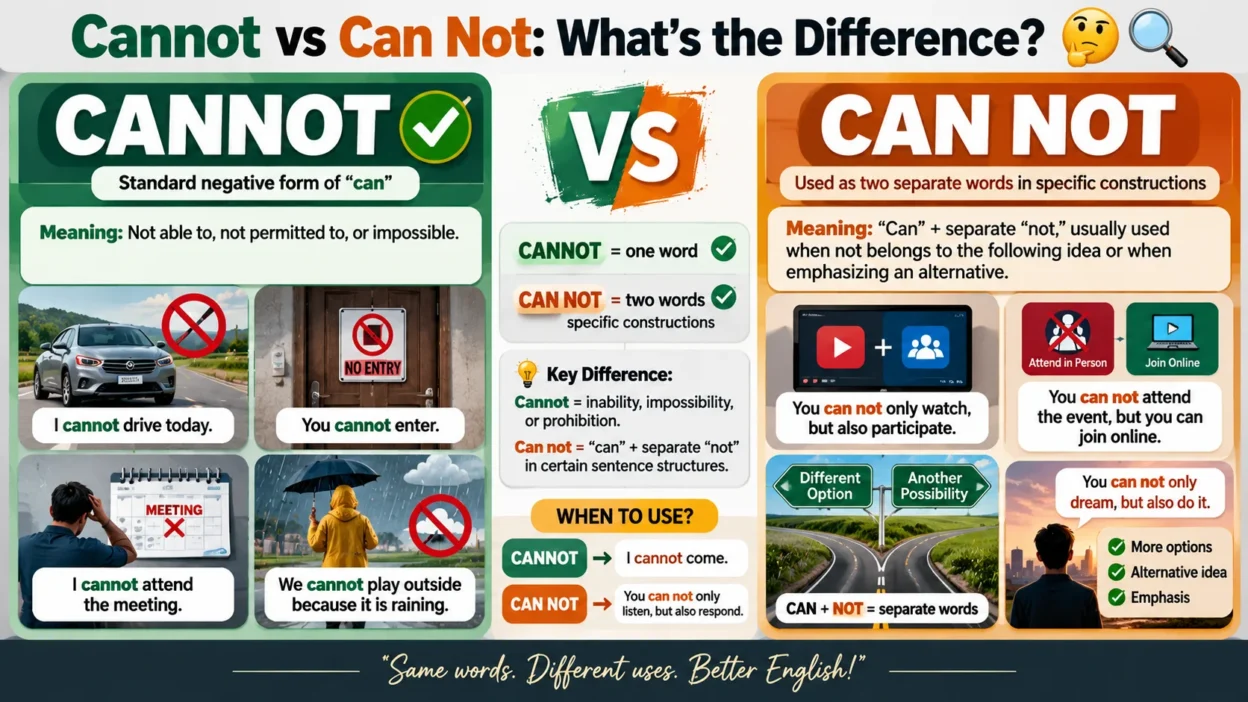
Simple rule: Use cannot when you mean “not able to” or “not permitted to.” Use can not when not belongs to another structure or needs deliberate emphasis. Major grammar references support cannot as the normal negative form.
📖 What Does Cannot Mean?
The word cannot expresses inability, impossibility, prohibition, or lack of permission. English speakers use this negative modal construction in everyday conversation and formal writing.
Definition of Cannot
Cannot means:
- Be unable to do something
- Be incapable of doing something
- Not have permission to do something
- Be impossible under particular circumstances
- Lack the opportunity to perform an action
For example:
I cannot swim.
Here, the speaker says that they do not have the ability to swim.
Another example shows prohibition:
You cannot enter this room without a badge.
Here, cannot means that the person does not have permission to enter.
Pronunciation
In American English, cannot commonly receives the pronunciation /ˈkæn.ɑt/, although connected speech can change the exact sound slightly.
Part of Speech
Cannot functions as the negative form of the modal verb can. Modal verbs work with a base verb:
- I cannot go.
- She cannot drive.
- We cannot wait.
- They cannot agree.
You do not normally add to after can or cannot.
Origin and Etymology
Cannot developed from the combination of can + not. English eventually established cannot as the standard closed spelling for ordinary negation. Modern grammar references recognize both spellings but overwhelmingly favor cannot for the normal negative meaning.
✍️ When Should You Use Cannot?
The standard cannot meaning appears whenever you simply want to negate can. This rule covers most sentences involving inability, impossibility, or prohibition.
Use cannot in sentences such as:
- I cannot attend the meeting.
- She cannot drive yet.
- We cannot accept your proposal.
- He cannot solve this puzzle.
- You cannot park here.
- They cannot enter without permission.
- This device cannot connect to Wi-Fi.
- We cannot finish the project today.
In each example, cannot directly creates the negative meaning of can.
Cambridge Grammar identifies cannot as the full form used for the negative meaning of can, while can’t provides the contracted form.
🚫 When Can You Use Can Not?
The phrase can not becomes useful when not performs a separate grammatical job. The clearest example appears in the construction not only … but also.
Consider:
She can not only sing but also dance.
Here, not belongs to the expression not only, so you should keep can and not separate.
You can also separate the words when the sentence means that someone has the ability or choice not to do something:
You can choose to stay, or you can not attend the event.
The meaning differs from a simple inability. The speaker presents not attending as an available choice.
The Chicago Manual of Style also gives examples where can not works because not belongs with the following action rather than directly negating can.
🆚 Cannot vs Can Not: Main Difference
The easiest way to understand the cannot vs can not difference involves asking what not modifies.
| Situation | Correct Form | Example |
|---|---|---|
| Simple inability | cannot | I cannot swim. |
| Lack of permission | cannot | You cannot enter. |
| Impossibility | cannot | This cannot happen. |
| “Not only” construction | can not | She can not only sing but also dance. |
| Ability to avoid an action | can not | You can not attend if you prefer. |
| Strong emphasis on “not” | can not can work | You can not use this equipment. |
The distinction matters because can not can create a different interpretation. The Language Portal of Canada specifically recommends cannot for the ordinary “be unable to” meaning and can not when writers emphasize not or connect it to another structure.
💬 Cannot vs Can Not: Example Sentences
These examples show how the two forms work in real sentences.
| Example Sentence | Meaning |
|---|---|
| I cannot come tonight. | I am unable to come. |
| She cannot solve the problem. | She lacks the ability to solve it. |
| You cannot park here. | Parking is not permitted. |
| We cannot ignore the warning. | We are unable or unwilling to ignore it. |
| This computer cannot run that software. | The computer lacks the capability. |
| He cannot attend the class. | He is unable to attend. |
| They cannot finish the work today. | Finishing today is not possible. |
| She can not only write but also edit. | She has both abilities. |
| You can not participate if you prefer. | You have the option not to participate. |
| We can choose to stay, or we can not go. | Not going remains an available choice. |
🔄 Synonyms of Cannot
The following cannot synonyms can help you vary your vocabulary when context allows:
| Synonym | Meaning |
|---|---|
| Unable to | Lacking the ability |
| Incapable of | Not having the capacity |
| Impossible to | Not possible |
| Forbidden to | Not permitted |
| Prohibited from | Officially not allowed |
| Not able to | Unable |
| Unavailable to | Not accessible or possible |
| Barred from | Prevented from entering or doing |
| Prevented from | Stopped from acting |
| Not permitted to | Lacking permission |
| Disallowed | Not allowed |
| Unfeasible | Not practical or possible |
| Unworkable | Unable to function successfully |
| Out of the question | Impossible or unacceptable |
| Beyond one’s ability | Too difficult to accomplish |
Choose the synonym according to context. Unable to usually describes ability, while forbidden and prohibited focus on permission or rules.
↔️ Antonyms of Cannot
The antonyms of cannot usually express ability, permission, or possibility.
| Antonym | Meaning |
|---|---|
| Can | Have ability or permission |
| Able to | Have the ability |
| Capable of | Have the capacity |
| Possible | Able to happen |
| Permitted to | Allowed |
| Allowed to | Given permission |
| Authorized to | Officially permitted |
| Free to | Having the choice |
| Possible to | Able to happen |
| Competent to | Having sufficient ability |
The most direct opposite remains can.
🧩 Related Terms and Vocabulary
Understanding related words makes the cannot meaning easier to recognize in different contexts.
| Related Word | Meaning |
|---|---|
| Can | Expresses ability or possibility |
| Can’t | Contraction of cannot |
| Could | Past ability or possibility |
| Could not | Negative form of could |
| May | Expresses permission or possibility |
| May not | Negative permission or possibility |
| Might | Expresses possibility |
| Must | Expresses necessity |
| Must not | Expresses prohibition |
| Should | Expresses advice or expectation |
| Unable | Lacking ability |
| Impossible | Unable to happen |
| Permission | Approval to do something |
| Ability | Capacity to perform an action |
| Prohibition | Rule against an action |
🌎 Cannot and Can Not in Real-Life Writing
The cannot vs can not usage appears across many forms of communication. In daily conversation, people often say can’t because contractions sound natural and informal. In professional and academic writing, writers frequently choose cannot instead.
Daily Conversation
You might hear:
I can’t come today.
You can write the same idea more formally:
I cannot come today.
Business Communication
Professional messages often favor cannot:
We cannot approve the request without additional documentation.
Academic Writing
Academic writers commonly use cannot when they need the full form:
Researchers cannot draw a final conclusion from this evidence alone.
Online Messaging
Text messages and social media often favor can’t:
I can’t believe this happened!
You should still use cannot when your writing needs a more formal tone.
⚠️ Common Cannot vs Can Not Mistakes
These mistakes often appear when writers treat the two forms as interchangeable.
| Mistake | Correct Usage |
|---|---|
| I can not swim. | I cannot swim. |
| She can not drive. | She cannot drive. |
| We can not accept it. | We cannot accept it. |
| You can not enter here. | You cannot enter here. |
| He cannot only sing but dance. | He can not only sing but also dance. |
| I can not attend the meeting. | I cannot attend the meeting. |
| They can not solve it. | They cannot solve it. |
| She can not understand the lesson. | She cannot understand the lesson. |
| You cannot only read but write. | You can not only read but also write. |
| I cannot choose not to go. | I can choose not to go. |
A useful test works in most ordinary situations: if you can replace the phrase with can’t without changing the intended meaning, cannot will usually fit.
❓ Frequently Asked Questions
1. Which is correct: cannot or can not?
Cannot is correct for ordinary negative statements. Use can not when not belongs to another grammatical structure or needs special emphasis.
2. Should I write “I cannot” or “I can not”?
Write I cannot when you mean “I am unable to.” For example, “I cannot attend the meeting” clearly expresses inability.
3. Why does “can not only” have a space?
Because not belongs to the phrase not only … but also. For example, “She can not only sing but also dance.”
4. Is cannot one word in American English?
Yes. American English commonly uses cannot as the standard full negative form of can.
5. Is cannot one word in British English?
Yes. British English also commonly uses cannot as the standard negative form.
6. What is the difference between cannot and can’t?
They generally express the same negative meaning. Cannot gives you the full form, while can’t provides the contraction.
7. Can “can not” mean “have the ability not to”?
Yes. In a sentence such as “You can not attend,” the wording can mean that you have the option or ability not to attend. Context determines the intended meaning.
8. What is the easiest way to remember the rule?
Use cannot for normal negation. Look for a special structure such as not only … but also before choosing can not.
🎯 Conclusion
The main rule for cannot vs can not remains simple: use cannot when you want to express the ordinary negative meaning of can. It can describe inability, impossibility, lack of permission, or prohibition. Use can not only when not has a separate grammatical role, such as in not only … but also, or when the sentence deliberately separates can from not.
When you write formal emails, academic assignments, articles, or professional documents, cannot usually gives you the clearest standard form. In casual conversations and messages, you can use can’t as its contraction. Once you understand what not modifies, the choice becomes much easier.

Andrew Foster is a researcher and content writer at Differopedia, specializing in clear, accurate, and easy-to-understand comparison guides, definitions, and informational articles. His work focuses on helping readers make informed decisions through well-researched, reliable content.