
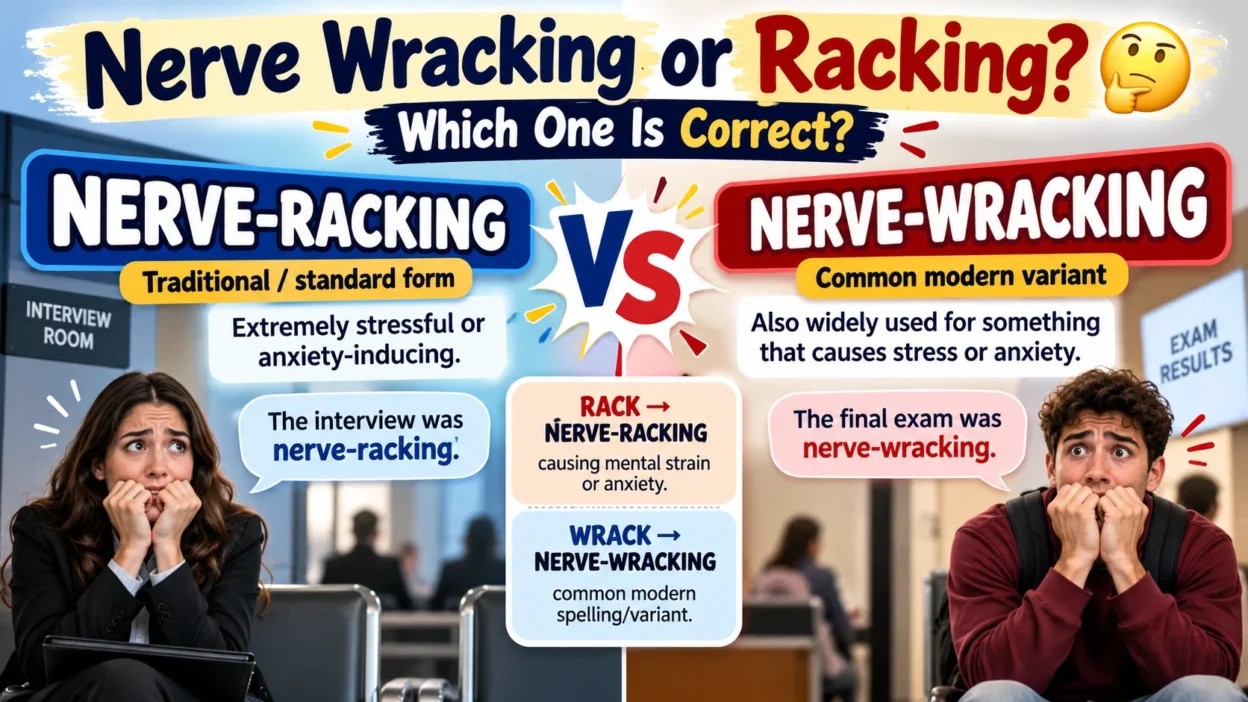
If you have ever wondered whether nerve wracking or racking is correct, you are not alone. You may also have seen nerve-wracking, nerve-racking, and even nerve-wrecking, which can make the spelling confusing. The traditional form is nerve-racking, while nerve-wracking has also become an accepted variant in modern English. Both expressions describe something that causes worry, nervousness, anxiety, or emotional tension. For polished writing, you can safely use nerve-racking with a hyphen, especially in formal or academic contexts. So, when you describe a stressful interview, difficult exam, tense competition, or anxious wait, “a nerve-racking experience” is a clear and natural choice.
⚡Nerve Wracking or Racking?
| Term | Meaning | Correct? | Best Use |
|---|---|---|---|
| nerve-racking | Causing worry or nervousness | ✅ Yes | Traditional form |
| nerve-wracking | Causing worry or nervousness | ✅ Yes | Accepted variant |
| nerve wracking | Intended to mean stressful | ⚠️ Less standard | Avoid in polished writing |
| nerve-wrecking | Usually intended to mean stressful | ❌ Not the standard expression | Avoid |
Nerve-racking has the longer-established history. Dictionary.com also lists nerve-wracking as a variant, and Cambridge explicitly gives both forms.
📖 What Does Nerve-Racking Mean?
Nerve-racking means causing a lot of worry, nervousness, anxiety, or emotional tension.
Cambridge defines the expression as something difficult that causes considerable worry. Oxford gives a similar definition: something that makes you feel very nervous and worried.
For example:
The job interview was nerve-racking.
This sentence tells us that the interview made the speaker feel very nervous.
You can describe many situations as nerve-racking, including:
- 😰 A job interview
- 📝 An important exam
- 🎤 A public speech
- ⏳ A long wait
- 🚗 A difficult drive
- 🏆 A close competition
- 💼 An important meeting
🔤 Pronunciation & Part of Speech 🗣️
Nerve-racking functions as an adjective.
In American English, dictionaries give the pronunciation approximately as /ˈnɝːvˌrækɪŋ/. British English uses a similar pronunciation. The two spellings nerve-racking and nerve-wracking normally sound the same because the w in wracking does not create a separate sound.
You can place the adjective before a noun:
It was a nerve-racking experience.
Or after a linking verb:
The experience was nerve-racking.
🏛️ Where Does Nerve-Racking Come From?
The traditional spelling connects racking with the verb rack, which has meanings related to stretching, straining, or tormenting.
The expression nerve-racking dates back to the early 19th century. Etymological sources place the original form around 1812, while nerve-wracking appeared later.
The later nerve-wracking spelling probably developed because English speakers often confuse rack and wrack. Their similar pronunciation makes the confusion even easier.
Today, dictionaries recognize nerve-wracking as a variant rather than treating it simply as an accidental spelling mistake.
🆚 Nerve-Racking vs. Nerve-Wracking
The biggest question is whether the two forms have different meanings.
They generally do not.
| Feature | Nerve-Racking | Nerve-Wracking |
|---|---|---|
| Meaning | Causes nervousness or worry | Causes nervousness or worry |
| Part of speech | Adjective | Adjective |
| Pronunciation | Same | Same |
| Status | Traditional form | Accepted variant |
| Hyphenation | Nerve-racking | Nerve-wracking |
Cambridge lists nerve-wracking as another form of nerve-racking, while Oxford does the same.
Therefore, you do not need to worry that nerve-wracking automatically makes your sentence wrong.
If you want the traditional spelling, choose nerve-racking.
✍️ Should You Write “Nerve Wracking” Without a Hyphen?
When the expression works as a compound adjective, the hyphenated form gives you the clearest standard spelling:
nerve-racking
or
nerve-wracking
For example:
She had a nerve-racking interview.
Waiting for the results was nerve-wracking.
You may see nerve wracking without a hyphen in search queries, casual posts, or informal online writing. However, edited writing generally favors the hyphenated forms.
🚫 Is “Nerve-Wrecking” Correct?
Nerve-wrecking often appears because people associate the expression with wreck, meaning to damage or destroy something.
However, when you mean stressful or anxiety-inducing, standard dictionaries support nerve-racking and nerve-wracking, not nerve-wrecking. Grammar-focused sources also identify nerve-wrecking as a common incorrect form.
Compare:
❌ The interview was nerve-wrecking.
✅ The interview was nerve-racking.
✅ The interview was nerve-wracking.
The second and third sentences express the intended meaning clearly.
📝 10 Examples of Nerve-Racking
| Example Sentence | Meaning |
|---|---|
| The job interview was nerve-racking. | It caused a lot of nervousness. |
| Waiting for my exam results was nerve-racking. | The uncertainty caused anxiety. |
| Driving through the storm was nerve-racking. | The difficult drive created tension. |
| Giving my first speech felt nerve-racking. | Public speaking made me nervous. |
| The final minutes of the game were nerve-racking. | The uncertain result created tension. |
| That phone call was nerve-racking. | The conversation caused worry. |
| The long wait became nerve-racking. | Waiting increased the speaker’s anxiety. |
| Her first performance was nerve-racking. | Performing made her nervous. |
| The difficult decision was nerve-racking. | The decision created considerable stress. |
| The flight became nerve-racking during the turbulence. | The situation caused nervousness. |
Oxford specifically lists experience and wait among natural words that commonly appear with nerve-racking.
🔄 Useful Synonyms for Nerve-Racking
You can replace nerve-racking with several words depending on the context.
| Synonym | Meaning |
|---|---|
| Stressful | Causing stress |
| Anxious | Connected with worry |
| Worrying | Causing concern |
| Tense | Full of emotional pressure |
| Trying | Difficult or demanding |
| Unnerving | Making someone nervous |
| Distressing | Causing emotional discomfort |
| Unsettling | Making someone uncomfortable |
| Troubling | Causing concern |
| Alarming | Causing fear or worry |
| Worrisome | Likely to cause worry |
| Disquieting | Creating uneasiness |
| Difficult | Hard to handle |
| Taxing | Requiring considerable effort |
| Nail-biting | Extremely tense or suspenseful |
Cambridge lists stressful and trying as direct synonyms, while Collins gives tense, trying, difficult, and worrying.
↔️ Antonyms of Nerve-Racking 🌿
The opposite of something nerve-racking creates calm rather than anxiety.
| Antonym | Meaning |
|---|---|
| Calming | Reducing nervousness |
| Relaxing | Helping you feel relaxed |
| Peaceful | Free from tension |
| Reassuring | Reducing worry |
| Comforting | Providing emotional comfort |
| Soothing | Creating calm |
| Pleasant | Enjoyable |
| Serene | Very calm |
| Tranquil | Peaceful and quiet |
| Stress-free | Free from significant stress |
For example, a nerve-racking interview may leave you anxious, while a reassuring conversation can help you relax.
⚠️ Common Mistakes to Avoid
| Mistake | Correct Usage |
|---|---|
| nerve wracking experience | nerve-racking experience |
| nerve-wrecking interview | nerve-racking interview |
| nerve racking situation | nerve-racking situation |
| nerve-raking experience | nerve-racking experience |
| nerve wracking wait | nerve-racking wait |
| The exam was nerve-wrecking. | The exam was nerve-racking. |
| Nerve-wracking has a different meaning. | Both forms generally share the same meaning. |
| The w in wracking has a separate sound. | The w remains silent. |
| Nerve-racking means physically damaging nerves. | It normally means emotionally stressful or worrying. |
| You must always call nerve-wracking incorrect. | Major dictionaries recognize it as a variant. |
💬 How People Use Nerve-Racking in Real Life
People use nerve-racking in everyday conversations when they want to emphasize nervousness or uncertainty.
You might hear:
“That was a nerve-racking interview.”
“Waiting for the results was nerve-racking.”
“The final five minutes were so nerve-racking!”
The word also works well in social media posts and online messages. People often use it to describe suspenseful games, difficult experiences, important decisions, or stressful situations.
In formal writing, you can also use it, although stressful, anxiety-inducing, or difficult may sound more technical in an academic context.
❓ FAQs
Is it nerve-racking or nerve-wracking?
Both forms are accepted. Nerve-racking represents the traditional form, while nerve-wracking has become an established variant.
Is nerve-wracking grammatically correct?
Yes. Cambridge and Oxford both list nerve-wracking as a variant of nerve-racking.
Does nerve-racking mean stressful?
Yes. It describes something that causes considerable worry, anxiety, nervousness, or tension.
Is nerve-wrecking correct?
Use nerve-racking or nerve-wracking when you mean stressful or anxiety-inducing. Nerve-wrecking does not represent the standard expression.
Should I use a hyphen?
Yes. Write nerve-racking or nerve-wracking when the expression functions as a compound adjective.
Do nerve-racking and nerve-wracking sound the same?
Yes. The two forms normally have the same pronunciation, even though their spellings differ.
What is another word for nerve-racking?
Depending on the context, you can use stressful, worrying, tense, trying, unnerving, distressing, or anxiety-inducing.
What is the safest spelling for formal writing?
Nerve-racking offers the traditional spelling and works well in formal writing. However, modern dictionaries also accept nerve-wracking.
🎯 Final Verdict: Which One Should You Choose?
If you need a simple rule, remember nerve-racking as the traditional spelling and nerve-wracking as an accepted modern variant. Both forms describe something that causes considerable nervousness, worry, anxiety, or tension. Cambridge, Oxford, Dictionary.com, and Collins all support the relationship between the two forms.
For polished writing, use the hyphen. If you want the most traditional option, choose nerve-racking. Avoid nerve-wrecking when you mean stressful.
So, the next time you describe a stressful interview, tense exam, uncertain wait, or difficult experience, you can confidently write: “It was a nerve-racking experience.”

Andrew Foster is a researcher and content writer at Differopedia, specializing in clear, accurate, and easy-to-understand comparison guides, definitions, and informational articles. His work focuses on helping readers make informed decisions through well-researched, reliable content.