
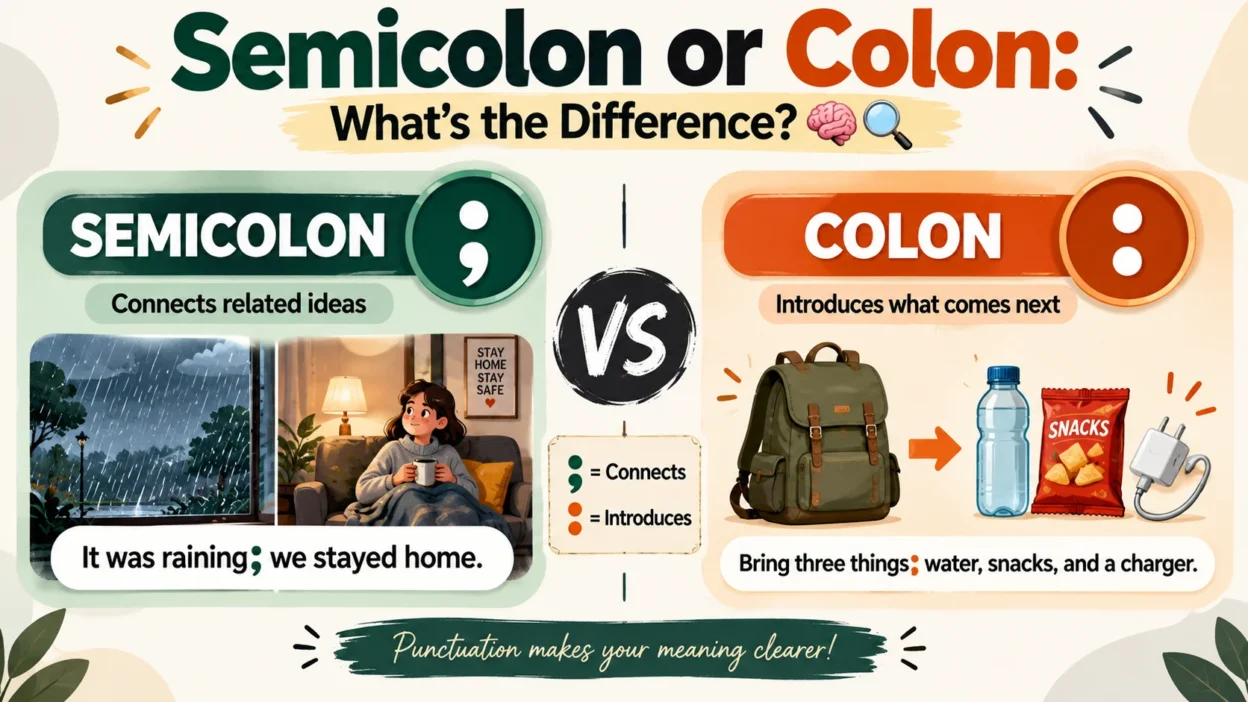
Have you ever wondered whether to use a semicolon or colon while writing? Although these punctuation marks look similar, they serve different purposes. A semicolon (;) connects closely related independent clauses, while a colon (:) introduces a list, explanation, example, or additional information. For example, “The store was closing; we hurried home” connects two related thoughts, while “We had one goal: get home before dark” introduces a specific idea. In this guide, you’ll learn the key differences, usage rules, examples, and common mistakes so you can choose the right punctuation mark with confidence.
Quick Answer Table
| Term | Meaning | Usage | Category |
|---|---|---|---|
| Semicolon (;) | Connects closely related complete thoughts | Joins independent clauses | Punctuation |
| Colon (:) | Introduces information that follows | Introduces lists, explanations, and examples | Punctuation |
| Semicolon vs. colon | Choice between two punctuation marks | Helps writers select the correct mark | Grammar |
| ; | Semicolon symbol | Connects related clauses or separates complex list items | Punctuation |
| : | Colon symbol | Introduces or emphasizes following information | Punctuation |
Simple rule: A semicolon connects, while a colon introduces.
What Does Semicolon or Colon Mean?
The phrase semicolon or colon refers to the choice between two punctuation marks.
Semicolon Definition
A semicolon looks like a period above a comma: ;. Writers mainly use it to connect two closely related independent clauses without a coordinating conjunction.
Example:
The rain stopped; we continued our walk.
Both sides can stand as complete sentences:
- The rain stopped.
- We continued our walk.
The semicolon shows that the writer wants readers to see a close connection between those thoughts.
Colon Definition
A colon contains two vertically aligned dots: :. Writers use it to introduce information that explains, identifies, illustrates, or expands on what came before.
Example:
She packed three essentials: water, food, and sunscreen.
The first part prepares the reader for the information after the colon.
Pronunciation
You pronounce semicolon and colon as the names of the punctuation marks. In normal speech, people usually describe the punctuation rather than pronounce the symbol itself.
Part of Speech
Both semicolon and colon function as nouns.
Examples:
- I need a semicolon here.
- Add a colon before the list.
- The editor corrected the semicolon.
Origin and Etymology
The word semicolon combines semi- with colon and historically describes a punctuation mark that creates a break between a comma-level pause and a stronger sentence-ending pause.
Colon comes through Latin from Greek terminology associated with a clause or part of a sentence.
Semicolon vs. Colon: The Main Difference
The biggest difference involves the relationship between the information on each side.
A semicolon connects two related, balanced thoughts:
The meeting ended late; everyone went home.
A colon points forward to an explanation or specific information:
The meeting ended with one decision: everyone would return tomorrow.
The semicolon treats both clauses as independent ideas. The colon makes the second part explain or identify the first. Grammar references commonly describe this distinction as connection versus introduction or expansion.
Easy Memory Trick
Remember:
Semicolon = connects.
Colon = introduces.
You can also think of a colon as saying, “Here is what I mean.”
A semicolon says, “These two ideas belong together.”
When Should You Use a Semicolon?
1. Connect Two Independent Clauses
Use a semicolon when two complete sentences have a close relationship.
The weather changed suddenly; we canceled the picnic.
Both parts can stand alone.
2. Connect Ideas Without “And” or “But”
A semicolon can connect two independent clauses without a coordinating conjunction.
I wanted to call her; my phone had no signal.
You could also write:
I wanted to call her, but my phone had no signal.
3. Use a Semicolon Before Transitional Words
You can place a semicolon before words such as however, therefore, nevertheless, consequently, and meanwhile when they connect independent clauses.
The task looked difficult; however, we finished it quickly.
The semicolon separates the independent clauses, while however shows their relationship.
4. Separate Complicated List Items
Use semicolons to separate list items when those items already contain commas.
The speakers came from Austin, Texas; Denver, Colorado; and Miami, Florida.
The semicolons make each location easier to identify.
When Should You Use a Colon?
1. Introduce a List
Use a colon after a complete thought when you want to introduce a list.
We bought three fruits: apples, oranges, and bananas.
Do not place a colon directly after an incomplete phrase such as:
We bought: apples, oranges, and bananas.
Instead, write:
We bought apples, oranges, and bananas.
The clause before the colon should normally stand independently.
2. Introduce an Explanation
A colon can introduce information that explains the preceding statement.
She had one concern: the deadline was approaching.
The second part explains the concern.
3. Introduce an Example
You can use a colon when the following information illustrates the previous idea.
Several punctuation marks can clarify writing: commas, colons, and semicolons.
4. Introduce a Quotation
A colon can introduce a quotation when the preceding sentence provides a suitable introduction.
The teacher gave us one important reminder: “Check your work carefully.”
MLA guidance also recognizes the colon as a way to connect a statement with a following explanation or quotation.
Semicolon or Colon: 10 Usage Examples
| Example Sentence | Meaning |
|---|---|
| The sun disappeared; the temperature dropped. | The semicolon connects related thoughts. |
| I finished my homework; then I watched television. | The semicolon links related actions. |
| She wanted to travel; her brother preferred to stay home. | It connects contrasting ideas. |
| We had one problem: nobody brought the key. | The colon introduces an explanation. |
| He needs three things: time, patience, and practice. | The colon introduces a list. |
| The road was dangerous; we drove slowly. | The semicolon connects two complete clauses. |
| She had one goal: win the competition. | The colon introduces the goal. |
| The team faced several challenges: injuries, delays, and bad weather. | The colon introduces examples. |
| I called twice; nobody answered. | The semicolon connects related complete thoughts. |
| Remember this rule: practice improves your writing. | The colon introduces an explanation. |
Semicolon vs. Colon: Synonyms and Related Grammar Terms
Punctuation marks do not have true synonyms in the same way ordinary vocabulary words do. However, several grammar terms describe related functions.
| Related Term | Meaning |
|---|---|
| Punctuation | Marks that organize written language |
| Independent clause | A complete grammatical thought |
| Dependent clause | A clause that cannot normally stand alone |
| Sentence | A complete grammatical unit |
| Comma | A punctuation mark that creates a shorter pause |
| Period | A punctuation mark that ends a declarative sentence |
| Colon | A mark that introduces following information |
| Semicolon | A mark that connects closely related clauses |
| Clause | A group of words containing a subject and verb |
| List | A sequence of related items |
| Explanation | Information that makes an idea clearer |
| Example | Information that illustrates an idea |
| Quotation | Reproduced words from a speaker or source |
| Transition | A word or phrase that connects ideas |
| Grammar | Rules governing language structure |
Where Do People Use Semicolons and Colons?
You will encounter these punctuation marks in many types of writing.
Daily Conversation
People rarely notice punctuation during speech, but writers use semicolons and colons when they turn spoken ideas into written sentences.
Social Media
Writers sometimes use colons to introduce lists, explanations, or dramatic points. Semicolons can connect short, related statements.
Business Communication
Professional emails and reports often use colons for lists and semicolons for closely connected clauses.
Our priorities are clear: improve service, reduce delays, and support customers.
Academic Writing
Students and researchers use both marks to create precise sentence relationships. Academic writing often benefits from clear punctuation because complex ideas need easy-to-follow structures.
Online Messaging
You can use either mark in messages, although casual writing often favors simpler punctuation. Correct usage still matters when you want your message to look polished.
Common Semicolon and Colon Mistakes
| Mistake | Correct Usage |
|---|---|
| She bought three items; milk, bread, and eggs. | She bought three items: milk, bread, and eggs. |
| I was tired, I continued working. | I was tired; I continued working. |
| My favorite colors are: red and green. | My favorite colors are red and green. |
| The rain stopped: we went outside. | The rain stopped; we went outside. |
| He had one goal; win the race. | He had one goal: win the race. |
| Although it was late; we continued. | Although it was late, we continued. |
| The team arrived; however, the game had ended. | The team arrived; however, the game had ended. |
| She needed: patience and time. | She needed patience and time. |
| We visited Paris, France, Rome, Italy, and Madrid, Spain. | We visited Paris, France; Rome, Italy; and Madrid, Spain. |
| I knew the answer; because I studied. | I knew the answer because I studied. |
A common mistake involves placing a colon after an incomplete clause. Another involves using a semicolon to introduce an ordinary list. Grammar resources consistently identify these errors as important punctuation problems.
FAQs
1. What is the easiest way to remember semicolon vs. colon?
Remember semicolon = connection and colon = introduction. A semicolon connects related thoughts, while a colon points toward information that explains or expands on the preceding idea.
2. Which mark introduces a list?
The colon normally introduces a list after a complete clause. For example, “Bring these items: water, food, and sunscreen.”
3. Which mark joins two independent clauses?
The semicolon commonly joins two closely related independent clauses without a coordinating conjunction.
4. Can I replace a semicolon with a period?
Often, yes. If both sides contain complete sentences, you can usually replace the semicolon with a period. The semicolon simply keeps the related thoughts more closely connected.
5. Can I replace a colon with a semicolon?
Usually, no. A colon creates a specific relationship in which the following material explains, expands, identifies, or illustrates the preceding material.
6. Why do writers confuse colons and semicolons?
The marks look similar and both can appear between substantial pieces of information. Their grammatical functions, however, differ.
Conclusion
Understanding semicolon or colon becomes easier when you focus on how the ideas connect. A semicolon (;) joins two closely related independent clauses, while a colon (:) introduces a list, explanation, example, or additional information. When two complete thoughts belong closely together, choose a semicolon; when the second part explains or expands on the first, choose a colon. Remember that colons can introduce lists, examples, explanations, and quotations, while semicolons can separate complex list items. With practice, you can use both punctuation marks naturally and make your writing clearer and more precise.
semicolon-or-colon.

Andrew Foster is a researcher and content writer at Differopedia, specializing in clear, accurate, and easy-to-understand comparison guides, definitions, and informational articles. His work focuses on helping readers make informed decisions through well-researched, reliable content.