Have you ever typed damn or danm and wondered which spelling is correct? The confusion often comes from the silent n in damn, which makes its pronunciation different from its spelling. The correct spelling is damn, while danm usually appears as a typing or spelling mistake. People use damn to express frustration, surprise, anger, disappointment, admiration, or strong emphasis. The word can also function as a verb or intensifier in different contexts. In this guide, you will learn the meaning, pronunciation, origin, examples, synonyms, common mistakes, and proper usage of damn.
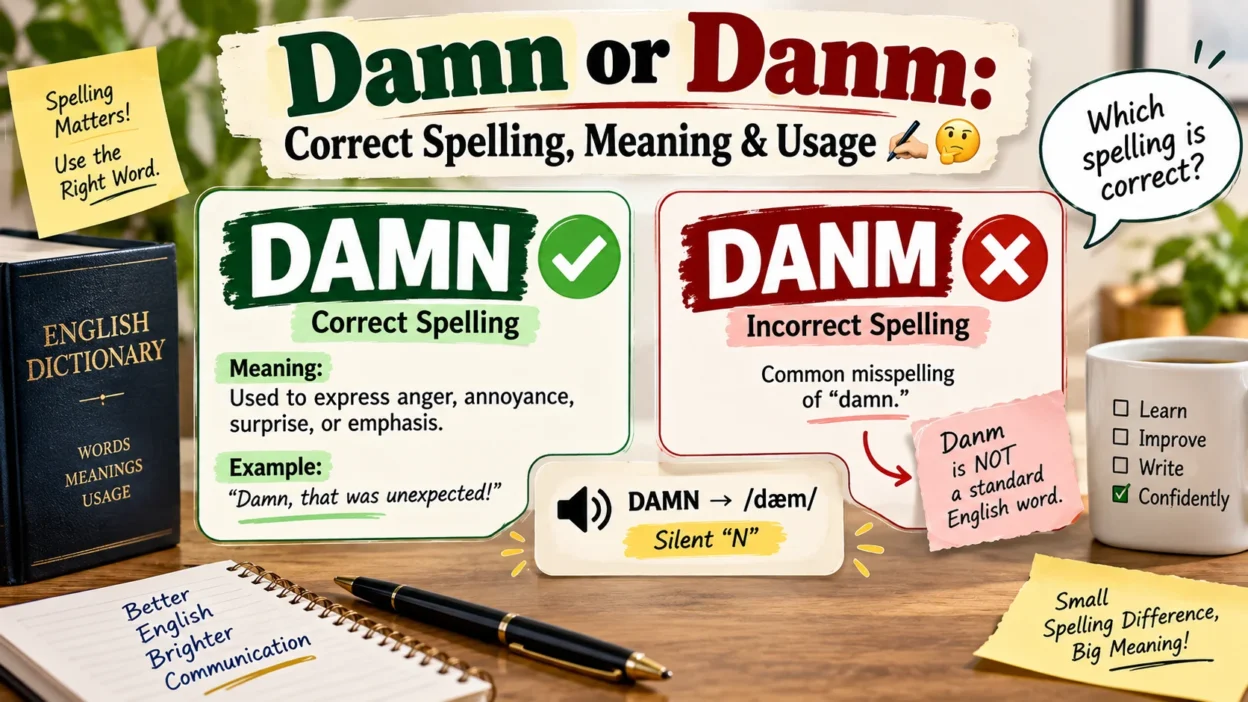
Damn or Danm: Quick Answer ✅
| Term | Meaning | Usage | Category |
|---|---|---|---|
| Damn | Standard English word expressing emotion, emphasis, or condemnation | Casual speech, writing, dialogue | Correct |
| Danm | Common misspelling of damn | Typing mistakes | Incorrect |
| Dam | A structure that holds back water | Geography, engineering | Different word |
| Dame | A title or term for a woman | Names and formal titles | Different word |
Simple rule: Write damn, not danm, when you mean the common English word.
Correct: Damn, I forgot my keys.
Incorrect: Danm, I forgot my keys.
Both American and British English use damn with the same spelling.
What Does Damn Mean? 📖
Damn has several meanings depending on context.
As an interjection, it expresses a strong reaction:
Damn! I missed the bus.
Here, the speaker shows frustration.
As an intensifier, it adds emphasis:
That was a damn good movie.
Here, damn strengthens “good.”
As a verb, it can mean to condemn or strongly criticize:
The report damned the decision as irresponsible.
The word has also developed several informal expressions that people commonly use in conversation, texting, entertainment, and social media.
How Do You Pronounce Damn? 🔊
Most English speakers pronounce damn as /dæm/. The final n normally remains silent. This pronunciation makes damn sound like dam, which creates much of the spelling confusion.
You should remember this simple pattern:
Spelling: D-A-M-N
Pronunciation: approximately “dam”
The n stays in the spelling even though you normally do not hear it.
Why Do People Write Danm? 🤔
People usually write danm for three reasons:
- The silent n: Speakers do not hear the final n.
- Fast typing: People can accidentally reverse adjacent letters.
- Phonetic spelling: English learners sometimes spell words according to sound.
The correct letter order remains D-A-M-N, not D-A-N-M. Spelling references specifically list danm among common misspellings of damn.
A useful memory trick makes this easy:
DAM + N = DAMN
Think of dam, then add the silent n.
Damn: Part of Speech and Origin 🏛️
The word damn can function as a verb, interjection, and informal intensifier.
Its history goes back through Middle English and Old French to Latin damnāre, meaning “to condemn” or “to inflict loss.” The Latin noun damnum meant loss or harm.
Over centuries, English speakers expanded the word’s use. Today, casual speakers often use it to express strong emotion rather than literal condemnation.
This history also explains why the spelling contains an n even though modern speakers generally leave that sound silent.
Damn in Everyday English 💬
People use damn in several emotional situations.
Frustration
Damn, I forgot my wallet.
The speaker expresses annoyance.
Surprise
Damn! That’s a huge house.
The speaker reacts to something unexpected.
Admiration
Damn, you did an amazing job!
Here, the speaker expresses strong approval or surprise.
Emphasis
This is damn difficult.
The word intensifies “difficult.”
Disappointment
Damn, we lost the game.
The speaker expresses disappointment.
The meaning depends heavily on context and tone.
Damn in Texting and Social Media 📱
You will often see damn in casual messages, comments, captions, and social media conversations.
Examples include:
- “Damn, that’s wild.”
- “Damn, I forgot.”
- “Damn! That was close.”
- “Damn, you look great.”
- “This is damn expensive.”
People may also stretch the word in informal texting, such as damnnn, to add emotional emphasis. However, these creative spellings do not change the standard spelling: damn.
Search results also show that people commonly ask about “danm meaning in chat,” “how to spell damn,” and similar queries because of this informal online usage.
Damn vs Dam vs Danm vs Dame 🔍
These words look similar but have different meanings.
| Word | Meaning | Example |
|---|---|---|
| Damn | Exclamation, intensifier, or verb | Damn, that’s surprising. |
| Dam | Structure that controls water | The dam holds back the river. |
| Danm | Misspelling of damn | Danm is incorrect here. |
| Dame | Title or form of address | Dame Helen Mirren received the title. |
The dam/damn confusion makes particular sense because both words normally sound alike.
However, their meanings differ completely.
Is Damn a Swear Word? ⚠️
Yes. Many English speakers consider damn a mild swear word or profanity. Its perceived strength varies according to culture, audience, setting, and personal preference.
You may hear it in:
- Casual conversations
- Movies and television
- Fictional dialogue
- Text messages
- Social media
- Informal writing
You should consider a softer alternative in formal or sensitive situations.
For example:
Informal:
Damn, that was difficult.
Neutral:
That was extremely difficult.
For a milder emotional expression, darn, gosh, wow, or shoot may work depending on the context.
Is Damn Formal or Informal? 📝
People generally treat damn as informal. You can use it naturally in casual conversation, creative dialogue, and social media, but formal communication usually calls for more neutral wording.
| Situation | Better Approach |
|---|---|
| Texting a friend | Damn can fit |
| Casual conversation | Damn can fit |
| Social media | Depends on audience |
| Business email | Prefer neutral wording |
| Academic essay | Usually avoid it |
| Official document | Use formal alternatives |
Always consider your audience before using profanity.
10 Damn Examples With Meanings 💡
| Example Sentence | Meaning |
|---|---|
| Damn! I missed the train. | Frustration |
| Damn, that’s expensive. | Surprise |
| That was a damn good meal. | Strong emphasis |
| Damn, you finished already? | Surprise |
| Damn! We lost again. | Disappointment |
| This test is damn difficult. | Emphasis |
| Damn, that looks amazing. | Admiration |
| I damn well know the truth. | Strong emphasis |
| Damn it, I forgot my phone. | Anger or frustration |
| The critic damned the decision. | Strong condemnation |
15 Synonyms for Damn 🔄
| Synonym | Meaning |
|---|---|
| Condemn | Express strong disapproval |
| Denounce | Publicly criticize |
| Decry | Condemn openly |
| Censure | Express formal disapproval |
| Criticize | Point out faults |
| Blame | Hold responsible |
| Berate | Criticize strongly |
| Reproach | Express disappointment |
| Curse | Use a curse or profanity |
| Swear | Use offensive language |
| Darn | Use a milder expression |
| Gosh | Mild surprise |
| Shoot | Mild frustration |
| Wow | Strong surprise |
| Blast | Informally express anger |
Not every synonym works in every sentence. Choose one according to the intended meaning.
10 Contrasting Words for Damn ↔️
When damn means condemn or criticize, these words provide useful contrasts:
| Word | Meaning |
|---|---|
| Praise | Express approval |
| Approve | Accept positively |
| Commend | Praise strongly |
| Support | Show approval |
| Encourage | Give confidence |
| Forgive | Release blame |
| Accept | Receive positively |
| Celebrate | Show positive recognition |
| Defend | Support against criticism |
| Exonerate | Clear someone from blame |
Common Mistakes With Damn ❌
| Mistake | Correct Usage |
|---|---|
| Danm, that’s good. | Damn, that’s good. |
| This is dam good. | This is damn good. |
| Danm it! | Damn it! |
| I wrote danm yesterday. | I wrote damn yesterday. |
| Danm, I forgot. | Damn, I forgot. |
| That was dam difficult. | That was damn difficult. |
| Danm right! | Damn right! |
| He is danm serious. | He is damn serious. |
| A danm good idea | A damn good idea |
| I damn? when you mean water | Use dam for a water barrier |
Related Terms and Expressions 🔗
| Related Word | Meaning |
|---|---|
| Damned | Past form or adjective |
| Damning | Strongly condemning |
| Damn it | Expression of frustration |
| Damn right | Strong agreement |
| Damn well | Strong emphasis |
| Damn good | Very good |
| Damn sure | Very certain |
| Damnable | Worthy of condemnation |
| Condemn | Strongly criticize |
| Curse | Invoke harm or use profanity |
| Profanity | Offensive or irreverent language |
| Swear word | Offensive expression |
| Intensifier | Word that adds emphasis |
| Interjection | Emotional expression |
| Misspelling | Incorrect written form |
FAQs 📚
Is it damn or danm?
Damn is correct. Danm is a misspelling.
How do you spell damn?
Spell it D-A-M-N.
What does damn mean?
It can express frustration, surprise, anger, admiration, or emphasis. As a verb, it can mean condemn.
Is damn offensive?
Many speakers consider it mild profanity, so context matters.
What is a softer word for damn?
Darn often works as a milder substitute, while gosh, wow, and shoot can fit certain contexts.
Is dam the same as damn?
No. A dam holds back water, while damn commonly expresses emotion or emphasis.
Conclusion 🎯
When you wonder about damn or danm, remember that damn is the correct spelling. Danm usually appears as a spelling or typing mistake. The word damn can express frustration, surprise, anger, admiration, or strong emphasis. You can use it in casual conversations, texting, and social media, but formal writing may require softer alternatives. The easiest way to remember it is DAM + N = DAMN. Always keep the silent n when you spell the word.

Andrew Foster is a researcher and content writer at Differopedia, specializing in clear, accurate, and easy-to-understand comparison guides, definitions, and informational articles. His work focuses on helping readers make informed decisions through well-researched, reliable content.