The difference between gift vs present often confuses English learners because both words describe something you give to another person without expecting payment. People commonly use these terms for birthdays, Christmas, weddings, anniversaries, and other special occasions. Although both words share almost the same meaning, they have slightly different uses and associations. Understanding these differences helps you choose the right word in everyday conversations, emails, and writing. A gift can describe a physical item, a thoughtful gesture, or even a natural talent, while a present usually refers to something you give another person to celebrate an occasion or show appreciation. For example, you might receive a beautiful birthday present from a friend, while someone might say you have a special gift for singing. In this guide, we’ll explore their meanings, origins, differences, and practical examples to help you use both words correctly.
🎁 Gift vs Present
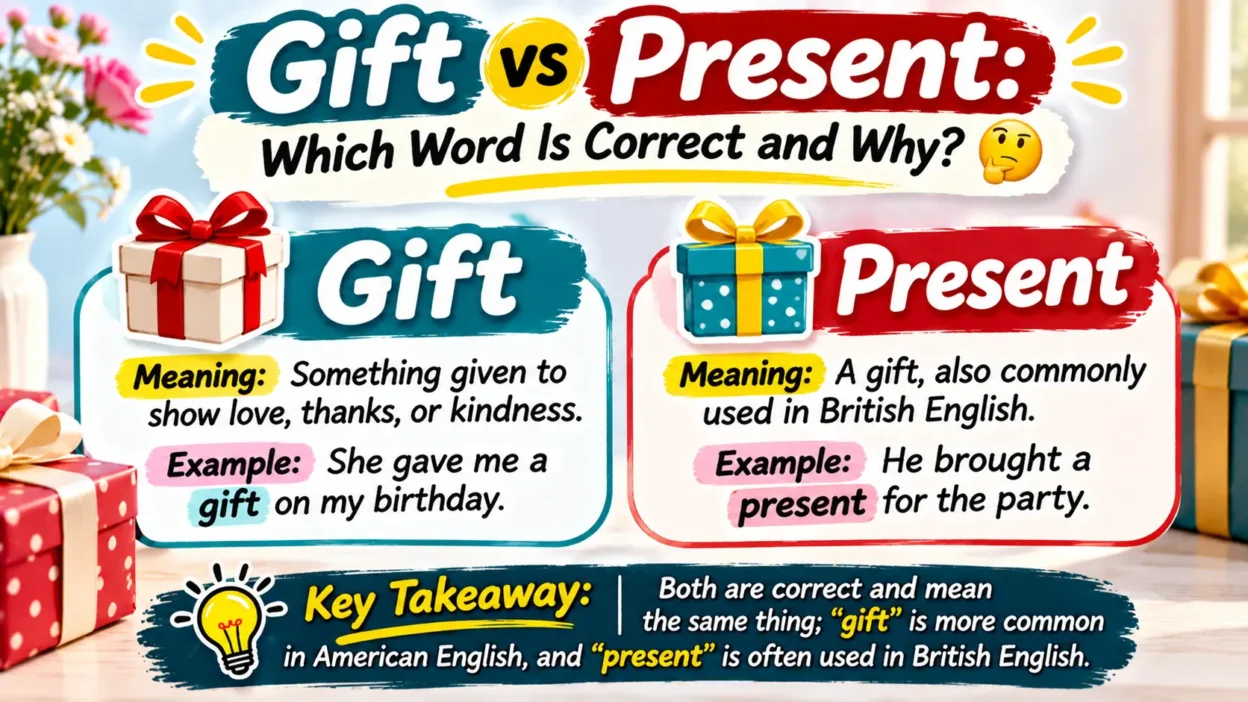
Gift and present both describe something that one person gives to another without expecting payment. However, gift has a broader meaning because it can also describe a natural talent or ability.
| Term | Meaning | Usage | Category |
|---|---|---|---|
| Gift | Something given freely or a natural ability | Birthday gift, special gift, gift for music | Noun and verb |
| Present | Something given to another person | Christmas present, birthday present | Noun and verb |
Quick tip: Use gift when discussing an item or someone’s natural ability. Use present when talking about something someone gives for a special occasion.
📖 What Does Gift Mean?
A gift is something that you voluntarily give to another person without expecting money or anything in return. People give gifts to express love, kindness, gratitude, friendship, and appreciation.
The word also describes someone’s natural ability or special talent. For example, a person might have a gift for painting, singing, teaching, or solving difficult problems.
- Pronunciation: /ɡɪft/
- Part of speech: Noun and verb
- Meaning: Something given freely or a natural talent
- Plural: Gifts
- Origin: From Old Norse gift, meaning something given or bestowed.
Examples:
- My sister gave me a beautiful birthday gift.
- She has a natural gift for music.
- Thank you for this thoughtful gift.
🎀 What Does Present Mean?
A present is something that one person gives another person, usually to celebrate a special occasion or express affection. People commonly use this word when discussing birthdays, Christmas, weddings, anniversaries, and holidays.
As a verb, present means to formally give, offer, or introduce something to someone. However, the pronunciation changes depending on its grammatical role.
- Pronunciation (noun): /ˈprez.ənt/
- Pronunciation (verb): /prɪˈzent/
- Part of speech: Noun and verb
- Meaning: Something given to someone or formally offered
- Plural: Presents
- Origin: From Latin praesentare, meaning to place before or offer, through Old French.
Examples:
- I bought my mother a lovely present.
- We exchanged Christmas presents.
- The teacher will present the award tomorrow.
🔍 What Is the Difference Between Gift and Present?
Gift and present have almost identical meanings when they describe something given to another person. However, their contexts can help you decide which word sounds more natural.
The main distinction involves the broader meaning of gift. People use it for both physical objects and natural abilities, while present generally describes an item someone gives another person.
| Gift | Present |
|---|---|
| Has a broader meaning | Usually describes something given |
| Can describe natural talents | Does not normally describe talents |
| Works in formal and informal English | Common in everyday conversations |
| Can function as a noun and verb | Can function as a noun and verb |
| Appears in expressions about generosity | Often appears in celebration-related expressions |
Examples:
- She has a gift for writing beautiful stories.
- I bought her a birthday present.
- His gift for leadership impressed everyone.
- My parents gave me a wonderful Christmas present.
You can usually replace present with gift when discussing physical items. However, you cannot naturally replace gift with present when discussing someone’s abilities.
💬 Gift vs Present: Example Sentences
These sentences demonstrate how people use both words in everyday American English.
| Example Sentence | Meaning |
|---|---|
| I bought my brother a birthday gift. | Something given for a birthday |
| She received a beautiful present. | An item someone gave her |
| This watch is a gift from my father. | Something given out of love |
| He has a natural gift for music. | A special musical ability |
| We exchanged Christmas presents. | Items exchanged during Christmas |
| Thank you for your thoughtful gift. | Appreciation for something received |
| My friend gave me a wedding present. | Something given to celebrate marriage |
| Teaching is her greatest gift. | A natural teaching ability |
| They prepared presents for the children. | Items prepared for children |
| I want to give you a special gift. | Something offered voluntarily |
✍️ Is Gift a Noun or a Verb?
The word gift works as both a noun and a verb. Its meaning depends on how you use it in a sentence.
As a noun, it describes something someone gives or a natural ability. As a verb, it means to give something to another person, often as a generous gesture.
Noun examples:
- Her gift made everyone smile.
- He has a gift for storytelling.
Verb examples:
- They gifted their son a new laptop.
- The company gifted scholarships to talented students.
In everyday American English, people often prefer give instead of gift as a verb. However, gift also appears in business communication, promotional writing, and formal announcements.
🎄 When Should You Use Gift or Present?
Both words work in several situations, but certain expressions sound more natural with one than the other.
Use gift when:
- You describe someone’s natural talent.
- You discuss donations or charitable contributions.
- You want to express generosity or appreciation.
- You describe something valuable someone gives you.
Use present when:
- You discuss birthday celebrations.
- You talk about Christmas exchanges.
- You describe wedding or anniversary surprises.
- You want a traditional, conversational expression for a physical item.
For example, Americans commonly say “birthday present” and “birthday gift.” Both sound natural, so you can choose either expression.
🔄 Gift vs Present: Synonyms and Related Words
Several English words share meanings with gift and present. However, some describe specific types of giving rather than interchangeable alternatives.
| Synonym | Meaning |
|---|---|
| Donation | Something given to support a cause |
| Offering | Something presented or given |
| Giveaway | Something distributed without payment |
| Contribution | Something provided to help others |
| Token | A small item expressing appreciation |
| Reward | Something given for an achievement |
| Keepsake | An item someone keeps as a reminder |
| Souvenir | Something kept to remember a place or event |
| Prize | Something awarded for winning |
| Favor | An act of kindness |
| Charity | Voluntary help or donations |
| Grant | Money given for a specific purpose |
| Bequest | Property left to someone in a will |
| Present | Something given to another person |
| Gesture | An action that expresses a feeling |
⚠️ Common Mistakes When Using Gift and Present
English learners sometimes confuse these words or use them in unnatural expressions. The following examples show how you can avoid common mistakes.
| Mistake | Correct Usage |
|---|---|
| She has a present for singing. | She has a gift for singing. |
| I received a birthday gift yesterday. | Correct |
| He gave me a present for Christmas. | Correct |
| This is my natural present. | This is my natural gift. |
| Thank you for the present. | Correct |
| She gifted me a beautiful necklace. | Correct |
| I bought a gift for my friend. | Correct |
| He has a present for painting. | He has a gift for painting. |
| We exchanged birthday gifts. | Correct |
| My greatest present is patience. | My greatest gift is patience. |
🇺🇸 Gift vs Present in American English
American English speakers use both words naturally. Neither word has a completely different meaning in the United States, and both appear in everyday conversations.
For example, someone might say, “I bought a present for my wife,” while another person might say, “I bought a gift for my wife.” Both sentences sound correct.
However, gift appears more often in expressions such as gift card, gift shop, gift basket, and gift certificate. Meanwhile, present frequently appears in expressions such as birthday present, Christmas present, and wrapped present.
Your choice should depend on the context and the expression that sounds most natural.
❓ FAQs
Is a gift the same as a present?
Yes. Both words describe something you give to another person without expecting payment. However, gift also describes natural talents and abilities.
Which word is more common in American English?
Americans commonly use both words. Gift appears in many commercial expressions, while present often appears in conversations about birthdays and holidays.
Can I use gift instead of present?
Yes. You can usually replace present with gift when discussing something someone gives another person. Both expressions sound natural.
Can present mean talent?
No, not in ordinary modern English. Use gift when describing someone’s natural ability, such as a gift for singing or writing.
Is gifting grammatically correct?
Yes. Gifting is the present participle of the verb gift. For example, “We are gifting our employees a holiday bonus.”
Is birthday gift or birthday present correct?
Both expressions are correct. You can say “birthday gift” or “birthday present” without changing the basic meaning.
Does present have other meanings?
Yes. Present can describe something happening now, someone attending a place, or something existing in a particular location. For example, “She is present in class.”
📝 Conclusion
Understanding gift vs present becomes easier when you recognize their shared meaning and different applications. Both words describe something you give to another person voluntarily, especially during birthdays, Christmas, weddings, and other celebrations. However, gift has a broader meaning because it can also describe natural talents, abilities, and generosity. Present usually refers to a physical item that someone gives another person. In American English, both expressions sound natural, and you can use them interchangeably in most situations involving physical items. Remember one simple rule: use gift when describing someone’s special ability, and choose either word when discussing something you give for a special occasion. With these examples and explanations, you can confidently use both words in everyday conversations and writing.

Andrew Foster is a researcher and content writer at Differopedia, specializing in clear, accurate, and easy-to-understand comparison guides, definitions, and informational articles. His work focuses on helping readers make informed decisions through well-researched, reliable content.