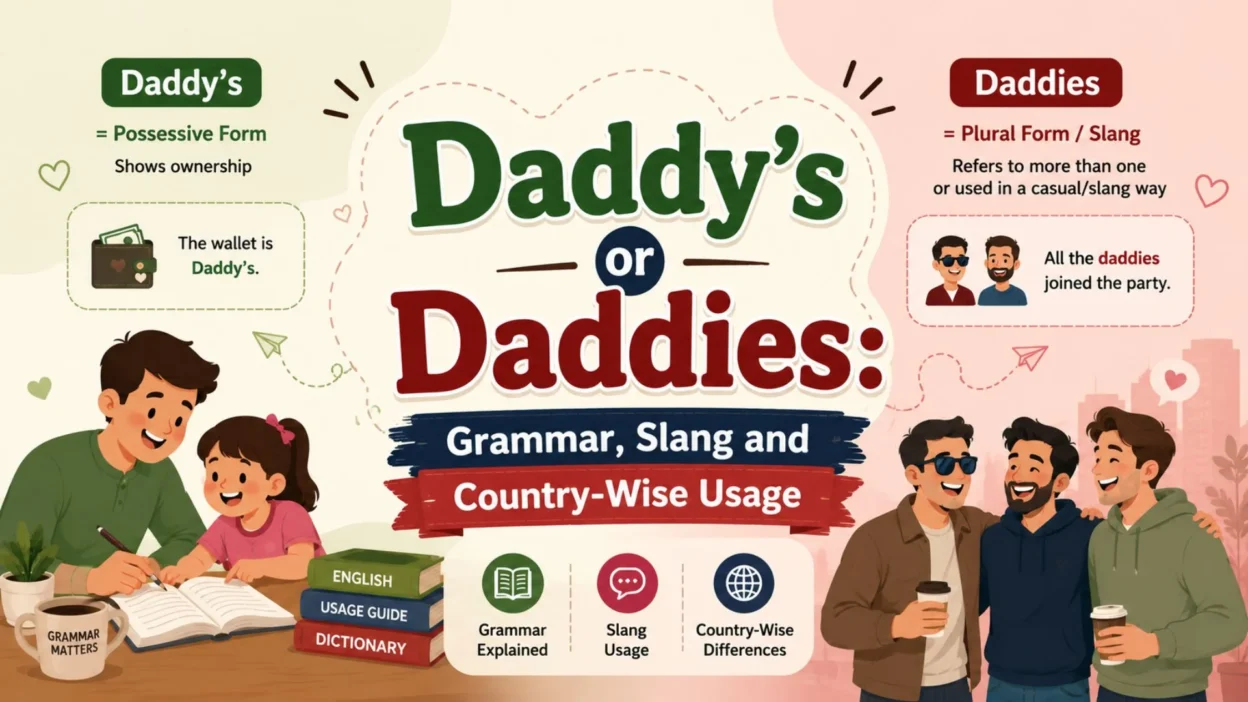
You probably know daddy means “father,” but do you know when to write Daddy’s versus Daddies? Many people confuse these two forms. Daddy’s shows possession (one daddy owns something), while Daddies means more than one daddy. Beyond grammar, this word carries very different cultural weight in the US versus the UK. Americans use it casually in slang, music, and social media. Brits are more reserved and prefer dad in most situations. In this guide, we will cover every meaning, grammar rule, and country-specific usage so you can write and speak with confidence—whether you are in New York, London, or anywhere else.
Quick Answer Table
| Term | Meaning | US / UK Note |
|---|---|---|
| Daddy’s | Possessive singular (one father’s) | Same in both countries |
| Daddies | Plural (two or more fathers) | Same in both countries |
| Daddy | Informal term for father | US: used by adults too; UK: mostly for children |
| Sugar Daddy | Wealthy older man who gives gifts | US: very common; UK: used but more negative |
| Baby Daddy | Unmarried biological father | US: everyday term; UK: rare, they say father of my child |
| Zaddy | Very stylish, attractive man | US Gen Z slang; UK: imported from US cultur |
Main Meaning & Pronunciation
Daddy (plural: daddies) is an informal noun that primarily means father. Children use it as a term of endearment, and some adults continue using it affectionately.
Pronunciation: US and UK both say /ˈdæd.i/ (DAD-ee). No difference.
Part of Speech: Countable noun. You can have one daddy or many daddies.
Etymology: The word first appeared in English around 1523. It comes from baby-talk “da-da” plus the suffix -y. Interestingly, similar words exist across many languages—Welsh tad, Greek tata, and Irish daid. For centuries, daddy stayed a simple child’s word. It only gained sexual and slang meanings in the late 20th century, first through such as African American Vernacular English (AAVE) with baby daddy in the 1990s, then expanding into internet thirst culture in the 2010s.
US vs UK English: How “Daddy” Differs
This is the most critical section for our audience. While the spelling and pronunciation are identical, cultural usage could not be more different.
| Aspect | United States (US) | United Kingdom (UK) |
|---|---|---|
| Family use | Adults often call their fathers daddy without embarrassment. | Brits stop using daddy by teenage years and switch to dad. |
| Baby Daddy | A standard term in daily US speech, TV, and hip-hop. | Rare and seen as overly American. They say my child’s father. |
| Sugar Daddy | Openly used in dating apps and gossip columns. | Used but carries a seedier, more transactional tone. |
| Calling celebrities “Daddy” | Common on US Twitter, TikTok, and Instagram—it shows admiration. | Done too, but often ironically or sarcastically to mock US fans. |
| Workplace | Completely unacceptable in professional settings. | Even more unacceptable—Brits find it bizarre and unprofessional. |
| Regional US variations | Southerners use daddy as a respectful title for older men. West Coasters use it liberally in slang. | Few regional variations; usage is consistent across the UK. |
Key Takeaway: For a US audience, you can freely use baby daddy, sugar daddy, and call attractive men daddy in casual content. For UK readers, stick to dad or father unless you are targeting young, internet-savvy Brits who consume US pop culture.
Daddy’s vs Daddies – Grammar Made Simple
- Daddy’s = possessive singular. It shows one daddy owns something.
Example: “We took daddy’s truck to the store.” - Daddies = plural. It refers to more than one daddy.
Example: “The daddies organized a playdate for their kids.”
Quick check: If you can replace it with his, use daddy’s. If you can replace it with they, use daddies. Never write daddys—that is a common spelling error.
Slang & Internet Meanings (Brief)
- Sugar Daddy – An older man who provides money or gifts in exchange for companionship.
- Baby Daddy – The biological father of a child, usually not married to the mother.
- The Daddy – The best or biggest example of something. “That steakhouse is the daddy of all grill joints.”
- Zaddy – US Gen Z slang for an extremely attractive, stylish man. Popularized by celebrities like Idris Elba and Jason Momoa.
- Daddy (BDSM/gay culture) – A dominant older male partner in a consensual power-exchange dynamic.
- Daddy-o – Vintage 1950s beatnik slang for a cool guy. Nobody uses it today except ironically.
Usage Examples (Active Voice)
| Example Sentence | Meaning |
|---|---|
| “I borrowed daddy’s jacket for the party.” | Possession (one father). |
| “The daddies at the school gate waved goodbye.” | Plural (multiple fathers). |
| “She calls her sugar daddy every Friday.” | Wealthy older partner. |
| “My baby daddy picks up our son every weekend.” | Unmarried biological father. |
| “That actor is total daddy material.” | Attractive older man (US slang). |
| “In the UK, you would not call your boss ‘daddy’.” | Cultural warning. |
| “All the daddies brought their kids to the zoo.” | Plural fathers in action. |
Synonyms & Antonyms (Short Lists)
Synonyms (8): dad, father, pop, papa, old man, parent, sire, patriarch.
Antonyms (6): mother, mom, mama, child, son, daughter.
Common Mistakes (US vs UK Focus)
| Mistake | Correct Usage |
|---|---|
| Writing daddies when you mean possession. | You should write daddy’s for possession. |
| Using baby daddy in UK formal writing. | You should use father of the child in the UK. |
| Calling a British boss daddy as a joke. | You should avoid this; Brits find it odd. |
| Confusing daddies with daddy’s in texts. | Replace with his (possessive) or they (plural). |
| Using sugar daddy in UK business emails. | Use sponsor or benefactor instead. |
| Spelling it daddys (no apostrophe). | Write daddies for plural and daddy’s for possessive. |
| Assuming all Americans like being called daddy. | Ask first; it is a personal and context-specific term. |
Psychological Context (Brief)
You might have heard the term “daddy issues” in US pop culture. While psychologists prefer father complex or attachment issues, the slang persists. Attachment theory shows that children with secure bonds to their fathers grow into adults with healthier relationships. An absent or inconsistent father can lead some people to seek validation from older men—which directly connects to the sugar daddy and daddy kink phenomena. In the US, calling a partner daddy can signal trust and a desire for protection. In the UK, that same term might feel theatrical because British culture favors emotional restraint. Understanding this layer helps you use the word with cultural and emotional intelligence.
FAQs
1. Is it Daddy’s or Daddies for a family name?
Use Daddy’s for one father’s things, and Daddies for multiple fathers.
2. Do Americans use “daddy” more than Brits?
Yes, Americans use it far more casually in slang, pop culture, and daily family life.
3. What does “baby daddy” mean in the US?
It means the biological father of a child, often not married to the mother.
4. Can I call my partner “daddy” in the UK?
Only in specific BDSM or queer subcultures; generally, Brits find it odd.
5. How do you pronounce “daddies” in US English?
You say DAD-eez – exactly the same as the UK.
6. Is “daddy” considered rude in professional settings?
Yes, in both US and UK offices. Never use it professionally.
7. What is a “zaddy” and how is it different?
Zaddy is US slang for an extremely stylish, attractive man—a playful upgrade of daddy.
Conclusion
We have covered everything you need to know about Daddy’s and Daddies—from basic grammar to the deep cultural gap between the US and the UK. Americans embrace daddy in everyday slang, hip-hop, and social media. Brits use it more cautiously and prefer dad or father in most situations. When you write for a US audience, you can confidently use terms like baby daddy or sugar daddy. For UK readers, tone it down. Remember: Daddy’s shows ownership (singular), while Daddies means multiple. Use active voice, stay direct, and you will never confuse your readers again—whether they are in New York or London.

Andrew Foster is a researcher and content writer at Differopedia, specializing in clear, accurate, and easy-to-understand comparison guides, definitions, and informational articles. His work focuses on helping readers make informed decisions through well-researched, reliable content.