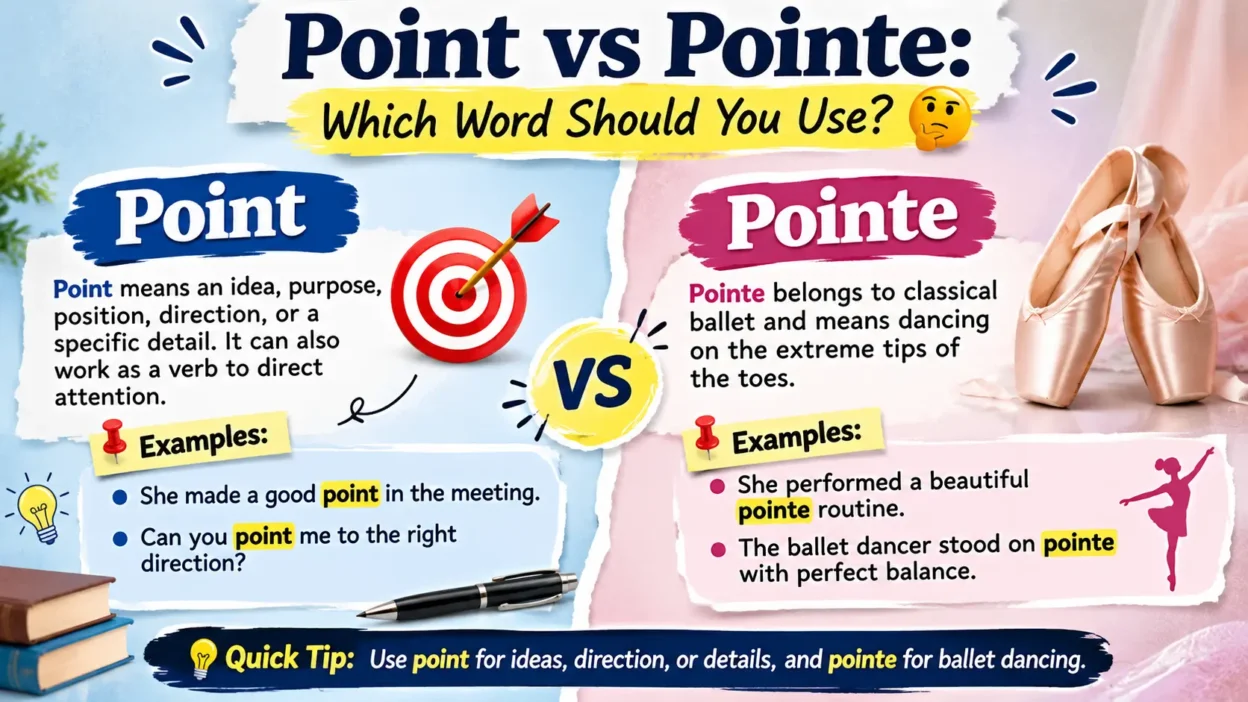
Point vs pointe can confuse writers because both words look and sound similar but have different meanings and uses. The word point appears in everyday conversations, business, mathematics, and writing to describe an idea, purpose, position, or direction. In contrast, pointe mainly belongs to classical ballet, where it describes dancing on the tips of the toes. Understanding the difference between these two words helps you avoid spelling mistakes and choose the correct term in every situation. Although their pronunciation often sounds identical, their meanings depend on the context. In this guide, you’ll discover their definitions, pronunciation, origins, grammatical roles, synonyms, and practical examples. We’ll also explore common mistakes and simple tips to help you remember when to use point and pointe correctly.
Point vs Pointe
| Term | Meaning | Usage | Category |
|---|---|---|---|
| Point | An idea, position, purpose, tip, or specific location | Making an argument or identifying something | Noun and verb |
| Pointe | A ballet technique in which dancers support their weight on the tips of their toes | Classical ballet and dance | Noun |
The easiest way to remember: Use point for an idea, position, or purpose. Use pointe when you discuss ballet dancing on the tips of the toes.
What Does Point Mean? 📍
The word point has several meanings in English. People use it to describe an idea, purpose, location, direction, sharp end, or specific detail. It works as both a noun and a verb, which makes it one of the most versatile words in everyday communication.
Definition of Point
According to major English dictionaries, point can refer to a particular place, position, idea, purpose, or small mark. As a verb, it describes directing something toward a person or object.
For example:
- Noun: You made an excellent point during the meeting.
- Verb: Please point toward the nearest exit.
- Location: We reached the highest point of the mountain.
- Purpose: I understand the point of this exercise.
Pronunciation of Point
The word point has one syllable. American English speakers pronounce it as /pɔɪnt/.
The pronunciation includes the familiar vowel sound in words such as coin and join. The final consonant combination creates the ending sound.
Part of Speech
Point functions as a noun and a verb.
| Part of Speech | Function | Example |
|---|---|---|
| Noun | Identifies an idea or purpose | You raised an important point. |
| Noun | Describes a location | Meet me at this point. |
| Noun | Identifies a score | Our team earned one point. |
| Verb | Directs attention | I point to the correct answer. |
| Verb | Indicates direction | The arrow points north. |
Origin and Etymology of Point
The word point entered English through Middle English and Old French. Its roots connect to the Latin word punctum, which refers to something pricked, a small mark, or a spot.
The related Latin verb pungere means to prick or pierce. Over time, English speakers developed several meanings, including a sharp tip, a specific location, a mark, and an important idea.
Interestingly, the history of point also connects with the French word pointe. Both spellings share historical roots, but modern English gives them different specialized uses. Etymology, Origin & Meaning+2
Contextual Meanings of Point
You can understand point more easily when you examine the context in which someone uses it.
| Context | Meaning | Example |
|---|---|---|
| Conversation | Main idea | That’s a good point. |
| Mathematics | Exact position or geometric location | Mark the point on the graph. |
| Business | Important detail | Let’s discuss the main point. |
| Sports | Scoring unit | The player scored five points. |
| Geography | Specific location or land projection | We visited a coastal point. |
| Writing | Small punctuation mark | Add a decimal point. |
| Technology | Display or measurement unit | Choose a 12-point font. |
| Directions | Indicating a position | Point toward the entrance. |
What Does Pointe Mean? 🩰
The word pointe belongs mainly to the world of classical ballet. It describes a dancing position or technique in which a dancer balances on the extreme tips of the toes while wearing specially designed ballet shoes.
Unlike point, this spelling does not normally describe an argument, purpose, location, or general idea. You will usually encounter it in ballet lessons, dance performances, choreography, and discussions about professional dancers.
Definition of Pointe
Pointe is a ballet term that refers to dancing on the tips of the toes. Dancers use specially reinforced shoes called pointe shoes to support this demanding technique.
For example:
- The ballerina performed beautifully on pointe.
- My sister started pointe training this year.
- The dance instructor taught the students basic pointe techniques.
- She needs stronger ankles before beginning pointe work.
Pronunciation of Pointe
American English dictionaries commonly give pronunciations such as /pwɑnt/ and /pɔɪnt/, while some references also show a French-influenced pronunciation.
In everyday American English, many speakers pronounce pointe exactly like point. This makes the two words homophones in those varieties of English.
The French-influenced pronunciation may sound different depending on the speaker and regional accent. English meaning – Cambridge Dictionary+2
Part of Speech
Pointe functions as a noun.
| Part of Speech | Function | Example |
|---|---|---|
| Noun | Describes ballet dancing on the tips of the toes | She practices pointe every morning. |
| Noun | Identifies a ballet position | The dancer held her pointe position. |
| Noun | Describes a dance technique | Pointe requires strength and balance. |
Origin and Etymology of Pointe
The word pointe comes from French, where it means a tip or pointed end. English adopted the ballet-related term during the nineteenth century.
Its connection to the French expression pointe du pied refers to the tip of the foot. Ballet terminology preserved this specialized meaning, particularly when dancers began performing movements on the extreme tips of their toes.
The word also appears in expressions such as en pointe and pointe work. These expressions describe the technique and practice of ballet dancing on the tips of the toes. Etymology, Origin & Meaning+2
Contextual Meanings of Pointe
| Context | Meaning | Example |
|---|---|---|
| Classical ballet | Dancing on the tips of the toes | She performs en pointe. |
| Dance training | Practicing pointe techniques | The students attend pointe class. |
| Ballet footwear | Special shoes for pointe dancing | She purchased new pointe shoes. |
| Choreography | Movements involving pointe technique | The choreography includes difficult pointe sequences. |
| Dance performance | A dancer’s ability to perform on pointe | Her pointe work looks graceful. |
Point vs Pointe: Key Differences Explained 🔍
Although point and pointe share similar spellings and pronunciations, they serve different purposes. Their main difference comes from meaning and context rather than sound.
| Difference | Point | Pointe |
|---|---|---|
| Main meaning | Idea, position, purpose, or tip | Ballet dancing on toe tips |
| Part of speech | Noun and verb | Noun |
| Origin | Old French and Latin roots | French |
| Common field | Everyday English | Classical ballet |
| Pronunciation | /pɔɪnt/ | Varies by English accent |
| General usage | Extremely common | Specialized |
| Verb form | Points, pointed, pointing | No standard verb form |
| Related expression | Point out | En pointe |
| Example | I understand your point. | She dances en pointe. |
When Should You Use Point?
Choose point when you want to communicate an idea, purpose, location, direction, score, or detail.
Consider these examples:
- I want to make an important point.
- The road reaches its highest point here.
- She pointed toward the beautiful painting.
- Our team earned another point.
- What is the point of this discussion?
When Should You Use Pointe?
Choose pointe when you discuss ballet technique, toe dancing, pointe shoes, or dancers who perform on the tips of their toes.
Consider these examples:
- She practices pointe for two hours.
- The ballet instructor explained pointe technique.
- My daughter wants to learn pointe dancing.
- The dancer performed an impressive movement en pointe.
- Her pointe shoes fit perfectly.
Remember: If your sentence discusses an idea or purpose, write point. If it discusses ballet dancing on the tips of the toes, write pointe.
Point vs Pointe: 15+ Usage Examples ✍️
Examples make the difference between these two words easier to understand. The following sentences demonstrate how each spelling works in natural American English.
| Example Sentence | Meaning |
|---|---|
| 1. You made an excellent point during the discussion. | An important idea or argument. |
| 2. Please point toward the nearest restaurant. | Direct attention toward something. |
| 3. The main point of this lesson is grammar. | The central purpose or idea. |
| 4. We reached the highest point of the hill. | A particular location or height. |
| 5. Our basketball team scored another point. | A unit of scoring. |
| 6. I disagree with your point about the budget. | A particular argument. |
| 7. The pencil has a sharp point. | The pointed end of an object. |
| 8. She pointed out an error in my report. | She identified a mistake. |
| 9. The ballerina performed on pointe. | She danced on the tips of her toes. |
| 10. My sister started learning pointe last month. | She began ballet toe-dancing lessons. |
| 11. The instructor introduced basic pointe exercises. | Ballet exercises for pointe technique. |
| 12. She needs new pointe shoes for the performance. | Special ballet shoes for dancing on toe tips. |
| 13. The dancers practiced their pointe work together. | They practiced their ballet technique. |
| 14. Her performance included several en pointe movements. | Movements performed on the tips of the toes. |
| 15. The young ballerina dreams of mastering pointe. | She wants to develop advanced ballet technique. |
| 16. The choreographer added a beautiful pointe sequence. | A sequence involving toe-tip ballet movements. |
Synonyms of Point and Pointe 📚
Synonyms help you express similar ideas without repeating the same word. However, remember that point has several meanings, so you should choose synonyms according to the context.
Synonyms of Point
| Synonym | Meaning |
|---|---|
| Idea | A thought or concept |
| Argument | A reason supporting an opinion |
| Purpose | The reason something exists |
| Objective | A goal someone wants to achieve |
| Position | A particular place or viewpoint |
| Location | A specific place |
| Detail | A particular piece of information |
| Aspect | One part of a subject |
| Matter | A subject or issue |
| Issue | A topic that requires attention |
| Topic | A subject of discussion |
| Focus | The central subject |
| Tip | The pointed end of something |
| Peak | The highest point |
| Summit | The top of a mountain or position |
| Direction | The course toward which something moves |
| Mark | A visible sign or symbol |
| Score | The number of points earned |
| Highlight | An important or noticeable feature |
| Principle | A fundamental rule or belief |
Synonyms of Pointe
Pointe has a specialized ballet meaning, so it does not have many exact synonyms. The following expressions describe closely related movements or positions rather than interchangeable replacements.
| Related Expression | Meaning |
|---|---|
| Toe dancing | Dancing on the tips of the toes |
| Pointe work | Ballet movements performed on pointe |
| En pointe | A position supported on the toe tips |
| On pointe | Dancing on the tips of the toes |
| Toe-tip position | A position supported by the toe tips |
| Ballet technique | A method of performing ballet movements |
| Classical ballet | A traditional form of ballet |
| Pointe technique | The specialized technique of pointe dancing |
| Toe balance | Balancing on the toes |
| Tiptoe position | Standing on the tips of the toes |
| Pointe movement | A ballet movement performed on pointe |
| Ballet footwork | Foot movements used in ballet |
These expressions describe related concepts, but they do not all replace pointe in every sentence.
Antonyms of Point and Pointe ↔️
An antonym expresses the opposite meaning of a word. Since point has multiple meanings, its opposites depend on the context. Similarly, pointe does not have one universal dictionary antonym.
Antonyms of Point
| Antonym | Meaning |
|---|---|
| Disagreement | An opposing opinion |
| Opposition | Resistance to an idea |
| Counterargument | An argument against another argument |
| Irrelevance | Lack of connection to the subject |
| Confusion | Lack of clarity or understanding |
| Vagueness | Lack of specific information |
| Generality | A broad rather than specific idea |
| Bluntness | Lack of a sharp or pointed edge |
| Bottom | The lowest part of something |
| Beginning | The starting position or stage |
| Departure | Movement away from a location |
| Digression | Moving away from the main subject |
These are contextual opposites, not universal antonyms. For example, bluntness contrasts with the sharp-tip meaning of point, while counterargument contrasts with its argumentative meaning.
Opposite or Contrasting Terms for Pointe
| Term | Meaning |
|---|---|
| Flat-footed | Standing with the feet flat on the floor |
| Demi-pointe | Standing on the balls of the feet |
| Full-foot position | Supporting the foot on the floor |
| Heel-down position | Keeping the heels on the ground |
| Resting position | A relaxed position without pointe balance |
| Parallel standing | Standing with the feet parallel |
| Natural stance | A comfortable standing position |
| Grounded position | Maintaining contact with the floor |
| Barefoot stance | Standing without ballet shoes |
| Non-pointe movement | Ballet movement that does not use pointe technique |
These expressions describe contrasting positions or movements rather than strict dictionary antonyms.
Real-Life Usage of Point and Pointe 🌎
Both spellings appear in real-life communication, but their frequency and contexts differ. You will encounter point in almost every area of English, while pointe mainly appears in dance-related conversations.
1. Daily Conversation
People frequently use point when they explain opinions, discuss plans, or clarify information.
Examples:
- You have a good point.
- That’s exactly my point.
- I see your point now.
- Let me point something out.
You will hear pointe less often in everyday conversations unless someone discusses ballet, dance training, or a performance.
2. Social Media
Social media users frequently write point when sharing opinions, explaining arguments, or responding to discussions.
Examples:
- “You completely missed my point.”
- “That’s a fair point.”
- “My point exactly!”
Dance creators and ballet students may use pointe in posts about their training, performances, and pointe shoes.
For example:
- “Finally achieved my first pointe milestone!”
- “Working hard to improve my pointe technique.”
3. Business Communication
Business professionals use point to communicate important information, identify objectives, and explain strategies.
Examples:
- Let’s discuss the main point of this proposal.
- I want to point out an important concern.
- The presentation covers five key points.
You might encounter pointe in a business discussion about ballet schools, dance studios, or professional dance performances.
4. Academic Writing
Students and researchers use point when presenting arguments, explaining concepts, or discussing evidence.
Examples:
- The author makes an important point about education.
- This point supports the central argument.
- The research highlights three significant points.
Academic writing may use pointe when discussing ballet history, dance education, choreography, or performance techniques.
5. Online Messaging
People commonly use point in text messages when they want to explain something clearly.
Examples:
- “What’s your point?”
- “You have a valid point.”
- “I understand your point now.”
Someone who studies ballet might also write:
- “I have pointe practice tomorrow.”
- “My new pointe shoes arrived!”
Common Mistakes When Using Point and Pointe ⚠️
Writers sometimes confuse these words because they sound alike. However, their meanings make the correct spelling easy to identify.
| Mistake | Correct Usage |
|---|---|
| 1. You made a great pointe. | You made a great point. |
| 2. I understand your pointe. | I understand your point. |
| 3. She dances on point. | She dances on pointe. |
| 4. I bought new point shoes. | I bought new pointe shoes. |
| 5. Let me pointe out the problem. | Let me point out the problem. |
| 6. The main pointe is clear. | The main point is clear. |
| 7. She practices point dancing. | She practices pointe dancing. |
| 8. That’s not the pointe of my argument. | That’s not the point of my argument. |
| 9. The ballerina performs point work. | The ballerina performs pointe work. |
| 10. I want to pointe toward the door. | I want to point toward the door. |
| 11. She learned how to dance on pointes technique. | She learned pointe technique. |
| 12. What is the pointe of this meeting? | What is the point of this meeting? |
Helpful tip: Before choosing a spelling, identify the subject of your sentence. If you discuss an idea, direction, or purpose, choose point. If you discuss ballet dancing on toe tips, choose pointe.
❓FAQs
What Is the Main Difference Between Point and Pointe?
Point refers to an idea, location, purpose, direction, or sharp end. Pointe refers to a ballet technique in which dancers balance on the tips of their toes.
Does Pointe Have an E at the End?
Yes. The correct spelling is pointe, with an additional E at the end. This spelling distinguishes the ballet term from the everyday English word point.
Is Pointe a Noun or Verb?
Pointe functions as a noun in English. It describes a ballet position or technique rather than an ordinary action.
What Is the Plural of Pointe?
The standard plural form is pointes. You can use it when discussing multiple pointe positions or ballet shoes, depending on the context.
What Does On Pointe Mean?
On pointe describes a dancer performing while balancing on the tips of the toes. You will commonly encounter this expression in ballet classes and dance performances.
Why Do Point and Pointe Sound Alike?
Both words have French historical connections and share similar sounds in many English accents. American English speakers often pronounce them identically, even though their spelling and meanings differ.
How Can I Remember Point vs Pointe?
Remember that point has the general meaning, while pointe belongs to ballet. Associate the extra E with the specialized dance term to make the spelling easier to remember.
Do Pointe Shoes Help Ballet Dancers Balance?
Yes. Pointe shoes provide structural support around the toes and help trained dancers perform on the tips of their feet. However, dancers also need strength, technique, and balance to use them safely.
🎯Conclusion
Understanding point vs pointe becomes easy when you remember their different meanings and uses. The word point describes an idea, purpose, position, direction, or specific detail, while pointe refers to a classical ballet technique in which dancers balance on the tips of their toes. Although both words look and sound similar, you should never interchange them in ordinary writing. Always consider the context before choosing the correct spelling. Use point when discussing an argument or purpose, and choose pointe when talking about ballet techniques or specialized dance shoes. By learning their definitions, examples, and differences, you can confidently use both words in everyday conversations, academic writing, and professional communication.

Andrew Foster is a researcher and content writer at Differopedia, specializing in clear, accurate, and easy-to-understand comparison guides, definitions, and informational articles. His work focuses on helping readers make informed decisions through well-researched, reliable content.