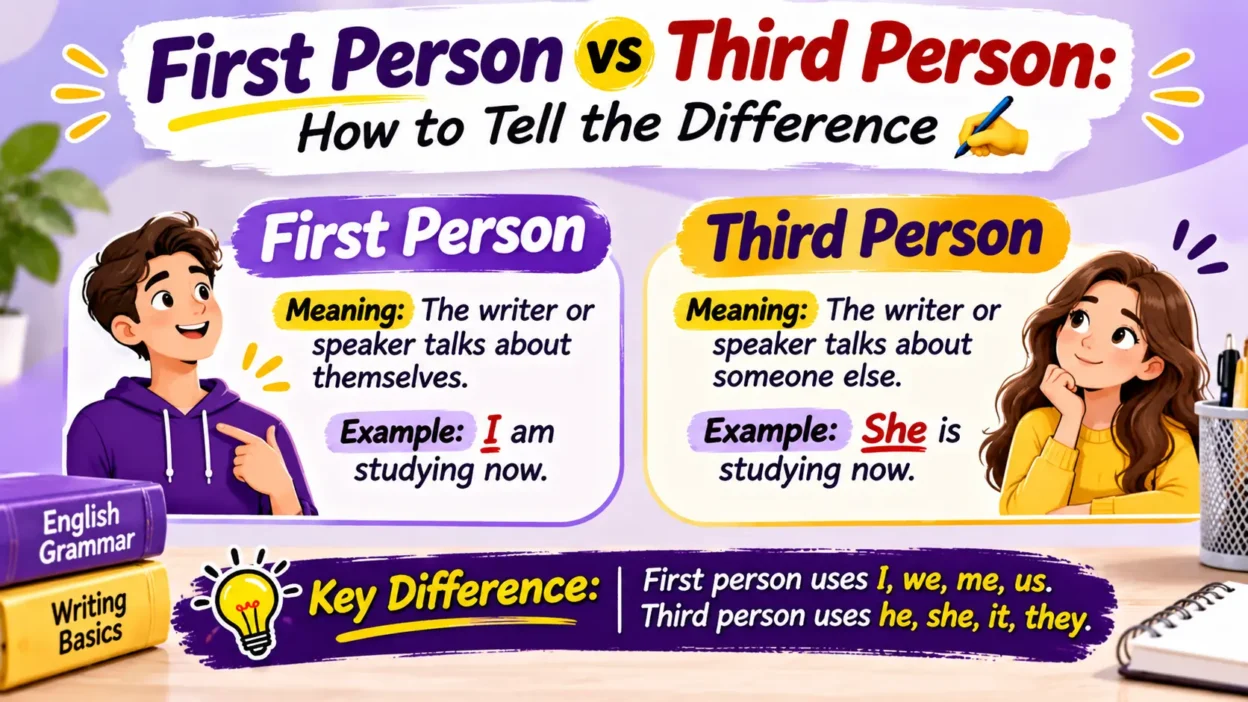
Third person vs first person is an important grammar comparison that explains who speaks, who performs an action, and whose perspective a sentence expresses. These perspectives appear in everyday conversations, academic writing, professional communication, and storytelling. First person focuses on the speaker or writer, while third person describes someone or something else. For example, “I enjoy reading” uses the first-person perspective, whereas “She enjoys reading” uses the third-person perspective. Understanding this difference helps you choose the correct pronouns, maintain consistent writing, and avoid common grammar mistakes. Whether you write essays, stories, or professional documents, knowing when to use each perspective can improve your communication and writing skills.
📖Third Person vs First Person
| Term | Meaning | Usage | Category |
|---|---|---|---|
| First person | Refers to the speaker or writer | I, me, we, us | Grammar |
| Third person | Refers to someone or something else | He, she, it, they | Grammar |
| Second person | Refers to the person being addressed | You, your | Grammar |
Simple difference: First person means talking about yourself, while third person means talking about another person, object, or subject.
📝 What Does First Person Mean?
First person refers to the speaker or writer. People use this perspective when they discuss their experiences, feelings, opinions, or actions.
The main first-person pronouns include I, me, my, mine, we, us, our, and ours. These words help readers identify the person speaking or writing.
Examples:
- I love spending time with my family.
- We enjoy playing basketball.
- My brother gave me a beautiful gift.
- Our team won the competition.
First-person writing creates a personal and direct connection with readers. Writers commonly use it in personal stories, diaries, autobiographies, and reflective essays.
👤 What Does Third Person Mean?
Third person refers to someone or something other than the speaker and the person receiving the message. Writers use this perspective to discuss people, characters, animals, objects, and ideas.
Common third-person pronouns include he, she, it, they, him, her, them, his, hers, and their.
Examples:
- She enjoys reading novels.
- He plays soccer every weekend.
- They visited the museum yesterday.
- Sarah completed her homework.
Third-person writing often creates a more observational tone. Authors frequently choose it for novels, biographies, reports, research papers, and professional documents.
🔍 Key Differences Between First Person and Third Person
Both perspectives help people communicate, but they differ in their pronouns, subjects, and writing styles.
| Feature | First Person | Third Person |
|---|---|---|
| Perspective | Speaker or writer | Another person or subject |
| Main pronouns | I, me, we, us | He, she, it, they |
| Writing style | Personal | Observational |
| Common use | Personal stories | Academic writing and fiction |
| Example | I enjoy music. | She enjoys music. |
| Connection | Direct personal experience | Outside observation |
The easiest way to remember this difference is to identify who performs the action. If the speaker talks about themselves, the sentence uses first person. If the speaker discusses someone else, it generally uses third person.
📚 First-Person and Third-Person Pronouns
Pronouns provide one of the easiest ways to recognize grammatical perspective. Each person uses different pronouns depending on the subject’s role in a sentence.
| First-Person Pronouns | Third-Person Pronouns |
|---|---|
| I | He |
| Me | Him |
| My | His |
| Mine | Hers |
| Myself | Himself |
| We | They |
| Us | Them |
| Our | Their |
| Ours | Theirs |
| Ourselves | Themselves |
Remember that they can also refer to one person when someone uses singular they. However, it remains a third-person pronoun.
✍️ Examples of First Person vs Third Person
These examples show how the same idea changes when you switch between first-person and third-person perspectives.
| First-Person Example | Third-Person Example |
|---|---|
| I love cooking. | She loves cooking. |
| I play football. | He plays football. |
| We study English. | They study English. |
| My dog is friendly. | His dog is friendly. |
| I finished my homework. | Sarah finished her homework. |
| We visited New York. | They visited New York. |
| I enjoy reading books. | He enjoys reading books. |
| Our family loves traveling. | Their family loves traveling. |
| I work at a hospital. | She works at a hospital. |
| We celebrate birthdays together. | They celebrate birthdays together. |
These examples also demonstrate an important grammar rule: third-person singular subjects often require an -s or -es ending in the simple present tense.
For example, write “I work” but “She works.”
🎭 Types of First-Person and Third-Person Writing
Writers can use different narrative styles depending on the story and the information they want to share.
First-person writing:
- First-person singular: Uses I to describe one person’s experiences.
- First-person plural: Uses we to describe experiences shared by a group.
Third-person writing:
- Third-person limited: Follows one character’s thoughts and experiences.
- Third-person omniscient: Allows the narrator to describe the thoughts and feelings of multiple characters.
- Third-person objective: Describes actions and dialogue without directly revealing characters’ private thoughts.
For example, “I entered the room” uses first person, while “Emily entered the room” uses third person.
💼 When Should You Use First Person or Third Person?
Your writing purpose determines which perspective works best.
| Situation | Recommended Perspective |
|---|---|
| Personal diary | First person |
| Autobiography | First person |
| Personal experience essay | First person |
| Fictional novel | First or third person |
| Professional biography | Third person |
| Business report | Usually third person |
| Research paper | Follow the required style guide |
| Personal blog | First person |
| Instructional guide | Often second person |
| Academic analysis | Often third person |
Modern academic styles do not always prohibit first-person writing. For example, APA Style allows researchers to use I or we when describing their own research actions. Always follow your instructor’s or publication’s requirements.
⚠️ Common Mistakes When Using First Person and Third Person
Writers sometimes confuse pronouns, change perspectives unexpectedly, or use incorrect verb forms.
| Mistake | Correct Usage |
|---|---|
| She enjoy music. | She enjoys music. |
| I likes reading. | I like reading. |
| They loves football. | They love football. |
| He go to school. | He goes to school. |
| Me completed the task. | I completed the task. |
| Her is my friend. | She is my friend. |
| We enjoys traveling. | We enjoy traveling. |
| Him plays basketball. | He plays basketball. |
| I went to his house, and she welcomed me. | I went to her house, and she welcomed me. |
| The student should submit your work. | The student should submit their work. |
One important rule can prevent many of these mistakes: maintain a consistent perspective when you discuss the same subject.
💡 Related Grammar Terms You Should Know
Understanding these related terms can make the difference between first-person and third-person writing even clearer.
| Related Term | Meaning |
|---|---|
| Second person | Refers to the person receiving a message. |
| Pronoun | A word that replaces a noun. |
| Subject | The person or thing performing an action. |
| Object | The person or thing receiving an action. |
| Personal pronoun | A pronoun that identifies grammatical person. |
| Possessive pronoun | Shows ownership. |
| Reflexive pronoun | Refers back to the subject. |
| Narrative | The way someone tells a story. |
| Point of view | The perspective from which someone writes. |
| Subject-verb agreement | Matching verbs with their subjects. |
| Singular | Refers to one person or thing. |
| Plural | Refers to more than one person or thing. |
| First-person narrator | A narrator who uses I or we. |
| Third-person narrator | An outside narrator who describes characters. |
| Conjugation | Changing a verb to match grammatical requirements. |
❓ FAQs
Is first person the same as third person?
No. First person refers to the speaker or writer, while third person refers to another person, object, or subject.
What are examples of first-person words?
Common first-person words include I, me, my, mine, we, us, our, and ourselves.
What are examples of third-person words?
Common third-person words include he, she, it, they, him, her, them, his, and their.
Is they first person or third person?
They is a third-person pronoun. People use it for multiple individuals or as a singular, gender-neutral pronoun.
Should I write an essay in first person or third person?
Your assignment determines the appropriate perspective. Many academic essays favor third person, but some styles, including APA, allow first person when you describe your own research.
Can you use first person and third person together?
Yes. You can use both perspectives when you discuss different speakers or subjects. However, avoid switching perspectives unexpectedly because doing so can confuse readers.
Is third-person writing more formal than first-person writing?
Third-person writing often creates a more formal and objective tone. However, first-person writing also works well in professional and academic contexts when the situation calls for personal experience or direct ownership of research.
What is the easiest way to identify first and third person?
Look at the pronouns and identify the speaker’s role. I and we indicate first person, while he, she, it, and they indicate third person.
🎯 Conclusion
Understanding third person vs first person helps you communicate clearly and choose the right grammatical perspective for different writing situations. First person uses pronouns such as I, me, and we to describe the speaker’s experiences or actions. Third person uses pronouns such as he, she, it, and they to discuss other people, objects, or subjects. Both perspectives serve important purposes in everyday communication, creative writing, academic work, and professional documents. Remember to maintain consistent pronouns, follow subject-verb agreement, and choose a perspective that matches your purpose. Once you understand these basic differences, you can write more naturally, avoid common grammar mistakes, and express your ideas with greater confidence.

Andrew Foster is a researcher and content writer at Differopedia, specializing in clear, accurate, and easy-to-understand comparison guides, definitions, and informational articles. His work focuses on helping readers make informed decisions through well-researched, reliable content.