Understanding the distinction between ago vs before is a common challenge for English learners. You might wonder why we say “three years ago” but “three years before the wedding.” We often encounter this confusion when speaking or writing about past events.
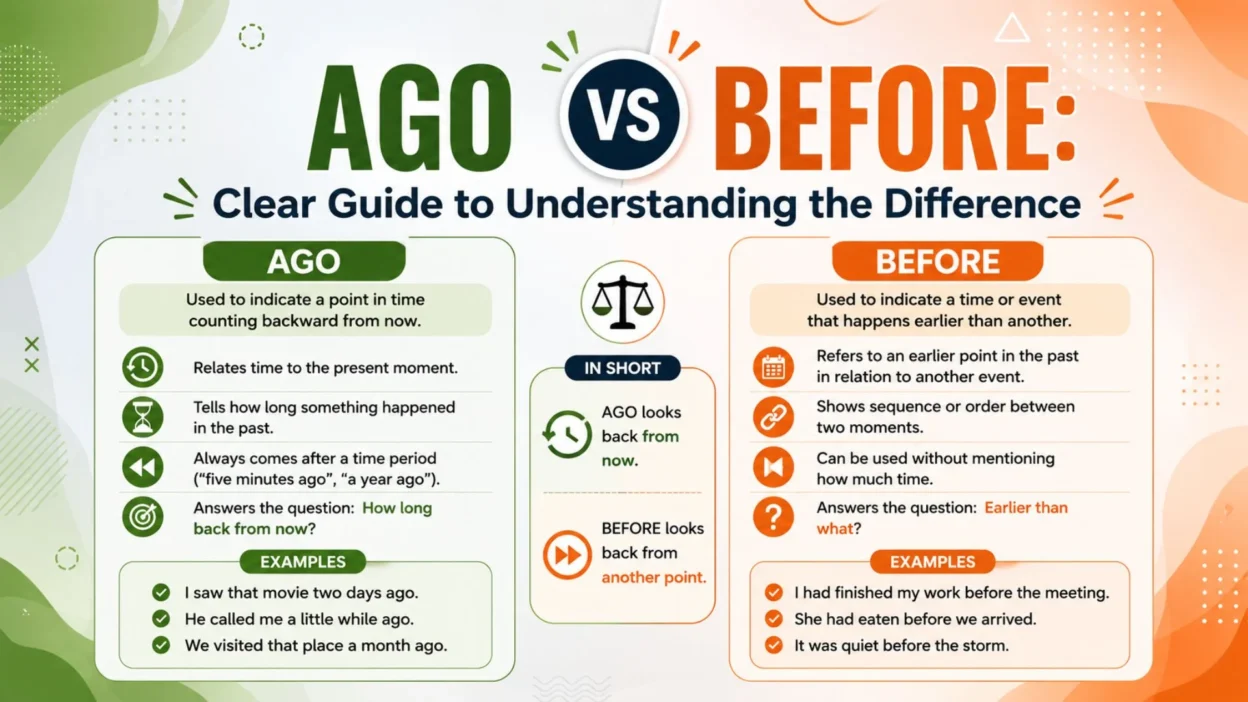
The battle of ago vs before comes down to one simple rule: time reference. Ago counts backward from the present moment (now). Before counts backward from another past event or specific point in time. We use “ago” when measuring from today. We use “before” when comparing one past event to another. By the end of this guide, you will master ago vs before with confidence.
Ago vs Before: Quick Comparison Table
Here is a quick cheat sheet for ago vs before to help you remember the core rules instantly.
| Term | Meaning | Usage Formula | Category |
|---|---|---|---|
| Ago | Counts time backward from the present moment | [Time period] + ago + Simple Past verb | Adverb |
| Before | Refers to a time earlier than another event | before + [noun/clause] or [action] + before | Adverb, Preposition, Conjunction |
Quick rule: If you ask “How long before now?” choose ago. If you compare two events, choose before.
Ago vs Before: Understanding the Core Rule
The core rule of ago vs before is all about the anchor point. When we use “ago,” we anchor our time to right now. For example, “I called you an hour ago” means one hour before this exact moment.
When we use “before,” we anchor our time to another event. For example, “I called you an hour before the meeting” means one hour earlier than the meeting, not necessarily one hour ago from now. To master ago vs before, you must ask yourself: “Am I measuring from the present, or from another point in history?” This simple question solves most confusion regarding ago vs before.
Ago vs Before: How to Use “Ago” Correctly
Let us dive deeper into ago vs before by focusing on “ago” first. You can only use “ago” with a specific time period, and you must always pair it with the simple past tense.
- ✅ “I graduated three years ago.”
- ✅ “She left ten minutes ago.”
- ❌ “I have graduated three years ago.” (Wrong tense)
When discussing ago vs before, remember that “ago” cannot stand alone. You must specify how long: two days, five years, or ten seconds. In American conversation, you will hear “Just a minute ago.” In British English, you might hear “Ages ago.” Both countries agree on the grammar of ago vs before, even if the slang differs.
Ago vs Before: How to Use “Before” Correctly
Now, let us explore the other side of ago vs before: the word “before.” Unlike “ago,” “before” does not always need a specific time. You can say “I have seen this before” without saying when. You can also use “before” as a preposition, conjunction, or adverb.
- ✅ “I had never visited that museum before.” (Adverb, no specific time)
- ✅ “He left before I arrived.” (Conjunction comparing events)
- ✅ “Please finish your homework before dinner.” (Preposition, future reference)
The flexibility of “before” sets it apart in the debate of ago vs before. You cannot use “ago” to compare two past events. You must use “before” when you show sequence. Understanding this nuance is crucial for mastering ago vs before.
Ago vs Before: USA vs UK Pronunciation and Usage
While the grammar of ago vs before remains universal, Americans and British speakers have subtle differences in pronunciation and style.
Pronunciation:
- American: Ago sounds like /əˈɡoʊ/ (rhymes with “go”).
- British: Ago sounds like /əˈɡəʊ/ (a slightly rounded vowel). Both pronounce “before” similarly.
Everyday Usage:
- In the USA: Americans often say “just” + “ago”: “I just saw him a minute ago.” They also use “way back” instead of “long ago” in casual slang.
- In the UK: British speakers say “about 5 minutes ago.” They also say “ages ago” for a very long time. In formal UK writing, you might see “prior to” instead of “before,” but the distinction of ago vs before remains unchanged.
Social Media:
Both countries display timestamps using “ago” (e.g., “Posted 3m ago”). The only difference is casual phrasing, not the core rule of ago vs before.
Ago vs Before: Usage Examples in Sentences
Let us reinforce ago vs before with practical examples you can use daily. All sentences use active voice to show clear meaning.
| Example Sentence | Meaning |
|---|---|
| I submitted my report two hours ago. | You submitted it two hours before now. |
| She called me five minutes ago. | She called five minutes before this moment. |
| We moved to this city ten years ago. | You moved ten years before today. |
| He left before I arrived. | He departed earlier than your arrival. |
| We met two days before the wedding. | You met two days earlier than the wedding day. |
| I have seen that movie before. | You watched it at some earlier time. |
| Please finish your homework before dinner. | Complete it earlier than dinner time. |
| They finished the project three days ago. | They completed it three days before today. |
Ago vs Before: Common Mistakes to Avoid
Many learners make specific errors regarding ago vs before. Here is a table of the most frequent mistakes and their corrections to help you perfect ago vs before.
| Mistake (Wrong) | Correct Usage (Right) |
|---|---|
| ❌ I have seen him a week ago. | ✅ I saw him a week ago. (Use simple past) |
| ❌ I graduated before three years. | ✅ I graduated three years ago. |
| ❌ He left before now. | ✅ He left earlier. OR He left before I arrived. |
| ❌ She called me ago. | ✅ She called me an hour ago. (Specify time) |
| ❌ I have been there before three years. | ✅ I was there three years ago. OR I have been there before. |
| ❌ The meeting started before an hour. | ✅ The meeting started an hour ago. |
| ❌ We met ago two days. | ✅ We met two days ago. (Time before “ago”) |
| ❌ He died before five years. | ✅ He died five years ago. |
| ❌ She arrived before 10 minutes. | ✅ She arrived 10 minutes ago. |
| ❌ I knew him before 5 years. | ✅ I knew him 5 years ago. |
FAQs
Let us answer the most common questions people ask about ago vs before. These responses will clarify any remaining confusion.
1. When should I use “ago” in a sentence?
Use “ago” when measuring time backward from the present moment. Example: “I called you an hour ago.”
2. When should I use “before” in a sentence?
Use “before” when comparing two events or referring to an earlier time without measuring from now. Example: “I called you before the meeting.”
3. Can I use “ago” with the present perfect tense?
No. “Ago” always takes the simple past tense. You cannot say “I have seen him a week ago.” Always say “I saw him a week ago.”
4. Is the rule of ago vs before different in American and British English?
No. The grammar is identical in both countries. Only the pronunciation and casual slang (like “ages ago” in the UK) differ.
5. Can “before” mean “in front of” physically?
Yes. “Before” also indicates physical position: “He stood before the judge.” This usage is unrelated to time but still part of understanding ago vs before in full.
6. What tense works best with “before”?
You can use past perfect, simple past, or present perfect with “before.” For example, “I had never tried sushi before,” or “I have seen this before.”
7. Can I use “ago” to talk about the future?
Never. “Ago” only refers to the past. For the future, use “from now” (e.g., “The meeting starts in an hour”).
8. Why do people confuse ago vs before?
People confuse them because both talk about the past. However, “ago” counts from today, while “before” counts from another event. Understanding this anchor point clears up ago vs before instantly.
Conclusion:
Now you have completely mastered the distinction between ago vs before. Remember this final golden rule: “ago” looks backward from now, while “before” looks backward from another event. You will use “ago” when measuring time from today. You will use “before” when comparing events or referencing an earlier time without a specific measurement.
Whether you speak American or British English, the grammar rules for ago vs before remain exactly the same. Practice our examples daily, and you will never second-guess yourself again. Next time you speak or write about the past, you will choose the right word with complete confidence. We have covered everything from definitions to country-wise usage, ensuring you fully understand ago vs before.

Andrew Foster is a researcher and content writer at Differopedia, specializing in clear, accurate, and easy-to-understand comparison guides, definitions, and informational articles. His work focuses on helping readers make informed decisions through well-researched, reliable content.