
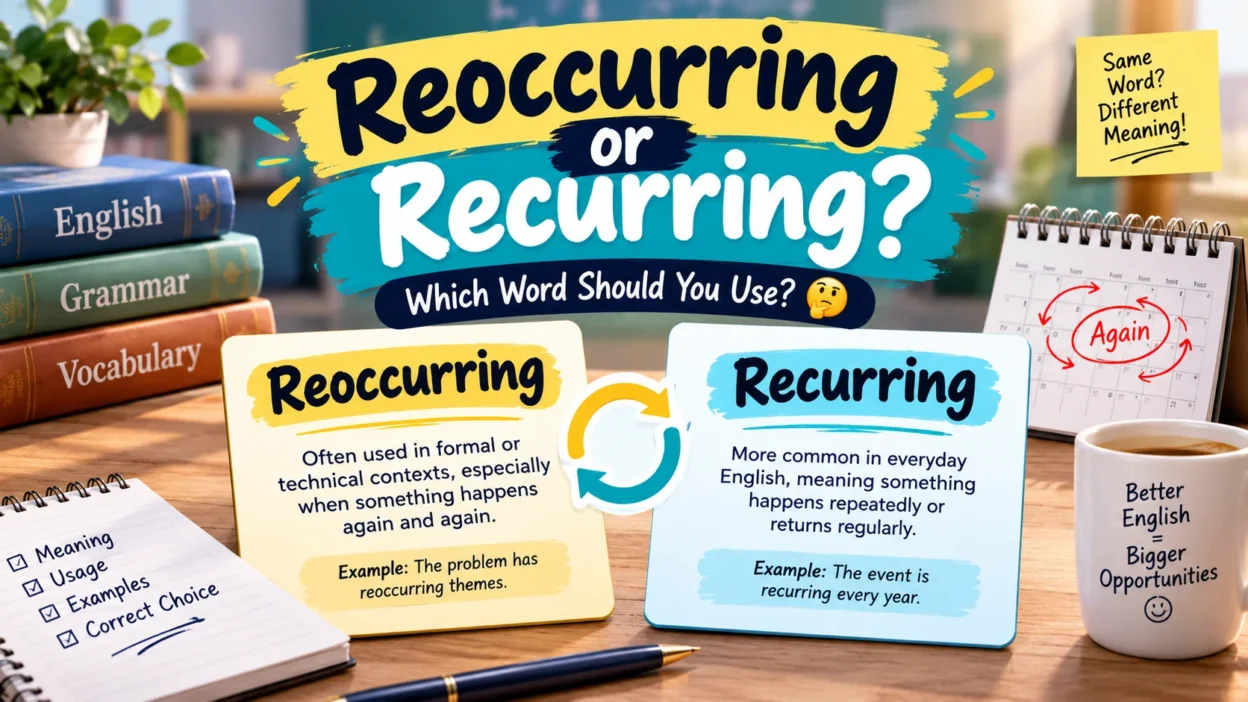
Have you ever wondered whether to use reoccurring or recurring? 🤔 These words look and sound similar, but they can differ in meaning and usage. Recurring usually describes something that happens repeatedly or returns over time, while reoccurring emphasizes something happening again. However, the distinction isn’t always strict, and both words can overlap in meaning. In this guide, we’ll explain reoccurring vs. recurring, explore practical examples, and show you which word is more natural in everyday and professional English.
⚡ Quick Answer: Reoccurring vs. Recurring
| Word | Meaning | Common Examples |
|---|---|---|
| Recurring | Happening repeatedly or returning over time | Recurring payment, problem, meeting, theme |
| Reoccurring | Happening again | Reoccurring error, issue, or event |
| Recur | To happen again or repeatedly | “The problem may recur.” |
| Reoccur | To occur again | “The error may reoccur.” |
| Recurrence | An instance or act of recurring | “The recurrence was unexpected.” |
| Reoccurrence | An instance of something occurring again | “We want to prevent a reoccurrence.” |
The simplest way to remember them
If you’re describing something that keeps happening or returns repeatedly, recurring is usually the safest and most natural choice.
If you specifically want to emphasize that something has occurred again, reoccurring can be appropriate.
However, don’t assume that recurring always means something happens on a fixed schedule. A recurring problem, dream, or concern can return at irregular intervals.
📖 What Does Recurring Mean?
Recurring is the present participle of the verb recur, and it can also work as an adjective.
The verb recur means to happen again or repeatedly, often suggesting that something returns over time or becomes a recognizable pattern.
For example:
- We have a recurring meeting every Monday.
- The customer reported a recurring problem.
- She has a recurring dream.
- The novel explores a recurring theme.
- The company earns recurring subscription revenue.
- The software has a recurring technical issue.
Notice that not all of these examples involve a fixed schedule. A recurring technical issue may happen at unpredictable times. What makes it recurring is that the issue returns repeatedly.
This makes recurring a very versatile word in modern English.
🔄 What Does Reoccurring Mean?
Reoccurring comes from the verb reoccur, which means to occur again.
The word can be used when something happens another time, especially when the writer wants to emphasize the fact that an occurrence has happened again.
For example:
- The software error is reoccurring after the latest update.
- We’re investigating the reoccurring issue.
- The same complaint was reoccurring during the project.
- The warning message keeps reoccurring.
- The technical failure is reoccurring despite several repairs.
That said, reoccurring is less common than recurring in many contexts.
In fact, some sentences that use reoccurring could naturally use recurring instead. This is why the two words shouldn’t be treated as completely separate categories.
⚖️ Recurring vs. Reoccurring: What’s the Difference?
The most useful distinction is one of emphasis rather than a rigid grammatical rule.
Recurring commonly emphasizes repetition, return, or an established pattern.
Reoccurring emphasizes that something has occurred again.
Consider these examples:
We continue to have a recurring problem with the website.
Here, the focus is on a problem that repeatedly returns.
Now consider:
The website error reoccurred after the update.
Here, the focus is on the error happening again after a particular event.
Both words are valid, but recurring is often more natural when you’re describing an ongoing or repeated situation.
Choose recurring when:
- Something happens repeatedly.
- Something returns over time.
- A pattern has developed.
- You’re describing an ongoing issue.
- You’re discussing repeated themes or activities.
- You’re talking about subscriptions or regular payments.
Choose reoccurring when:
- You want to emphasize that something occurred again.
- Another occurrence is the main point.
- The context specifically focuses on an event happening another time.
💼 Is “Recurring Problem” or “Reoccurring Problem” Correct?
Both expressions can be understood, but recurring problem is generally the more natural choice.
For example:
We continue to experience a recurring problem with the payment system.
This tells the reader that the issue keeps coming back.
You could also say:
The payment problem is reoccurring after each system update.
This emphasizes that the problem is occurring again.
In professional writing, however, recurring problem is usually the cleaner choice because it is familiar and widely used.
✍️ Recurring Examples in Everyday English
Here are some natural examples of recurring:
- I have a recurring appointment every Thursday.
- The company charges a recurring monthly fee.
- We noticed a recurring error in the report.
- She has a recurring dream about her childhood home.
- The novel contains a recurring theme of friendship.
- The team holds a recurring meeting each month.
- Rising costs are a recurring concern for the business.
- The same issue became a recurring problem.
- The service generates recurring revenue.
- A recurring character appears throughout the television series.
These examples demonstrate how widely recurring is used across business, technology, literature, entertainment, and everyday conversation.
🔁 Reoccurring Examples in Everyday English
Here are examples where reoccurring can communicate the idea of something happening again:
- The error is reoccurring after the latest update.
- We’re investigating the reoccurring issue.
- The same complaint was reoccurring throughout the process.
- The technical failure is reoccurring despite several repairs.
- The problem became reoccurring after the equipment was replaced.
- We need to determine why the warning keeps reoccurring.
- The same mistake was reoccurring during the project.
In several of these examples, recurring would also be perfectly natural. That’s an important part of understanding the relationship between the two words.
🏢 Recurring vs. Reoccurring in Professional Writing
When you’re writing an email, report, business document, website article, or academic paper, recurring is usually the better default.
It’s especially common in phrases such as:
- Recurring revenue
- Recurring expenses
- Recurring payments
- Recurring meetings
- Recurring tasks
- Recurring customers
- Recurring issues
- Recurring themes
- Recurring patterns
For example:
The finance department reviewed the company’s recurring expenses.
Or:
The development team identified a recurring software issue.
These expressions sound natural and professional.
Reoccurring isn’t grammatically wrong in formal writing, but it can sound less natural when recurring already communicates the intended meaning.
💰 Recurring vs. Reoccurring in Business
Business English strongly favors recurring in many situations.
You will commonly see phrases such as recurring revenue, recurring costs, recurring billing, and recurring subscriptions.
For example:
Our software company relies heavily on recurring subscription revenue.
The business is trying to reduce recurring operating expenses.
If you’re describing a specific problem happening again, however, reoccur can be useful:
The payment error reoccurred after the system migration.
Here, reoccurred clearly focuses on the error happening again.
💻 Recurring vs. Reoccurring in Technology
Technology is another field where both forms can appear.
For an ongoing technical issue, recurring bug or recurring error sounds natural:
The developers are working to fix a recurring login problem.
When describing another occurrence of a particular error, you might write:
The login error reoccurred after the update.
Both expressions can work, but the sentence’s emphasis determines which one sounds better.
If you’re discussing an issue that repeatedly returns, recurring is usually the more straightforward choice.
📝 Recurrence vs. Reoccurrence
The noun forms are:
- Recurrence — an instance or act of recurring
- Reoccurrence — an instance or act of occurring again
For example:
The recurrence of the issue affected several customers.
And:
The team introduced safeguards to prevent a reoccurrence of the error.
These words also overlap in meaning. Recurrence is generally more common, particularly when discussing repeated events, problems, patterns, or themes.
🔤 Recur vs. Reoccur
The same basic idea applies to the verbs.
Recur means to happen again or repeatedly:
The problem may recur if the underlying cause isn’t fixed.
Reoccur means to occur again:
The error may reoccur after the software update.
Both verbs are legitimate. In many situations, recur is the shorter and more established choice.
A simple memory trick is:
Recur → return or happen repeatedly.
Reoccur → occur again.
Because the meanings overlap, context matters more than trying to apply an absolute rule.
🚫 Common Mistakes to Avoid
One of the biggest mistakes is believing that recurring always means scheduled.
That’s too narrow.
For example:
We continue to face a recurring technical problem.
The problem doesn’t have to happen every Monday at 10 a.m. It can return at irregular intervals and still be described as recurring.
Another mistake is assuming that reoccurring is always incorrect. It is a valid word and can be appropriate when the writer wants to emphasize another occurrence.
Also watch out for spelling errors:
- reocurring ❌
- reoccuring ❌
- recurrance ❌
- recurring ✅
- reoccurring ✅
- recurrence ✅
- reoccurrence ✅
🧠 How to Remember the Difference
Here’s an easy way to remember the distinction:
Recurring = repeatedly returning.
Reoccurring = occurring again.
If you’re talking about something that keeps coming back, recurring will usually be your best choice.
If you’re emphasizing that something has happened another time, reoccurring may fit better.
And when you’re unsure, recurring is often the safer choice because it’s extremely common in everyday and professional English.
❓ Frequently Asked Questions
Is “recurring” or “reoccurring” correct?
Both words are correct. Recurring generally describes something happening repeatedly or returning over time, while reoccurring emphasizes something happening again. Their meanings overlap.
Is it “recurring payment” or “reoccurring payment”?
Recurring payment is the standard and more natural expression. It describes a payment that is charged repeatedly, often according to a billing arrangement.
Is “recurring problem” correct?
Yes. Recurring problem is a common and natural phrase. It describes a problem that repeatedly returns or continues to happen.
Is “reoccurring problem” grammatically correct?
Yes. Reoccurring problem is grammatically possible. However, recurring problem is generally more common and natural, especially in professional writing.
Which is more common: recurring or reoccurring?
Recurring is more common in general and professional usage. It’s frequently used for payments, revenue, meetings, problems, themes, tasks, and events.
Can recurring mean something that happens unexpectedly?
Yes. Recurring does not require a fixed schedule. Something can recur at irregular or unpredictable intervals and still be described as recurring.
What is the noun form of recurring?
The noun form is recurrence.
Example:
The recurrence of the issue surprised the team.
What is the noun form of reoccurring?
The noun form is reoccurrence.
Example:
The company introduced safeguards to prevent a reoccurrence of the error.
Should I use recurring or reoccurring in formal writing?
In most cases, recurring is the better default. It’s familiar, concise, and widely used in professional communication. Use reoccurring when emphasizing another occurrence is important to your meaning.
🎯 Coclusion
When choosing reoccurring or recurring, recurring is usually the more natural and widely used option for something that happens repeatedly or returns over time. Reoccurring is also correct and emphasizes that something has happened again. Remember that recurring does not have to mean scheduled or predictable. When in doubt, recurring is generally the safest choice for everyday and professional writing.

Andrew Foster is a researcher and content writer at Differopedia, specializing in clear, accurate, and easy-to-understand comparison guides, definitions, and informational articles. His work focuses on helping readers make informed decisions through well-researched, reliable content.