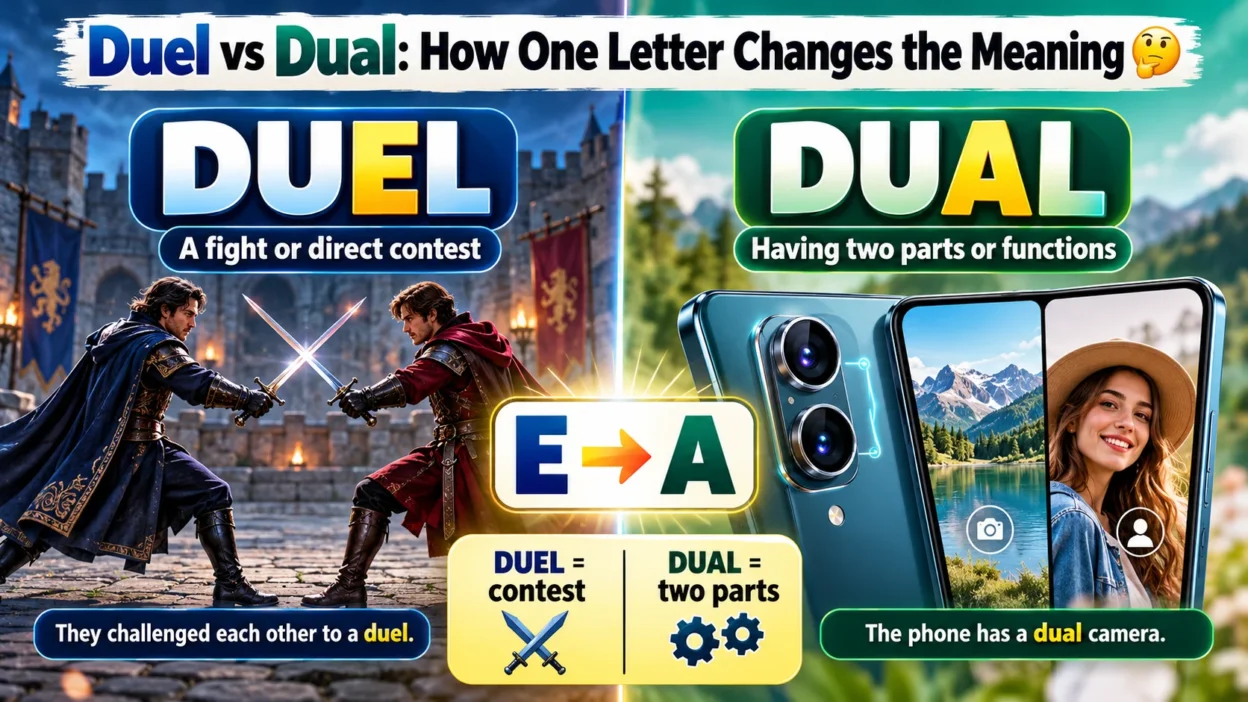
If you often confuse duel vs dual, you are not alone because these two English words sound almost identical but have completely different meanings. Duel refers to a fight, contest, or direct confrontation between two opponents, while dual describes something that has two parts, functions, roles, or aspects. You may encounter duel in historical stories, movies, sports, games, and descriptions of intense competition. In contrast, dual commonly appears in phrases such as dual citizenship, dual purpose, dual role, and dual-screen device. Although their pronunciation can make them confusing, their meanings become clear when you look at the context. In this guide, you will learn the difference between duel vs dual, including their meanings, pronunciation, grammar, examples, synonyms, common mistakes, and easy ways to remember them.
⚡ Duel vs Dual: The Quick Answer
| Term | Meaning | Usage | Category |
|---|---|---|---|
| Duel | A fight or contest between two opponents | “The rivals fought a duel.” | Noun/Verb |
| Dual | Consisting of two parts or aspects | “She has dual citizenship.” | Adjective |
The simplest rule is:
Dual = two or double.
Duel = fight or contest.
Both words can involve the idea of two, but only duel describes confrontation.
🔤 What Does “Duel” Mean?
Duel works as both a noun and a verb.
As a noun, a duel means a fight or contest between two opponents. Traditionally, people used the word for formal combat, especially when two people arranged a fight to settle a dispute or defend their honor.
As a verb, duel means to fight or compete directly against another person or side.
Pronunciation
Both duel and dual commonly sound like /ˈduːəl/ in English, although pronunciation can vary slightly by accent.
Part of Speech
- Duel — noun
- Duel — verb
Origin
The noun duel comes through French from Latin duellum, meaning war or combat. English later developed the modern sense of a formal fight between two people.
Common Meaning
Today, people use duel in both literal and figurative contexts. A literal duel involves physical combat, while a figurative duel describes two people or groups competing intensely.
Examples include:
- a sword duel
- a pistol duel
- a verbal duel
- a political duel
- a musical duel
✌️ What Does “Dual” Mean?
Dual usually functions as an adjective. It describes something that contains, involves, or serves two parts, purposes, roles, or aspects.
For example, dual citizenship means that someone holds citizenship in two countries. A dual-purpose tool serves two purposes.
Pronunciation
Like duel, dual commonly has the pronunciation /ˈduːəl/.
Part of Speech
- Dual — adjective
Origin
Dual comes from Latin dualis, which relates to duo, meaning “two.”
Common Meaning
You can usually replace dual with an idea such as double, two-part, or involving two.
Common expressions include:
- dual citizenship
- dual purpose
- dual role
- dual responsibility
- dual career
- dual camera
- dual controls
- dual monitors
- dual nationality
🧠 Duel vs Dual: The Difference in Context
The easiest way to choose the correct spelling involves asking what your sentence describes.
If your sentence describes two parts or functions, choose dual.
If your sentence describes a fight or direct contest, choose duel.
Compare these sentences:
- The phone has dual cameras.
- The two warriors entered a duel.
- She has dual citizenship.
- The rivals dueled for the championship.
- The machine has a dual function.
- The debate became a verbal duel.
This context-based approach works better than trying to remember the spelling alone.
✍️ Duel vs Dual Examples
| Example Sentence | Meaning |
|---|---|
| The knights prepared for a duel. | They prepared for a fight. |
| The smartphone has dual cameras. | It has two cameras. |
| The rivals challenged each other to a duel. | They challenged each other to a contest. |
| She holds dual citizenship. | She has citizenship in two countries. |
| The debate turned into a verbal duel. | The speakers competed intensely. |
| This machine has a dual purpose. | It serves two purposes. |
| The two champions dueled for the title. | They competed directly. |
| He performs dual roles in the company. | He performs two roles. |
| The movie features an exciting sword duel. | It features a sword fight. |
| The car comes with dual exhaust pipes. | It has two exhaust pipes. |
🔎 Synonyms for “Duel”
| Synonym | Meaning |
|---|---|
| Fight | Physical or verbal conflict |
| Combat | Armed or physical fighting |
| Battle | A major fight or conflict |
| Contest | Competition between opponents |
| Confrontation | Direct conflict |
| Showdown | Final or important confrontation |
| Conflict | Serious disagreement or opposition |
| Clash | Direct disagreement or fight |
| Struggle | Difficult competition or conflict |
| Match | Organized competition |
| Competition | An attempt to defeat another |
| Encounter | Meeting or confrontation |
| Challenge | A test or competitive situation |
| Face-off | Direct competition |
| Skirmish | Small-scale fight or conflict |
🔄 Antonyms and Contrasting Ideas
“Duel” does not have one perfect antonym in every context, but these words express opposing ideas depending on the sentence.
| Antonym/Contrast | Meaning |
|---|---|
| Cooperation | Working together |
| Peace | Absence of conflict |
| Agreement | Shared opinion |
| Harmony | Peaceful agreement |
| Partnership | Working jointly |
| Collaboration | Creating something together |
| Friendship | Positive personal relationship |
| Unity | Being joined together |
| Reconciliation | Restoring friendly relations |
| Truce | Temporary end to fighting |
🔗 Related Words You Should Know
| Related Word | Meaning |
|---|---|
| Duality | The state of having two aspects |
| Duo | A pair of people or things |
| Double | Twice as much or consisting of two |
| Dueling | The act of fighting or competing in a duel |
| Duelist | A person who takes part in a duel |
| Combat | Physical fighting |
| Opponent | Someone who competes against another |
| Rival | A person competing for the same goal |
| Conflict | A disagreement or struggle |
| Confrontation | A direct conflict |
| Twofold | Having two parts or aspects |
| Bilateral | Involving two sides |
| Pair | Two matching or associated things |
| Twin | One of two people or things born or existing together |
| Double-purpose | Designed for two purposes |
🌎 How People Use Duel and Dual in Real Life
You will encounter dual frequently in everyday descriptions, technology, business, education, and formal writing. People talk about dual roles, dual monitors, dual citizenship, dual functions, and dual responsibilities.
Duel appears less often in ordinary conversation because its traditional meaning involves formal combat. However, writers and speakers still use it in historical discussions, entertainment, sports, gaming, and figurative descriptions of competition.
For example, a sports commentator might describe two elite competitors as engaging in a “duel,” even when nobody physically fights.
In business writing, dual appears much more naturally:
The manager has a dual role within the organization.
In a historical article, duel fits naturally:
The two gentlemen arranged a duel after their dispute.
❌ Common Mistakes With Duel and Dual
| Mistake | Correct Usage |
|---|---|
| He has duel citizenship. | He has dual citizenship. |
| The knights fought a dual. | The knights fought a duel. |
| This is a duel-purpose product. | This is a dual-purpose product. |
| They challenged each other to a dual. | They challenged each other to a duel. |
| The laptop has duel screens. | The laptop has dual screens. |
| She has duel responsibilities. | She has dual responsibilities. |
| The warriors entered a dual. | The warriors entered a duel. |
| The device offers duel functions. | The device offers dual functions. |
| The rivals dualed for the title. | The rivals dueled for the title. |
| He described the debate as a verbal dual. | He described the debate as a verbal duel. |
💡 An Easy Memory Trick
Remember this simple connection:
DUAL = DOUBLE
Both ideas relate to two.
If you can replace the word with double, two-part, or two-sided, choose dual.
The device has dual controls.
The device has two sets of controls.
For duel, think of fight or face-off.
The two warriors fought a duel.
The two warriors faced off.
This trick can help you select the correct word quickly when writing.
❓FAQs
Is “Duel” Ever Used as a Verb?
Yes. Duel can function as a verb.
You can say:
- The two fighters dueled at dawn.
- The musicians dueled on stage.
- The rivals dueled for first place.
- The two players duel for control of the game.
This distinction provides another useful clue: dual normally describes something, while duel can describe an action.
Is “Dual” a Noun or an Adjective?
Dual primarily functions as an adjective. It modifies a noun by showing that something has two parts, functions, or aspects.
Examples include:
- dual purpose
- dual nationality
- dual role
- dual system
- dual function
Some specialized grammatical contexts also use dual as a noun, particularly when discussing languages that distinguish exactly two people or things. However, everyday English learners usually encounter dual as an adjective.
Are Duel and Dual Homophones?
Yes. In many varieties of English, duel and dual have the same or nearly the same pronunciation. Their spelling and meaning remain different.
That makes them easy to confuse in speech because you cannot rely on sound alone. Context helps you identify the intended word.
What Is the Difference Between Dual and Duel Citizenship?
The correct phrase is dual citizenship.
It means that a person legally holds citizenship in two countries. Duel citizenship would incorrectly suggest that citizenship involves a fight.
Similarly:
- dual nationality ✅
- dual passport arrangements ✅
- duel nationality ❌
What Is the Difference Between a Duel and a Battle?
A duel traditionally involves two opposing people, while a battle can involve larger groups, armies, or multiple participants.
A sword fight between two characters can qualify as a duel. A conflict between two armies normally qualifies as a battle.
The words can overlap when writers use them figuratively, but duel emphasizes direct competition between two opponents.
Is “Dual Purpose” Correct?
Yes. Dual purpose means something has two purposes or functions.
For example:
This tool has a dual purpose: it cuts material and measures its thickness.
Never write duel purpose when you mean two functions.
🎯 Conclusion
The difference between duel vs dual becomes easy to understand when you connect each spelling with its meaning. Dual describes two parts, functions, roles, or aspects, while duel refers to a fight, contest, or direct confrontation. Use dual when discussing technology, citizenship, responsibilities, or functions, and use duel when describing combat, competition, or a showdown. A simple way to remember the difference is “dual = double” and “duel = fight.” Once you remember this shortcut, you can choose the correct word confidently in essays, emails, articles, and everyday writing.

Andrew Foster is a researcher and content writer at Differopedia, specializing in clear, accurate, and easy-to-understand comparison guides, definitions, and informational articles. His work focuses on helping readers make informed decisions through well-researched, reliable content.