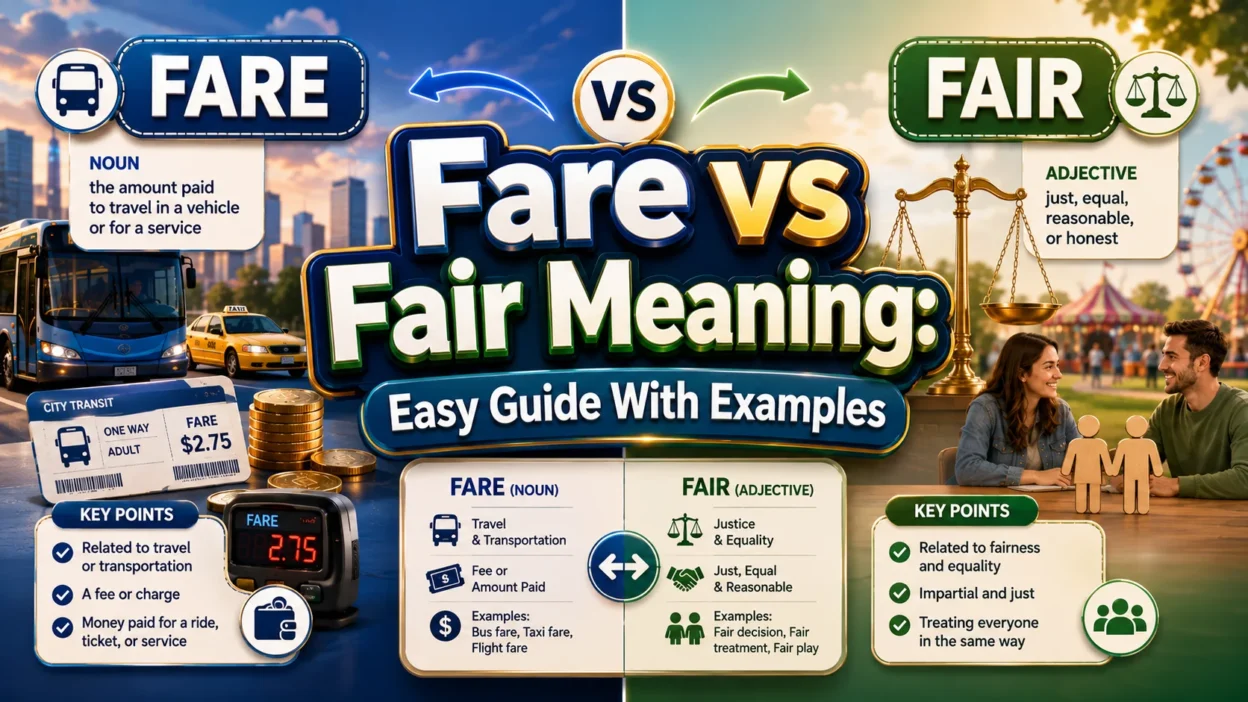
Understanding fare vs fair meaning can help you avoid one of the most common spelling mistakes in English. These two words sound the same in most English accents, but they have completely different meanings. Because they are homophones, you need to understand the context before choosing the correct spelling.
Fare usually refers to the price you pay for transportation, such as a bus, train, taxi, or flight. It can also describe food, especially a particular type or style of food. As a verb, fare means to perform, progress, or manage in a particular situation.
Fair, on the other hand, usually describes something reasonable, equal, or just. It can also refer to a public event, suitable weather, or a light color.
Once you connect each spelling with its main meanings, the difference becomes much easier to remember.
Quick Answer: Fare vs Fair
| Term | Meaning | Common Usage | Part of Speech |
|---|---|---|---|
| Fare | Transportation cost, food, or performance/progress | Bus fare, local fare, fare well | Noun, Verb |
| Fair | Just, reasonable, equal, pleasant, or a public event | Fair price, fair decision, county fair | Adjective, Noun, Adverb |
Simple rule: Remember fare for a fee, food, or how someone performs. Remember fair for justice, equality, reasonable treatment, or an event.
What Does “Fare” Mean?
Fare has several meanings, so you need to look at the surrounding words.
Fare as a Transportation Price
The most common meaning of fare refers to the money someone pays for transportation.
Examples include:
- bus fare
- train fare
- taxi fare
- subway fare
- airline fare
- cab fare
Example: “The bus fare increased this month.”
Here, fare means the amount of money you pay to travel.
Fare as Food
Fare can also mean food, especially a particular type or style of food.
Example: “The restaurant serves traditional Mexican fare.”
In this sentence, fare means a type or style of food.
Fare as a Verb
As a verb, fare means to perform, progress, or manage in a particular situation.
You often see this meaning in phrases such as:
- How did you fare?
- How did she fare on the test?
- The team fared well.
- He fared poorly during the interview.
Example: “How did you fare on your final exam?”
The sentence asks how well you performed.
Fare in “Fare Well”
You may also see fare in the expression fare well.
Fare well means to do well, succeed, or experience a positive outcome.
Example: “I hope you fare well in your new job.”
Do not confuse fare well with fair well. The standard expression uses fare.
What Does “Fair” Mean?
Fair has several common meanings, but they usually connect with ideas such as equality, justice, reasonableness, appearance, or an event.
Fair as Just or Equal
The most common meaning of fair describes something reasonable, impartial, or equal.
Example: “The teacher gave every student a fair opportunity.”
Here, fair means equal and reasonable.
You can use it when discussing:
- fair treatment
- fair competition
- fair rules
- fair judgment
- fair opportunities
- fair decisions
Fair as Reasonable
Fair can also describe a price, offer, deal, or amount that seems reasonable.
Example: “That seems like a fair price for the car.”
The speaker considers the price reasonable.
Fair as a Public Event
A fair can also mean a public event where people gather for entertainment, food, games, rides, shopping, or exhibitions.
Examples include:
- county fair
- state fair
- school fair
- craft fair
- book fair
- trade fair
Example: “We visited the county fair last weekend.”
Fair as Light in Color
Fair can describe someone or something with a light color.
For example:
- fair hair
- fair skin
- fair complexion
Example: “She has fair hair and blue eyes.”
Fair as Pleasant Weather
In some contexts, fair describes pleasant or clear weather.
Example: “The weather should remain fair this afternoon.”
Here, fair means reasonably pleasant or clear.
Fare vs Fair: Pronunciation
In most varieties of English, fare and fair have the same pronunciation.
They are generally pronounced:
/fer/
Because they sound alike, listening alone cannot tell you which spelling you need. You must use the meaning and context.
This makes fare vs fair a classic homophone pair, similar to:
- there / their / they’re
- hear / here
- right / write
- sea / see
Fare vs Fair: Examples
| Example Sentence | Meaning |
|---|---|
| The bus fare costs three dollars. | Transportation price |
| We paid the train fare online. | Transportation price |
| The restaurant serves delicious Italian fare. | Food |
| How did you fare in your interview? | Perform or progress |
| She fared well in the competition. | Performed successfully |
| The teacher gave us a fair test. | Reasonable or impartial |
| Everyone deserves a fair chance. | Equal |
| That is a fair price for the service. | Reasonable |
| We went to the county fair. | Public event |
| He has fair hair. | Light-colored |
These examples show why context matters. The pronunciation stays similar, but the meaning changes completely.
Fare vs Fair: Common Mistakes
| Mistake | Correct Usage |
|---|---|
| The bus fair is expensive. | The bus fare is expensive. |
| We paid the train fair. | We paid the train fare. |
| How did you fair on the test? | How did you fare on the test? |
| I hope you fair well. | I hope you fare well. |
| The restaurant serves Italian fair. | The restaurant serves Italian fare. |
| Everyone deserves a fare chance. | Everyone deserves a fair chance. |
| That is not a fare deal. | That is not a fair deal. |
| We visited the county fare. | We visited the county fair. |
| She has fare skin. | She has fair skin. |
| The price seems fare. | The price seems fair. |
How to Remember Fare vs Fair
A simple memory trick can help you choose the right word quickly.
Remember “Fare = Fee”
If you are talking about the fee you pay for transportation, use fare.
Fare → Fee
For example:
“The taxi fare is $20.”
You can also remember fare for food and performance:
Fare = fee + food + performance
Remember “Fair = Fairness”
If you are talking about equality, justice, or reasonable treatment, choose fair.
Fair → Fairness
For example:
“Everyone deserves a fair chance.”
You can also connect fair with a fair as an event.
Fare vs Fair in Everyday English
You will encounter both words frequently in everyday communication.
Daily Conversation
People commonly use fare when discussing transportation:
“What is the bus fare?”
They use fair when discussing reasonable treatment:
“That doesn’t seem fair.”
Business Communication
Businesses often use fare when discussing travel costs:
“The airline offers discounted fares.”
They use fair when discussing prices, agreements, or treatment:
“We want to offer customers a fair price.”
Academic Writing
Students may use fare when explaining performance:
“The students fared well on the examination.”
They may use fair when discussing impartiality:
“Researchers should provide fair opportunities to participants.”
Social Media and Messaging
People commonly use both words in casual online conversations.
For example:
“How did you fare at the game?”
or:
“That’s not fair!”
Because autocorrect can sometimes choose the wrong homophone, checking the context before posting can prevent mistakes.
Synonyms for Fare and Fair
Because fare and fair have multiple meanings, their synonyms depend on the context.
Synonyms for Fare
| Synonym | Meaning |
|---|---|
| Fee | Money charged for a service |
| Charge | Amount requested for something |
| Cost | Price of something |
| Price | Amount paid |
| Rate | Fixed amount charged |
| Food | Something prepared to eat |
| Cuisine | Style of cooking |
| Perform | Do or execute something |
| Progress | Move forward successfully |
| Manage | Deal with a situation |
Synonyms for Fair
| Synonym | Meaning |
|---|---|
| Just | Morally right or reasonable |
| Equal | The same in value or opportunity |
| Impartial | Not favoring one side |
| Reasonable | Sensible or acceptable |
| Honest | Truthful and sincere |
| Unbiased | Free from favoritism |
| Equitable | Fair and balanced |
| Appropriate | Suitable for the situation |
| Moderate | Not excessive |
| Legitimate | Fair or valid |
Related Terms You Should Know
| Related Word | Meaning |
|---|---|
| Farewell | A goodbye or departure |
| Farecard | A card used to pay transportation costs |
| Bus fare | Price of traveling by bus |
| Train fare | Price of traveling by train |
| Airfare | Cost of an airline ticket |
| Fairness | Quality of treating people equally |
| Fairly | In a fair or reasonable way |
| Fair-minded | Willing to consider people equally |
| Fairness | Impartial and equal treatment |
| Fairground | Area where a fair takes place |
| County fair | Local public entertainment event |
| Trade fair | Event where businesses display products |
| Fair play | Honest and respectful behavior |
| Fare well | Do well or succeed |
| Fare-paying | Relating to someone who pays a transportation fare |
Related Questions
Is “fare” and “fair” the same word?
No. Fare and fair are different words that usually sound the same. Fare commonly refers to transportation costs, food, or performance, while fair often means just, equal, reasonable, or a public event.
Is it “bus fare” or “bus fair”?
The correct phrase is bus fare because fare means the money you pay for transportation.
Is it “fair well” or “fare well”?
The correct expression is fare well. It means to do well or succeed.
Is it “fair price” or “fare price”?
The correct phrase is usually fair price when you mean a reasonable price. For transportation, you can say fare to describe the actual transportation charge.
Are fare and fair homophones?
Yes. In most English varieties, fare and fair sound alike but have different meanings and spellings.
How can I remember the difference?
Remember fare = fee when you discuss transportation. Remember fair = fairness when you discuss equality, justice, or reasonable treatment.
FAQ
What does fare mean?
Fare commonly means the amount you pay for transportation. It can also mean food or describe how someone performs or progresses.
What does fair mean?
Fair commonly means just, equal, impartial, or reasonable. It can also describe a public event, light coloring, or pleasant weather.
Which is correct: “fare price” or “fair price”?
Use fair price when you mean a reasonable price. Use fare when you specifically mean a transportation charge.
Which is correct: “fare well” or “fair well”?
Use fare well. The phrase means to do well or succeed.
What is the difference between airfare and fair?
Airfare means the cost of an airline ticket. Fair usually means reasonable, equal, or just.
Can fair describe food?
Usually, fare describes food or cuisine. For example, “The restaurant serves traditional American fare.”
Can fare work as a verb?
Yes. Fare can work as a verb meaning to perform, progress, or manage. For example, “She fared well in the competition.”
Conclusion
The difference between fare vs fair is easy to understand once you know their meanings. Fare usually refers to a transportation cost, food, or how someone performs. Fair usually means just, equal, reasonable, or impartial. It can also describe a public event, light color, or pleasant weather. A simple trick is to remember “fare = fee” for transportation. Think of “fair = fairness” when talking about equality or justice. Understanding the context will help you choose the correct word every time.

Andrew Foster is a researcher and content writer at Differopedia, specializing in clear, accurate, and easy-to-understand comparison guides, definitions, and informational articles. His work focuses on helping readers make informed decisions through well-researched, reliable content.