You have probably typed “ques or cues” into a search engine at some point, wondering which word fits your sentence. These two terms sound identical when spoken, but they carry completely different meanings. Understanding the distinction will save you from embarrassing mistakes in your writing. In this guide, we will break down everything you need to know about both words.
Quick Answer Table
| Term | Meaning | Usage | Category |
|---|---|---|---|
| Cues | Signals, prompts, or hints that guide action | “The director gave the actor his cues.” | Noun/Verb |
| Ques | Informal abbreviation for “questions” | “Got any ques about the assignment?” | Noun (slang) |
| Cue | A long tapered stick used in billiards | “He grabbed his cue and lined up the shot.” | Noun |
| Cue | To prompt or signal someone to act | “I will cue you when it is your turn.” | Verb |
The Core Difference Between Ques and Cues
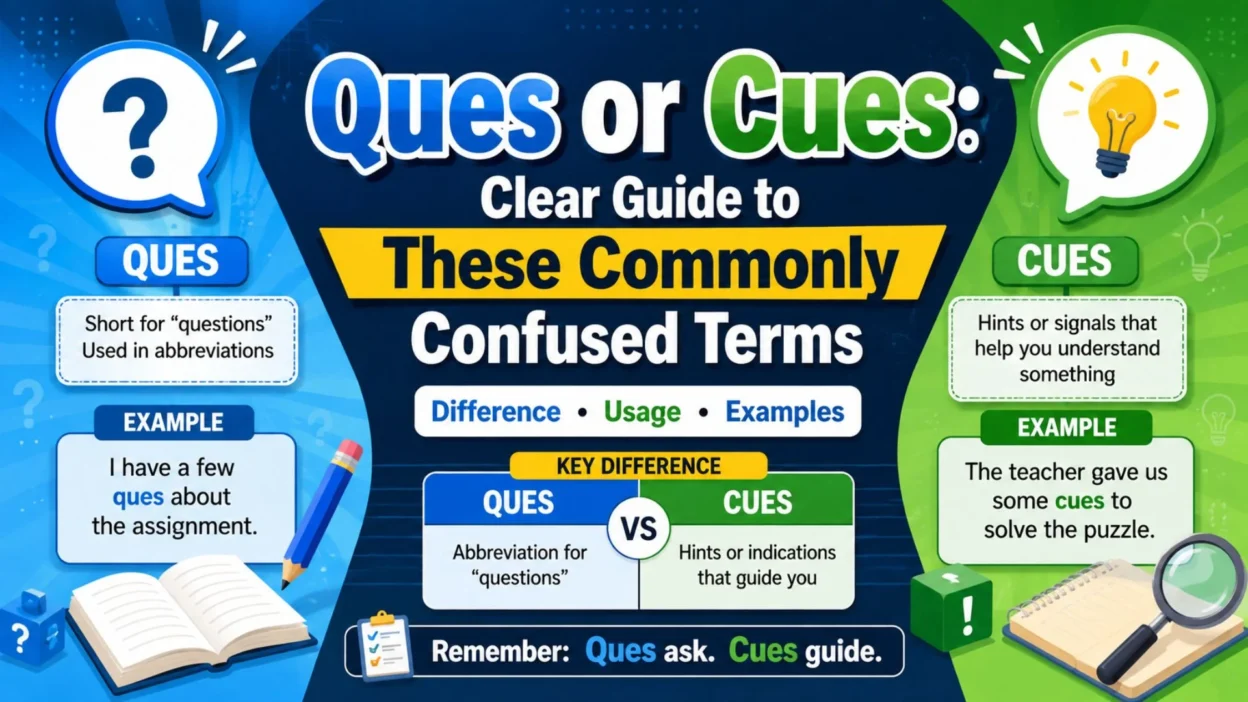
The fundamental difference comes down to one thing: “ques” asks; “cues” directs.
When you write “ques,” you are asking a question or referring to questions. When you write “cues,” you are referring to signals or prompts that guide action. This distinction is crucial for clear communication.
| Aspect | Ques | Cues |
|---|---|---|
| Core meaning | Questions | Signals or prompts |
| Function | Asks for information | Directs or guides action |
| Formality | Informal, slang | Formal and informal |
| Verb form | None (noun only) | Yes (“to cue”) |
What Does “Cues” Mean?
Definition and Pronunciation
Cues (pronounced /kyo͞oz/) are signals, prompts, or hints that tell someone to take a specific action. In the performing arts, cues tell actors when to speak or move. In everyday life, cues guide our behavior in countless ways.
Part of Speech
“Cues” functions as both a noun and a verb. As a noun (plural), it means signals or prompts that guide action. As a verb (third-person singular), it means signals or prompts someone to act.
Origin and Etymology
The word “cue” likely comes from the Latin word “quandō,” meaning “when.” In early theatrical scripts, actors would see the letter “q” written in their parts to indicate when they should enter. Over time, this abbreviation evolved into the word “cue.” The billiards meaning comes from the French word “queue,” meaning “tail.”
What Does “Ques” Mean?
Definition and Pronunciation
Ques (pronounced /kyo͞oz/) is primarily an informal abbreviation for the word “questions.” You will most commonly encounter it in text messages, social media posts, and casual digital communication.
Part of Speech
“Ques” functions as a noun (plural) in almost all cases. It serves as an informal shorthand for “questions.”
Origin and Etymology
“Ques” emerged as a natural abbreviation in written communication. People shortened “questions” to “ques.” for convenience in note-taking. With the rise of digital communication, the period dropped away, and “ques” became a standalone slang term.
Usage Examples
| Example Sentence | Meaning |
|---|---|
| The director gave the actors their cues before the performance began. | The director provided signals to guide the actors’ actions. |
| She took her cue from the audience’s reaction and adjusted her speech. | She used the audience’s response as a signal to change her approach. |
| I will cue you when it is your turn to speak. | I will give you a signal when you should start speaking. |
| The pool player carefully chalked his cue before the match. | He prepared his billiards stick for the game. |
| Do you have any ques about the homework assignment? | Do you have any questions about the homework? |
| Hit me with your ques, and I will answer what I can. | Send me your questions, and I will answer them. |
| Visual cues on the website guide users to the checkout button. | Design elements direct users toward making a purchase. |
| The therapist picked up on subtle social cues from her patient. | The therapist noticed small signals indicating how the patient felt. |
| Ques for the class discussion are due tomorrow. | The questions for discussion must be submitted by tomorrow. |
| The stage manager cued the sound effects at exactly the right moment. | The stage manager triggered the sound effects at the precise time. |
Synonyms for Cues
| Synonym | Meaning |
|---|---|
| Signal | A gesture or action that conveys information |
| Prompt | A cue given to remind someone or encourage action |
| Hint | A subtle or indirect suggestion |
| Clue | Information that helps solve a problem |
| Suggestion | An idea or plan put forward for consideration |
| Indicator | Something that points to or shows something else |
| Reminder | Something that causes someone to remember something |
| Nudge | A gentle push or encouragement to do something |
| Inkling | A slight knowledge or suspicion |
| Tip-off | A piece of information given in advance |
| Intimation | A hint or subtle indication |
| Gesture | A movement expressing an idea or meaning |
| Whisper | A soft tone, often used metaphorically for subtle cues |
| Lead | Information that may help in discovery |
| Catchword | A word or phrase that becomes popular |
Antonyms for Cues
| Antonym | Meaning |
|---|---|
| Silence | Complete absence of sound or signal |
| Stillness | Absence of movement that might serve as a cue |
| Confusion | Lack of clear signals or understanding |
| Misunderstanding | Failure to interpret signals correctly |
| Neglect | Failure to give proper signals or attention |
| Disregard | Paying no attention to signals or cues |
| Ignorance | Lack of knowledge about what signals mean |
| Omission | Leaving out important signals or information |
| Inattention | Failure to notice or respond to cues |
| Ambiguity | Signals that are unclear or open to interpretation |
Related Terms
| Related Word | Meaning |
|---|---|
| Queue | A line of people or vehicles waiting |
| Prompt | To encourage or remind someone to do something |
| Signal | A gesture or action that conveys information |
| Hint | A subtle suggestion or piece of information |
| Clue | Information that helps solve a problem |
| Question | A sentence worded to elicit information |
| Inquiry | An act of asking for information |
| Query | A question addressed to an official or organization |
| Interrogative | A word used in asking a question |
| Stimulus | Something that causes a response or reaction |
| Gesture | A movement that expresses an idea |
| Indicator | Something that points to something else |
| Prompting | The action of encouraging someone to do something |
| Reminder | Something that causes someone to remember |
| Whisper | A quiet tone, often used for subtle cues |
Real-Life Usage
Daily Conversation: You will hear “cues” frequently in everyday speech. People talk about taking social cues from others or reading body language cues. You will rarely hear “ques” in spoken conversation because it is primarily a written abbreviation.
Social Media: On social media, “ques” thrives. You will see posts like “Any ques? Drop them below.” “Cues” appears too, but in a different context—influencers talk about “style cues” or “visual cues.”
Business Communication: In business settings, “cues” is the professional choice. Project managers give cues to their teams. “Ques” rarely appears in formal business communication. Professional documents always use the full word “questions.”
Academic Writing: Academic writing demands precision. Scholars use “cues” when discussing signals or indicators in their research. “Ques” has limited use in academic contexts. Formal papers always spell out “questions.”
Online Messaging: In online messaging, “ques” is king. Texters love the brevity. You will see “Got any ques?” constantly. “Cues” appears less frequently but carries its standard meaning when it does.
Common Mistakes
| Mistake | Correct Usage |
|---|---|
| Using “ques” when you mean signals | Use “cues” when referring to signals or prompts. |
| Using “cues” when you mean questions | Use “ques” (or “questions”) when asking about something. |
| Writing “que” when you mean “cue” | Write “cue” for a signal or billiards stick. |
| Writing “cue” when you mean “queue” | Write “queue” for a line of people or data. |
| Using “ques” in formal writing | Use “questions” in formal writing. |
| Spelling “cues” as “queues” | Remember that “cues” are signals, while “queues” are lines. |
| Confusing “cue” with “queue” | Distinguish between a signal and a line. |
| Writing “ques” as a verb | Remember that “ques” is only a noun. |
| Using “cues” as an abbreviation for questions | Reserve “cues” for signals; use “ques” for questions. |
| Misspelling “cues” as “ques” professionally | Double-check your spelling in professional writing. |
Semantic Keywords and Related Concepts
Understanding “ques or cues” requires exploring several interconnected concepts. Homophones are words that sound the same but have different meanings. “Cues” and “ques” are homophones, as are “cue” and “queue.” This similarity creates confusion for many writers. Context clues help readers understand unfamiliar words. Non-verbal communication often relies on cues to convey meaning without words.
Social cues are the signals people send through body language, facial expressions, and tone of voice. Visual cues guide users through websites and interfaces. Audio cues synchronize sound and picture in video editing. Question words like who, what, when, where, why, and how help form questions that “ques” represents.
Frequently Asked Questions
What is the difference between ques and cues?
Ques means questions, while cues means signals or prompts that guide action.
Can I use ques in formal writing?
No, you should use “questions” instead of “ques” in formal writing.
Is cue and queue the same thing?
No, cue is a signal or billiards stick, while queue is a line of people or data.
Why do people confuse ques and cues?
People confuse them because they sound exactly the same when spoken.
How do you pronounce cues?
You pronounce it “kyooz,” rhyming with “news” and “views.”
What are social cues?
Social cues are non-verbal signals that indicate how to behave in social situations.
Is ques a real word?
Yes, it is an informal abbreviation for “questions” used in digital communication.
Can cues be used as a verb?
Yes, “cue” can be used as a verb meaning to signal or prompt someone to act.
Conclusion
Understanding the difference between “ques” and “cues” will make your writing clearer and more professional. Remember that “ques” asks questions and “cues” directs action. We encounter both terms regularly in our daily lives, from social media posts to business meetings. The next time you type either word, pause and consider your meaning. Are you asking something or signaling something? This simple check will prevent embarrassing mistakes and help you communicate with confidence. Now you can use both terms correctly and explain the difference to others who might struggle with these confusing homophones.

Andrew Foster is a researcher and content writer at Differopedia, specializing in clear, accurate, and easy-to-understand comparison guides, definitions, and informational articles. His work focuses on helping readers make informed decisions through well-researched, reliable content.