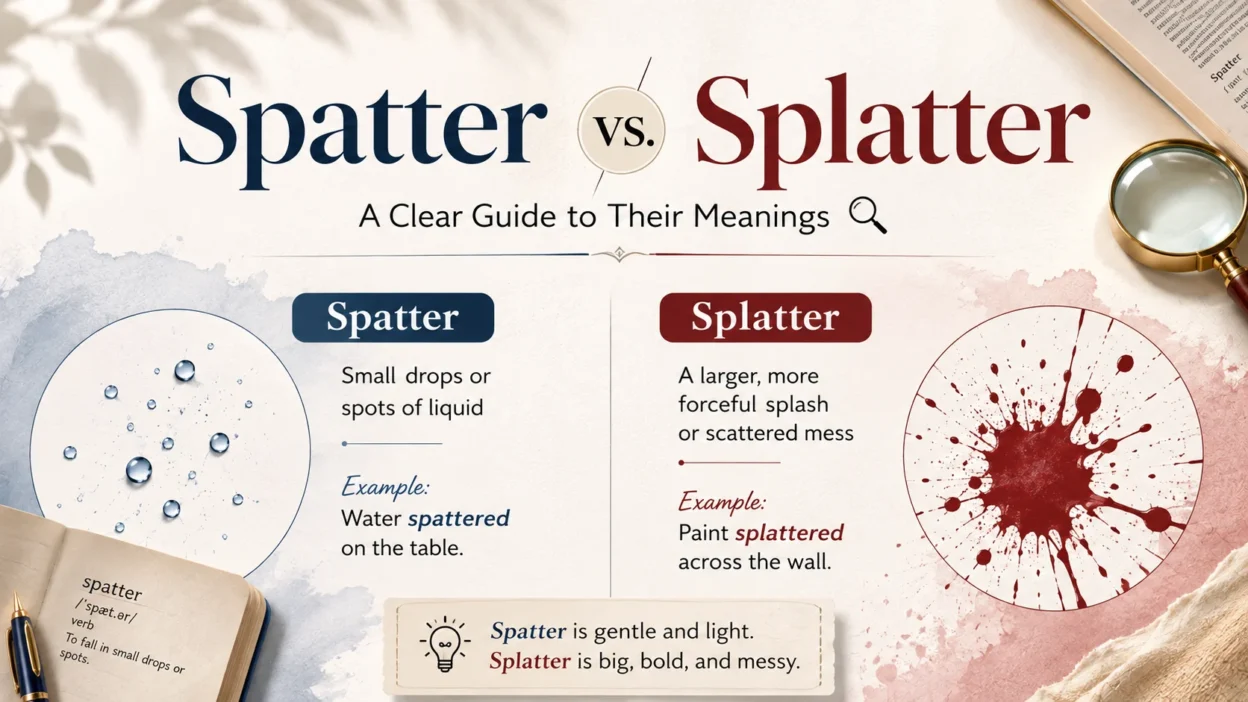
Have you ever wondered whether spatter or splatter is the better word? 🤔 These similar words both describe substances being scattered, but they can create different impressions. Spatter often suggests scattered drops in a lighter or more neutral way, while splatter tends to suggest a messier or more forceful spread. However, the meanings overlap, so context matters. In this guide, we’ll explain spatter vs. splatter, compare their uses, and provide clear examples for everyday, technical, and creative writing.
⚡ Spatter vs. Splatter: Quick Answer
| Word | General Meaning | Typical Impression |
|---|---|---|
| Spatter | To scatter drops or small particles over an area | Light, scattered, or relatively neutral |
| Splatter | To scatter liquid or another substance messily or forcefully | Messy, vivid, or dramatic |
A simple way to remember the difference is:
Spatter often emphasizes scattered drops, while splatter often emphasizes a messy or forceful spread.
However, don’t treat this as a strict size rule. There is considerable overlap between the two words, and native speakers may choose either depending on the context.
📖 What Does Spatter Mean?
Spatter can function as both a verb and a noun.
As a verb, spatter means to scatter small drops or particles of a substance onto something.
For example:
Hot oil spattered onto the stove.
As a noun, spatter can refer to the drops, marks, or pattern produced by this action.
There was grease spatter on the kitchen wall.
The word is especially useful when you want to describe scattered drops without necessarily emphasizing a dramatic or chaotic impact.
You might encounter spatter when talking about:
- Rain
- Cooking oil
- Paint
- Mud
- Bloodstain patterns
- Water
- Grease
- Small droplets
For example:
Rain spattered against the window.
Here, spattered creates the image of scattered drops hitting the glass.
💥 What Does Splatter Mean?
Splatter can also be used as both a verb and a noun.
As a verb, it means to scatter or splash a liquid or substance, often producing a messy or noticeable spread.
For example:
The paint splattered across the floor.
As a noun, splatter refers to the resulting drops, marks, or mess.
We had to clean the paint splatter from the floor.
Compared with spatter, splatter often sounds more vivid and dramatic. It can suggest that a substance was scattered with enough force to create an obvious mess.
For example:
Mud splattered all over my shoes.
This sounds more dramatic than simply saying mud spattered the shoes.
⚖️ Spatter vs. Splatter: What’s the Difference?
The most useful distinction is tone and emphasis, rather than a rigid rule about the exact size of the drops.
Spatter often suggests scattered droplets or particles and can sound neutral or technical.
Splatter often suggests a messier, heavier, or more forceful scattering.
Compare these examples:
A few drops of oil spattered onto the counter.
The sentence focuses on scattered droplets.
A bucket of paint splattered across the wall.
The second sentence creates a stronger image of a messy impact.
But the distinction isn’t absolute. The same event could sometimes be described with either word depending on what the writer wants to emphasize.
A useful comparison
Spatter:
- Often sounds more neutral
- Commonly describes scattered droplets
- Frequently appears in technical contexts
- Can describe light rain or cooking oil
- Often focuses on the pattern of drops
Splatter:
- Often sounds more dramatic
- Commonly describes a messy spread
- Frequently appears in art and informal descriptions
- Can suggest greater force or impact
- Often emphasizes the resulting mess
🍳 Spatter vs. Splatter in Cooking
Both words are common when describing cooking accidents, but they can create slightly different impressions.
Spatter works well when describing small drops of hot oil or liquid:
The bacon grease spattered while it was cooking.
Hot soup spattered onto the countertop.
Splatter works when the situation is messier or more dramatic:
The sauce splattered all over the inside of the microwave.
The frying oil splattered across the stovetop.
In cooking, spatter often sounds more neutral, while splatter emphasizes the mess.
🎨 Spatter vs. Splatter in Art
The two words also appear frequently in discussions about painting and visual art.
Spatter can describe a technique in which small drops of paint are scattered across a surface.
For example:
The artist used a brush to spatter paint across the canvas.
Splatter often creates a more energetic or dramatic image:
The artist created a bold splatter effect with bright paint.
The noun paint splatter is especially common in everyday descriptions.
You may also see the phrase splatter painting, which describes artwork created by scattering or throwing paint onto a surface.
In artistic contexts, splatter can therefore suggest spontaneity, movement, and visual impact.
🔬 Spatter in Forensic and Technical Contexts
Spatter has an important place in technical and forensic language.
The phrase blood spatter has long been used to describe patterns created when blood is dispersed into droplets. Modern forensic writing often uses the broader term bloodstain pattern analysis for the scientific examination of bloodstains and their distribution.
For example:
Investigators documented the blood spatter at the scene.
The report analyzed the bloodstain patterns found on the wall.
It’s best not to claim that blood splatter is grammatically incorrect. Splatter is a real English word and can occur in ordinary descriptions of blood. However, spatter and bloodstain pattern analysis are more appropriate choices when precision and technical terminology matter.
This is an important distinction between everyday language and specialized vocabulary.
🌧️ Spatter in Everyday Descriptions
Spatter works naturally when describing scattered drops of water, mud, paint, or another substance.
Examples include:
Rain spattered against the windshield.
Mud spattered the lower part of his trousers.
The wet brush spattered paint across the paper.
Tiny drops of water spattered the pavement.
The word doesn’t necessarily mean that the event was dramatic. It can simply describe the distribution of scattered drops.
🧼 Splatter for Messy Situations
When the main idea is a visible or unpleasant mess, splatter is often a stronger choice.
For example:
The children splattered mud across the hallway.
Tomato sauce splattered onto the kitchen floor.
Paint splattered across his shirt.
Water splattered everywhere when the pipe burst.
These sentences create a more vivid image than spatter might.
Still, context matters. A speaker could use spattered in some of these situations without producing a serious grammatical error.
✍️ Spatter vs. Splatter Examples
Here are some examples showing how the two words work naturally in sentences:
| Example | What It Suggests |
|---|---|
| Oil spattered from the hot pan. | Scattered drops of oil |
| Rain spattered against the glass. | Drops hitting a surface |
| Paint spattered the artist’s clothes. | Scattered paint drops |
| Mud splattered across the car. | A noticeable, messy spread |
| Sauce splattered across the wall. | A messy splash or spread |
| Paint splattered onto the floor. | A forceful or untidy spread |
| The artist added paint splatter to the canvas. | A dramatic artistic effect |
| Investigators examined the blood spatter pattern. | Technical/forensic terminology |
The examples show a general tendency rather than an unbreakable rule.
🧩 When Can Spatter and Splatter Both Work?
One of the most important things to understand is that spatter and splatter can overlap.
English vocabulary doesn’t always divide neatly into two completely separate categories. The choice may depend on the amount of force, the appearance of the substance, the context, or simply the writer’s preferred wording.
For example:
Mud spattered the car.
and
Mud splattered the car.
Both sentences are understandable. The first sounds somewhat more neutral, while the second creates a messier or more dramatic impression.
Similarly:
Paint spattered across the canvas.
and:
Paint splattered across the canvas.
Both can work, but splattered may emphasize the energetic or chaotic nature of the painting process.
Therefore, don’t worry about identifying an exact drop size before choosing a word. Think about the image and tone you want to create.
🚫 Common Mistakes to Avoid
Treating the size difference as an absolute rule
It’s tempting to memorize:
Small = spatter
Large = splatter
This is useful as a quick memory aid, but real usage is more flexible. The words overlap.
Assuming splatter is informal or incorrect
Splatter is a legitimate English word. It is widely used in everyday conversation, art, fiction, journalism, and other contexts.
Assuming spatter is only used for blood
Although spatter is important in forensic terminology, it is also commonly used for rain, oil, paint, mud, and other substances.
Calling blood splatter grammatically wrong
It’s better to distinguish between technical terminology and everyday language. Blood spatter is an established forensic expression, while blood splatter can occur in ordinary speech and media.
Assuming the words have different spellings in US and UK English
Both spatter and splatter are spelled the same in American and British English. The main issue is meaning and context, not regional spelling.
🌎 American and British English Usage
Unlike color/colour or center/centre, spatter and splatter don’t have separate American and British spellings.
Both words are used in both varieties of English.
The difference is primarily about meaning, tone, and context, not nationality.
You may encounter splatter frequently in casual descriptions, art, entertainment, and dramatic writing, while spatter can sound especially natural in neutral or technical descriptions. But this isn’t an absolute American-versus-British rule.
For international readers, the safest approach is to focus on the context rather than trying to assign one word exclusively to American or British English.
🧠 How to Remember Spatter vs. Splatter
Here’s an easy memory trick:
Spatter = scattered drops.
Splatter = a messier or more forceful spread.
You can also remember the extra “l” in splatter as a visual reminder of a larger or louder mess.
But remember that this is a memory aid, not a strict dictionary rule.
When you’re describing a technical pattern or simply scattered droplets, spatter may be the better choice.
When you want to emphasize a messy, vivid, or forceful spread, splatter often sounds more natural.
❓ Frequently Asked Questions
Is there a difference between spatter and splatter?
Yes, although their meanings overlap. Spatter often describes scattered droplets in a neutral or technical way, while splatter often suggests a messier or more forceful spread.
Is “blood spatter” or “blood splatter” correct?
Blood spatter is an established forensic term. Modern forensic work also commonly uses bloodstain pattern analysis. Blood splatter can appear in everyday or media language, so it isn’t best described as simply grammatically wrong.
Is spatter or splatter better for paint?
Either can work. Paint splatter is especially common when describing a messy or energetic artistic effect, while spatter can describe the scattering of small paint droplets.
Should I say “oil spatter” or “oil splatter”?
Both are possible. Oil spatter works well for scattered drops from a hot pan, while oil splatter can emphasize the mess produced by the splashing oil.
Is “spatter” a noun or a verb?
Both. You can say “rain spattered the window” as a verb or “there was rain spatter on the glass” as a noun.
Is “splatter” a noun or a verb?
Both. For example, “paint splattered across the wall” uses it as a verb, while “paint splatter covered the floor” uses it as a noun.
Are spatter and splatter synonyms?
They are closely related words, but they aren’t perfect synonyms in every context. Splatter often adds a sense of messiness or force, while spatter can sound more neutral.
Which word should I use in formal writing?
Choose the word that best fits the context. Spatter may be preferable in technical or scientific descriptions, while splatter is perfectly appropriate in many formal discussions of art, literature, or other subjects where a vivid effect is intended.
🎯 Conclusion
Both spatter and splatter are correct words, and their meanings overlap. Spatter often suggests scattered droplets and a more neutral or technical description, while splatter tends to create a messier or more forceful image. When choosing between them, focus on the context and the effect you want to create. Remember, the small-versus-large distinction is a helpful guide—not an absolute rule.

Andrew Foster is a researcher and content writer at Differopedia, specializing in clear, accurate, and easy-to-understand comparison guides, definitions, and informational articles. His work focuses on helping readers make informed decisions through well-researched, reliable content.