Have you ever typed “damn or danm” and wondered which spelling actually works? You are not alone. Many people confuse these two spellings because English speakers pronounce damn without clearly sounding the final n.
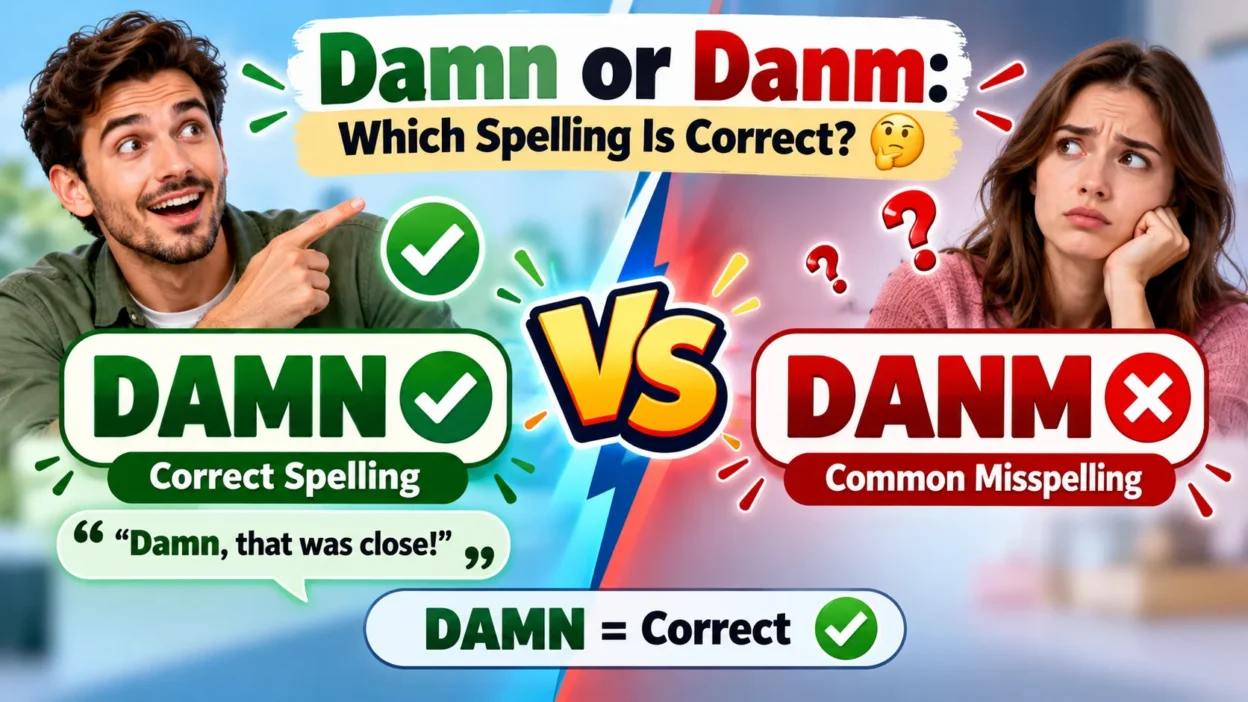
The correct spelling is damn. Danm does not represent the standard English word and usually appears as a typing or spelling mistake. The word damn can express anger, frustration, disappointment, surprise, or strong emphasis. Depending on the sentence, it can also work as a verb, noun, adjective, or adverb. Cambridge lists several informal uses, including emotional expressions and emphasis.
In this guide, you will learn the difference between damn and danm, the correct pronunciation, the meaning of damn, its origin, common examples, synonyms, related terms, and mistakes to avoid.
⚡ Damn or Danm
| Term | Meaning | Usage | Category |
|---|---|---|---|
| Damn | A standard English word expressing anger, surprise, emphasis, or criticism | Conversation, informal writing, social media | Correct |
| Danm | A misspelling of damn | Usually typing mistakes | Incorrect |
| Dam | A barrier that holds back water | Engineering, geography | Different word |
| Dame | A title or formal term for a woman | Names and titles | Different word |
Simple rule: If you mean the English swear word or expression, write damn, not danm.
Correct: Damn, I forgot my wallet.
Incorrect: Danm, I forgot my wallet.
The confusion often comes from pronunciation. English speakers usually pronounce damn as /dæm/, so the final n does not create a separate sound. Cambridge and Collins both give the pronunciation as /dæm/.
📖 What Does Damn Mean?
Damn has several meanings, and context determines the exact meaning. As an interjection, people often use it to show anger, annoyance, disappointment, or surprise.
For example:
“Damn! I missed the train.”
Here, the speaker expresses frustration.
People also use damn to add strong emphasis. In a sentence such as “That was a damn good movie,” the word strengthens good. Cambridge describes this informal use as a way to emphasize something, while Oxford also lists damn as an informal swear word used for emphasis.
As a verb, damn can mean to strongly criticize or condemn someone or something. In religious contexts, it can also refer to condemning someone to eternal punishment.
🔊 How Do You Pronounce Damn?
The standard pronunciation of damn is /dæm/ in both American and British English. The n remains silent, which explains why many people accidentally write danm or other incorrect spellings.
You pronounce the word similarly to dam, but you still spell it with the final n:
Correct spelling: D-A-M-N
Pronunciation: /dæm/
Remembering the spelling and pronunciation separately can help you avoid the common danm mistake.
🧩 What Part of Speech Is Damn?
The word damn can perform several grammatical roles.
As an interjection, it expresses an emotional reaction:
Damn! I forgot the tickets.
As an adverb, it can mean “very” or strongly emphasize another word:
She worked damn hard.
As an adjective-like modifier, it can intensify a noun:
Where are my damn keys?
As a verb, it can mean to condemn or strongly criticize:
The critics damned the decision.
As a noun, it can appear in expressions such as “not give a damn” or “not worth a damn.” Cambridge recognizes these informal noun uses.
🏛️ Where Does the Word Damn Come From?
The history of damn goes back several centuries. Dictionaries trace it through Middle English and Old French to the Latin verb damnare, meaning “to condemn.” The Latin noun damnum referred to loss, damage, or harm.
Over time, English speakers developed several related uses. The word retained its connection with condemnation while also becoming a common informal exclamation and intensifier.
Today, people use damn much more broadly than its original religious or legal sense.
💬 How Do People Use Damn in Everyday English?
People commonly use damn in casual conversation when they want to express a strong emotion or emphasize an idea. The meaning can change dramatically depending on tone.
For example, “Damn, that hurt” can express pain or frustration. “Damn, that looks amazing” can express admiration or surprise.
The word can also show determination or indifference in expressions such as “damn the consequences.” People use phrases such as “give a damn” to talk about caring and “not worth a damn” to describe something with little or no value.
Because damn counts as an informal and sometimes offensive swear word, you should consider your audience before using it in formal settings.
✍️ Damn vs. Danm: Usage Examples
| Example Sentence | Meaning |
|---|---|
| Damn, I forgot my phone. | Shows frustration |
| That was a damn good meal. | Adds emphasis |
| Damn, you look great tonight. | Shows admiration or surprise |
| I don’t give a damn about the rumor. | Shows that the speaker does not care |
| This old car isn’t worth a damn. | Says something has little value |
| He worked damn hard for the promotion. | Means he worked very hard |
| Damn it, I missed the bus. | Shows annoyance |
| She knows damn well what happened. | Adds strong emphasis |
| The critics damned the movie. | Strongly criticized the movie |
| Damn, that was unexpected. | Shows surprise |
Notice that none of these sentences require danm. When you mean the standard English word, damn provides the correct spelling.
🔄 Synonyms for Damn
The best synonym depends on the meaning you want to express. Some words describe anger, while others describe criticism, emphasis, or condemnation.
| Synonym | Meaning |
|---|---|
| Curse | Use offensive or angry language |
| Swear | Use a swear word |
| Condemn | Strongly disapprove of something |
| Criticize | Point out faults |
| Denounce | Publicly express strong disapproval |
| Censure | Officially criticize |
| Blame | Hold someone responsible |
| Disparage | Speak negatively about something |
| Berate | Scold or criticize strongly |
| Denigrate | Belittle someone or something |
| Decry | Publicly criticize |
| Rebuke | Express sharp disapproval |
| Exclaim | Speak suddenly with emotion |
| Complain | Express dissatisfaction |
| Emphasize | Give something extra importance |
Dictionary sources list words such as condemn, criticize, denounce, censure, and disparage among related meanings and synonyms for the verb damn.
🚫 Antonyms for Damn
The opposite of damn depends on which meaning you intend. When damn means condemn or criticize, its opposites include approval and praise.
| Antonym | Meaning |
|---|---|
| Praise | Express approval |
| Approve | Accept something positively |
| Support | Help or agree with something |
| Praise | Speak favorably about someone |
| Accept | Receive or tolerate something |
| Encourage | Give confidence or support |
| Recommend | Suggest something positively |
| Commend | Express approval |
| Admire | Regard something positively |
| Celebrate | Show appreciation or enjoyment |
For example, if a critic damns a movie, another critic might praise it.
🔗 Related Terms You Should Know
| Related Word | Meaning |
|---|---|
| Damned | Past form or adjective related to damn |
| Damnation | Condemnation or punishment |
| Damning | Strongly critical or condemning |
| Dammit | Informal form of “damn it” |
| Goddamn | Stronger expression involving damn |
| Condemn | Declare something wrong or unacceptable |
| Curse | Use offensive language or invoke harm |
| Swear | Use a profanity |
| Criticism | Expression of disapproval |
| Condemnation | Strong disapproval |
| Expletive | Word used to express emotion |
| Profanity | Offensive or irreverent language |
| Intensifier | Word that strengthens meaning |
| Anger | Strong feeling of displeasure |
| Frustration | Feeling caused by an obstacle or disappointment |
📱 Is Damn Used on Social Media and in Texting?
Yes. People frequently use damn in informal digital communication, including text messages, comments, captions, memes, and social media posts.
The word can communicate several emotions without requiring a long explanation. Someone might write “Damn!” after seeing surprising news, while another person might comment “Damn, that’s good!” to express admiration.
However, social media does not make danm a standard alternative spelling. If someone types danm, they usually made a typo rather than intentionally choosing another accepted spelling.
💼 Can You Use Damn in Formal Writing?
You should use caution with damn in professional, academic, or formal writing. Dictionaries classify many modern uses as informal, and Cambridge and Oxford note its potentially offensive or impolite character.
Formal writing usually benefits from more precise alternatives. Instead of writing “The report was damn important,” you can write “The report was extremely important.”
However, writers can use damn deliberately in dialogue, quotations, creative writing, journalism, or informal content when the tone requires it.
❌ Common Damn or Danm Mistakes
| Mistake | Correct Usage |
|---|---|
| Danm, I forgot. | Damn, I forgot. |
| I don’t give a danm. | I don’t give a damn. |
| That was danm good. | That was damn good. |
| Danm it! | Damn it! |
| I worked danm hard. | I worked damn hard. |
| It’s not worth a danm. | It’s not worth a damn. |
| He knows danm well. | He knows damn well. |
| What the danm? | What the damn? |
| She said danm loudly. | She said “damn” loudly. |
| Danm, that’s surprising. | Damn, that’s surprising. |
The easiest way to prevent this mistake involves remembering that the n appears in the spelling but not in the usual pronunciation.
🧠 Why Do People Write Danm Instead of Damn?
The main reason involves pronunciation. When people hear damn, they normally hear a sound close to dam, not a separate “n” sound.
That silent letter creates a spelling challenge, especially for people who rely heavily on phonetic spelling. A quick keyboard mistake can also move the n before the m, producing danm.
Still, danm does not become correct simply because people sometimes type it online. Standard English spelling remains damn.
❓ FAQs
Is “danm” a correct English word?
No. Danm does not serve as the standard spelling of the common English word. Use damn instead.
Is “damn” a bad word?
Damn can function as a swear word or expletive, and some people consider it offensive or impolite. Its acceptability depends on the audience and context.
Why is the N silent in damn?
English pronunciation does not normally sound the final n in damn. The standard pronunciation is /dæm/.
Does damn mean very?
Yes. In informal English, damn can work as an intensifier meaning very or extremely.
For example, “That was damn difficult” means “That was very difficult.”
Can damn mean criticize?
Yes. As a verb, damn can mean to criticize or condemn something strongly.
What does “I don’t give a damn” mean?
It means “I do not care” or “I am not concerned.” Cambridge lists this as an informal expression.
What does “not worth a damn” mean?
It means something has very little or no value.
🎯 Conclusion
When you wonder whether to write damn or danm, choose damn. It represents the standard English spelling, while danm usually results from a typing or spelling error.
The word damn has several uses. You can use it as an exclamation to express anger or surprise, as an intensifier to add emphasis, as a verb to criticize or condemn, and in expressions such as “give a damn” and “not worth a damn.”
The silent n explains much of the confusion. English speakers generally pronounce damn as /dæm/, but the n remains part of the correct spelling.
So, whenever you type this word, remember one simple rule: damn is correct; danm is not.

Andrew Foster is a researcher and content writer at Differopedia, specializing in clear, accurate, and easy-to-understand comparison guides, definitions, and informational articles. His work focuses on helping readers make informed decisions through well-researched, reliable content.