If you are confused about therefore vs. therefor, you are not alone. These two words look almost identical and sound very similar, but they have different meanings and functions. The good news is that the distinction is simple once you know what each word means.
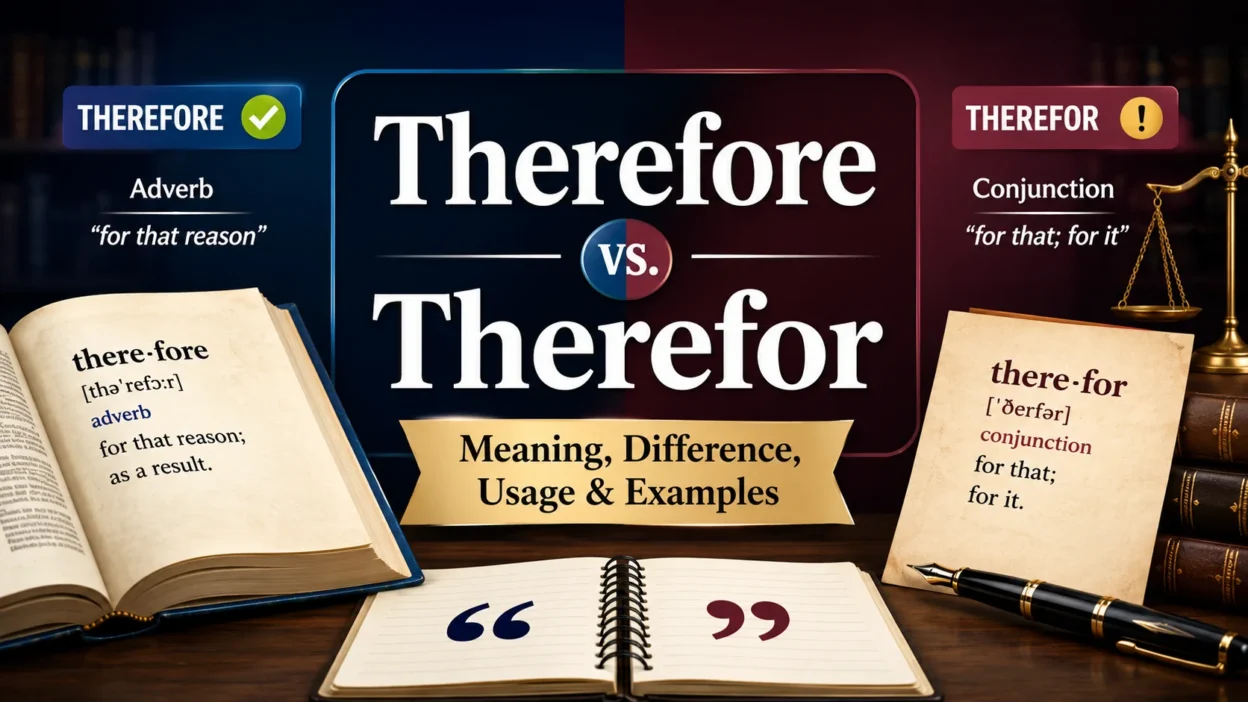
Therefore is the common word. It means “as a result,” “consequently,” or “for that reason” and is used to show a logical result. Therefor is a rare, formal word meaning “for that,” “for it,” or “in exchange for that.” It is most often found in legal, financial, and highly formal writing.
This guide explains the difference between therefore and therefor, shows how to use each word correctly, and provides clear examples to help you remember the distinction.
Quick Answer: Therefore vs. Therefor
Therefore means “as a result” or “for that reason.” Use it when showing a consequence or logical conclusion.
Therefor means “for that” or “in exchange for that.” It is uncommon in modern everyday English and is mainly used in legal or highly formal contexts.
| Word | Meaning | Main Use | Frequency |
|---|---|---|---|
| Therefore | As a result; for that reason | General, academic, business, and formal writing | Common |
| Therefor | For that; for it; in exchange for that | Legal and highly formal writing | Rare |
Easy memory trick
Think of:
- Therefore = result
- Therefor = for that
If you can replace the word with “as a result,” choose therefore. If you can replace it with “for that” or “for it,” choose therefor.
What Does Therefore Mean?
Therefore is an adverb, more specifically a conjunctive adverb, used to introduce or emphasize a logical consequence.
It can mean:
- As a result
- Consequently
- For that reason
- Thus
- Hence
Examples of Therefore
- The roads were flooded; therefore, the school closed early.
- She studied hard. Therefore, she passed the examination.
- The company exceeded its sales target; therefore, the team received a bonus.
- It was raining heavily; therefore, we canceled the outdoor event.
- He forgot his passport and therefore could not board the flight.
In each example, therefore connects an action, fact, or situation with its result.
Part of Speech
Therefore: Adverb / conjunctive adverb
Pronunciation
It is commonly pronounced approximately as THAIR-for.
Origin
Therefore developed from older English forms meaning essentially “for that” or “for that reason.” Over time, therefore became established primarily as a word expressing a consequence or conclusion.
How to Use Therefore in a Sentence
Therefore is common in academic writing, business communication, reports, essays, professional correspondence, and formal speech.
There are several common sentence patterns.
At the Beginning of a Sentence
When therefore introduces a new sentence, it is commonly followed by a comma:
The deadline was approaching. Therefore, we increased the team’s workload.
Another example:
The evidence was incomplete. Therefore, the committee postponed its decision.
In the Middle of a Sentence
Therefore can also appear within a sentence:
The product was therefore removed from the market.
Between Two Independent Clauses
When therefore connects two independent clauses, a semicolon can be used before it and a comma after it:
The weather was severe; therefore, the flight was delayed.
You can also separate the ideas into two sentences:
The weather was severe. Therefore, the flight was delayed.
The exact punctuation can vary depending on sentence structure and style, but therefore should clearly signal the relationship between the ideas.
What Does Therefor Mean?
Therefor is a legitimate English word, but it is much less common than therefore.
It means:
- For that
- For it
- In exchange for that
- In consideration of that
Unlike therefore, therefor does not introduce a consequence. Instead, it refers back to something previously mentioned.
Examples of Therefor
- The buyer paid the required amount and received the documents therefor.
- The tenant submitted the payment and received a receipt therefor.
- The company requested compensation therefor.
- The purchaser paid the agreed price and received the title therefor.
These examples have a distinctly formal or legal tone.
Part of Speech
Therefor: Adverb
Pronunciation
It is commonly pronounced approximately as thair-FOR, with the stress toward the second syllable.
When Should You Use Therefor?
In modern English, you will rarely need therefor. It is primarily encountered in:
- Legal contracts
- Court documents
- Financial documents
- Formal agreements
- Older or highly formal writing
For example:
The contractor completed the work and requested payment therefor.
In ordinary English, a clearer version would usually be:
The contractor completed the work and requested payment for it.
This is why therefor can sound unusual to modern readers. It is grammatically valid, but more natural alternatives are often available.
Therefore vs. Therefor: Examples Side by Side
| Word | Meaning | Example |
|---|---|---|
| Therefore | As a result | The store was closed; therefore, we went elsewhere. |
| Therefore | For that reason | She was tired; therefore, she went to bed early. |
| Therefor | For that | The buyer submitted payment and received a receipt therefor. |
| Therefor | For it | The company requested compensation therefor. |
The simplest distinction is that therefore explains a result, while therefor refers to something previously mentioned.
Therefore vs. Therefor in Everyday Writing
For most readers, therefore is the word you are likely looking for.
Academic Writing
Therefore is common when drawing conclusions:
The sample size was limited; therefore, the results should be interpreted cautiously.
Business Writing
It can explain a decision or consequence:
Sales declined during the quarter; therefore, management revised the marketing strategy.
Everyday Writing
Although it is somewhat more formal than so, therefore is perfectly acceptable:
I missed the bus; therefore, I arrived late.
Social Media and Messaging
Therefore may occasionally be used for emphasis, humor, or a deliberately formal tone:
I found pizza; therefore, everything is fine.
Therefor, by contrast, would be extremely unusual in casual messages or social media posts.
Therefore vs. Therefor: Common Mistakes
| Common Mistake | Correct Approach |
|---|---|
| Using therefor to mean “as a result” | Use therefore |
| Using therefore when you mean “for that” | Use therefor |
| Assuming therefor is always a misspelling | It is a real but rare word |
| Using therefor in casual conversation | Usually use “for that” or “for it” |
| Forgetting punctuation when therefore connects clauses | Use punctuation appropriate to the sentence structure |
| Replacing every instance of so with therefore | Choose based on tone and meaning |
Example of a Common Error
Incorrect:
The weather was terrible; therefor, the game was canceled.
Correct:
The weather was terrible; therefore, the game was canceled.
Here, the word introduces a result, so therefore is required.
Synonyms for Therefore
Depending on the context, alternatives to therefore include:
- Consequently
- Thus
- Hence
- Accordingly
- As a result
- For this reason
- So
For example:
The evidence was insufficient; therefore, the case was dismissed.
can become:
The evidence was insufficient; consequently, the case was dismissed.
Alternatives to Therefor
Because therefor is rare and formal, modern writers often use clearer phrases such as:
- For that
- For it
- In exchange for that
- In return for that
- In consideration of that
For most general audiences, these alternatives are easier to understand.
Is Therefor a Real Word?
Yes. Therefor is a real English word, but it is uncommon in contemporary everyday English.
It should not automatically be treated as a spelling mistake. Its meaning is different from therefore, and it is most likely to appear in legal, financial, or highly formal documents.
If you simply want to say “as a result,” however, the correct choice is therefore.
Therefore vs. Therefor vs. “For That”
A useful way to understand therefor is to compare it with the modern phrase “for that.”
- Therefore = as a result
- Therefor = for that
- For that = the clearer modern phrase in many contexts
For example:
The supplier completed the work and received payment therefor.
A more conversational version would be:
The supplier completed the work and received payment for it.
The formal version is grammatically valid, but the simpler version is often easier for modern readers.
Are Therefore and Therefor Different in US and UK English?
The distinction is not primarily an American-versus-British spelling difference.
Both American and British English use therefore as the normal word for expressing a consequence. Therefor is rare in both varieties and is particularly associated with legal or highly formal language.
So whether you are writing for a US, UK, or international audience, the same basic rule applies:
Use therefore for a result and therefor for “for that.”
FAQs
Is “therefor” a correct word?
Yes. Therefor is a legitimate English word meaning “for that,” “for it,” or “in exchange for that.” It is uncommon and tends to occur in formal or legal writing.
What does “therefore” mean?
Therefore means “as a result,” “consequently,” or “for that reason.” It introduces a logical consequence or conclusion.
Can therefore and therefor be used interchangeably?
No. They have different meanings. Use therefore to express a result and therefor when referring to something previously mentioned with the sense of “for that” or “for it.”
Is therefor just a misspelling of therefore?
No. Although the words look almost identical, therefor is a real word with its own meaning.
How can I remember the difference?
Use this simple rule:
Therefore = result.
Therefor = for that.
If you can replace the word with “as a result,” use therefore. If you can replace it with “for that” or “for it,” use therefor.
Is therefore a conjunction?
Therefore is traditionally classified as an adverb, more specifically a conjunctive adverb. It can connect ideas that have a cause-and-effect relationship, but it is not a coordinating conjunction like and, but, or so.
Should I use therefor in normal writing?
Usually, no. If you mean “for it” or “for that,” a modern phrase such as “for it” is often clearer. Reserve therefor for contexts where its formal style is appropriate.
Conclusion
The difference between therefore vs. therefor becomes easy once you focus on their meanings. Therefore is the common word used to express a result, consequence, or reason. You will see it in everyday writing, academic work, business communication, and professional documents.
Therefor, on the other hand, is a rare and formal word meaning “for that,” “for it,” or “in exchange for that.” It is most commonly encountered in legal and financial writing.
The easiest rule to remember is:
Therefore = as a result.
Therefor = for that.
When in doubt, check whether you are expressing a result or referring back to something “for that.” In ordinary writing, therefore will usually be the correct choice.

Andrew Foster is a researcher and content writer at Differopedia, specializing in clear, accurate, and easy-to-understand comparison guides, definitions, and informational articles. His work focuses on helping readers make informed decisions through well-researched, reliable content.