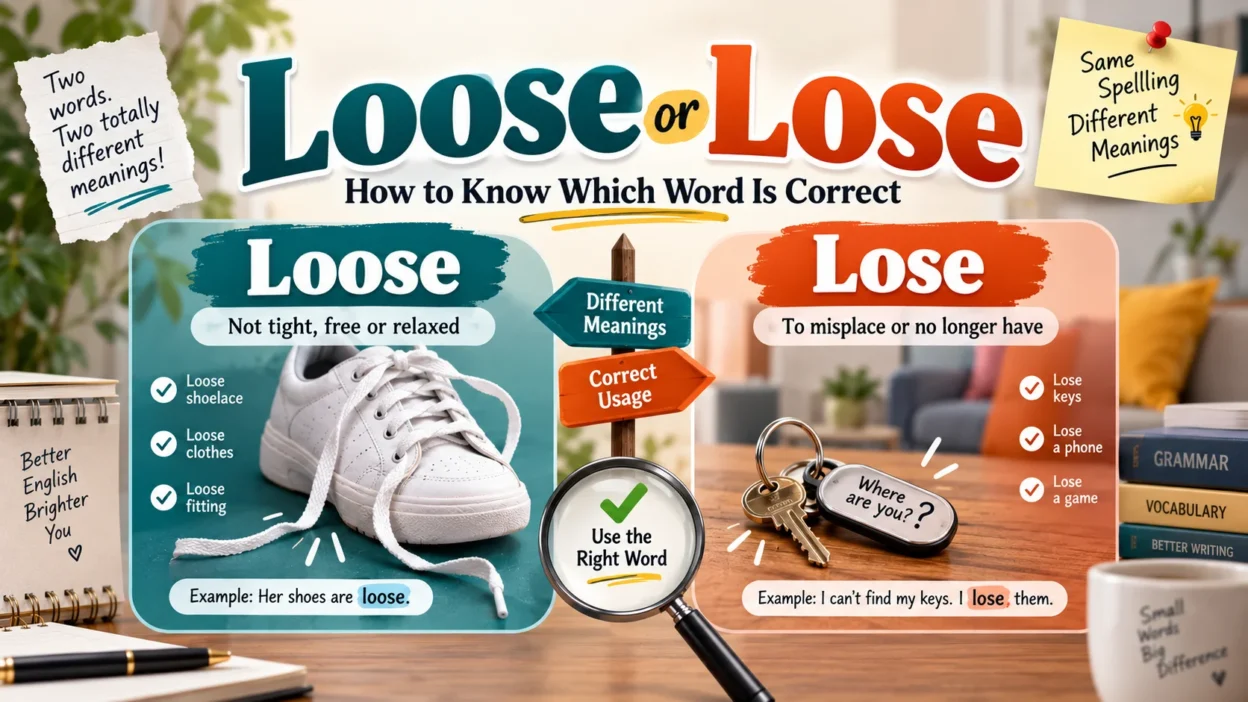
Have you ever wondered whether you should write loose or lose? These two words look almost identical, but they have different meanings, pronunciations, and grammatical roles. Confusing them can change the meaning of an entire sentence.
The easiest way to remember the difference is this: loose usually describes something that is not tight, firmly attached, or strictly controlled, while lose describes an action such as misplacing something, failing to win, or no longer having something.
For example, you might say, “My shoes are loose,” but “I don’t want to lose my shoes.” Once you understand this basic distinction, choosing the correct word becomes much easier.
Quick Answer: Loose vs. Lose 🔎
| Word | Meaning | Part of Speech | Example |
|---|---|---|---|
| Loose | Not tight, firmly fixed, or restricted | Adjective | My shirt is too loose. |
| Lose | To misplace, fail to win, or no longer have something | Verb | Don’t lose your keys. |
Simple rule: Use loose when describing something that is not tight. Use lose when talking about an action involving loss.
What Does “Loose” Mean? 🔓
Loose is primarily an adjective. It describes something that is not tight, firmly attached, controlled, or restricted. It is often used for clothing, objects, rules, connections, and situations.
Think of loose as the opposite of tight or secure.
Examples of “Loose”
- These pants are too loose.
- The screw is loose.
- I prefer loose clothing in summer.
- The dog broke loose from its leash.
- The company has loose rules about dress.
- The soil is loose and easy to dig.
The word can also appear in phrases such as loose change, loose ends, loose connection, and loose interpretation.
Pronunciation of “Loose”
Loose is pronounced like “looss” and rhymes with words such as goose, moose, and juice.
The double oo sound is long: /luːs/.
What Does “Lose” Mean? 🎯
Lose is a verb. It describes an action or situation in which someone no longer has something, fails to win, cannot find something, or experiences a reduction or disappearance.
Common meanings of lose include misplacing something, being defeated, wasting something, or no longer experiencing a feeling or condition.
Examples of “Lose”
- I don’t want to lose my phone.
- Our team might lose the game.
- She doesn’t want to lose her job.
- I often lose track of time while reading.
- Don’t lose your patience.
- He needs to lose weight.
Pronunciation of “Lose”
Lose is pronounced like “looz” and rhymes with choose, shoes, and blues.
Its pronunciation is different from loose, even though the spelling looks similar.
The Core Difference Between Loose and Lose 🧠
The easiest way to understand loose vs. lose is to remember their grammatical roles.
Loose generally describes a condition or quality.
The rope is loose.
Here, “loose” describes the condition of the rope.
Lose describes an action.
I might lose the rope.
Here, “lose” describes what someone might do.
So remember:
Loose = not tight
Lose = no longer have, misplace, or fail to win
This simple distinction works in most everyday situations.
Loose vs. Lose: Side-by-Side Examples
| Sentence | Correct Word | Why? |
|---|---|---|
| My shirt is too ___ | Loose | The shirt is not tight. |
| Don’t ___ your wallet. | Lose | You could misplace it. |
| The button is ___. | Loose | It is not firmly attached. |
| We could ___ the match. | Lose | The team could fail to win. |
| I need to ___ weight. | Lose | It means to reduce weight. |
| The dog got ___. | Loose | It escaped restraint. |
| Don’t ___ your focus. | Lose | It means to stop maintaining focus. |
| The rope is ___. | Loose | It is not pulled tight. |
Loose vs. Lose vs. Loosen 🔄
Another word that sometimes causes confusion is loosen.
These three words are related, but they are not interchangeable.
- Loose = not tight
- Lose = misplace, fail to win, or no longer have
- Loosen = make something less tight
For example:
My shoelaces are loose.
I don’t want to lose my shoes.
I need to loosen my shoelaces.
Notice how each word performs a different job. Loose describes a condition, lose describes an action involving loss, and loosen means to make something less tight.
Common Mistakes With Loose and Lose ❌
Because the words look so similar, spelling mistakes are common. Here are some of the most frequent errors.
“Don’t loose your keys.”
❌ Incorrect: Don’t loose your keys.
✅ Correct: Don’t lose your keys.
You are talking about misplacing your keys, so lose is correct.
“I need to loose weight.”
❌ Incorrect: I need to loose weight.
✅ Correct: I need to lose weight.
Here, lose means to reduce your weight.
“My shoelace is lose.”
❌ Incorrect: My shoelace is lose.
✅ Correct: My shoelace is loose.
The shoelace is not tight, so use loose.
“She will loose the game.”
❌ Incorrect: She will loose the game.
✅ Correct: She will lose the game.
A person or team can lose a game or competition.
“The screw is lose.”
❌ Incorrect: The screw is lose.
✅ Correct: The screw is loose.
The screw is not firmly attached.
More Everyday Examples 📚
Seeing these words in different contexts can make the distinction easier to remember.
Clothing
- These jeans are too loose.
- I don’t want to lose my jacket.
Sports
- The team may lose the championship.
- His shoelaces came loose during the race.
Objects
- The handle is loose.
- Be careful not to lose the handle.
Work and Business
- We cannot afford to lose this client.
- The manager uses a relatively loose communication style.
Time and Attention
- I always lose track of time when watching movies.
- Don’t lose focus during the presentation.
Physical Connections
- The wire is loose.
- Make sure you don’t lose the connector.
How to Remember Loose vs. Lose 💡
A few simple memory tricks can help you choose the right spelling.
1. Loose has two O’s
Think of the two O’s as a loose loop. The extra O can remind you that loose means something is not tight.
Loose = two O’s = not tight
2. Lose has one O
Think:
Lose = lost one O
If you remove one O from “loose,” you get “lose.”
3. Remember the opposites
Loose ↔ Tight
Lose ↔ Find / Win / Keep
If you’re talking about the opposite of tight, you probably need loose. If you’re talking about failing to keep or win something, you probably need lose.
4. Use pronunciation
If it rhymes with goose, choose loose.
If it rhymes with choose, choose lose.
Loose and Lose in Common Phrases
These words appear in many familiar expressions.
Common phrases with “loose”
- Loose change
- Loose ends
- Loose clothing
- Loose connection
- Break loose
- Let loose
- Loose rules
Common phrases with “lose”
- Lose weight
- Lose money
- Lose time
- Lose interest
- Lose focus
- Lose control
- Lose a game
- Lose your temper
- Lose your keys
Learning these common combinations can help you recognize the correct word naturally.
Why Do People Confuse Loose and Lose? 🤔
The main reason is their similar spelling. Both words begin with “lo” and contain the same basic letters, with an extra o distinguishing them.
However, their meanings are quite different.
Another reason is that people often type quickly, especially in text messages, social media posts, and informal online communication. This can lead to accidental spelling errors such as “loose weight” instead of “lose weight.”
The good news is that once you connect each word with its meaning, the difference becomes much easier to remember.
Frequently Asked Questions
Is “lose” a verb or an adjective?
Lose is a verb. It describes an action or change, such as misplacing something, failing to win, or no longer having something.
Is “loose” a verb or adjective?
Loose is primarily an adjective. It describes something that is not tight, secure, or restricted. It can also be used as a verb in certain contexts, although that use is much less common.
Which is correct: “lose weight” or “loose weight”?
Lose weight is correct. Here, “lose” is a verb meaning to reduce or become lighter in weight.
Which is correct: “loose clothing” or “lose clothing”?
Loose clothing is correct when you mean clothing that is not tight or fits loosely.
Can loose and lose be used interchangeably?
No. Loose and lose have different meanings and grammatical functions. Replacing one with the other can make a sentence incorrect or change its meaning.
What is the past tense of lose?
The past tense of lose is lost.
Example:
I lost my keys yesterday.
What is the difference between loose and loosen?
Loose usually describes something that is not tight, while loosen means to make something less tight.
Example:
The knot is loose.
Please loosen the knot.
What is an easy trick for remembering loose and lose?
Remember that loose has two O’s because it is not tight, while lose has one O because it “lost” an O. You can also remember that loose rhymes with goose, while lose rhymes with choose.
Conclusion ✨
Understanding loose vs. lose becomes simple once you focus on their meanings rather than their similar spelling. Loose usually describes something that is not tight, firmly attached, or restricted. Lose, on the other hand, is a verb used when you misplace something, fail to win, no longer have something, or experience a reduction.
When you’re unsure, ask yourself what you are trying to say. If you mean not tight, choose loose. If you mean misplace, fail to win, or no longer have, choose lose.
A quick memory trick can also help: loose has two O’s like a loose loop, while lose has one O because it lost one. With a little practice, you can use both words confidently in everyday conversation, professional writing, academic work, and online communication.

Andrew Foster is a researcher and content writer at Differopedia, specializing in clear, accurate, and easy-to-understand comparison guides, definitions, and informational articles. His work focuses on helping readers make informed decisions through well-researched, reliable content.