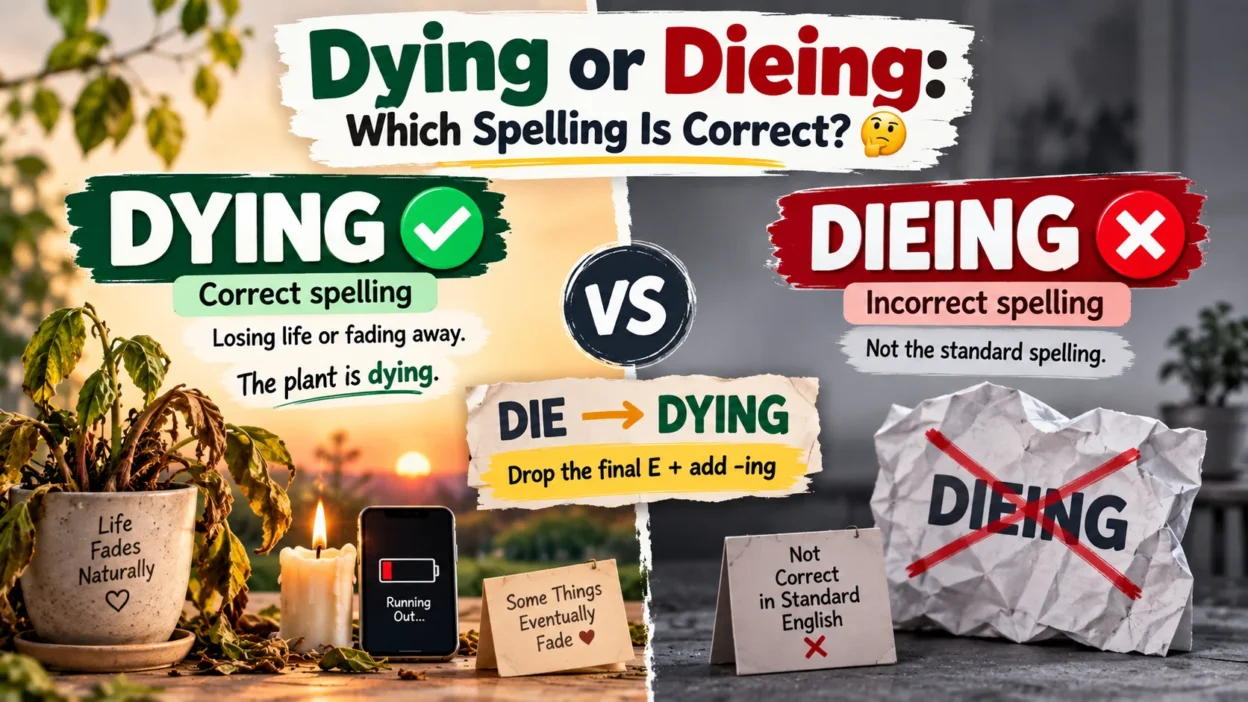
If you are unsure about dying or dieing, you are not alone because both forms look like they could come from the verb die. However, standard English uses dying when you mean the process of losing life, fading away, weakening, or coming to an end. Dieing does not normally work as the -ing form of die, although a dictionary records it as a rare technical form of a different verb connected with a manufacturing tool called a die. You will usually need dying in everyday conversation, school assignments, emails, articles, social media posts, and professional writing. Another word, dyeing, creates a separate spelling trap because it means changing the color of something. Once you understand these three forms, you can choose the correct word quickly and avoid a common English spelling mistake.
⚡ Dying or Dieing:
| Term | Meaning | Usage | Category |
|---|---|---|---|
| dying | Losing life, fading, weakening, or ending | Common | Standard English |
| dieing | Cutting, forming, or stamping with a die | Very rare/technical | Technical verb form |
| dyeing | Changing the color of something | Common | Verb form |
Quick rule: If you mean “in the process of dying,” use dying.
- ✅ The plant is dying.
- ❌ The plant is dieing.
- ✅ She is dyeing her hair.
Cambridge lists dying as the present participle of die, while American Heritage separately records dieing as the form of a technical verb meaning to cut, form, or stamp with a die.
📖 What Does Dying Mean?
Dying is the present participle of die. In its literal sense, it describes someone or something approaching death or losing life. Cambridge also gives broader meanings connected with things becoming less common, less important, or gradually ending.
You can therefore use dying in several ways:
- A person is dying.
- A plant is dying.
- A tradition is dying.
- A fire is dying down.
- A phone battery is dying.
- Someone is dying to know something.
🔊 Pronunciation
🧩 Part of Speech
Dying usually functions as a present participle, but it can also act as an adjective or noun depending on the sentence.
Examples:
- The patient is dying. — present participle
- A dying tradition deserves attention. — adjective
- Nurses care for the dying. — noun
🏛️ Why Is It Dying Instead of Dieing?
The spelling dying often confuses learners because adding -ing to many verbs feels straightforward. For example, read becomes reading, and play becomes playing.
However, die follows a special spelling pattern. The letters ie change to y before -ing:
- die → dying
- lie → lying
- tie → tying
- vie → vying
So you should not simply attach -ing to die and create dieing when you mean death.
A useful memory trick is to connect die → dying with lie → lying and tie → tying.
🆚 Dying vs. Dieing vs. Dyeing
These three spellings can look confusing, but their meanings differ clearly.
| Word | Base Word | Meaning | Example |
|---|---|---|---|
| dying | die | Losing life or fading | The flowers are dying. |
| dieing | die (technical tool sense) | Cutting or shaping with a die | The machine performs dieing. |
| dyeing | dye | Adding or changing color | She is dyeing her dress. |
In ordinary English, dying answers questions about death, decline, fading, or strong desire. Dyeing answers questions about color. Dieing only appears in a narrow technical context, and many writers can avoid it by using clearer phrases such as die cutting or die forming.
✍️ Dying: Literal and Figurative Meanings
The literal meaning relates directly to death.
Example:
“The old man is dying.”
English also uses dying figuratively. A business, tradition, trend, conversation, or industry can “die” when it gradually loses activity or importance.
Examples:
- The old tradition is dying.
- Interest in the product is dying.
- The fire is dying down.
- My phone battery is dying.
Cambridge includes meanings involving things becoming less common or important and also uses die for machines that stop functioning.
💬 Dying in Everyday Expressions
You will often see dying in expressions that do not describe literal death.
“I’m dying to know.”
This means “I really want to know.”
“I’m dying for coffee.”
This means “I really want coffee.”
“That joke was dying.”
In informal speech, someone may use this idea to describe a joke or conversation that loses energy.
Cambridge specifically lists be dying to and be dying for as expressions that communicate strong desire.
📝 10 Usage Examples
| Example Sentence | Meaning |
|---|---|
| The flowers are dying without water. | The flowers are losing life. |
| The tree is dying after the drought. | The tree is becoming unhealthy. |
| My phone is dying. | The battery is nearly empty. |
| The fire is dying down. | The fire is becoming weaker. |
| That tradition is dying. | The tradition is becoming less common. |
| I’m dying to hear your story. | I strongly want to hear it. |
| She is dying for a vacation. | She really wants a vacation. |
| The engine is dying. | The engine is losing power or stopping. |
| The old industry is dying out. | The industry is gradually disappearing. |
| Many people fear dying. | Many people fear death. |
🔄 Synonyms for Dying
The best synonym depends on your context.
| Synonym | Meaning |
|---|---|
| Passing away | Dying; softer expression |
| Perishing | Dying or being destroyed |
| Expiring | Dying; formal usage |
| Fading | Becoming weaker |
| Declining | Losing strength or importance |
| Failing | Losing ability to function |
| Weakening | Becoming less strong |
| Deteriorating | Becoming worse |
| Disappearing | Gradually ceasing to exist |
| Ending | Coming to a close |
| Dwindling | Becoming gradually smaller |
| Vanishing | Gradually disappearing |
| Withering | Losing freshness or vitality |
| Dying out | Gradually becoming extinct |
| Succumbing | Giving way to an illness or force |
For sensitive situations, speakers often choose softer expressions such as passing away instead of directly saying dying. Cambridge notes that English speakers commonly use euphemistic expressions when discussing death.
↔️ Antonyms of Dying
Depending on the context, these words can express the opposite idea:
| Antonym | Meaning |
|---|---|
| Living | Being alive |
| Alive | Having life |
| Surviving | Continuing to live |
| Thriving | Growing successfully |
| Growing | Increasing or developing |
| Flourishing | Developing strongly |
| Recovering | Returning to health |
| Reviving | Becoming active again |
| Beginning | Starting |
| Continuing | Carrying on |
🔗 Related Words and Terms
| Related Word | Meaning |
|---|---|
| Die | To stop living |
| Died | Past form of die |
| Death | The end of life |
| Dead | No longer alive |
| Dying | Present participle of die |
| Alive | Living |
| Mortality | The state of being subject to death |
| Mortal | Capable of dying |
| Deceased | A formal term for a dead person |
| Funeral | Ceremony connected with someone’s death |
| Burial | Placing a dead body in the ground |
| Grief | Deep sadness after loss |
| Bereavement | The experience of losing someone through death |
| Extinct | No longer existing |
| Decline | A gradual reduction or weakening |
🚫 Common Mistakes With Dying or Dieing
| Mistake | Correct Usage |
|---|---|
| The plant is dieing. | The plant is dying. |
| He is dieing of illness. | He is dying of illness. |
| My battery is dieing. | My battery is dying. |
| The fire is dieing down. | The fire is dying down. |
| The tradition is dieing out. | The tradition is dying out. |
| I am dieing to know. | I am dying to know. |
| She is dying her hair. | She is dyeing her hair. |
| They are dieing the fabric. | They are dyeing the fabric. |
| He was dieing laughing. | He was dying laughing. |
| The trend is dieing. | The trend is dying. |
🌐 How People Use Dying in Real Life
💬 Daily Conversation
In daily conversation, people use dying to talk about death, weak batteries, fading fires, and strong desires.
📱 Social Media
On social media, users often write phrases such as “I’m dying to see this” to express excitement, curiosity, or strong interest.
💼 Business Communication
In business communication, writers can describe a declining market, dying industry, or fading demand. However, professional writers should choose precise wording when discussing serious business conditions.
🎓 Academic Writing
In academic writing, dying can describe biological processes, population decline, endangered traditions, or historical change.
💬 Online Messaging
In online messaging, people often use dying informally to exaggerate reactions, such as “I’m dying laughing.”
❓ Frequently Asked Questions
What is the difference between dying and dieing?
Dying normally means losing life, fading, weakening, or approaching an end. Dieing has only a rare technical use connected with a manufacturing die.
Which spelling should I use in an essay?
Use dying when you mean the process of death or decline. Avoid dieing unless your technical subject specifically requires that specialized form.
Is “I am dying to know” correct?
Yes. I am dying to know means “I really want to know.” English uses dying in this expression as an informal way to emphasize strong desire.
What is the difference between dying and dyeing?
Dying comes from die. Dyeing comes from dye and means changing the color of something.
How can I remember the correct spelling?
Remember this simple pattern: die → dying. You can also connect it with lie → lying and tie → tying.
Is “dieing” always wrong?
Not absolutely. A specialized dictionary entry recognizes dieing as a technical form of die meaning to cut, form, or stamp with a die. For normal English writing, however, choose dying when you mean death or decline.
🎯 Conclusion
The difference between dying or dieing becomes easy once you separate their meanings. When you talk about losing life, fading away, becoming weaker, or coming to an end, use dying. The spelling comes from the verb die, which changes to dying rather than dieing in its standard present participle form. Dieing has a rare technical meaning connected with a manufacturing die, so most readers will never need it. Also remember dyeing, which means changing the color of something. If you remember just one rule, remember this: die → dying. Use dying in everyday writing, schoolwork, professional communication, and online messages whenever you mean the normal meaning of die.

Andrew Foster is a researcher and content writer at Differopedia, specializing in clear, accurate, and easy-to-understand comparison guides, definitions, and informational articles. His work focuses on helping readers make informed decisions through well-researched, reliable content.