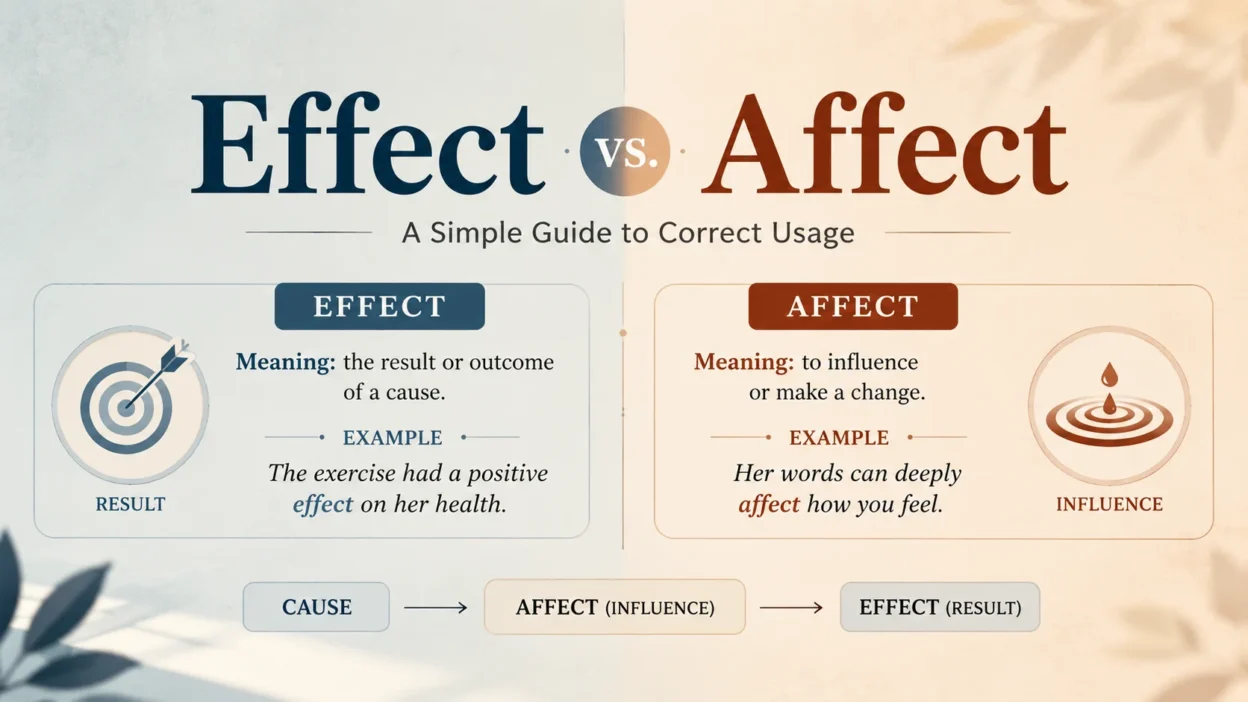
Effect vs. affect is one of the most common word-choice questions in English. The two words sound similar and are closely related in meaning, but they usually serve different grammatical roles.
The simplest rule is this: affect is usually a verb meaning “to influence” or “to change,” while effect is usually a noun meaning “the result” or “consequence.” However, both words have less common exceptions. Affect can be a noun in psychology, while effect can be a verb meaning “to bring about” or “cause.”
Understanding these patterns will help you choose the right word in emails, essays, business writing, academic work, and everyday communication.
Quick Answer: Effect vs. Affect
| Word | Main Meaning | Typical Part of Speech | Example |
|---|---|---|---|
| Affect | To influence or change | Verb | The weather affects my mood. |
| Effect | A result or consequence | Noun | The weather had an effect on travel. |
| Affect | Observable emotional expression | Noun, technical | The patient had a flat affect. |
| Effect | To bring about or cause | Verb, formal | The policy may effect significant changes. |
The Easy Memory Trick
A useful memory aid is:
Affect = Action
Effect = End result
For example, exercise can affect your health, and better health can be an effect of regular exercise.
This rule works in most everyday situations, although the less common noun and verb uses require additional attention.
What Does Affect Mean?
Affect is most commonly a verb meaning to influence, change, or have an impact on something.
When one thing affects another, it produces some kind of influence or change.
Examples of Affect as a Verb
- Lack of sleep can affect your concentration.
- The weather affected our travel plans.
- Social media can affect how people communicate.
- Rising prices may affect consumer behavior.
- The new schedule will affect everyone on the team.
In each example, affect describes something influencing or changing something else.
Affect in Questions
You will often see affect in questions such as:
How will this change affect our business?
Will the new rules affect my application?
Here, affect means influence or change.
What Does Effect Mean?
Effect is most commonly a noun meaning a result, consequence, or outcome.
It describes what happens because of an action, event, or condition.
Examples of Effect as a Noun
- The storm had a serious effect on the coastal towns.
- The new policy had a positive effect on the company.
- Lack of sleep can have a negative effect on your health.
- We noticed the effects of the training immediately.
- The medication produced several side effects.
In these examples, effect refers to the result produced by something.
Effect in Questions
You might ask:
What effect will this decision have?
Or:
What was the effect of the storm?
In both cases, effect means result or consequence.
Affect vs. Effect: The Main Difference
The easiest way to distinguish them is to think about action versus result.
| If you mean… | Use | Example |
|---|---|---|
| Influence | Affect | Noise can affect your concentration. |
| Change | Affect | The delay affected our plans. |
| Result | Effect | The delay had a major effect on the schedule. |
| Consequence | Effect | We discussed the long-term effects of the decision. |
A simple cause-and-effect pattern looks like this:
Cause → affects something → produces an effect
For example:
Heavy rain affected traffic, and the resulting delays were an effect of the weather.
Affect as a Noun
Although affect is usually a verb, it can also function as a noun in psychology and related fields.
As a noun, affect refers to a person’s observable emotional expression or outward emotional presentation.
For example:
The patient displayed a flat affect during the interview.
This is a technical use and is much less common in ordinary conversation.
It is important not to confuse this meaning with the everyday verb affect, which means “influence.”
Effect as a Verb
Although effect is usually a noun, it can also be used as a verb.
As a verb, effect means to bring about, produce, or cause something to happen. This usage is relatively formal and is often found in business, legal, and organizational writing.
For example:
The new leadership team hopes to effect major changes.
This means the team hopes to bring about major changes.
Compare these two sentences:
The new policy will affect employees.
Here, the policy will influence employees.
The new policy will effect changes.
Here, the policy will bring about changes.
This distinction is subtle but important.
Effect vs. Affect Examples
The following examples show how the two words work in everyday sentences:
| Sentence | Why It Is Correct |
|---|---|
| The weather affected our plans. | Affected means influenced. |
| The weather had a major effect on our plans. | Effect means result or impact. |
| Does caffeine affect your sleep? | Affect means influence. |
| What is the effect of caffeine on sleep? | Effect means result. |
| The new law may affect small businesses. | The law may influence them. |
| The new law could have a significant effect on small businesses. | The result could be significant. |
| The noise affected my concentration. | The noise changed or influenced concentration. |
| The noise had a negative effect on my concentration. | The negative result is the effect. |
Common Mistakes With Affect and Effect
| Incorrect | Correct |
|---|---|
| The medicine will effect your sleep. | The medicine will affect your sleep. |
| We saw a positive affect on sales. | We saw a positive effect on sales. |
| How does this effect our plans? | How does this affect our plans? |
| The new law had an immediate affect. | The new law had an immediate effect. |
| The weather effects farming. | The weather affects farming. |
| What is the long-term affect? | What is the long-term effect? |
| The changes will effect customers. | The changes will affect customers. |
A Common Trap: “Effect” as a Verb
One reason the basic rule does not work every time is that effect can be a verb.
Compare:
The new policy will affect employee morale.
Meaning: The policy will influence morale.
The new policy will effect significant changes.
Meaning: The policy will bring about significant changes.
If you mean influence, use affect. If you mean bring about, effect may be the correct verb.
Affect vs. Effect in American and British English
The basic distinction between affect and effect is essentially the same in American and British English.
In both varieties:
- Affect is normally used as a verb meaning “influence.”
- Effect is normally used as a noun meaning “result.”
- Affect can be a technical noun referring to observable emotion.
- Effect can be a formal verb meaning “bring about.”
There is no standard American-versus-British spelling difference between these words.
For example, both American and British writers would normally use:
The decision affected the company.
and:
The decision had a significant effect on the company.
Affect vs. Effect in Different Contexts
Academic Writing
Both words are common in academic writing:
Researchers examined how stress affects memory.
The study measured the effect of stress on memory.
Business Writing
Business communication frequently uses both:
Rising costs could affect profitability.
Rising costs could have a significant effect on profitability.
Everyday Conversation
The most common patterns are simple:
Will this affect me?
What effect will this have?
Social Media and Online Writing
Both words appear regularly online:
Does social media affect your sleep?
The video had a huge effect on the audience.
Related Words and Expressions
Understanding related terms can make the distinction easier.
| Word or Phrase | Meaning |
|---|---|
| Influence | The power to change or affect something |
| Impact | A strong effect or influence |
| Result | Something that happens because of an action or event |
| Consequence | A result that follows from something |
| Outcome | The final result of a process or situation |
| Side effect | An additional, often unintended, result |
| Ripple effect | A series of effects spreading from an initial event |
| Cause and effect | The relationship between an action and its result |
FAQs
What is the easiest way to remember affect vs. effect?
Remember Affect = Action and Effect = End result. Affect is usually a verb meaning influence, while effect is usually a noun meaning result.
Is affect always a verb?
No. Affect is usually a verb, but it can also be a noun in psychology, where it refers to observable emotional expression.
Is effect always a noun?
No. Effect is usually a noun, but it can be a verb meaning “to bring about” or “cause.” This verb use is more formal.
Should I use affect or effect after “have”?
Usually, effect is correct when you mean a result:
The decision had a major effect on sales.
Is “impact” the same as “affect”?
They can overlap in meaning, but they are not always interchangeable. Affect is a general verb meaning “influence,” while impact often emphasizes a significant or noticeable influence.
Do American and British English use affect and effect differently?
The basic rules are the same in both varieties of English. Neither word has a different standard spelling in American and British English.
How do I use affect in a sentence?
Use affect when you mean influence or change:
The weather can affect your mood.
How do I use effect in a sentence?
Use effect when you mean result or consequence:
The weather had a noticeable effect on travel.
Conclusion
The difference between effect vs. affect becomes much easier when you focus on their most common roles. Affect is usually a verb meaning to influence, change, or have an impact on something. Effect is usually a noun meaning the result or consequence of an action or event.
Remember the basic shortcut:
Affect = Action
Effect = End result
Just keep in mind that there are exceptions. Affect can be a technical noun for observable emotional expression, while effect can be a formal verb meaning “to bring about.”
Whether you are writing an email, essay, report, blog post, or academic paper, understanding this distinction will help you communicate more accurately and confidently.

Andrew Foster is a researcher and content writer at Differopedia, specializing in clear, accurate, and easy-to-understand comparison guides, definitions, and informational articles. His work focuses on helping readers make informed decisions through well-researched, reliable content.