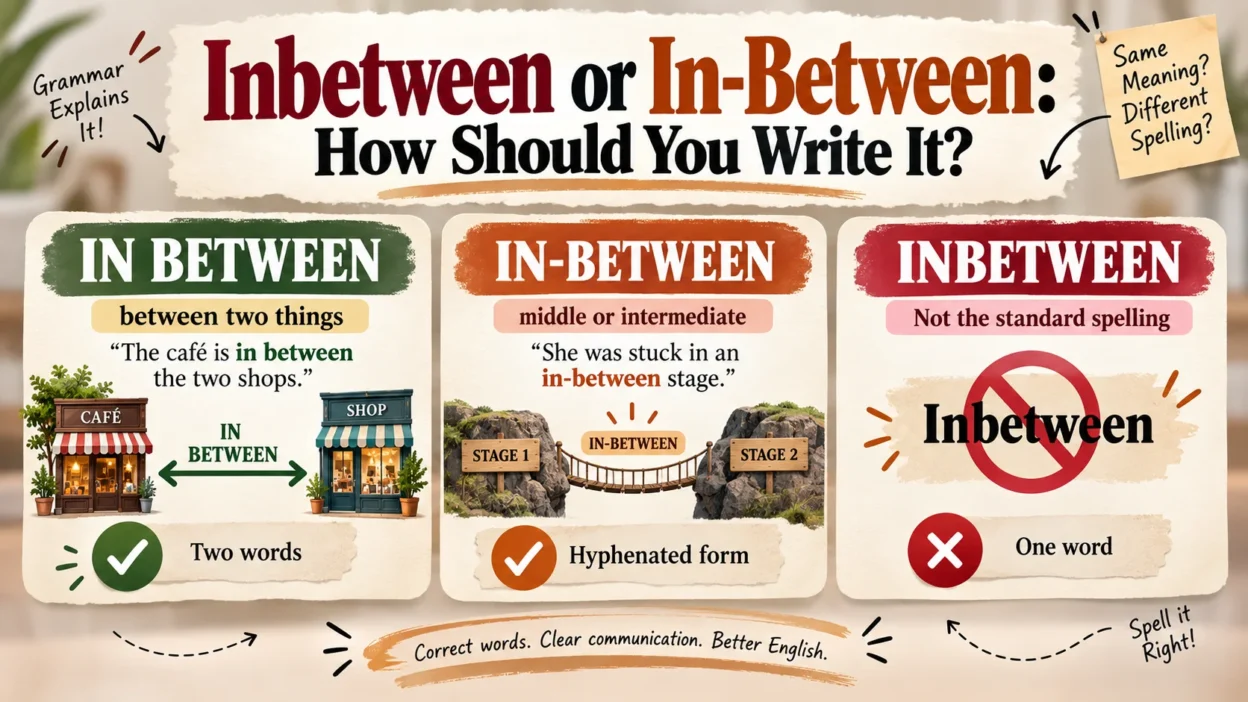
If you are confused about inbetween vs in between, you are not alone, as many people wonder whether it should be written as one word, two words, or with a hyphen. The standard form is “in between” when used as a preposition or adverb, while “in-between” can function as an adjective or noun in certain contexts. “Inbetween” as one word is not standard English. Understanding this difference can help you avoid spelling mistakes in emails, essays, websites, and social media posts. In this guide, you will learn the correct spelling, meaning, grammar, usage, examples, and common mistakes.
📖 Inbetween vs In Between: Quick Answer
The correct standard spelling is “in between” when the phrase describes a position, place, time, or situation that exists between two things. It is normally written as two separate words.
The hyphenated form “in-between” can be used when the expression functions as a noun or adjective, especially when it describes something intermediate or transitional. However, hyphenation can depend on the sentence and style guide.
| Term | Meaning | Typical Use | Correct? |
|---|---|---|---|
| in between | In an intermediate position, place, or time | Preposition/adverb | ✅ Yes |
| in-between | Intermediate or transitional; an intermediate state or thing | Adjective/noun | ✅ Yes, when appropriate |
| inbetween | Nonstandard spelling of the phrase | Incorrect in standard English | ❌ No |
So, if you are asking “Is it inbetween or in between?”, the safest answer is: write “in between” as two words.
✍️ What Does “In Between” Mean?
“In between” means occupying an intermediate position, location, period, or state separating two things. It can refer to physical space, time, categories, conditions, or stages of change.
For example, if a restaurant is located between a bank and a pharmacy, you could say:
The restaurant is in between the bank and the pharmacy.
The expression can also describe time:
I usually answer emails in between meetings.
In another context, it can describe a condition that falls somewhere between two extremes:
The weather was in between warm and cool.
The phrase is flexible because it can describe both a literal position and an abstract or transitional situation.
🧩 When Should You Use “In Between”?
Use “in between” when you are describing something located, occurring, or existing between two points, objects, events, choices, or conditions.
Physical Location
When something is positioned between two physical places or objects, in between is common and natural.
- The house is in between two large buildings.
- She placed the chair in between the tables.
- I found my keys in between the sofa cushions.
Time or Events
You can also use the phrase when referring to a period separating two activities or events.
- I will call you in between classes.
- We had a short break in between the sessions.
- He traveled in between jobs.
Intermediate Conditions
The phrase can describe something that does not completely belong to either of two categories.
- Her answer was somewhere in between yes and no.
- The color looks in between blue and gray.
- His personality is in between outgoing and reserved.
In all these examples, the phrase communicates the idea of something occupying a middle or intermediate position.
🔤 Is “Inbetween” One Word?
No. “Inbetween” is not the standard English spelling of the phrase.
People may write “inbetween” because the words are frequently spoken together, making them sound almost like a single unit. Fast typing and informal online communication can also contribute to this spelling mistake. However, combining the two words does not make it the accepted standard form.
For example:
❌ I sat inbetween my two friends.
✅ I sat in between my two friends.
The same rule applies whether you are writing an academic paper, blog post, business email, social media caption, or casual message. In standard English, write the phrase as “in between.”
🔗 When Should You Use “In-Between”?
The hyphenated form “in-between” is different from the ordinary two-word phrase. It can function as an adjective or noun, particularly when it describes something intermediate, transitional, or neither of two clearly defined alternatives.
For example:
- We are entering an in-between stage of the project.
- The room has an in-between color that is difficult to describe.
- There is no in-between; you must choose one option.
As an adjective, the hyphen helps show that in-between works together to modify another noun. As a noun, it can refer to an intermediate position or state.
However, do not automatically add a hyphen every time you write “in between.” The two-word form remains the normal choice when the phrase functions as a preposition or adverb.
⚖️ In Between vs Between: What Is the Difference?
“Between” and “in between” are closely related, but they are not always interchangeable.
Use “between” when you directly identify the things, people, places, or points that surround the middle position.
- The store is between the bank and the library.
- She stood between her two friends.
- The meeting is between Monday and Wednesday.
Use “in between” when you want to emphasize the intermediate position, space, or period itself, particularly when the surrounding points are understood from context.
- I sat in between the two chairs.
- There was a short break in between.
- She is in between jobs right now.
The choice often depends on sentence structure and emphasis rather than a completely different meaning.
💡 Common Examples of “In Between”
Here are some natural examples showing how in between works in different contexts:
| Example | Use |
|---|---|
| The café is in between the school and the park. | Physical location |
| I read during the time in between my classes. | Time |
| He is currently in between jobs. | Transitional situation |
| The color falls in between green and gray. | Intermediate quality |
| She stood in between her parents. | Position |
| We stopped in between the two cities. | Location |
| There is a break in between the lessons. | Time interval |
| The answer is somewhere in between yes and no. | Intermediate choice |
| I found the letter in between the pages. | Physical space |
| The temperature felt in between warm and cold. | Intermediate condition |
These examples demonstrate why in between is useful in everyday English. It can describe a physical space, a time period, a transitional stage, or an unclear middle position.
🚫 Common Mistakes With “In Between”
One of the most common mistakes is joining in and between into a single word. Another is using a hyphen where the normal two-word form is required.
| Incorrect | Correct |
|---|---|
| I’ll meet you inbetween the buildings. | I’ll meet you in between the buildings. |
| She works inbetween meetings. | She works in between meetings. |
| We sat inbetween the two rows. | We sat in between the two rows. |
| I found it inbetween the pages. | I found it in between the pages. |
| He is inbetween happy and sad. | He is in between happy and sad. |
| The inbetween stage was difficult. | The in-between stage was difficult. |
| There is no inbetween option. | There is no in-between option. |
A simple way to remember the distinction is this: use “in between” for the ordinary phrase, and use “in-between” when it functions as a combined adjective or noun.
🧠 Synonyms for “In Between”
Depending on the context, several words and phrases can communicate a similar idea to in between. However, they are not perfect replacements in every sentence.
Common alternatives include between, midway, halfway, intermediate, middle, central, transitional, and in the middle.
For example, “midway” works well when you are talking about a central point:
We stopped midway through the journey.
“Intermediate” is useful when describing a level or stage:
She has an intermediate level of English.
“Transitional” is appropriate when something is changing from one state to another:
The company is going through a transitional period.
The best synonym depends on whether you are describing physical location, time, level, position, or a transitional state.
🌐 How “In Between” Is Used in Everyday English
You can find in between in conversations, professional communication, academic writing, websites, social media, and everyday messages.
In conversation, someone might say, “I will call you in between appointments,” In a workplace, an employee might describe being “in between projects.” In personal writing, someone may describe themselves as being “in between two stages of life.”
The phrase is especially useful when describing situations that do not fit neatly into one category. For example, a movie may be in between comedy and drama, or a color may be in between two shades.
This makes in between a common and natural expression across many forms of English writing.
❓ Frequently Asked Questions About Inbetween vs In Between
Is “inbetween” a word?
“Inbetween” is not the standard spelling of the expression in modern standard English. Write “in between” as two words when using the ordinary phrase.
Is it “in between” or “in-between”?
Both forms can be correct, but they serve different grammatical purposes. “In between” is the normal two-word expression, while “in-between” can function as an adjective or noun.
Should I hyphenate “in between”?
Not normally. Use “in between” when it functions as a preposition or adverb. Use “in-between” when the expression functions as a combined adjective or noun and the hyphen improves clarity.
What does “in between” mean?
“In between” means occupying a position, period, or state that separates or falls between two things. It can refer to physical space, time, categories, or transitional situations.
Can “between” replace “in between”?
Sometimes. The two expressions can overlap in meaning, but their sentence structures are not always identical. “Between” often directly introduces the things being separated, while “in between” can emphasize the middle position or space itself.
What is the adjective form of “in between”?
When used as an adjective, “in-between” can describe something intermediate or transitional, such as “an in-between stage.” Depending on the sentence and style, writers may sometimes choose another construction instead.
What are synonyms for “in between”?
Depending on the context, alternatives include midway, halfway, intermediate, middle, central, transitional, and in the middle. The best choice depends on the intended meaning.
✅ Conclusion
When choosing between inbetween vs in between, remember that “in between” is the standard two-word form used in most sentences. The hyphenated “in-between” can be correct when it functions as an adjective or noun, such as “an in-between stage.” However, “inbetween” as one word should be avoided in standard English. Understanding this simple distinction makes your writing clearer and more professional. Whether you are writing an email, assignment, blog post, or social media caption, using the correct form will help you write with confidence.

Andrew Foster is a researcher and content writer at Differopedia, specializing in clear, accurate, and easy-to-understand comparison guides, definitions, and informational articles. His work focuses on helping readers make informed decisions through well-researched, reliable content.