Have you ever wondered whether to say “John and I” or “John and me”? The difference between I vs me is one of the most common English grammar questions. Although both words refer to the speaker, they have different grammatical jobs.
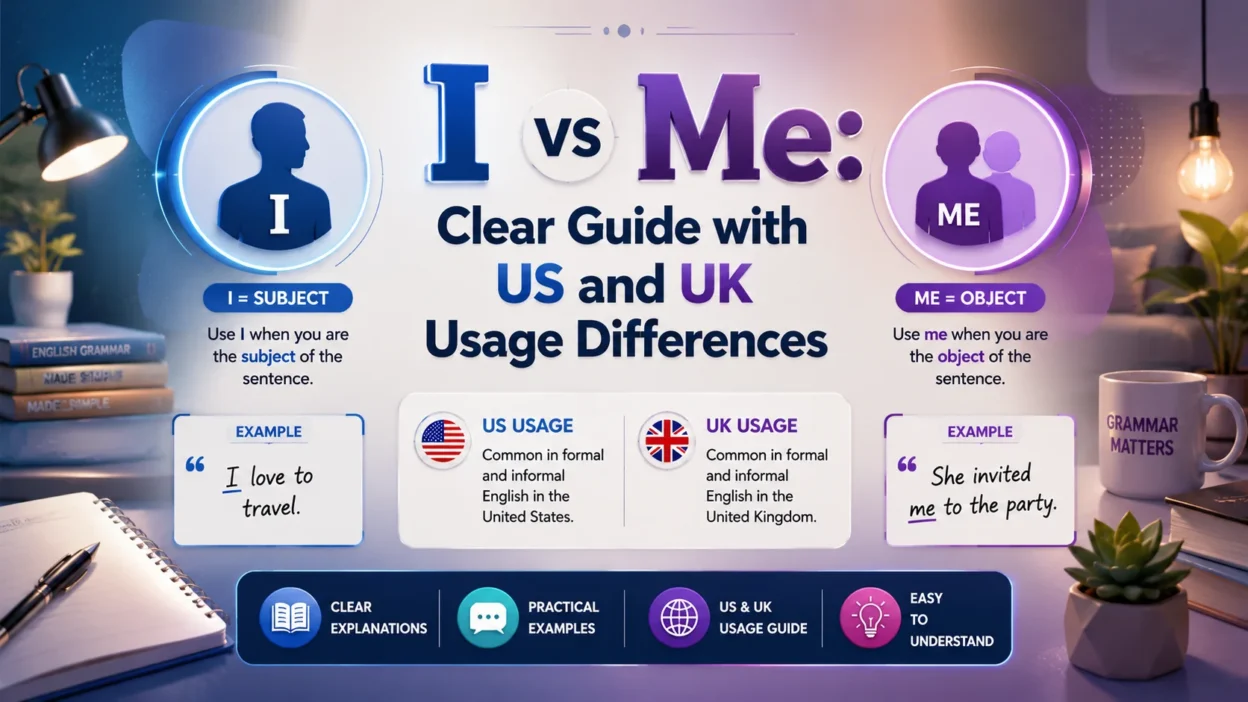
The simple rule is this: I is a subject pronoun, while me is an object pronoun. Use I when you are doing the action and me when you receive the action or follow a preposition. For example, you would say “I called Sarah,” but “Sarah called me.” The same basic rule applies in both American and British English.
I vs Me: Quick Answer
| Pronoun | Function | Example |
|---|---|---|
| I | Subject pronoun | I wrote the email. |
| Me | Object pronoun | She emailed me. |
The easiest rule to remember is: use I for the person doing the action and me for the person receiving the action.
What Does “I” Mean?
I is the first-person singular subject pronoun. It refers to the person speaking or writing when that person is the subject of a sentence.
Examples include “I love this song,” “I finished my homework,” “I called my friend,” “I need some help,” and “I will see you tomorrow.” In each sentence, I is the person performing or experiencing the action.
A useful question to ask is: Who is doing the action? If the answer is you, I is usually the correct form.
Pronunciation of “I”
I is pronounced /aɪ/, like eye. Its pronunciation is essentially the same in standard American and British English.
What Does “Me” Mean?
Me is the first-person singular object pronoun. Use it when you are receiving an action or when you follow a preposition.
Examples include “She called me,” “He helped me,” “They invited me,” “Please give me the book,” “Come with me,” and “This gift is for me.”
Here, me is not the person performing the main action. Instead, the action is directed toward the speaker.
I vs Me: The Basic Difference
The easiest way to understand I vs me is to remember that I is the subject and me is the object. Compare the sentences “I helped John” and “John helped me.” In the first sentence, I performs the action. In the second sentence, me receives the action.
| Situation | Correct Form | Example |
| Subject | I | I called him. |
| Direct object | me | He called me. |
| Indirect object | me | She gave me a gift. |
| After a preposition | me | Come with me. |
John and I vs John and Me
This is where many people become confused.
Use John and I when the phrase is the subject of the sentence. For example, “John and I went to the mall,” “Sarah and I finished the project,” “My brother and I watched the game,” and “Emily and I are going shopping” are all correct because the people named are performing the action.
Use John and me when the phrase is the object. For example, “She invited John and me,” “The teacher called John and me,” “They gave John and me tickets,” and “Please send the email to John and me” are correct because John and the speaker are receiving the action.
The Remove-the-Other-Person Test
A simple trick can help you choose between I and me. Take the sentence “John and I went to the store.” Remove “John,” and you get “I went to the store.” That sounds correct, so John and I is correct.
Now try “The teacher called John and me.” Remove “John,” and you get “The teacher called me.” That also works, so John and me is correct.
This test is especially useful when a sentence contains two people.
I vs Me After Prepositions
After a preposition, me is normally the correct form. Common prepositions include to, for, with, from, between, about, beside, and without.
Examples include “This letter is for me,” “Come with me,” “She spoke to me,” “They were waiting for me,” and “He sat beside me.”
One particularly common mistake is “Between you and I, this is a secret.” The standard form is “Between you and me, this is a secret.” Because between is a preposition, it takes the object form me.
I vs Me in Comparisons
Comparisons can be confusing because both forms appear in modern English.
For example, “She is taller than me” is extremely common in everyday American and British English. You may also see “She is taller than I am.” The second version makes the complete grammatical structure clearer.
Traditional grammar may also use “She is taller than I,” but “than I am” is generally a clearer formal choice because it makes the implied verb explicit.
For everyday conversation, “She is taller than me” sounds completely natural.
“It’s Me” vs “It Is I”
Another common question is whether to say “It’s me” or “It is I.” Traditional grammar has sometimes preferred “It is I” because I is the subject form. However, “It’s me” is extremely common and widely accepted in modern English.
For example, if someone asks “Who’s at the door?”, replying “It’s me” sounds natural in both American and British English.
“It is I” can sound more formal, traditional, or old-fashioned. Therefore, it would be misleading to say that Americans use “It’s me” while British speakers normally use “It is I.” Modern speakers in both countries commonly use “It’s me.”
I vs Me in American English
American English follows the same basic grammatical distinction:
- I for subjects
- me for objects
For example, “My friend and I went shopping,” “My friend invited me,” “Please send the information to my colleague and me,” and “Between you and me, I wouldn’t do it” all follow the standard rule.
American English frequently uses “It’s me” in everyday speech. It also commonly uses “than me” in ordinary conversation.
I vs Me in British English
British English follows the same core rules. Examples include “Sarah and I went home,” “She spoke to Sarah and me,” “This present is for me,” and “Between you and me, that’s not a good idea.”
British speakers also commonly say “It’s me.” More traditional or formal styles may use “It is I,” but this is not a defining rule of modern British English.
Therefore, the main difference between American and British English is not the basic grammar of I and me. Both varieties use the same subject-versus-object distinction.
Common I vs Me Mistakes
| Incorrect or Nonstandard | Correct Standard Form |
| Me and John went home. | John and I went home. |
| The gift is for I. | The gift is for me. |
| Between you and I, it’s difficult. | Between you and me, it’s difficult. |
| She called John and I. | She called John and me. |
| I and my sister went shopping. | My sister and I went shopping. |
| Me is going to the store. | I am going to the store. |
| He spoke with Sarah and I. | He spoke with Sarah and me. |
| Give it to James and I. | Give it to James and me. |
Some of these forms may appear in casual speech, but the corrected versions are better for formal writing.
How to Remember I vs Me
If you are unsure, use this simple three-step method.
1. Find the Action
Identify the main verb in the sentence.
2. Ask Who Performs the Action
If you are doing the action, use I. For example, “I wrote the article” is correct because the speaker performs the action of writing.
3. Ask Who Receives the Action
If the action happens to you, use me. For example, “She praised me” is correct because the speaker receives the action.
For sentences with another person, remove that person’s name and test the sentence. “Sarah and I went home” becomes “I went home,” which is correct. On the other hand, “Sarah called Tom and me” becomes “Sarah called me,” which is also correct.
Frequently Asked Questions
Is “John and I” always correct?
No. John and I is correct when the phrase is the subject. For example, “John and I went to the park.” When the phrase is the object, use John and me, as in “She invited John and me.”
Is “John and me” grammatically correct?
Yes, when it functions as an object. For example, “The manager spoke to John and me.” It is not the standard form for a compound subject in formal English.
Should I say “between you and I” or “between you and me”?
Use “between you and me.” The word between is a preposition, so the object pronoun me is appropriate.
Is “It’s me” correct?
Yes. “It’s me” is natural and widely accepted in modern English in both the US and UK.
Is “than me” grammatically correct?
“Than me” is very common in modern English, especially in everyday speech. For formal writing, “than I am” can be a clearer alternative.
Is “Me and John went” correct?
It can occur in informal speech, but it is considered nonstandard in formal writing. Use “John and I went.”
Conclusion
The difference between I vs me becomes much easier once you remember one basic rule: I is the subject form, while me is the object form.
Use I when you perform the action, as in “I called John.” Use me when you receive the action or follow a preposition, as in “John called me” and “This gift is for me.”
For compound phrases, use the remove-the-other-person test. If I works by itself, choose I; if me works, choose me.
American and British English follow essentially the same rules. Although expressions such as “It is I” may sound more formal or traditional, “It’s me” is widely accepted in both varieties.
Once you focus on the grammatical role instead of what simply sounds familiar, choosing between I and me becomes much easier.

Andrew Foster is a researcher and content writer at Differopedia, specializing in clear, accurate, and easy-to-understand comparison guides, definitions, and informational articles. His work focuses on helping readers make informed decisions through well-researched, reliable content.