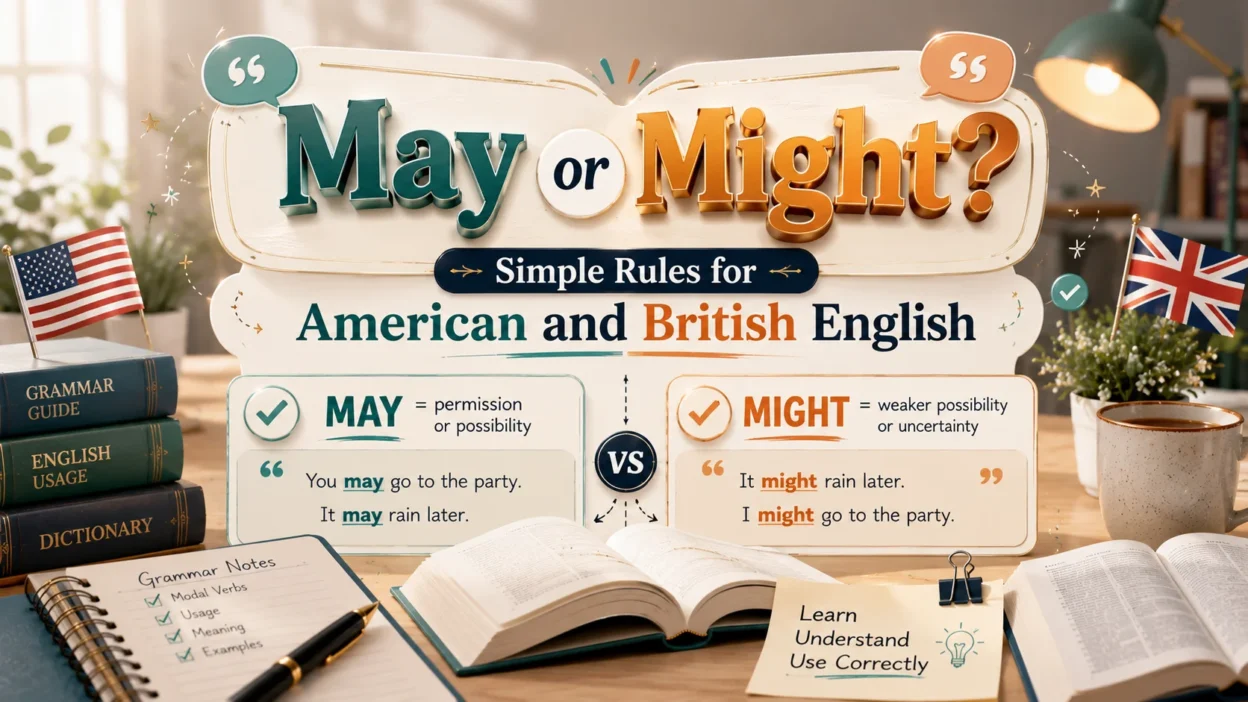
Ever paused while writing, unsure whether to use may or might? You are not alone. These two modal verbs confuse many English speakers. The difference comes down to probability and formality. We use may for more likely events, and might for less certain ones. American and British speakers also use them differently. This guide will clear up the confusion with simple rules and plenty of examples.
Quick Comparison Table
| Term | Meaning | Usage | Category |
|---|---|---|---|
| May | Higher probability (50%+); permission; formal requests | Likely outcomes; asking for permission; expressing wishes | Modal Verb |
| Might | Lower probability (under 50%); hypothetical; past of may | Unlikely outcomes; polite suggestions; reported speech | Modal Verb |
Main Meaning
Definition
May expresses possibility with higher likelihood or asks/gives formal permission. Might expresses weaker possibility or hypothetical situations.
Pronunciation
- May: /meɪ/ (rhymes with say)
- Might: /maɪt/ (rhymes with light)
Part of Speech
Both are modal auxiliary verbs. They help the main verb express mood, possibility, or necessity.
Origin
May comes from Old English mæg, meaning “I am able.” Might is its past tense form (meahte), which evolved into modern usage.
Contextual Meaning
We use these verbs to show something is possible but not certain. The key is how probable.
Detailed Explanation
Literal Meaning
Both indicate possibility without certainty. Think of it on a scale:
- Will = 100% certain
- May = 50–70% likely
- Might = 30–50% likely
- Might not = possible but unlikely
Common Meaning
In everyday conversation, people often use might more casually. May sounds more formal and deliberate. Most Americans say “I might go” rather than “I may go.”
Internet & Social Media
Online, might dominates. You will see “might delete later” or “might be my new favorite.” May appears less often in casual digital communication.
Permission Usage
Formal permission: May I help you?
Informal permission: Can I help you?
(We do NOT use might for permission in the US)
US vs. UK Usage
This is where speakers across the Atlantic differ significantly.
American English
Americans use might in most daily situations. We reserve may for formal requests and written documents.
Key points for US speakers:
- Use might for everyday conversation
- Use may for formal permission (especially in schools: “May I use the restroom?”)
- May appears in legal and academic writing
- Might does NOT ask for permission
US Examples:
- “I might grab lunch later.” (casual, common)
- “May I borrow your pen?” (formal)
- “It might snow tomorrow.” (less certain)
British English
Brits use might more flexibly. They often ask “Might I…?” for polite questions.
Key points for UK speakers:
- Might works for polite requests too
- May still exists in formal contexts
- The difference in probability remains the same
- Both words appear in everyday speech
UK Examples:
- “Might I have a word?” (polite request)
- “It may well rain later.” (quite likely)
- “We might pop in for tea.” (casual visit)
Usage Examples
| Example Sentence | Meaning |
|---|---|
| We may visit Paris next summer. | We have a good chance of going. |
| I might stay home tonight. | I will probably stay home. |
| May I help you with that bag? | Formal offer of assistance. |
| She might not attend the meeting. | It is possible she won’t come. |
| They may already know the news. | There is a strong chance they know. |
| I might try that new restaurant. | I am considering it, unsure yet. |
| May your dreams come true. | Expressing a wish or hope. |
| He might have missed the bus. | Speculating about a past event. |
| You may leave early today. | Giving formal permission. |
| We might need extra chairs. | We will possibly need them. |
Synonyms Table
| Synonym | Meaning |
|---|---|
| Could | Expresses possibility or ability |
| Can | Shows ability or informal permission |
| Might | Weaker possibility |
| May | Stronger possibility |
| Possibly | Perhaps, maybe |
| Perhaps | Expresses uncertainty |
| Maybe | Expresses possibility, informal |
| Would | Expresses conditional actions |
| Should | Expresses expectation or advice |
| Will | Definite future action |
| Shall | Formal future or offer |
| Ought to | Moral obligation or expectation |
| Could | Past ability or conditional |
| Might have | Past possibility |
| May have | Past probability |
Antonyms Table
| Antonym | Meaning |
|---|---|
| Cannot | Impossible, unable |
| Will not | Definite refusal or no |
| Impossible | Not possible at all |
| Definitely | Without any doubt |
| Certainly | Absolutely sure |
| Surely | Without question |
| Must | Strong obligation or certainty |
| Shall not | Formal refusal |
| No | Negative response |
| Never | At no time |
Related Terms
| Related Word | Meaning |
|---|---|
| Modal verb | Verbs expressing mood or possibility |
| Auxiliary verb | Helping verbs in sentences |
| Probability | How likely something happens |
| Possibility | Something that might exist or happen |
| Permission | Allowing someone to do something |
| Conditional | Expressing conditions or hypotheses |
| Hypothetical | Based on possible situations |
| Likelihood | The chance of something |
| Certainty | Being completely sure |
| Doubt | Feeling uncertainty |
| Speculation | Guessing without full knowledge |
| Conjecture | Forming an opinion without proof |
| Tentative | Not certain or fixed |
| Provisional | Temporary or subject to change |
| Potential | Possible but not yet realized |
Real-Life Usage
Daily Conversation
You will hear might everywhere. “I might be late.” “We might order pizza.” Americans use might constantly in casual talk.
Social Media
People write “might delete later” or “might try this.” Might sounds more relatable and less formal than may.
Business Communication
Professionals use may for formal offers: “You may contact our support team.” They use might for uncertain projections: “Sales might increase next quarter.”
Academic Writing
Scholars use may for likely outcomes and might for speculative or less certain conclusions. “The results may indicate a trend. The findings might suggest further research.”
Online Messaging
Text messages favor might. It feels natural and quick. “Might be there at 7.” “May” appears only in formal responses.
Common Mistakes
| Mistake | Correct Usage |
|---|---|
| Using might for permission in US | Use may or can: “May I leave early?” |
| Using may for very unlikely events | Use might: “She might (not may) win the lottery.” |
| Using might in present tense with high probability | Use may: “We may (not might) see you there.” |
| Forgetting might as past of may | Use might: “He said he might come” (reported speech). |
| Using may in casual texting | Use might: “I might come later” not “I may.” |
| Confusing probability levels | May = higher chance, Might = lower chance |
| Using might for formal permission in US | Sounds odd; stick with may or can |
| Using may for past tense | Use might: “He might have been there.” |
| Overusing may in daily speech | Sounds too formal; use might instead |
| Using might not when may not fits better | May not = unlikely; Might not = possibly not |
Semantic Keywords
- Modal verb
- Auxiliary verb
- Probability
- Possibility
- Permission
- Likelihood
- Certainty
- Hypothetical
- Conditional
- Formal vs informal
- American English
- British English
- Past tense
- Reported speech
- Speculation
FAQs
Can I use may and might interchangeably?
Yes in many cases, but careful speakers distinguish probability levels.
Which is more formal, may or might?
May is more formal for permission; might feels more casual overall.
Do Americans use might differently than Brits?
Yes, Americans rarely use might for permission; Brits do.
What is the past tense of may?
The past tense of may is might in reported speech.
Is might less certain than may?
Yes, might indicates lower probability than may.
Can we use might to ask for permission in the US?
Not typically; use may or can instead.
When should I use may in writing?
Use may for formal requests and expressing likelihood in professional writing.
Why do Americans use might so often?
Might sounds more natural and less formal for everyday conversation.
Conclusion
The difference between may and might is simple once you understand probability and context. Use may for more likely events and formal permissions. Use might for weaker possibilities and casual conversation. Remember that Americans favor might in everyday speech, while Brits use it even for polite requests. Choosing the right word will make your English sound more natural and precise. Next time you write or speak, ask yourself: “Is this likely or just possible?” That answer will guide your choice every time.

Andrew Foster is a researcher and content writer at Differopedia, specializing in clear, accurate, and easy-to-understand comparison guides, definitions, and informational articles. His work focuses on helping readers make informed decisions through well-researched, reliable content.