
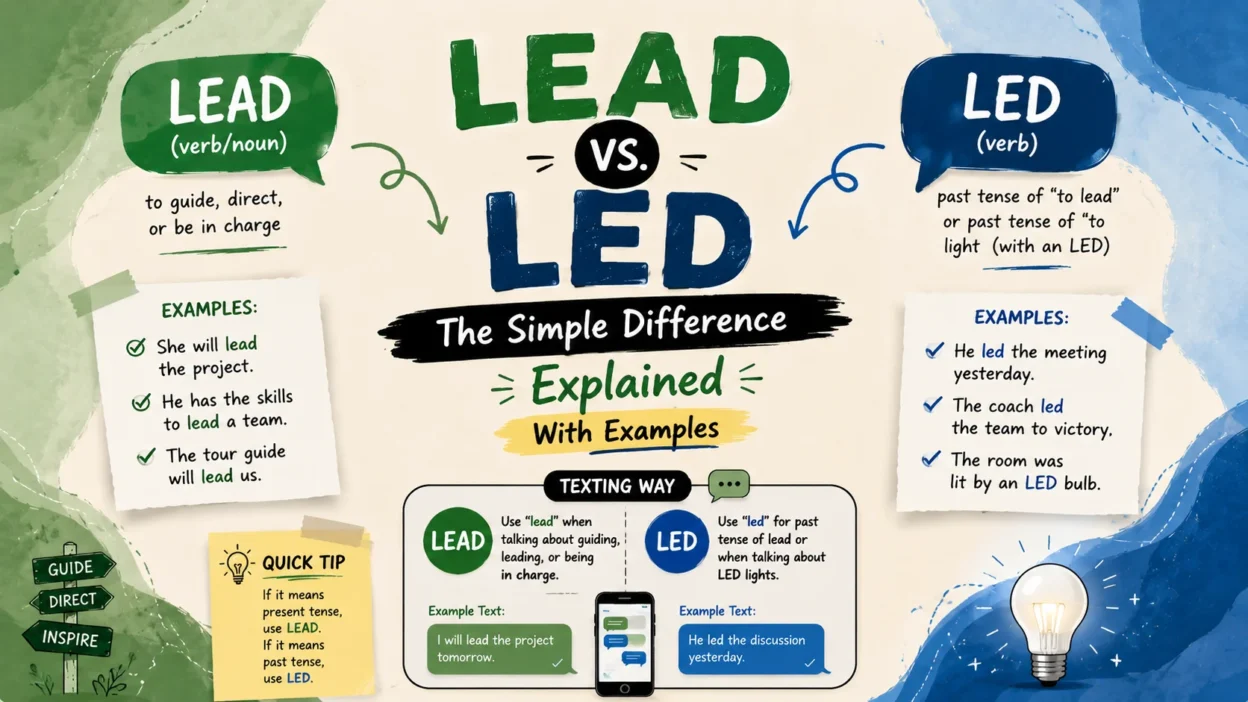
Many writers struggle with lead vs. led because these words look almost identical but serve different purposes. The confusion grows because lead has two pronunciations and several meanings.
Here is the easiest rule: lead works as the present-tense verb when you mean “guide” or “direct,” while led works as the past tense and past participle of that verb. The word lead also names the metal Pb, but people pronounce that meaning like led.
In this guide, you will learn the difference between lead and led, their pronunciations, meanings, common mistakes, American and British usage, and plenty of simple examples.
Quick Answer: Lead vs. Led
| Word | Meaning | Pronunciation | Example |
|---|---|---|---|
| lead (verb) | Guide, direct, or manage | leed /liːd/ | “She will lead the team.” |
| led (verb) | Past tense of lead | led /lɛd/ | “She led the team yesterday.” |
| lead (noun) | A soft, dense metal, Pb | led /lɛd/ | “The old paint contains lead.” |
| lead (noun) | Advantage, clue, or prospect | leed /liːd/ | “Our team has the lead.” |
The Simple Rule
Remember these three examples:
- I lead the team today.
- I led the team yesterday.
- The old pipes contain lead.
The first lead sounds like leed. The second led sounds like red. The third lead, which means the metal, also sounds like red.
How Do You Pronounce Lead and Led?
The word lead has two pronunciations because it carries different meanings.
Lead = “leed” /liːd/
Use this pronunciation when lead means to guide, direct, manage, or stay ahead.
Examples:
- “Who will lead the meeting?”
- “She leads the marketing team.”
- “Our team has the lead.”
- “The detective found a new lead.”
Lead = “led” /lɛd/
Use this pronunciation when lead means the metal.
Examples:
- “The old paint contains lead.”
- “Workers tested the pipes for lead.”
- “The laboratory measured the lead in the sample.”
Led = “led” /lɛd/
Led always sounds like red. It works as the past tense and past participle of the verb lead.
Examples:
- “She led the team yesterday.”
- “He led us through the forest.”
- “They have led several successful projects.”
American and British English follow the same pronunciation and spelling rules for these words.
What Does Lead Mean as a Verb?
As a verb, lead means to guide, direct, manage, or take charge of someone or something. You normally use it for a present or future action.
Examples:
- “I lead the marketing team.”
- “She will lead the discussion tomorrow.”
- “Our teacher leads the students through the lesson.”
- “He hopes to lead the company someday.”
- “Please lead the way.”
You can also use lead when one action or situation causes another result:
- “Poor planning can lead to delays.”
- “Regular practice can lead to better results.”
- “The discovery may lead to new opportunities.”
- “Hard work often leads to success.”
Forms of the Verb Lead
| Form | Example |
| Present | “I lead the team.” |
| Present, third person | “She leads the team.” |
| Past | “She led the team.” |
| Past participle | “She has led the team.” |
| -ing form | “She is leading the team.” |
Notice the important change: lead → led, not lead → leaded.
What Does Led Mean?
Led serves as the past tense and past participle of the verb lead. Use it when someone guided, directed, managed, or caused something in the past.
Examples:
- “She led the team last year.”
- “The guide led us through the forest.”
- “He led the meeting yesterday.”
- “Their research led to an important discovery.”
- “The coach led the players to victory.”
- “Her advice led me to a better decision.”
Compare these sentences:
- Present: “She leads the team.”
- Past: “She led the team.”
- Present perfect: “She has led the team for three years.”
Words such as yesterday, last year, earlier, previously, and ago often signal a past action, so led usually fits those sentences.
What Does Lead Mean as a Noun?
The noun lead has several meanings. Its pronunciation depends on the meaning.
Lead as a Metal
Lead names the chemical element Pb. In this meaning, pronounce it like led.
Examples:
- “The old house had lead pipes.”
- “The workers tested the paint for lead.”
- “The laboratory checked the water for lead.”
- “The manufacturer removed lead from the product.”
Remember: the metal always keeps the spelling lead, even though it sounds like led.
Lead as an Advantage
Lead can mean an advantage over another person or team.
Examples:
- “Our team has a ten-point lead.”
- “The runner took the lead in the final lap.”
- “The team lost its lead near the end.”
- “She holds a comfortable lead in the competition.”
Here, pronounce lead like leed.
Lead as a Clue
A lead can mean a clue, tip, or useful piece of information. Detectives, journalists, and investigators often use the word this way.
Examples:
- “The detective found a new lead.”
- “Police followed the lead.”
- “The reporter received an important lead.”
- “We finally have a promising lead on the story.”
Lead as a Sales Prospect
Businesses also use lead for a potential customer who shows interest in a product or service.
Examples:
- “The sales team generated 50 new leads.”
- “We contacted every qualified lead.”
- “The company converted several leads into customers.”
This meaning also uses the leed pronunciation.
Lead vs. Led: Real-Life Examples
These examples show how the words work in everyday situations:
- “She will lead the project.” — Future guidance.
- “She led the project last year.” — Past guidance.
- “The manager leads weekly meetings.” — Present responsibility.
- “The manager led yesterday’s meeting.” — Past action.
- “The detective found a new lead.” — A clue.
- “The runner took the lead.” — First position.
- “The old paint contained lead.” — The metal.
- “The teacher led the students outside.” — Past guidance.
- “Good preparation can lead to success.” — Cause or result.
- “She has led several successful campaigns.” — Past participle.
Common Mistakes With Lead and Led
Mistake: “She lead the team yesterday.”
Correct: “She led the team yesterday.”
The word yesterday tells us that the action happened in the past.
Mistake: “He led the meeting every Monday.”
If you mean that he regularly handles the meeting now, write:
“He leads the meeting every Monday.”
If you mean one meeting that happened in the past, write:
“He led the meeting last Monday.”
Mistake: “The pipe contains led.”
Correct: “The pipe contains lead.”
The metal uses the spelling lead, although the pronunciation sounds like led.
Mistake: “We lead the project last year.”
Correct: “We led the project last year.”
The phrase last year places the action in the past.
Mistake: “The detective found several leds.”
Correct: “The detective found several leads.”
A clue uses lead, and the plural form is leads.
Mistake: “She lead the way yesterday.”
Correct: “She led the way yesterday.”
Again, the past-time reference requires led.
Lead vs. Led in American and British English
American and British English follow the same basic rules for lead and led.
Both varieties use:
- lead for the present-tense verb
- led for the past tense
- lead for the metal
- lead for an advantage, clue, or sales prospect
One vocabulary difference appears with dogs. American speakers normally use leash, while British speakers can use lead for the strap that controls a dog.
For example:
- American English: “Put the dog on its leash.”
- British English: “Put the dog on its lead.”
Both countries also use lead in journalism for the opening part of a news story. Journalists sometimes use lede as a specialized spelling for that opening sentence or paragraph.
Lead, Led, and Lede: What’s the Difference?
These three words look similar, but they have separate uses:
- Lead /liːd/ = guide or direct: “She will lead the team.”
- Led /lɛd/ = past tense of lead: “She led the team yesterday.”
- Lead /lɛd/ = the metal: “The paint contains lead.”
- Lede /liːd/ = the opening of a news story: “The lede summarizes the main event.”
Easy Ways to Remember Lead vs. Led
Use this simple memory trick:
Lead = present. Led = past.
Think:
Today: “I lead.”
Yesterday: “I led.”
For the metal, remember:
Lead the metal = sounds like “led.”
You can also remember that lead and led do not follow the normal pattern of adding -ed to create the past tense. The correct forms are:
lead → led → led
For example:
- “I lead the group.”
- “I led the group yesterday.”
- “I have led the group before.”
Synonyms for Lead
The best synonym depends on the context. Common alternatives include:
- Guide
- Direct
- Manage
- Head
- Command
- Supervise
- Steer
- Conduct
- Captain
- Chair
- Oversee
- Spearhead
For example, “She leads the department” could become “She heads the department” or “She manages the department.”
FAQs:
What is the past tense of lead?
The past tense of the verb lead is led.
Example: “She led the group yesterday.”
Why does lead have two pronunciations?
Lead represents different meanings. The verb meaning “guide” sounds like leed, while the metal sounds like led.
Is “leaded” the past tense of lead?
No. When lead means “guide,” use led as the past tense.
Is lead pronounced leed or led?
It depends on the meaning. The verb lead and the noun meaning an advantage or clue use leed. The metal lead uses led.
Do American and British English use lead and led differently?
The basic grammar stays the same. British English can also use lead for a dog leash, while American English usually uses leash.
What does lede mean?
Lede is a journalism term for the opening sentence or paragraph of a news story.
How can I remember lead and led?
Remember: lead = present, led = past. Also remember that the metal lead sounds like led.
Conclusion
The difference between lead and led becomes simple when you focus on tense and meaning. Use lead when you talk about guiding, directing, or managing someone in the present or future, and Use led when that action happened in the past. Use lead for the metal Pb, but pronounce the metal like led.
The easiest rule remains:
Lead = present. Led = past. Lead = the metal.
For example, say, “I lead the team today,” “I led the team yesterday,” and “The old pipes contain lead.” These rules work in both American and British English, with only a few vocabulary differences.
Once you remember the pronunciation and tense patterns, you can confidently choose lead, led, or lede in everyday conversations, emails, essays, and professional writing.

Andrew Foster is a researcher and content writer at Differopedia, specializing in clear, accurate, and easy-to-understand comparison guides, definitions, and informational articles. His work focuses on helping readers make informed decisions through well-researched, reliable content.