
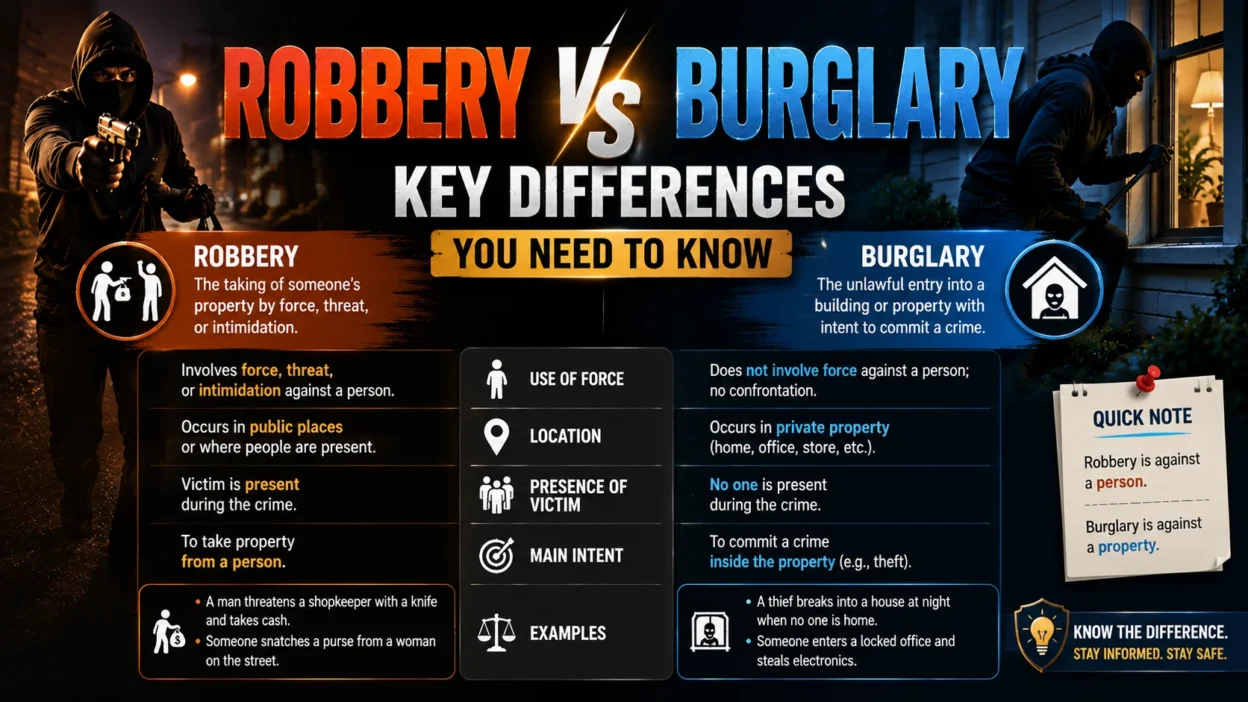
You often hear “robbery” and “burglary” in crime reports, but these words describe different crimes. Robbery involves taking property through force, threats, or fear involving a person, while burglary generally involves unlawful entry into a building or structure with criminal intent.
The exact legal definitions vary by jurisdiction, but one simple distinction makes these terms easier to understand: robbery focuses on the person and the taking, while burglary focuses on unlawful entry and criminal intent. This guide explains the difference with simple examples, US and England/Wales usage, common mistakes, and FAQs.
Note: Criminal-law definitions and penalties vary by jurisdiction. This article explains general terminology and does not provide legal advice.
Quick Answer: Robbery vs Burglary
| Term | Meaning | Example | Main Idea |
|---|---|---|---|
| Robbery | Taking or attempting to take property through force, threats, or fear | “The man threatened the cashier and took the money.” | Force or threat against a person |
| Burglary | Unlawfully entering a building or structure with criminal intent | “Someone broke into the house and stole a television.” | Unlawful entry and criminal intent |
Easy Memory Trick
Robbery = force or threat against a person.
Burglary = unlawful entry plus criminal intent.
What Exactly Is Robbery?
Robbery involves taking or attempting to take something valuable from another person through force, violence, intimidation, or a threat of force.
For example, imagine a man enters a convenience store, points a gun at the cashier, and demands money. He commits an act that fits the basic idea of robbery because he uses a threat against a person to obtain property.
The important point is that robbery involves more than simply taking someone’s property. Force, threats, intimidation, or fear play a central role in the offense.
Key Elements of Robbery
Robbery generally involves:
- Taking or attempting to take something valuable.
- Property that belongs to or remains under another person’s control.
- Force, violence, intimidation, or a threat of force.
- A connection between the taking and the person who controls the property.
Common examples include armed robbery, street robbery involving threats, and carjacking involving force or threats.
The exact legal requirements differ between jurisdictions, so local law determines whether a particular incident qualifies as robbery.
What Exactly Is Burglary?
Burglary focuses on unlawful entry and criminal intent rather than force against a person.
For example, suppose someone enters a neighbor’s house without permission while the family remains away. The person intends to steal electronics from inside. The situation may qualify as burglary if it meets the applicable legal requirements.
Unlike robbery, burglary does not necessarily require a confrontation with a victim. No one needs to remain inside the building, and the offender does not necessarily need to use force against anyone.
Key Elements of Burglary
Depending on the jurisdiction, burglary generally involves:
- Unlawful or unauthorized entry into a building or structure.
- Criminal intent connected to the entry.
- An intended offense such as theft or another qualifying crime.
- Any additional requirements that local law establishes.
A person does not always need to smash a window or force open a door to commit burglary. Some laws can treat unauthorized entry as sufficient when the other required elements exist.
Robbery vs Burglary: The Core Differences
The easiest way to distinguish the two crimes involves one basic question:
Does the crime involve taking property from a person through force or threats, or does it involve unlawful entry with criminal intent?
| Difference | Robbery | Burglary |
| Main focus | Taking property from a person | Unlawful entry into a structure |
| Force against a person | Central to the basic offense | Not required |
| Victim presence | Often matters because the taking involves the person | The victim does not necessarily need to be present |
| Entry into a building | Not required | Usually central to the offense |
| Breaking a door/window | Not required | Not always required |
| Criminal intent | Involves an unlawful taking | Entry connects to the required criminal intent |
| Both crimes together? | Yes, depending on circumstances | Yes, depending on circumstances |
For example, if someone threatens you and takes your phone, the situation may involve robbery.
If someone enters your home without permission while you are away and intends to steal, the situation may involve burglary.
US Legal Context
In the United States, individual states create and enforce their own criminal laws. As a result, the exact definitions, elements, classifications, and penalties can differ from one state to another.
The FBI uses standardized definitions for national crime reporting. Its Uniform Crime Reporting program describes robbery as taking or attempting to take something valuable from a person’s care, custody, or control through force or threat of force. The FBI describes burglary as unlawful entry into a structure to commit a felony or theft.
These definitions explain common phrases in American news reports, including:
- Armed robbery
- Bank robbery
- Street robbery
- Residential burglary
- Commercial burglary
American speakers also commonly use “burglarized” when they describe an unlawful break-in.
For example:
“Someone burglarized our house last night.”
People also commonly say:
“Someone broke into our house.”
However, everyday speech does not always match legal terminology perfectly.
What About Robbery and Burglary Penalties?
US law does not provide one nationwide punishment for every robbery or burglary case. State law, the degree of the offense, weapons, injuries, previous convictions, the type of property, and other circumstances can affect the outcome.
For that reason, avoid statements such as “robbery always carries X years” or “burglary always receives Y years.” The applicable jurisdiction determines the actual charge and penalty.
UK Legal Context: England and Wales
When discussing UK terminology, we should distinguish England and Wales from Scotland and Northern Ireland because different legal systems apply.
In England and Wales, the Theft Act 1968 provides the main statutory framework for robbery and burglary.
Under Section 8, robbery involves theft combined with force against a person or putting someone in fear of immediate force. The law therefore connects robbery closely with both theft and force or fear.
Section 9 addresses burglary. Broadly, burglary can involve entering a building or part of a building as a trespasser with the required criminal intent, or entering as a trespasser and then committing or attempting certain offenses.
So, in England and Wales:
Robbery focuses on theft plus force or fear.
Burglary focuses on trespassory entry plus the criminal conduct or intent required by law.
US vs UK Everyday Usage
The basic distinction remains similar, but Americans and Britons often choose different words when they describe a break-in.
American English
Americans commonly say:
- “Our house was burglarized.”
- “Police are investigating a burglary.”
- “The store had an armed robbery.”
- “Someone broke into the garage.”
British English
British speakers commonly say:
- “Our flat was burgled.”
- “There was a burglary at the shop.”
- “The man committed robbery.”
- “Someone broke into the house.”
If you write for an American audience, “burglarized” sounds more natural than “burgled.” British English commonly uses “burgled.”
Real-Life Examples of Robbery and Burglary
| Situation | Term | Why? |
| A man threatens a cashier and demands money. | Robbery | He uses a threat against a person to obtain property. |
| Someone enters a house unlawfully while the owners are away and steals electronics. | Burglary | The situation centers on unlawful entry and criminal intent. |
| Someone threatens a person and takes their phone. | Robbery | The offender uses force or a threat during the taking. |
| Someone enters an office without permission intending to steal computers. | Burglary | The offender enters unlawfully with criminal intent. |
| Someone secretly removes a wallet from a pocket. | Usually theft | The offender does not normally use force or threats. |
| Someone forces a driver out of a car and takes the vehicle. | Robbery | The offender uses force or threats to take the vehicle. |
The exact legal classification depends on the facts and the law that applies to the incident.
Common Mistakes People Make
| Common Mistake | Better Understanding |
| “Someone robbed my house while I was away.” | “Someone burglarized my house” or “Someone broke into my house.” |
| “The burglar pointed a weapon at me and demanded my wallet.” | The threat may support robbery, while the unlawful entry may also raise burglary issues. |
| “She was burgled on the subway.” | The incident would generally involve theft from the person, or potentially robbery if force or threats occurred. |
| “They burglarized the store while nobody was inside.” | Burglary may describe the unlawful entry when the required criminal intent exists. |
| “Robbery and burglary mean the same thing.” | They describe different crimes with different legal elements. |
| “Pickpocketing is always robbery.” | Pickpocketing generally involves theft unless force or threats change the legal classification. |
Can One Incident Involve Both Robbery and Burglary?
Yes. One incident can potentially involve both robbery and burglary.
For example, someone could unlawfully enter a house intending to steal. After entering, the person could confront a resident and use force or threats to take property.
Depending on the applicable law, the unlawful entry could support a burglary charge, while the later taking through force or threats could support a robbery charge.
Therefore, burglary does not simply “turn into” robbery. Different parts of the same incident can support different criminal offenses.
Is Pickpocketing Robbery or Burglary?
Usually, pickpocketing counts as theft rather than robbery or burglary.
If someone quietly removes your wallet without your knowledge, the offender normally uses neither force nor threats. That makes theft a more appropriate general description.
However, if the offender uses force or threatens you while taking the property, the law may classify the conduct differently.
Pickpocketing also normally has nothing to do with unlawful entry into a building, so burglary would not ordinarily describe the act itself.
Which Is Worse: Robbery or Burglary?
There is no universal answer because jurisdictions use different criminal classifications and sentencing rules.
Robbery generally ranks as a particularly serious offense because it involves force, threats, or fear directed at a person. Burglary can also carry serious consequences, especially when the offender enters a dwelling or involves weapons, violence, or other aggravating circumstances.
The specific facts and applicable law determine the seriousness and potential punishment.
FAQs
Can burglary happen without breaking a door or window?
Yes. A person does not always need to damage a door or window; unlawful entry and the required criminal intent may satisfy the applicable law.
Can someone commit burglary without stealing anything?
Yes. Some burglary laws focus on unlawful entry combined with the required criminal intent, so the offender may not need to complete the intended theft.
Is carjacking robbery?
Carjacking can qualify as robbery when someone takes a vehicle from a person through force or threats, although local law determines the exact classification.
Do Americans say “burgled”?
Americans usually say “burglarized” or “broken into,” while British speakers commonly use “burgled.”
Does the US use the same definition as the UK?
No. US criminal definitions vary by jurisdiction, while England and Wales use statutory definitions under the Theft Act 1968.
Can a crime involve both robbery and burglary?
Yes. An incident can potentially involve both offenses when it includes unlawful entry and a separate taking involving force or threats.
Is pickpocketing robbery?
Usually not. Pickpocketing generally counts as theft when the offender uses neither force nor threats.
Which is more serious, robbery or burglary?
Robbery generally receives especially serious treatment because it involves force or threats against a person, but the law and circumstances determine the actual penalty.
Conclusion
The difference between robbery and burglary becomes simple when you focus on the main action. Robbery involves taking property through force, threats, or fear involving a person, while burglary generally involves unlawful entry into a building or structure with criminal intent.
Remember this simple rule: robbery focuses on a person, while burglary focuses on unlawful entry and criminal intent. For everyday English, Americans commonly say “burglarized,” while British speakers commonly say “burgled.”

Andrew Foster is a researcher and content writer at Differopedia, specializing in clear, accurate, and easy-to-understand comparison guides, definitions, and informational articles. His work focuses on helping readers make informed decisions through well-researched, reliable content.