
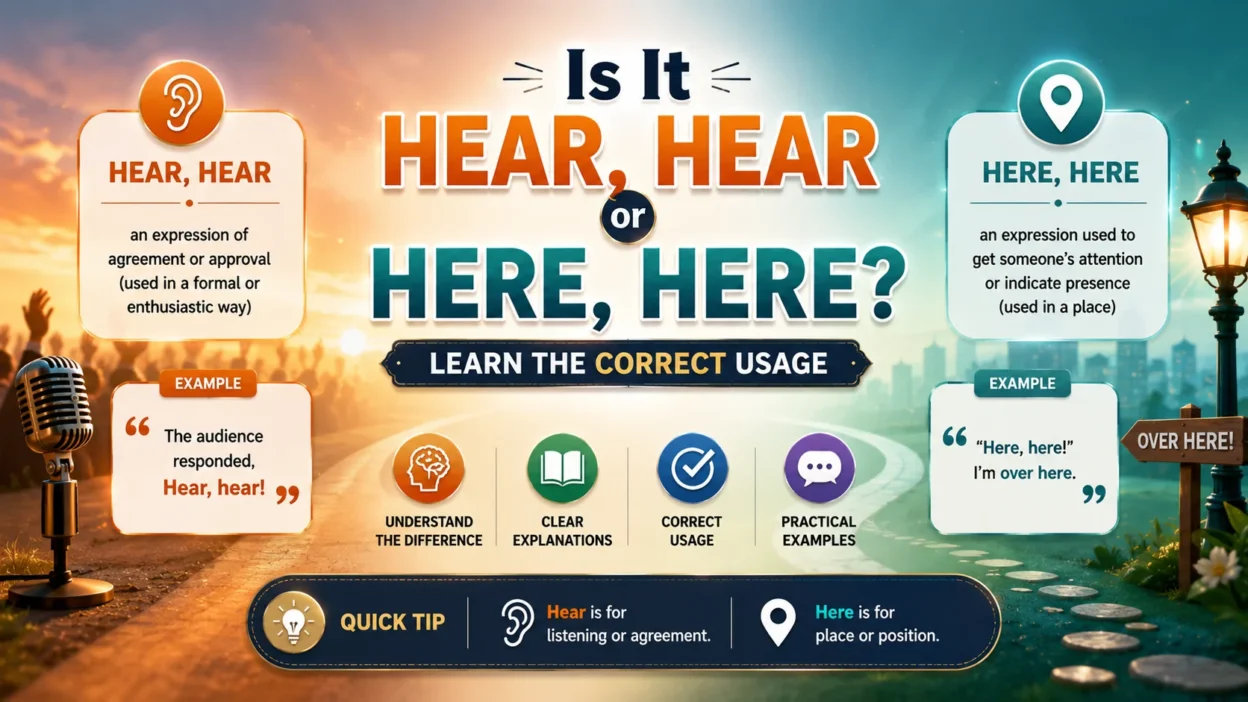
Have you ever wondered whether the correct expression is “hear, hear” or “here, here” when you strongly agree with someone? This is a common English spelling confusion because hear and here are homophones—they sound alike but have different meanings.
The correct expression for showing agreement or approval is “hear, hear.” It means something like “I agree,” “well said,” or “I strongly support that.” By contrast, “here, here” is usually an incorrect spelling when someone intends to use the traditional expression of agreement.
The confusion is easy to understand because you cannot hear the difference between the two spellings when someone says the phrase aloud. In this guide, you’ll learn the correct spelling, meaning, pronunciation, origin, examples, and differences between British and American English.
Quick Answer: Hear, Hear or Here, Here?
| Expression | Meaning | Correct for Agreement? |
|---|---|---|
| Hear, hear | An expression of agreement or approval | Yes |
| Here, here | Uses “here” to refer to a place or location | No, not for expressing agreement |
If you want to show that you strongly agree with someone, write:
“Hear, hear!”
Think of it as saying, “Listen to that speaker—they are right!”
What Does “Hear, Hear” Mean?
“Hear, hear” is an interjection used to express agreement, approval, or support for something someone has just said.
It can mean:
- I agree.
- Well said.
- Exactly.
- Absolutely.
- I strongly support that.
- That’s an excellent point.
For example:
“Everyone deserves a fair opportunity.”
“Hear, hear!”
The second speaker is expressing strong agreement with the first speaker.
The phrase is particularly associated with speeches, debates, public discussions, and British parliamentary language, although it is also understood and used in American English.
Why Do People Write “Here, Here”?
The main reason is that hear and here are homophones. Homophones are words that sound alike but have different spellings and meanings.
- Hear = to perceive or listen to sound
- Here = in, at, or toward this place
Compare these sentences:
I can hear music.
Please come here.
Although the words sound the same, their meanings are different.
When someone hears “hear, hear!”, they cannot see which spelling is being used. Someone who has never encountered the expression in writing may naturally assume it is “here, here.”
That is why “here, here” is a common misspelling when someone wants to express agreement.
Hear, Hear vs. Here, Here: Side-by-Side Comparison
The easiest way to understand the difference is to compare the two expressions directly.
| Feature | Hear, Hear | Here, Here |
| Main meaning | Agreement or approval | Repeated use of “here” |
| Pronunciation | Same | Same |
| Used as an agreement expression? | Yes | No |
| Example | “That’s an excellent idea.” “Hear, hear!” | “Put the boxes here, here, and there.” |
| Connection | Listening to or approving a speaker | Location or place |
| Common error? | No | Yes, when intended to mean “I agree” |
The key distinction is simple:
Hear, hear = I agree.
Here = this place.
So if someone makes a good point and you want to show approval, choose “hear, hear.”
Pronunciation of “Hear, Hear”
Both words in “hear, hear” have the same pronunciation.
- American English: /hɪr hɪr/
- British English: /hɪə hɪə/
Because hear and here are pronounced alike, listening to the phrase does not tell you how to spell it.
You have to remember the meaning.
Easy Memory Trick
Think:
Hear = listen.
When someone says something you strongly agree with, you are essentially saying:
“Hear what this person is saying!”
Therefore, the correct spelling is:
Hear, hear! ✓
Not:
Here, here! ✗ when expressing agreement.
Where Did “Hear, Hear” Come From?
The expression has a long history in British parliamentary language.
Forms such as “Hear him! Hear him!” were used to encourage listeners to pay attention to a speaker. Over time, the shorter “hear, hear!” became established as an expression of approval or agreement.
Historical records show the expression being used in parliamentary contexts by the 18th century. Today, it remains strongly associated with debates in the UK Parliament.
The UK parliamentary guide Erskine May recognizes cries of “hear, hear” as part of long parliamentary usage. Depending on context and tone, the expression can communicate approval, although it can also sometimes be used ironically or to express disapproval.
When to Use “Hear, Hear” vs. “Here”
Knowing the meaning is the easiest way to choose the correct spelling.
Use “Hear, Hear” for Agreement
Use “hear, hear” when someone has made a statement and you want to show that you agree with or approve of it.
Example:
“We should provide better resources for students.”
“Hear, hear!”
Here, “hear, hear” means:
“I completely agree with you.”
Use “Here” for Location
Use “here” when referring to a particular place or position.
Examples:
“Your phone is here.”
“Please sit here.”
“Come here and look at this.”
In these sentences, here refers to a location.
Simple Rule
If your meaning is “I agree,” use:
Hear, hear!
If your meaning involves a place or location, use:
Here.
How to Use “Hear, Hear” in a Sentence
Here are some natural examples:
- “We need to make education more accessible.” “Hear, hear!”
- “That was an excellent point.” “Hear, hear!”
- “Everyone should have the opportunity to succeed.” “Hear, hear!” she replied.
- “We should spend more time helping our community.” “Hear, hear!”
- “To friendship and good health!” “Hear, hear!” everyone responded.
- “This is exactly the change our town needs.” “Hear, hear!” said James.
- “We must protect these historic buildings.” “Hear, hear!” came the response.
- “Let’s make this event better for everyone.” “Hear, hear!”
In each example, the expression shows approval or strong agreement with the preceding statement.
Hear, Hear in British vs. American English
British English
“Hear, hear” is strongly associated with British English, particularly political and parliamentary speech.
You may encounter it in:
- Parliamentary debates
- Political speeches
- Public meetings
- Formal discussions
- Debates
- Toasts
- Everyday conversations
Its long association with the UK Parliament gives it a particularly traditional or formal feel in British contexts.
American English
American English speakers also understand and use “hear, hear.” However, it is generally less common in everyday American conversation than it is in British political and parliamentary contexts.
Americans may more often use expressions such as:
- I agree!
- Absolutely!
- Exactly!
- Well said!
- You said it!
- Right on!
Still, “hear, hear” is perfectly understandable in American English and can be used for emphasis, humor, or strong agreement.
Common Mistakes With “Hear, Hear”
| Common Mistake | Correct Form |
| “Here, here!” to mean “I agree” | “Hear, hear!” |
| “Here hear!” | “Hear, hear!” |
| “Hear hear!” | “Hear, hear!” |
| Thinking both spellings mean agreement | Only “hear, hear” is the established expression |
| Using “here” because it sounds the same | Use “hear” for agreement |
The traditional written form includes a comma:
Hear, hear!
Although you may see “hear hear” without a comma in informal online writing, “hear, hear” is the standard form.
Is “Here, Here” Ever Correct?
This is where context matters.
“Here, here” is not the standard expression for showing agreement. If you mean “I agree” or “well said,” you should write “hear, hear.”
However, the word here itself is perfectly correct when referring to a location, and it can appear more than once when the context calls for it.
For example:
“Put one box here, another box here, and the rest by the door.”
Here, the repeated word here refers to locations. It is not the traditional expression of agreement.
So the important rule is:
“Here, here” is not the correct spelling of “hear, hear.”
The words here and hear can both be correct English words; it is their meaning and context that determine which one you need.
Synonyms for “Hear, Hear”
If you want to express agreement without using “hear, hear,” you can say:
- I agree
- Well said
- Absolutely
- Exactly
- You said it
- Right on
- I couldn’t agree more
For example:
“We need to support local businesses.”
You could respond:
“Hear, hear!”
or:
“Absolutely!”
Both show agreement, although they have slightly different tones.
Can “Hear, Hear” Be Used Casually?
Yes. Although “hear, hear” can sound formal or traditional, it can also be used in casual conversation.
For example:
“We definitely deserve pizza tonight.”
“Hear, hear!”
In this situation, the phrase sounds playful and enthusiastic rather than formal.
It can also be used ironically or sarcastically, depending on the speaker’s tone and context.
FAQs
1. Is it “hear, hear” or “here, here”?
The correct expression for showing agreement is “hear, hear.” “Here, here” is usually a spelling mistake when someone intends to express agreement.
2. What does “hear, hear” mean?
“Hear, hear” means “I agree,” “well said,” or “I strongly approve of what you just said.”
3. Why do people write “here, here”?
People confuse the two because hear and here are homophones. They sound alike but have different spellings and meanings.
4. Is “hear, hear” British or American?
The expression is strongly associated with British English, especially parliamentary language, but American English speakers also understand and use it.
5. Can I use “hear, hear” in casual conversation?
Yes. It can be used casually, although it may sound formal, traditional, playful, or humorous depending on the situation.
6. Does “hear, hear” need a comma?
Yes. “Hear, hear!” is the traditional written form. The comma separates the repeated words.
7. Can “hear, hear” be sarcastic?
Yes. Depending on context and tone, someone can use “hear, hear” sincerely or ironically.
8. How can I remember the correct spelling?
Remember “hear = listen.” When you agree with what someone has said, think that you are telling others to listen to the speaker. Therefore, write “hear, hear.”
Conclusion
When you want to express strong agreement, the correct phrase is “hear, hear,” not “here, here.” The confusion occurs because hear and here are homophones, meaning they sound alike but have different meanings and spellings.
“Hear, hear” is an interjection that means “I agree,” “well said,” or “I approve.” It has a long association with British parliamentary speech and continues to appear in debates, speeches, public meetings, conversations, and online discussions. American English speakers also understand the phrase, although alternatives such as “absolutely,” “exactly,” and “well said” may be more common.
The easiest way to remember the difference is simple: hear = listen, while here = a place. So when someone makes an excellent point and you want to show your agreement, confidently write:
Hear, hear!

Andrew Foster is a researcher and content writer at Differopedia, specializing in clear, accurate, and easy-to-understand comparison guides, definitions, and informational articles. His work focuses on helping readers make informed decisions through well-researched, reliable content.