Choosing between like vs such as can be confusing because both expressions can appear before nouns and examples. In many situations, they seem interchangeable, especially in everyday conversation. However, they can communicate slightly different ideas.
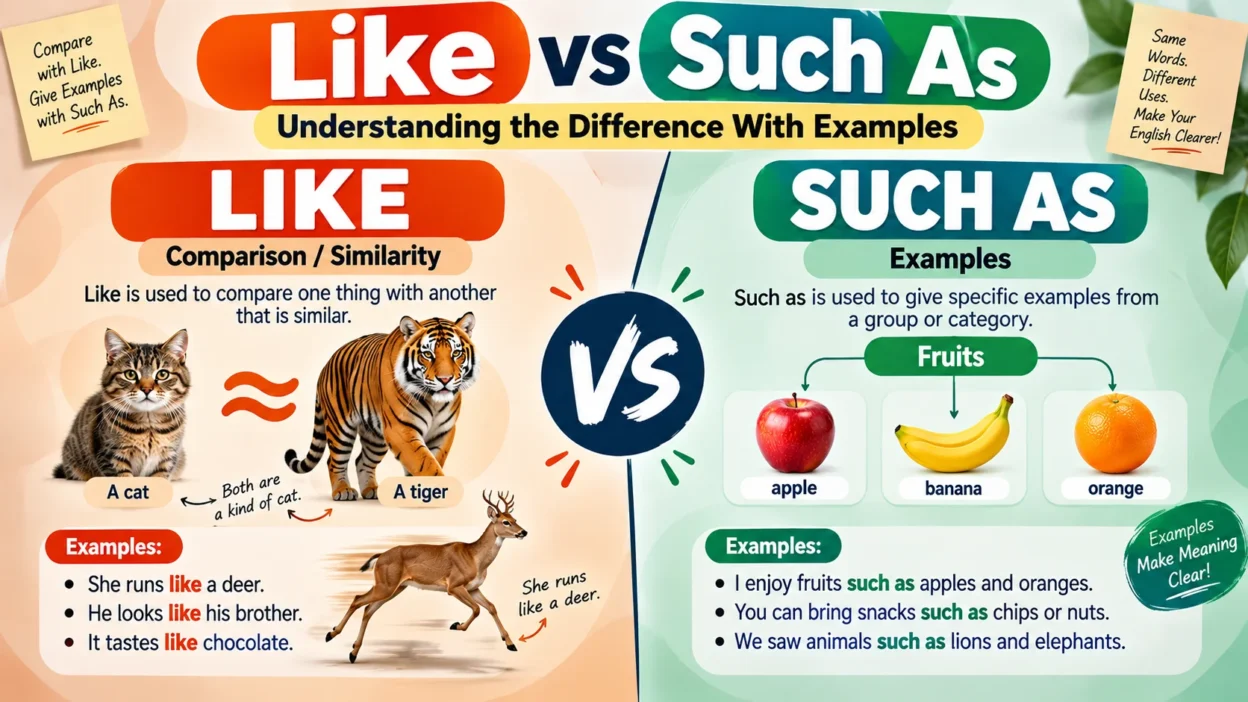
The traditional grammar guideline is simple: use “like” when you mean “similar to” and use “such as” when you want to introduce actual examples that belong to the category you mentioned. For example, “cities like Paris” can mean cities that are similar to Paris, while “cities such as Paris” presents Paris as an example of the cities being discussed.
This distinction is particularly useful in academic, professional, and formal writing, where precision matters. At the same time, modern English usage is more flexible than the traditional rule suggests, so context is important.
Quick Answer: Like vs Such As
| Expression | Main Meaning | Typical Use | Example |
|---|---|---|---|
| Like | Similar to | Comparison or similarity | Cities like Paris |
| Such as | For example / including | Specific examples | Cities such as Paris |
| Like in casual usage | Can introduce examples | Informal speech and writing | Fruits like apples |
| Such as in formal writing | Clearly introduces examples | Academic and professional writing | Fruits such as apples |
Easy Trick to Remember
Ask yourself:
Am I comparing something with another thing, or am I giving examples?
- If you mean “similar to”, choose like.
- If you mean “for example” or “including”, choose such as.
What Does “Like” Mean? 🤔
Like has several grammatical functions, but in this comparison it is commonly used as a preposition meaning “similar to” or “in the same way as.”
For example:
- She runs like a professional athlete.
- He looks like his father.
- We need a vehicle like this one.
- I enjoy movies like Die Hard.
In these examples, like establishes a comparison or points to something with similar characteristics.
Consider this sentence:
We want a city like New York.
This normally means that we want a city similar to New York in some way. New York serves as the comparison rather than necessarily being one of the cities we want.
“Like” Can Be More Flexible in Everyday English
The traditional rule says that like should be reserved for comparisons. However, real-world English is more flexible. Native speakers frequently use like before examples in casual conversation.
For instance:
I enjoy fruits like apples and oranges.
Depending on context, this can mean that apples and oranges are examples of fruits the speaker enjoys. It does not necessarily mean the speaker enjoys fruits merely similar to apples and oranges.
Therefore, the distinction is best treated as a useful clarity guideline, rather than an absolute rule that every English speaker follows in every situation.
What Does “Such As” Mean? 📚
Such as is commonly used to introduce specific examples of a broader category.
For example:
I enjoy outdoor activities such as hiking and kayaking.
Here, hiking and kayaking are actual examples of outdoor activities.
Other examples include:
- She has visited countries such as Japan and Brazil.
- We need supplies such as paper and ink.
- The course covers skills such as communication and teamwork.
- Several animals, such as dolphins and whales, are highly intelligent.
The phrase such as is especially useful when you want your reader to understand clearly that the following words are examples belonging to the category you just mentioned.
Like vs Such As: The Main Difference 🔍
The easiest way to understand the difference is to focus on comparison versus examples.
Use “Like” for Similarity
Use like when you are saying that one thing resembles another.
Example:
She wants a dress like the one in the window.
The speaker wants a dress that is similar to the one in the window. It does not necessarily mean that the exact dress is wanted.
Another example:
He needs a laptop like mine.
This means he wants a laptop similar to the speaker’s laptop.
Use “Such As” for Actual Examples
Use such as when you are identifying members of a category.
Example:
I enjoy sports such as tennis and swimming.
Tennis and swimming are being presented as specific examples of sports the speaker enjoys.
Another example:
We sell products such as notebooks, pens, and folders.
The listed products belong to the larger category of products being discussed.
Compare These Sentences Side by Side
The difference becomes clearer when the sentences are placed together:
| Sentence | Intended Meaning |
|---|---|
| I want a phone like yours. | I want a phone similar to yours. |
| I use phones such as iPhones and Samsung models. | These are examples of phones I use. |
| She likes cities like Paris. | She likes cities similar to Paris. |
| She has visited cities such as Paris and Rome. | Paris and Rome are actual cities she has visited. |
| He enjoys books like The Hobbit. | He enjoys books similar to The Hobbit. |
| He owns books such as The Hobbit and Dune. | These are specific books he owns. |
The important point is that context determines the intended meaning. The same noun can sometimes appear naturally after either expression.
Common Examples of “Like” vs “Such As” ✍️
Here are some practical examples:
Example 1: Cities
Like:
I want to live somewhere like New York.
Meaning: I want a place with characteristics similar to New York.
Such as:
I have visited major cities such as New York and Chicago.
Meaning: New York and Chicago are specific examples of major cities I have visited.
Example 2: Food
Like:
I enjoy desserts like cheesecake.
Meaning: I enjoy desserts similar to cheesecake, or cheesecake may be used informally as an example.
Such as:
I enjoy desserts such as cheesecake and pie.
Meaning: Cheesecake and pie are specific examples of desserts I enjoy.
Example 3: Skills
Like:
We need employees with skills like leadership.
Meaning: We need skills similar to leadership or related qualities.
Such as:
We need employees with skills such as leadership and communication.
Meaning: Leadership and communication are specific examples of the skills required.
Is “Like” Wrong for Giving Examples?
Not necessarily.
This is one of the most important improvements to the traditional explanation. Saying that “like” is always wrong when introducing examples is too rigid for modern English.
In everyday speech and informal writing, people commonly use like to introduce examples:
You can use vegetables like carrots and spinach.
Most readers will understand that carrots and spinach are examples of vegetables.
However, if your goal is maximum precision—especially in academic, business, legal, or formal writing—such as often makes the relationship clearer:
You can use vegetables such as carrots and spinach.
So rather than thinking “like is incorrect,” think:
“Such as is usually clearer when I specifically mean actual examples.”
Common Mistakes to Avoid ⚠️
Mistake 1: Using “like” when a formal example is intended
Less precise:
The company offers services like consulting and training.
More precise:
The company offers services such as consulting and training.
The second sentence clearly identifies consulting and training as examples of the company’s services.
Mistake 2: Assuming “such as” always means every possible example
When you write:
We sell products such as notebooks and pens.
You are giving examples. You are not necessarily saying notebooks and pens are the only products sold.
Mistake 3: Treating the traditional rule as absolute
English usage changes according to context. In casual speech, like is commonly used to introduce examples. The important question is whether the sentence is clear and whether the level of formality suits your audience.
What About Commas With “Such As”? 📝
Punctuation depends on whether the example phrase is essential or nonessential to the sentence.
Compare:
Animals such as dogs and cats are common pets.
Here, the phrase identifies which animals are being discussed, so no comma is necessary.
Now consider:
Some animals, such as dolphins and whales, are highly intelligent.
Here, the main statement is already complete, and the example is additional information, so commas can be used.
The same principle applies to many phrases introduced by such as: punctuation depends on the role the phrase plays in the sentence, not simply on the presence of the words “such as.”
Like vs Such As in Formal Writing 🎓
For academic and professional writing, clarity should be your priority.
If you are introducing actual examples, such as is often the safer and more precise choice:
The study examined factors such as age, income, and education.
If you are making a comparison, like is appropriate:
The results were similar to those from studies like this one.
This distinction can make formal writing easier to understand because the reader can immediately see whether you are listing examples or drawing a comparison.
Alternatives to “Such As”
Depending on the sentence, you can replace such as with several expressions:
- For example — introduces an example.
- For instance — similar to “for example.”
- Including — emphasizes members of a larger group.
- Namely — identifies specific items more directly.
For example:
Several sports, such as tennis and swimming, are popular.
You could also write:
Several sports, including tennis and swimming, are popular.
Or:
Several sports are popular. For example, tennis and swimming are widely played.
Choose the alternative that best matches the sentence rather than replacing such as automatically.
Frequently Asked Questions ❓
What is the basic difference between “like” and “such as”?
Like usually expresses similarity or comparison, while such as normally introduces specific examples that belong to a larger category.
Is “like” grammatically correct for examples?
Yes, especially in informal and everyday English. However, such as is often clearer when you specifically intend to identify actual examples.
Is “such as” more formal than “like”?
Generally, such as is preferred when introducing examples in formal, academic, and professional writing. Like is extremely common in everyday English and has many other grammatical uses.
Can “like” and “such as” be interchangeable?
Sometimes, particularly when like is being used informally to introduce examples. However, replacing one with the other can change or clarify the intended meaning, so context matters.
When should I use “like”?
Use like when you mean similar to or when you are making a comparison.
Example:
She wants a car like yours.
When should I use “such as”?
Use such as when you want to introduce examples of a category.
Example:
She likes cars such as electric SUVs and hybrids.
Do I always need a comma before “such as”?
No. Use commas when the phrase is additional, nonessential information. If the phrase is necessary to identify or limit what you mean, commas may not be appropriate.
Conclusion
Understanding like vs such as becomes much easier when you focus on the intended meaning. Like commonly expresses similarity or comparison, while such as clearly introduces examples belonging to a broader category.
The traditional rule is helpful, but it should not be treated as an absolute law of English. In casual speech and informal writing, like is frequently used before examples, and readers usually understand the intended meaning from context. In formal, academic, and professional writing, however, such as is often the better choice when you want to make it unmistakable that the following words are examples.
A simple test can help: if you mean “similar to,” use “like.” If you mean “for example” or “including,” use “such as.” With regular practice, choosing between these two expressions will become much more natural.

Andrew Foster is a researcher and content writer at Differopedia, specializing in clear, accurate, and easy-to-understand comparison guides, definitions, and informational articles. His work focuses on helping readers make informed decisions through well-researched, reliable content.